
What if you could bypass the grueling 18 month probate process simply because a single deed was never signed? It’s a common and stressful discovery to find that a family home was left out of a living trust, seemingly forcing you into a public and costly court battle. You’re likely worried about high statutory fees and confusing language in the Probate Code. A petition to confirm trust assets in California is often the most efficient way to resolve this hurdle.
This article explains how a Heggstad petition (a legal procedure used to move property into a trust after death) can often offer a faster path. You’ll discover how families from Los Angeles County to Sacramento County can secure an uncontested court order ex parte (with no formal hearing) in as little as 7 to 10 days in Santa Clara County. We’ll outline how to resolve these title issues using a fixed fee approach.
Key Takeaways
- Learn how a petition to confirm trust assets in California allows you to transfer real property into a trust without the 12 to 18 month delay of a traditional probate.
- Discover how uncontested matters can be resolved via ex parte petitions in as little as 7 to 10 days in Santa Clara County, bypassing the months-long wait for noticed hearings.
- Understand the benefits of a fixed-fee legal model that covers both filing and attorneys’ fees, providing financial predictability during a complex transition.
- Determine if your situation qualifies for a Heggstad solution or if the assets fall under the $208,850 small estate threshold applicable to deaths on or after April 1, 2025.
Why Assets Are Often Left Out of a Living Trust in California
Creating a trust is only half the battle of estate planning. Many families throughout the State of California discover too late that real estate or financial accounts were never formally retitled into the trust’s name. This "unfunded trust" dilemma occurs when a decedent clearly intended to include an asset but failed to record the deed or update the account registration. If the value of these omitted assets exceeds $208,850 for those dying on or after April 1, 2025, the law typically requires a full probate administration. This threshold is adjusted for inflation every three years, but even modest homes in California often exceed this limit. Fortunately, a petition to confirm trust assets in California can often resolve these clerical errors without a year of court delays.
Identifying Trust Funding Errors in California
To determine if an asset was properly transferred, you should check the last recorded deed. If the deed lists an individual name rather than the trust name, the property is likely unfunded. You may also see signs of incomplete transfers in brokerage statements that don’t reference the trust. While many people believe a "Pour-Over Will" solves this, it’s actually just a safety net that still requires court action to move the asset. The Estate of Heggstad case established the legal precedent that written intent can be sufficient to confirm ownership, allowing a specialized attorney to fix these titling mistakes efficiently.
The Cost of Doing Nothing: Probate vs. Petition
A standard probate in counties like San Diego County or Sacramento County typically lasts 12 to 18 months. During this lengthy process, statutory fees based on the gross value of the estate can significantly reduce the inheritance. By contrast, a Heggstad petition offers a fixed-fee legal solution that provides financial predictability. Understanding Successor Trustee Duties for an Unfunded Trust is vital for anyone managing an estate. Filing a petition to confirm trust assets in California allows families to avoid the public and expensive probate process while securing the title in a fraction of the time.
What is a Petition to Confirm Trust Assets under Probate Code Section 850?
A petition to confirm trust assets in California relies on Probate Code Section 850, which grants the court authority to determine ownership of property. This procedure helps families in Los Angeles County and Orange County avoid full probate by declaring that an asset was intended for the trust. The process is often called a Heggstad petition, named after a landmark 1993 case. In that matter, the court ruled that a settlor’s (the person who created the trust) written intent to include an asset was sufficient to establish ownership. It’s a request for the court to confirm that the asset is already part of the trust estate rather than a new transfer of title.
Key Evidence Needed for a Heggstad Petition in California
Success depends on proving the deceased person’s intent through specific documentation. Courts typically look for a "Schedule A" (a list of assets) attached to the trust document. If that’s missing, we often rely on general assignment language within the trust that declares all property belongs to the trust entity. For a deeper look at these requirements, see our California Probate Code Section 850 Guide. Since these petitions are uncontested, the evidence must be clear and compelling to satisfy the court’s requirements.
Types of Assets Recoverable via Probate Code Section 850
This remedy isn’t limited to family homes. It applies to various holdings, including real property such as land or commercial buildings, financial accounts, and brokerage holdings. It’s even a viable path for transferring an LLC to trust after death. If you’re managing assets in San Bernardino County or Riverside County, you can find a fixed-fee solution to evaluate your documents and secure a court order without the complexity of a full probate case.
The Ex Parte Advantage: Speeding Up the Heggstad Process in California
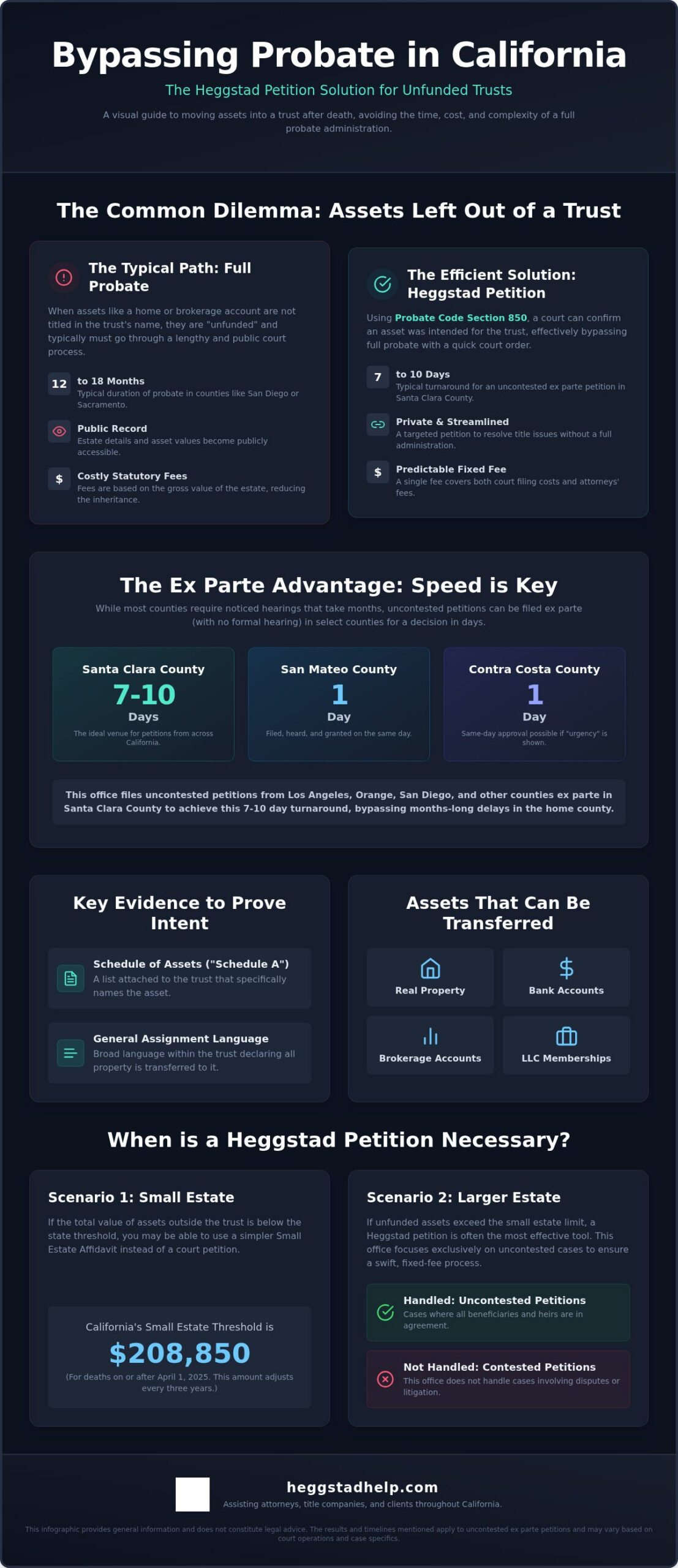
Many people believe that obtaining a court order always requires a formal hearing scheduled months in advance. In many jurisdictions, a noticed hearing (a court date where all interested parties are formally notified to appear) is typically set 30 to 60 days after filing, or even several months later depending on the specific court’s backlog. You don’t have to wait that long. A petition to confirm trust assets in California can often be handled ex parte (with no formal hearing). This approach allows for a rapid resolution that completely bypasses the standard 12 to 18 month probate process.
County-Specific Timelines for Heggstad Petitions
Procedural speed depends heavily on where the matter is heard. In Santa Clara County, uncontested petitions are typically granted in just 7 to 10 days. San Mateo County provides even more immediate results, as petitions can often be filed, heard, and granted on the same day. In Contra Costa County, a same-day order is also possible if "urgency" is demonstrated to the Court’s satisfaction. By focusing on these specific jurisdictions, we provide a faster alternative to the delays common in other California courts.
Statewide Assistance for California Families
Our office assists families, attorneys, and title companies throughout the State of California, including those in Los Angeles County, Orange County, and San Diego County. While courts in Sacramento County or San Francisco County often require noticed hearings that take many months, we can file uncontested petitions from those areas ex parte in Santa Clara County to secure a decision in days. This specialized strategy serves clients in Alameda County, Riverside County, San Bernardino County, Marin County, and Santa Cruz County. You can secure an ex parte court order to correct your trust title quickly and efficiently.
How to File a Petition to Confirm Trust Assets with Expert Legal Help
Choosing the right legal representation is the most important step in resolving an unfunded trust. While a generalist probate lawyer might suggest a full administration, a specialist focuses on the specific mechanics of a petition to confirm trust assets in California. To begin, successor trustees should collect the original trust agreement and the most recent property deed. These documents are essential. They provide the evidence needed to demonstrate the settlor’s intent to the court. Our office assists attorneys and families across the State of California, ensuring that the transition of title is handled with calm competence.
Fixed Fees and Predictable Outcomes
We provide a fixed-fee model for all Heggstad matters. This fee is transparent and covers both the court filing fees and all attorneys’ fees. This approach allows you to avoid the high statutory fees associated with traditional probate. Our office focuses exclusively on uncontested petitions to ensure maximum speed and efficiency. We don’t handle contested petitions (cases where a party formally objects to the transfer). For a complete breakdown of the requirements, see our Heggstad Petition Filing Guide for 2026.
Working with HEGGSTAD HELP
Working with a Board-Certified Specialist like Robert P. Bergman provides a level of expertise that general practitioners often lack. We coordinate with title companies and legal professionals from San Diego County and Riverside County to San Bernardino County. While a noticed hearing in Sacramento County or San Francisco County can take several months, we can file ex parte in Santa Clara County to secure an order in 7 to 10 days. This rapid service is also available for clients in Los Angeles County, Orange County, Alameda County, Marin County, and Santa Cruz County. If you’re ready to resolve title issues, Contact HEGGSTAD HELP for a consultation on your missing trust assets.
Secure Your Family’s Legacy with a Heggstad Petition
Discovering an unfunded trust doesn’t have to lead to a year of court delays. By utilizing Probate Code Section 850, you can transfer title to the trust and honor the settlor’s intent. Whether you’re managing property in Los Angeles County, Orange County, or San Diego County, our specialized approach ensures efficiency. Filing a petition to confirm trust assets in California through an ex parte process in Santa Clara County typically results in a court order within 7 to 10 days.
Robert P. Bergman, a Board-Certified Specialist, provides the calm competence needed to navigate these hurdles. We offer fixed fees that cover both filing and attorneys’ fees for uncontested matters, providing financial transparency. You don’t have to face this situation alone. Get a Fixed-Fee Quote for Your Heggstad Petition in California and resolve your title issues with confidence.
Frequently Asked Questions
What is the small estate threshold in California for 2026?
The small estate threshold for a Small Estate Affidavit in California is $208,850 for individuals dying on or after April 1, 2025. This value remains at this level throughout 2026. If the total value of assets left outside the trust in Sacramento County or Alameda County is below this amount, you may use a simplified affidavit process instead of filing a formal Heggstad petition in court.
How long does a Heggstad petition take in Santa Clara County?
An uncontested petition to confirm trust assets in California typically takes 7 to 10 days to be granted in Santa Clara County. This rapid timeline is possible because the matter is heard ex parte (without a formal hearing). While jurisdictions like San Diego County or Orange County may take months for a noticed hearing, we often file in Santa Clara to provide a faster resolution.
Can I file a Heggstad petition if there is no Schedule A attached to the trust?
Yes, you can still file a Heggstad petition even if a formal Schedule A (the list of assets intended for the trust) is missing. Courts often accept a "general assignment" clause within the trust document as sufficient evidence of the settlor’s intent. We help families in Los Angeles County and Riverside County review their documents to find the necessary language to support a successful court filing.
What is the difference between a noticed hearing and an ex parte petition?
A noticed hearing is a formal court date set 30 to 60 days after filing, or several months later in backlogged counties like Marin County or San Francisco County. An ex parte petition is a request for a court order without a formal hearing, which is significantly faster. For example, San Mateo County can grant these orders the same day they are filed, bypassing the schedule entirely.
Does a Heggstad petition avoid the need for a full probate?
Yes, a successful petition to confirm trust assets in California completely avoids the need for full probate administration. Instead of a 12 to 18 month court process and high statutory fees, this procedure allows you to transfer title to the trust in just days. This office provides a fixed-fee solution for uncontested petitions throughout Santa Cruz County and San Bernardino County.

Article by
Robert P. Bergman, Attorney at Law
Attorney Robert P. Bergman ("Bob Bergman") has been a Board-Certified Specialist in Estate Planning, Trust and Probate Law since 2011, as certified by the California State Bar Board of Legal Specialization. For several years, Bob has assisted families and the clients of other attorneys with obtaining court orders through Heggstad petitions to avoid the time and expense of Probate administration. Bob is friendly, very approachable, and believes in explaining complex legal topics in clear ordinary language so that his clients understand exactly what they're doing and why they're doing it.
Bob is often able to assist clients who are in other counties than his home county of Santa Clara through his approach to Heggstad petitions.
Disclaimer
This article is for informational purposes only. Nothing in this article is intended to replace legal advice from a competent attorney or be considered legal guidance for anybody's specific legal situation. Nobody should rely on information in this article in making legal decisions without such consultation.


