
Imagine the sinking feeling of discovering your parent died house not in trust California after you thought their estate plan was complete. It’s a stressful situation to realize the family home was left out of the trust, especially when facing a 12 to 18 month probate delay and high statutory fees. You might worry that a pending home sale or refinancing opportunity will slip away while the court system grinds slowly along. Fortunately, you don’t have to endure a full probate administration just to fix a paperwork error. This article explains how a Heggstad Petition, filed under Probate Code Section 850, can transfer the property into the trust in as little as 7 to 10 days. We’ll show you how this specialized ex parte process helps families from Los Angeles County to San Diego County and Sacramento County correct titles and honor their loved one’s intentions quickly.
Key Takeaways
- Learn how a Heggstad Petition, filed under Probate Code Section 850, can confirm a property belongs in a trust even if the deed wasn’t properly recorded before your loved one passed away.
- Discover how to bypass the 12 to 18 month probate delay by filing an uncontested petition ex parte in Santa Clara County, which typically grants orders in just 7 to 10 days.
- If your parent died house not in trust California, you’ll see how to correct the title quickly to protect home sales or refinancing opportunities in counties like San Diego County or Riverside County.
- Understand the $208,850 small estate threshold for deaths on or after April 1, 2025, and how fixed fees cover both filing fees and attorney fees for a transparent, predictable process.
Understanding the Heggstad Petition in California
When a parent died and their house is not in trust in California, this discovery often happens during a time of grief, adding unnecessary stress to an already difficult period. Many families believe they’re stuck in a 12 to 18 month probate process, but a faster path exists. The Estate of Heggstad created a legal precedent that allows for "title recovery" without full probate. A Heggstad Petition is a procedure used to confirm that an asset belongs in a trust despite a missing or unrecorded deed. It’s a logical solution that prioritizes the intent of the settlor (the person who created the trust) over a simple clerical oversight.
Common scenarios involve a parent forgetting to record a deed after a refinancing or failing to properly assign an LLC interest to the trust. Whether the property is in San Diego County or Riverside County, these errors don’t have to trigger a year of court hearings. If there’s evidence that the parent intended the house to be part of the trust, the court has the power to correct the title and honor their original wishes.
Legal Basis Under Probate Code Section 850
The authority for this process comes from Probate Code Section 850. This section allows a successor trustee to petition the court to confirm that the trust owns the property, even if the house was never formally deeded during the parent’s lifetime. Heggstad Help focuses exclusively on these uncontested title correction filings. By filing ex parte (without a formal hearing) in Santa Clara County, the office can often secure an order in 7 to 10 days. Similar speed is available in San Mateo County and Contra Costa County. This avoids the long delays seen in Los Angeles County or Orange County, where noticed hearings can take many months. All these petitions are handled with fixed fees that cover both filing fees and attorney fees. It’s a direct path for families who don’t want to deal with full probate; however, this office does not handle contested petitions.
The Heggstad Petition Process in California: Speed and Timelines
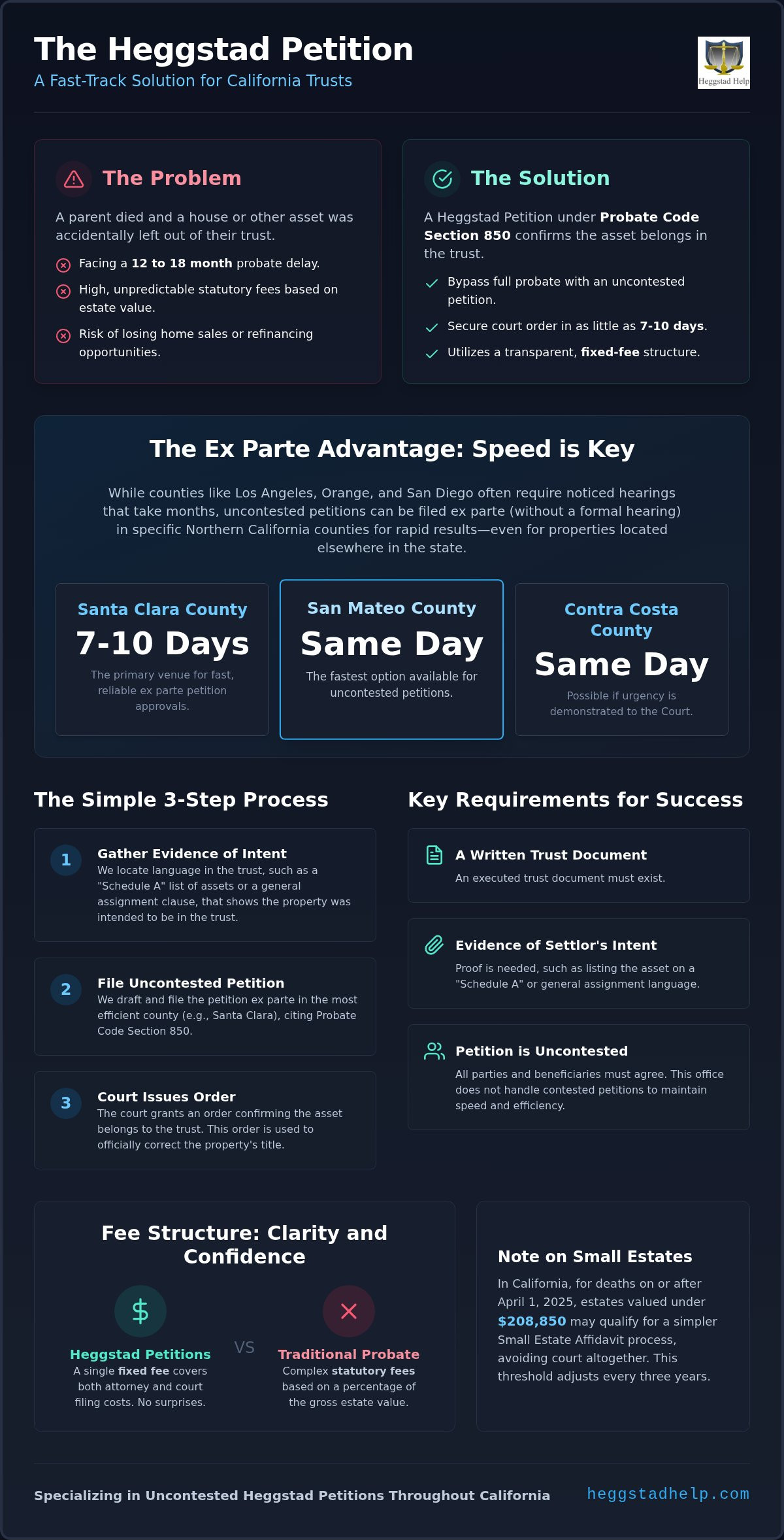
Finding out that your parent died house not in trust California can feel like a major setback for any successor trustee. However, the path to resolution involves three specific steps. First, we gather evidence of the settlor’s intent, such as a "Schedule A" list of assets or general assignment language found within the trust document itself. Second, we draft and file the petition according to California Probate Code § 850. Finally, the court issues an order confirming the house as a trust asset, which allows for the immediate correction of the title.
The speed of this process depends heavily on whether the petition is filed as a noticed hearing or an ex parte petition. Noticed hearings are typically set 30 to 60 days after filing, or even several months later in backlogged jurisdictions. In contrast, an uncontested ex parte petition bypasses the formal hearing requirement. For families in Los Angeles County, Orange County, or San Bernardino County, choosing the right venue is the key to avoiding a year-long probate stay.
Ex Parte Filing: Why Santa Clara County is the Best Venue for Fast Results
While courts in Riverside County or San Diego County often require months for a hearing, Santa Clara County typically grants ex parte petitions in 7 to 10 days. If you’re dealing with an urgent timeline in San Mateo County, petitions can often be filed, heard, and granted the same day. In Contra Costa County, same-day grants are also possible if urgency is demonstrated to the Court’s satisfaction. This office helps clients from Alameda County, Sacramento County, San Francisco County, Marin County, and Santa Cruz County utilize these efficient Northern California venues to resolve title issues quickly. You can explore how our ex parte services work to see if your situation qualifies for this accelerated, fixed-fee timeline.
Requirements and Fixed Fees for Heggstad Petitions in California
To qualify for this procedure when a parent died house not in trust California, two primary conditions must be met. First, a written trust document must exist. Second, we must provide evidence that the parent intended the real estate to be part of that trust. This evidence often appears as a reference to the property on a "Schedule A" (a list of trust assets) or within a general assignment of all assets to the trust. Because this office focuses on efficiency, we only handle uncontested petitions where all parties agree on the settlor’s intent.
Unlike the traditional California probate process, which uses a "statutory fee" system (a sliding scale percentage based on the gross value of the estate), our approach uses a transparent model. We offer fixed fees for Heggstad Petitions that cover both the court’s filing fees and the attorney’s fees. This predictability helps families in Marin County, Santa Cruz County, and San Francisco County avoid the financial uncertainty typically associated with estate administration.
Small Estate Alternatives and the $208,850 Threshold
If you’re dealing with assets other than the home, you should check the total value of the remaining estate. For individuals who passed away on or after April 1, 2025, the threshold for using a Small Estate Affidavit in California is $208,850. If the total value of the personal property falls below this amount, you may be able to use simplified procedures that don’t require any court involvement. The State of California adjusts this threshold every three years to account for inflation. While these affidavits work well for bank accounts or vehicles, the Heggstad Petition remains the primary tool for correcting real property titles quickly in counties like San Bernardino County or Alameda County. By filing ex parte, you can achieve results in days rather than the months required for noticed hearings.
Securing Your Family’s Legacy Without the Probate Delay
Discovering that a parent died house not in trust California shouldn’t lead to a year of legal frustration. By utilizing Probate Code Section 850, you can bypass the standard probate process and secure a court order in just days. Whether you’re in Orange County, Riverside County, or San Diego County, our ex parte process in Santa Clara County ensures a swift resolution for uncontested matters. You’ll benefit from the expertise of a Board-Certified Specialist in Estate Planning, Trust and Probate Law who provides fixed fees covering both filing and attorney costs. This specialized approach protects home sales and refinancing opportunities from court backlogs. Contact Heggstad Help today for a fixed-fee consultation on your Heggstad Petition in California and resolve these title issues with confidence. You’ve worked hard to manage the estate; we’re here to help you finish the job correctly.
Frequently Asked Questions
How long does a Heggstad Petition in California take?
The timeline depends on the county and the filing method used. An uncontested petition filed ex parte (without a formal hearing) in Santa Clara County is typically granted in 7 to 10 days. In San Mateo County, these orders can often be obtained the same day they’re filed. This is significantly faster than noticed hearings in Riverside County or San Bernardino County, which often take several months to conclude.
Can I sell the house while the Heggstad Petition is pending?
You can list the property and enter a contract, but you can’t close the sale until the court order is issued. When a parent died house not in trust California, title companies won’t transfer the deed until a court order is recorded. Our ex parte process in Santa Clara County or Contra Costa County provides the speed necessary to satisfy buyers and lenders, preventing the sale from falling through.
What if the house is located in Los Angeles County but the trust was signed elsewhere?
The location of where the trust was signed doesn’t restrict our ability to help. While the house might be in Los Angeles County, Orange County, or San Diego County, we frequently file uncontested petitions in Santa Clara County to take advantage of the 7 to 10 day ex parte timeline. This approach allows families across the State of California to avoid the significant backlogs found in their local probate courts.
Is a Heggstad Petition cheaper than probate in California?
Yes, a Heggstad Petition filed under Probate Code Section 850 is generally much more cost-effective than full probate. Standard probate fees are "statutory" (fees set by law based on a percentage of the gross estate value), which can be quite high. Our office provides fixed fees that cover both the court’s filing fees and the attorneys’ fees, offering financial transparency for families in Sacramento County or Alameda County.

Article by
Robert P. Bergman, Attorney at Law
Attorney Robert P. Bergman ("Bob Bergman") has been a Board-Certified Specialist in Estate Planning, Trust and Probate Law since 2011, as certified by the California State Bar Board of Legal Specialization. For several years, Bob has assisted families and the clients of other attorneys with obtaining court orders through Heggstad petitions to avoid the time and expense of Probate administration. Bob is friendly, very approachable, and believes in explaining complex legal topics in clear ordinary language so that his clients understand exactly what they're doing and why they're doing it.
Bob is often able to assist clients who are in other counties than his home county of Santa Clara through his approach to Heggstad petitions.
Disclaimer
This article is for informational purposes only. Nothing in this article is intended to replace legal advice from a competent attorney or be considered legal guidance for anybody's specific legal situation. Nobody should rely on information in this article in making legal decisions without such consultation.


