
Imagine you’re just days away from closing the sale of a family home, only to have the title company halt everything because the property was never officially deeded to the trust. It’s a stressful realization that usually triggers fears of a 12 month probate process and high legal costs. You likely feel overwhelmed by the legal complexity, but you don’t have to wait a year to resolve this title issue.
By understanding the Heggstad petition timeline California courts follow, you can often bypass the traditional probate route entirely. This article explains how we help families and attorneys secure a court order to confirm trust ownership in as little as 7 to 10 days. We’ll provide a clear roadmap of the court process under the Probate Code Section, showing you how to move from a blocked sale to a successful resolution with speed and precision.
Key Takeaways
- Learn how a Heggstad petition (a legal request under Probate Code Section 850) can bypass the 12 month probate process in the State of California by confirming trust assets in a single hearing.
- Discover how the Heggstad petition timeline California families experience can be reduced to just 7 to 10 days through expedited filing in Santa Clara County or even the same day in San Mateo County.
- Understand how we assist attorneys and families in Los Angeles County, Orange County, and San Diego County with uncontested petitions using fixed fees that cover all filing and legal costs.
- Identify how to navigate potential delays from court backlogs in Alameda County or Marin County by utilizing expedited filing strategies in specific jurisdictions to meet urgent real estate deadlines.
Understanding the Heggstad Petition Timeline in California vs. Traditional Probate
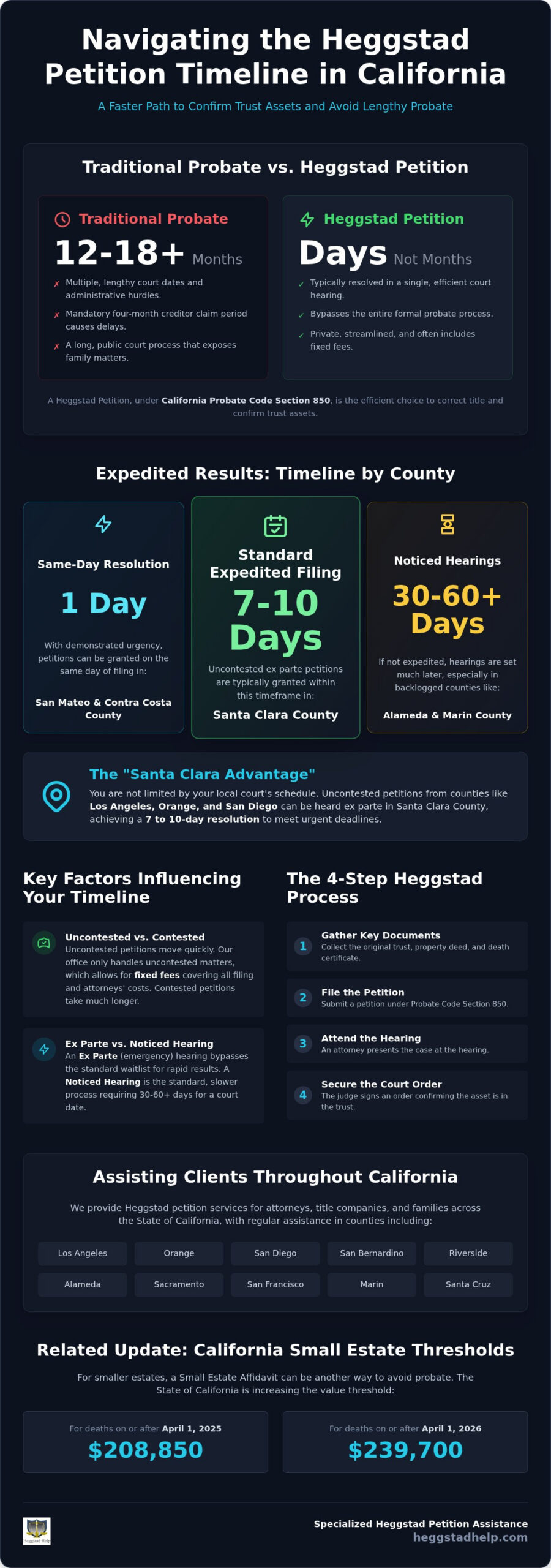
When a loved one passes away and you discover a property was left out of their trust, you’re usually facing a formal probate process in the State of California. This standard procedure often lasts 12 to 18 months, or even longer in busy jurisdictions. However, a Heggstad petition (a specific legal request under Probate Code Section 850) provides a much faster alternative. It’s a faster way forward. Based on the legal precedent set in the Estate of Heggstad, this petition allows a court to declare that the property is already part of the trust. Instead of multiple court dates and administrative hurdles, title issues can often be resolved in a single hearing.
The Heggstad petition timeline California families follow begins with document collection. You’ll need to gather the original trust document, the most recent deed, and the death certificate. For residents in Los Angeles County or San Francisco County, this process is the primary tool used to avoid "forgotten asset" probate. This avoids a long, public court process when intent was clear. We provide this assistance to attorneys, title companies, and clients throughout the State of California, including those in San Bernardino County, San Diego County, and Sacramento County.
Why filing a Heggstad Petition in California is the efficient choice
Choosing Heggstad petition filing is often the most logical path because of its "one and done" nature. Unlike a full probate, there’s no four-month creditor claim period to wait through. You also don’t need to wait for the court to appoint a permanent executor or administrator. This streamlined approach corrects the trust asset title directly, moving the property into the hands of the successor trustee much faster. Whether you’re in Orange County, Riverside County, Alameda County, or Marin County, this specialized service minimizes the complexity of asset recovery with fixed fees.
Expedited Heggstad Petition Filings: Same-Day and 7-Day Results
The standard Heggstad petition timeline California courts provide can vary wildly depending on the specific jurisdiction. In Santa Clara County, uncontested petitions filed ex parte (on an emergency basis) are typically granted within 7 to 10 days. This is a dramatic improvement over the months-long wait times found in many other parts of the State of California. If you’re dealing with extreme urgency, San Mateo County and Contra Costa County offer even faster results. In these jurisdictions, a petition can often be filed and granted on the very same day if you demonstrate a clear need for immediate action.
Many people don’t realize they aren’t stuck with their local court’s slow schedule. We often utilize the "Santa Clara Advantage" for clients in Orange County or San Diego County. Uncontested petitions from these areas can be heard in Santa Clara County, allowing for that same 7 to 10 day resolution. This expedited path is essential for attorneys and title companies when a real estate closing is already scheduled. Using California Probate Code Section 850 effectively requires knowing which courts prioritize efficiency. If you’re facing a title issue that threatens a sale, our Ex Parte Court Order Services can provide the rapid resolution you need.
How to secure an Ex Parte Court Order in California
An ex parte session is a specialized court hearing designed to bypass the standard multi-month waiting list. It’s an emergency procedure that allows the court to act quickly on undisputed matters. This process requires a Board-Certified Specialist who understands the strict local court rules to ensure the petition is granted without delay. We regularly assist clients in San Bernardino County, Riverside County, and Sacramento County using these fast-track methods. By meeting the court’s specific requirements for notice and documentation, we help families move from legal limbo to a confirmed title in record time.
Key Factors That Influence Your Heggstad Petition Timeline
While ex parte filings offer the fastest path, several variables affect the Heggstad petition timeline California courts provide. If an emergency hearing isn’t possible, a noticed hearing is typically set 30 to 60 days after filing. In counties like Alameda County or Marin County, significant backlogs can push these dates out several months. You must also allow for the time required to provide legal notice to all interested parties under the Probate Code Section. These requirements ensure that everyone with a legal interest in the estate has an opportunity to review the request.
The nature of the petition is a major factor in how quickly you reach a resolution. We exclusively handle uncontested petitions, where all beneficiaries and heirs are in agreement. Contested cases take significantly longer and fall outside our scope. If the asset value is below certain limits, you might use a Small Estate Affidavit instead of a petition. The threshold for this shortcut is $208,850 for those dying on or after April 1, 2025.
Preparing for a Heggstad Petition in California
Successor trustees should immediately gather documents like a "General Assignment" or "Schedule A" to prove the creator’s intent to include the asset in the trust. These records are vital for success in jurisdictions from Santa Cruz County to San Diego County. Robert P. Bergman provides these services with a fixed-fee structure that covers all filing fees and legal fees. This transparency helps the families, attorneys, and title companies we assist in Los Angeles County, Orange County, San Bernardino County, Riverside County, San Francisco County, and Sacramento County. For more help with missing assets, view the successor trustee guide.
Secure Your Trust Assets Without the Wait
The Heggstad petition timeline California families face doesn’t have to stretch into a year long probate ordeal in the State of California. By utilizing expedited filing strategies in Santa Clara County or San Mateo County, you can often secure a court order in as little as 7 to 10 days. This efficient path allows you to confirm title to real estate while avoiding the high costs of traditional court proceedings. Whether you’re in Los Angeles County, Orange County, or San Diego County, we provide a clear roadmap to resolution.
If you’re dealing with an asset worth less than the small estate threshold ($208,850 for deaths on or after April 1, 2025), other shortcuts may apply. However, for most real property issues, a Heggstad petition remains the gold standard. Get a Fixed-Fee Heggstad Petition Consultation today with a Board-Certified Specialist. You can move forward with confidence and peace of mind.
Frequently Asked Questions
How long does a Heggstad petition take in Santa Clara County?
In Santa Clara County, an uncontested Heggstad petition filed ex parte (on an emergency basis) is typically granted within 7 to 10 days of filing. This expedited process bypasses the standard multi month waiting list for noticed hearings. It’s a highly efficient way to confirm trust assets when time is of the essence, especially for families facing immediate real estate deadlines.
Can I file a Heggstad petition if the property is in Los Angeles County but I want it done faster?
Yes, you can often achieve a faster result even if the property is located in Los Angeles County. While a noticed hearing in that jurisdiction might take several months, uncontested petitions from any county can be heard ex parte in Santa Clara County. This strategy allows for a 7 to 10 day resolution for clients in Orange County, San Diego County, or anywhere in the State of California.
What is the California small estate threshold for 2026?
The California small estate threshold depends on the date of death. For individuals dying on or after April 1, 2025, the threshold is $208,850. If the excluded assets are below these amounts, you might use a Small Estate Affidavit instead of the Heggstad petition timeline California courts usually require.
Is a Heggstad petition faster than a Spousal Property Petition in California?
A Heggstad petition is often much faster than a Spousal Property Petition in California if filed ex parte. A Spousal Property Petition typically requires a noticed hearing set 30 to 60 days after filing. In contrast, an uncontested Heggstad petition can be resolved in as little as 7 to 10 days. This speed is a primary advantage for successor trustees managing trust assets.
What happens if someone contests the Heggstad petition?
If a Heggstad petition is contested, meaning an heir or interested party disagrees with the request, the process will take significantly longer. Contested matters require formal discovery and multiple court appearances to resolve disputes. It’s important to understand that our office does not handle contested petitions. We focus exclusively on uncontested filings to maintain our fixed fee structure and predictable timelines.
Do I need to go to court for a Heggstad petition hearing in California?
In most cases, you don’t need to personally appear in court for an uncontested Heggstad petition hearing in California. When we handle the filing, we appear on your behalf to present the evidence of the trustor’s intent. This applies to our clients in San Bernardino County, Riverside County, and Sacramento County. We manage the procedural hurdles so you don’t have to.

Article by
Robert P. Bergman, Attorney at Law
Attorney Robert P. Bergman ("Bob Bergman") has been a Board-Certified Specialist in Estate Planning, Trust and Probate Law since 2011, as certified by the California State Bar Board of Legal Specialization. For several years, Bob has assisted families and the clients of other attorneys with obtaining court orders through Heggstad petitions to avoid the time and expense of Probate administration. Bob is friendly, very approachable, and believes in explaining complex legal topics in clear ordinary language so that his clients understand exactly what they're doing and why they're doing it.
Bob is often able to assist clients who are in other counties than his home county of Santa Clara through his approach to Heggstad petitions.
Disclaimer
This article is for informational purposes only. Nothing in this article is intended to replace legal advice from a competent attorney or be considered legal guidance for anybody's specific legal situation. Nobody should rely on information in this article in making legal decisions without such consultation.


