Imagine the frustration of discovering that your loved one’s home was never officially transferred into their trust, potentially triggering a year-long probate process. Finding the title to house not in trust name after death is a common complication that often leads to fears of high statutory probate fees (standard costs set by the State of California) and confusing court requirements. You shouldn’t have to face months of delay just to correct a technical oversight on a deed.
Fortunately, you can often avoid a full probate administration by using a Heggstad petition (a legal request to confirm that an asset belongs in a trust). This specialized process allows you to secure trust ownership of the home quickly and efficiently. We will explain how this procedure works under the Probate Code Section and why filing an uncontested petition in California can reduce your wait time from many months to just a few days.
Key Takeaways
- Discover why finding the title to house not in trust name after death doesn’t require a 12-month probate if you can legally demonstrate the owner’s intent to include the property in their trust.
- Learn how a Heggstad petition (a court order to confirm trust ownership) avoids high statutory fees by using a fixed-fee model that covers both filing and attorney costs.
- Understand the speed of ex parte filings in the State of California, which can grant ownership in 7 to 10 days in Santa Clara County or the same day in San Mateo County.
- Find out how families in Los Angeles County or Orange County can avoid months of court delays by filing uncontested petitions ex parte in Santa Clara County.
The Problem: Why Your House Title is Not in the Trust Name After Death
Many families believe that simply signing a trust document protects their home from court intervention. However, a common oversight occurs when the trust is created but the corresponding deed is never recorded with the county recorder. If you discover the title to house not in trust name after death, it means the trust is "unfunded." This mistake often comes to light only when a successor trustee tries to sell or transfer the property. It’s a stressful realization that can leave you feeling overwhelmed, but it doesn’t mean the estate plan has failed entirely.
Without a recorded deed, the State of California legally considers the property part of the decedent’s probate estate. This classification typically requires a formal court process to transfer ownership, even if the trust document specifically mentions the home. For trustees in Los Angeles County or Orange County, managing a title to house not in trust name after death can feel like a massive roadblock during an already difficult time.
The Risks of an Unfunded Trust in the State of California
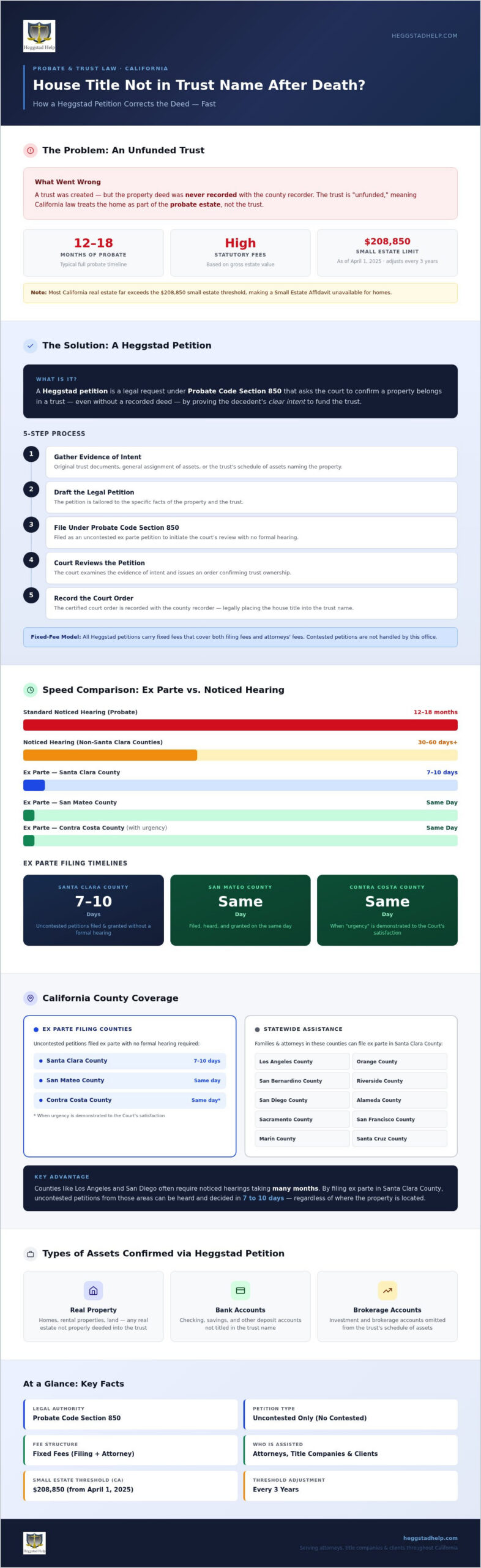
Relying on a full probate administration is often the most expensive and time-consuming path. These proceedings usually last 12 to 18 months and involve high statutory fees based on the gross value of the estate. While some assets can pass via a Small Estate Affidavit, the threshold for this is $208,850 for those dying on or after April 1, 2025. This amount adjusts every three years, but most real estate in California exceeds this limit anyway. Understanding successor trustee duties for an unfunded trust is the first step toward finding a faster, legal resolution through the courts.
The Solution: Using a Heggstad Petition to Transfer Real Property
A Heggstad petition is a specialized legal request submitted to the court to confirm that an asset, such as a home, belongs in a trust despite a missing or incorrect deed. If you find the title to house not in trust name after death, this procedure offers a direct path to resolution. It relies on demonstrating the decedent’s clear intent to include the property in their estate plan, which is often evidenced by a general assignment of assets or a specific mention of the home in the trust’s schedule of assets.
The process generally follows five structured steps to achieve a successful transfer:
- Gathering the original trust documents and any supporting evidence of the owner’s intent.
- Drafting the legal petition tailored to the specific facts of the property.
- Filing the petition under the correct Probate Code Section to initiate the court’s review.
- Attending the court review or hearing to present the case for the transfer.
- Recording the final, certified court order with the county recorder to update the property records.
Understanding Probate Code Section 850 for Real Property
The legal mechanism behind this solution is California Probate Code Section 850, which empowers the court to correct title errors without a full probate. For families in Los Angeles County, Orange County, or San Diego County, this is a vital tool. A successful petition results in a court order that functions exactly like a deed, legally placing the house title into the trust name. Our office specializes in filing these as uncontested petitions to ensure the fastest possible results throughout the State of California. It is important to note that our office does not handle contested petitions. If you are struggling with an unfunded trust, you can view our fixed-fee Heggstad services to see how we can help.
Fast-Track Title Correction in California: Ex Parte vs. Noticed Hearings
When you find the title to house not in trust name after death, the speed of your resolution depends entirely on the court’s calendar. Traditional noticed hearings (formal proceedings where all interested parties receive legal notice of a specific court date) typically take 30 to 60 days to be set. In many jurisdictions like Los Angeles County or San Diego County, this wait can extend to several months depending on the current backlog.
HEGGSTAD HELP utilizes an ex parte process (a legal request made to the court without a formal hearing) to bypass these lengthy delays. In Santa Clara County, petitions are typically granted in 7 to 10 days. If the property is in San Mateo County, the petition can often be filed, heard, and granted on the same day. In Contra Costa County, they can often be granted the same day if "urgency" is demonstrated to the Court’s satisfaction.
Families and attorneys in Orange County, San Bernardino County, Riverside County, Alameda County, Sacramento County, San Francisco County, Marin County, and Santa Cruz County benefit from this efficiency. Uncontested petitions from these regions can be heard ex parte in Santa Clara County. This allows for a final decision in just 7 to 10 days rather than waiting months for a noticed hearing in their home county.
Fixed-Fee Heggstad Petitions in California
Our office provides a streamlined solution for attorneys, title companies, and families throughout the State of California facing a title to house not in trust name after death. We offer fixed fees that cover both the court filing fees and attorney’s fees, ensuring financial predictability during a complex time. We specifically handle uncontested cases and do not handle contested petitions. For a professional evaluation of your situation, you can access our Heggstad petition filing services to begin correcting your trust title today.
Take Control of Your Property Transfer Today
Finding the title to house not in trust name after death is a common complication, but it shouldn’t lead to a year of court delays. By filing a Heggstad petition under the Probate Code Section, you can bypass a full probate administration and secure the home’s title. While noticed hearings in Riverside County, San Bernardino County, or Sacramento County can take months, our office uses ex parte filings in Santa Clara County to achieve results in 7 to 10 days. We provide fixed-fee services for uncontested petitions throughout the State of California, assisting families in San Diego County, Alameda County, and San Francisco County. We don’t handle contested petitions, focusing instead on efficient title corrections for estates over the $208,850 threshold. Fix your trust title error with a Heggstad petition expert today and gain the peace of mind that comes with a resolved estate.
Frequently Asked Questions
What happens if a house was never put into a living trust in California?
If the title to house not in trust name after death remains in an individual’s name, the State of California considers it part of the probate estate. This typically triggers a full probate administration unless the estate value is below the small estate threshold of $208,850 for deaths on or after April 1, 2025. Most real property exceeds this limit, requiring a court order for transfer.
How long does a Heggstad petition take to transfer a house title?
Timelines vary based on the specific court’s procedure. In Santa Clara County, an ex parte petition (a request made without a formal hearing) is typically granted in 7 to 10 days. In San Mateo County, these can be granted the same day. This is much faster than noticed hearings in San Bernardino County or Riverside County, which often take several months to resolve.
Can I sell a house if the title is not in the trust name after death?
You cannot legally sell the property until the title is corrected. Title companies require a clear chain of ownership before they’ll authorize a sale. If you find the title to house not in trust name after death, a Heggstad petition provides the necessary court order to transfer the home into the trust. This allows you to proceed with a sale without a 12-month probate.
Do I need a full probate if I have a Heggstad petition?
No, a Heggstad petition is designed to bypass a full probate administration by confirming the asset belongs in the trust. This specialized process is used throughout the State of California to correct title errors efficiently. Our office handles these as uncontested petitions for a fixed fee, helping families in Sacramento County, Marin County, and Santa Cruz County avoid the high costs of traditional proceedings.

Article by
Robert P. Bergman, Attorney at Law
Attorney Robert P. Bergman ("Bob Bergman") has been a Board-Certified Specialist in Estate Planning, Trust and Probate Law since 2011, as certified by the California State Bar Board of Legal Specialization. For several years, Bob has assisted families and the clients of other attorneys with obtaining court orders through Heggstad petitions to avoid the time and expense of Probate administration. Bob is friendly, very approachable, and believes in explaining complex legal topics in clear ordinary language so that his clients understand exactly what they're doing and why they're doing it.
Bob is often able to assist clients who are in other counties than his home county of Santa Clara through his approach to Heggstad petitions.
Disclaimer
This article is for informational purposes only. Nothing in this article is intended to replace legal advice from a competent attorney or be considered legal guidance for anybody's specific legal situation. Nobody should rely on information in this article in making legal decisions without such consultation.


