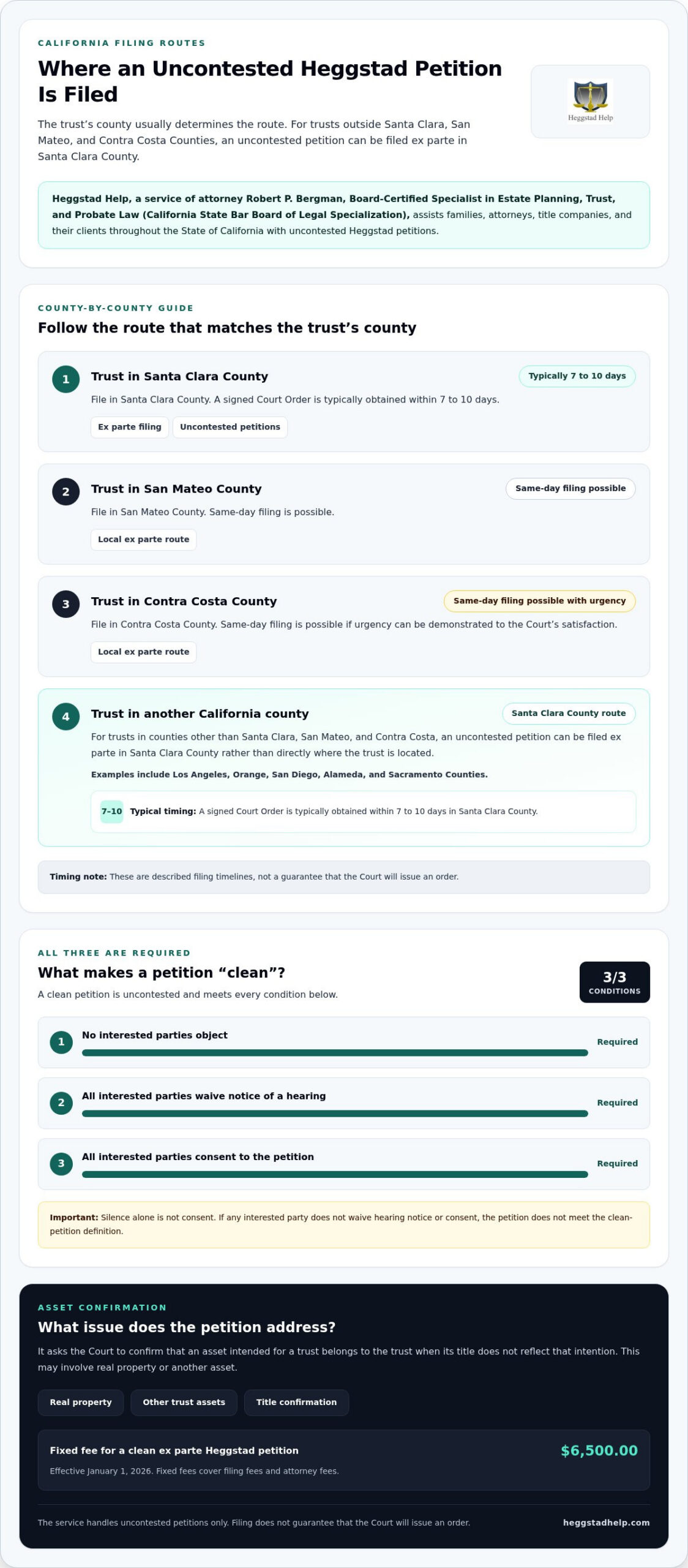
An asset left out of a trust doesn’t always have to go through probate. A flat fee Heggstad petition lawyer in California can prepare an uncontested court petition asking a judge to recognize property as part of a trust when written evidence supports the trust creator’s intent. The fixed fee covers filing fees and attorney fees, while the court order may help resolve the property’s trust status.
It is understandable to want clear information about the process and cost, especially when a home or other asset was not titled in the trust’s name. The evidence and whether interested parties agree are key considerations. An ex parte petition, submitted without a noticed hearing, may be an option when all interested parties consent and waive notice.
This article explains what a Heggstad petition can do, what evidence may support it, and who must receive notice. It also covers what a fixed fee includes and how filing in Santa Clara County may offer a faster path for eligible petitions involving property elsewhere in California.
Key Takeaways
- A Heggstad petition may help address property left out of a living trust when written evidence shows the trust creator intended it to belong to the trust.
- A court order can confirm property as a trust asset; gather trust documents and any writing that identifies the property before preparing a petition.
- Fixed fees cover filing fees and attorney fees, while whether the petition is uncontested and which court handles it affect the process.
- According to the California Legislature, all parties involved must receive 30 days’ notice of a Heggstad petition hearing; identifying everyone who needs notice is an important preparation step.
What is a Heggstad petition?
A Heggstad petition asks a California Probate Court to recognize omitted property as part of a trust. It can address an asset the trust creator intended to include but did not formally transfer.
Assets Omitted from a Living Trust
A revocable living trust lets its creator manage property during life and direct its distribution later. But creating a trust document does not, by itself, change title to every asset. For example, a home may remain in the creator’s individual name if its deed was never recorded in the trust’s name. A Heggstad petition asks the court to treat qualifying omitted property as trust property, potentially avoiding full probate administration for that asset.
Trust-Funding Intent and Property Transfers
The petition takes its name from Estate of Heggstad, decided in 1993. That case supports a court recognizing property as trust property when evidence shows the creator intended that result. A successor trustee generally files the petition, presenting the trust documents and other evidence through the California Probate Court process. A Heggstad petition may address real property or other assets omitted from a living trust.
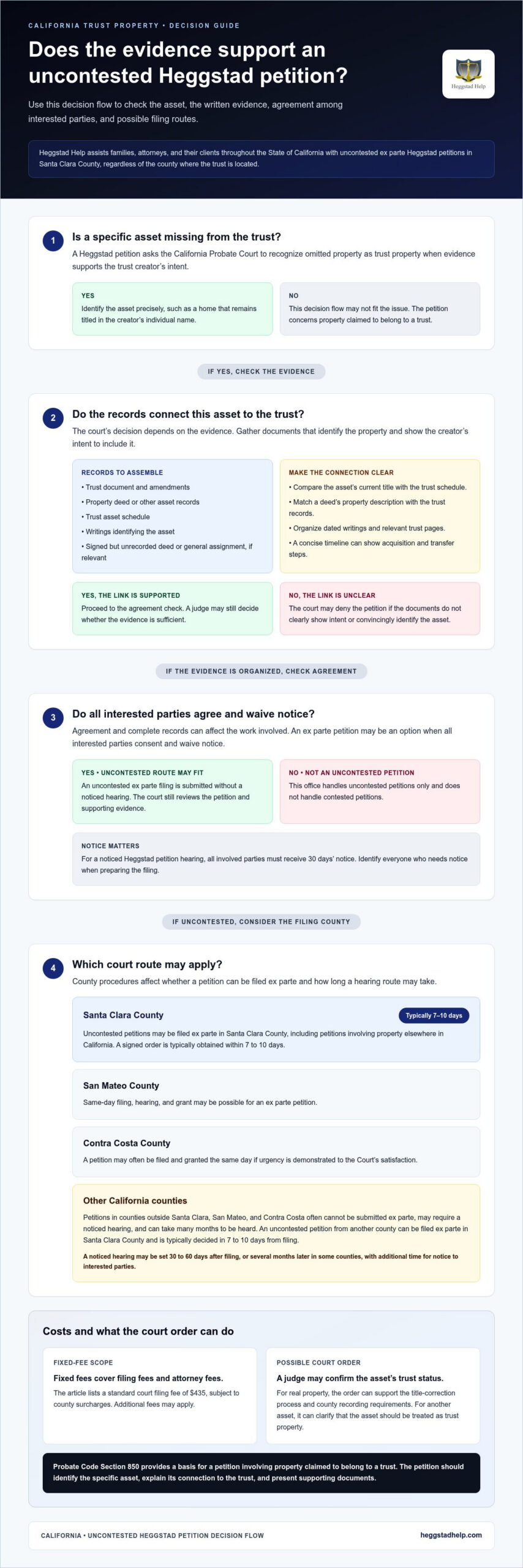
A California court may deny a Heggstad petition if the evidence does not clearly show that the trust creator intended to include the asset, or if the documents do not identify the property convincingly. Compare the asset’s current title with the trust schedule and gather dated writings connecting the asset to the trust. The court’s decision depends on the evidence presented.
Court orders confirming property as a trust asset
A Heggstad petition asks a California Probate Court to decide whether an omitted asset belongs to a trust. If the evidence supports the request, the judge’s order can confirm the asset’s trust status and help guide the next steps for its transfer.
Probate Code Section 850 provides a basis for a petition involving property claimed to belong to a trust. A trustee or beneficiary with an interest in the trust and property may ask the court to decide the ownership question. The petition should identify the specific asset, explain how it relates to the trust, and present documents supporting the requested order.
Organize the evidence so the connection between the asset and trust is clear. For example, match the property description on a deed with the address or legal description in a trust schedule. Include relevant trust pages, amendments, and writings that explain the transaction. A concise timeline can show when the asset was acquired and what steps were taken to place it in the trust.
A final order gives the trustee a court decision to use when addressing the asset’s ownership and administration. For real property, the trustee can use the order as part of the title-correction process and follow the recording requirements for the county where the property is located. For another asset, the order can clarify that it should be treated as trust property. Keep the signed order with the trust records and share it with those handling the transfer.
A reported successful Heggstad petition in Solano County involved personal property worth more than $1 million. That example shows the petition can concern more than a house, but the evidence must identify the particular asset and support its connection to the trust. If you’re preparing a filing, review the court-order petition process and assemble the asset records before submission.
Flat fees for uncontested and regular petitions
Heggstad petition attorneys may charge a fixed fee or bill by the hour. The billing method, filing route, and court requirements affect what the fee covers and how long the process may take.
Flat Fees and Billing Methods
How do flat-fee and hourly billing compare for Heggstad petition lawyers? A flat fee sets the charge for an agreed scope of work, while hourly billing varies with time spent. Ask which preparation and filing tasks the fee covers and how additional work is handled. For an uncontested petition, a fixed fee can make the legal charge more predictable, but it does not mean every petition qualifies.
Fees, Costs, and Timelines
What court filing fees and other costs apply to a California Heggstad petition? The standard filing fee is $435, subject to county surcharges. The listed fixed fee applies only to a clean ex parte petition, and additional fees may apply; consult the Fees and Costs page for those details. Ex parte petitions often have a small additional fee.
Timing depends on the court route. A signed order is typically obtained within 7 to 10 days in Santa Clara County. Same-day filing is possible in San Mateo County and, when urgency is demonstrated, in Contra Costa County. A noticed hearing may be set 30 to 60 days after filing or several months later in some counties.
Factors Affecting Legal Fees
Do Heggstad petition requirements, costs, or timelines vary by California county? Yes. Counties outside Santa Clara, San Mateo, and Contra Costa often require noticed hearings, which may take many months. Eligible, uncontested petitions from other counties can instead be filed ex parte in Santa Clara County, where a signed order is typically obtained within 7 to 10 days.
Agreement among interested parties, complete trustee records, and the need for document corrections can affect the work involved. Before a consultation, organize the trust, asset records, and written evidence of intent. The petition process depends on the case’s filing route and scope.
Notice to interested parties
Notice gives beneficiaries and other interested people a chance to learn about a Heggstad petition. According to the California Legislature, the court must give all parties involved 30 days’ notice of a Heggstad petition hearing.
Prepare a complete list of names and addresses for everyone who may need notice. Compare the list with the trust, amendments, and estate plan, and note each person’s relationship to the trust. For example, distinguish current beneficiaries from people named in an earlier trust version. Missing someone can delay the filing or require corrected notice.
Trustee notices may also matter. Probate Code Section 16061.7 addresses notice to beneficiaries, according to the California Legislature. Supporting Heggstad petition documents may include that trustee notice. Gather any relevant notice and proof of delivery with the trust records, so the court can review what beneficiaries received and when.
The notice route depends on the situation. A noticed hearing follows the 30-day notice period. An uncontested ex parte petition, meaning a request without a formal hearing, requires interested parties to agree to waive hearing notice, consent to the petition and venue, and present no objector. If even one interested person objects or will not consent, that route may not fit. The circumstances can then require a noticed hearing, which affects when the court considers the petition and when the trustee can distribute the property.
Before filing, check each name and mailing address against current records, and keep copies of notices and delivery documentation. That practical step helps the trustee show who received notice and address questions about what happened. For help preparing an uncontested petition and its notice materials, get assistance with Heggstad petition filing.
HEGGSTAD HELP: Heggstad Petition Filing
HEGGSTAD HELP, a service of attorney Robert P. Bergman, Board-Certified Specialist in Estate Planning, Trust, and Probate Law (California State Bar Board of Legal Specialization), assists families, attorneys, and their clients throughout the State of California with uncontested Heggstad petitions.
For an eligible petition involving an asset in another California county, HEGGSTAD HELP files the ex parte petition in Santa Clara County. A fixed fee applies only to a clean ex parte petition, meaning no interested parties object, all interested parties waive notice of a hearing, and all interested parties consent to the petition. Additional fees may apply; see the Fees and Costs page.
HEGGSTAD HELP also provides Ex Parte Court Order Services and Trust Asset Title Correction. Gather the trust and asset records before arranging next steps. Contact HEGGSTAD HELP to discuss an uncontested petition.
Prepare for a Clear Next Step
Before moving forward, identify what you need the court to resolve and who must be involved. A focused review can help distinguish a straightforward, uncontested matter from one involving objections. When choosing a flat fee Heggstad petition lawyer in California, discuss the case’s status, the requested court order, and the practical steps that follow.
For your first conversation, write down the main question, note any unresolved concerns among interested parties, and gather the information you already have in one place. This preparation helps keep the discussion focused on your circumstances and the decision ahead, rather than scattered details. You don’t have to map every procedural step alone.
Contact HEGGSTAD HELP to discuss the next step for your Heggstad petition. A clear plan can make a complicated process feel more manageable.
Frequently Asked Questions
Property left out of a trust?
First, identify who currently owns the property and whether the trust creator is living. Heggstad petition services can address trust-funding and title issues before or after a decedent’s death. If you are helping a family member, gather current ownership information and note any steps already taken to fund the trust. These details help frame the question for a flat fee Heggstad petition lawyer in California.
What is a Heggstad petition in California probate?
A Heggstad petition is a court request about whether particular property should be treated as belonging to a trust. It concerns the asset identified in the request, rather than asking the court to manage every part of an estate. Trustees and beneficiaries can describe the issue clearly by naming the property, explaining the trust-related question, and identifying the decision needed from the court.
When is a Heggstad petition needed to transfer property into a California living trust?
Consider a Heggstad petition when a trust exists but ownership records do not reflect the intended trust arrangement. Before distributing or retitling the asset, clarify the desired outcome and whether the trust creator’s written plan addresses it. For a property transfer, note the current owner shown on the title and the trust’s exact name.
What documents and evidence are required for a California Heggstad petition?
Along with trust and asset records, prepare a brief timeline of relevant events, such as when the trust was created, when the asset was acquired, and any later title changes. Keep property descriptions consistent across the materials. Before your consultation, download and complete the Trust Petition Consultation Worksheets, then organize them with your records. This helps a flat fee Heggstad petition lawyer in California understand the issue efficiently.
What is the step-by-step process and timeline for filing a Heggstad petition in California?
The practical sequence is to arrange a consultation, complete the worksheets, assemble the trust and asset information, and prepare the petition for the appropriate filing route. The schedule depends on preparation, required notice or consent, and court review. After booking through the consultation link, download the worksheets and return them by email or fax. Allow for title-related steps after the court issues an order.
How much do California probate attorneys charge for a Heggstad petition?
A clean petition means no interested parties object, all interested parties waive notice of a hearing, and all interested parties consent to the petition. Additional fees may apply; see the Fees and Costs page. Book a consultation using the “BOOK A HEGGSTAD TRUST PETITION CONSULTATION” link to discuss your matter.

Article by
Robert P. Bergman, Attorney at Law
Attorney Robert P. Bergman ("Bob Bergman") has been a Board-Certified Specialist in Estate Planning, Trust and Probate Law since 2011, as certified by the California State Bar Board of Legal Specialization. For several years, Bob has assisted families and the clients of other attorneys with obtaining court orders through Heggstad petitions to avoid the time and expense of Probate administration. Bob is friendly, very approachable, and believes in explaining complex legal topics in clear ordinary language so that his clients understand exactly what they're doing and why they're doing it.
Bob is often able to assist clients who are in other counties than his home county of Santa Clara through his approach to Heggstad petitions.
Disclaimer
This article is for informational purposes only. Nothing in this article is intended to replace legal advice from a competent attorney or be considered legal guidance for anybody's specific legal situation. Nobody should rely on information in this article in making legal decisions without such consultation.