
A paper stock certificate does not automatically keep shares out of a trust. A Heggstad petition for stock certificates may ask a California court to recognize shares as trust property when the owner intended to place them in the trust but did not complete the transfer. The key question is whether the available evidence supports that intent, not simply whether a physical certificate exists.
It is understandable to focus on the certificate itself: it represents ownership, and handling it after someone’s death can involve additional practical steps. But the trust documents and other records may help show whether the shares were meant to belong to the trust. Ownership arrangements and beneficiary designations can also affect the analysis.
This article explains which assets a Heggstad petition may address, what records can support a claim involving shares, and how notice and objections fit into the process. It also explains what a court order may accomplish, helping you distinguish an omitted trust asset from a different kind of transfer issue.
Key Takeaways
- A petition may help establish that an asset belongs to a California trust when ownership was never formally updated, if the evidence shows the owner intended to include it.
- Trust schedules, written assignments, and ownership records can help support the claim; organize documents that identify the specific asset.
- Notice gives interested parties an opportunity to object, so identify who may have an interest before the petition proceeds.
- Physical stock certificates involve transfer and ownership details that differ from brokerage-held shares; gather the certificate and related company records.
Which assets can a Heggstad petition reach?
A California Heggstad petition can ask the probate court to confirm that an omitted asset belongs to a trust. The settlor (the person who created the trust) may have intended to include property but never formally transferred or titled it in the trust’s name. Probate Code Section 850 allows a trustee or interested person to petition concerning property claimed to belong to a trust. Assets may include real estate, financial accounts, personal property, business interests, or stock certificates.
A stock or financial account with a beneficiary designation needs closer review. The designation or another ownership arrangement may determine who receives the asset, so gather account statements and beneficiary records alongside the trust documents. A petition addresses whether the specific asset belongs to the trust; it does not automatically override a separate transfer arrangement.
A Heggstad petition differs from a small estate procedure for stock: it asks the court to determine trust ownership, while a Small Estate Affidavit is a separate transfer procedure.
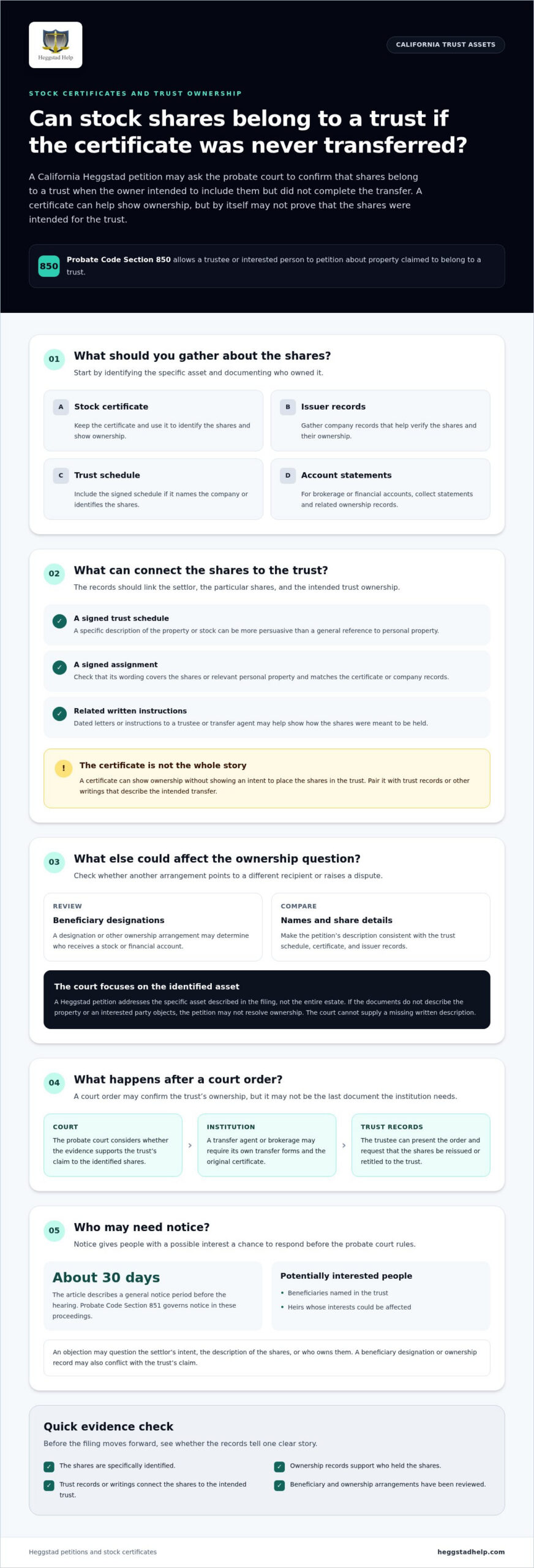
To file a Heggstad petition for stock in California, the petitioner identifies the shares and explains why the settlor intended them to be trust property. The filing should include supporting trust records and ownership documents, such as a schedule of assets or certificate. A California Superior Court’s probate division considers the petition under Probate Code Section 850.
A transfer agent or brokerage may require additional documents before updating its records, even after a court order. The order may confirm the trust’s ownership, but the institution may also require its transfer forms and the original certificate. After receiving the order, the trustee can present it to the transfer agent and request that the shares be reissued or retitled to the trust.
A Heggstad petition addresses the identified asset, not the entire estate. If the documents do not describe the property or an interested party objects, the petition may not resolve ownership. The court cannot supply a missing written description.
Evidence supporting a petition, including trust schedules and written assignments
California probate courts look for evidence connecting the specific property to the settlor’s intent. Relevant records may include a signed trust, its schedule of assets, a general assignment, a stock certificate, or correspondence describing how the shares should be held. The documents should identify the asset clearly enough to distinguish it from other property.
For stock, evidence may include a schedule listing the company and shares, an assignment naming the stock, or written instructions to a trustee or transfer agent. A certificate alone shows ownership but may not show that the settlor intended the shares to belong to the trust. Pair it with trust records or other writings that explain the intended transfer.
In Estate of Heggstad (1993), the court recognized that a settlor’s written declaration of holding property as trustee could create a trust without a separate deed. In Kucker v. Kucker (2011), a general assignment could transfer personal property. These decisions show why written intent matters when an asset was never formally transferred.
- Trust schedule: Include the signed schedule naming the property or identifying the stock. A generic reference to personal property may be less persuasive than a specific description.
- Assignment: Provide a signed assignment that covers the shares or relevant personal property. Match its language to the certificate and company records.
- Ownership documents: Gather the certificate, account statements, and issuer records showing the settlor owned the shares.
- Related writings: Include dated letters or instructions that link the asset to the trust and identify the intended trustee.
Osswald v. Anderson (1996) marks an important limit: a petition needs a writing describing the property; the court cannot create that missing writing. An attorney can organize the evidence so the parties and judge can follow the link between the settlor, the shares, and the trust. Keep originals and present copies with clear labels. For help preparing a Heggstad petition, organize the trust and stock records together.
Notice requirements and potential objections
Notice gives people with a possible interest in the stock a chance to respond before the probate court rules. California Heggstad petitions generally require a notice period of about 30 days before the hearing, according to California Superior Courts. California Probate Code Section 851 governs notice in these proceedings. Interested parties can include beneficiaries and heirs whose shares of the estate could be affected.
Before filing, identify each beneficiary named in the trust and any heirs who may have an interest. Include accurate names and addresses in the petition materials, then follow the court’s notice requirements. A beneficiary’s written consent or waiver may affect whether formal notice is needed, but the petition must still meet the applicable court requirements.
An objection may dispute the settlor’s intent, the stock description, or who owns the shares. For example, a beneficiary might challenge a schedule that lists company shares without identifying the issuer or quantity. Another party may point to a beneficiary designation or ownership record that conflicts with the trust’s claim. Specific records help the court understand the disagreement.
- Check the asset description: Compare the petition with the stock certificate, issuer records, and trust schedule.
- Review the claimed ownership: Identify any joint owner, beneficiary designation, or other arrangement affecting the shares.
- Track notice: Keep copies of filed notices and proof showing when and how each interested party received them.
- Address objections: Organize the trust documents and ownership records that respond to each disputed point.
A noticed hearing may be set 30 to 60 days after filing, with additional time needed for notice. In counties outside Santa Clara, San Mateo, and Contra Costa, Heggstad petitions often require noticed hearings and may take many months to be heard. Uncontested petitions from those counties can instead be heard ex parte in Santa Clara County, often with a decision 7 to 10 days after filing. Ex parte means the court considers the petition without a formal hearing; it does not mean interested-party notice requirements disappear.
Using Heggstad petitions for stock certificates
A paper certificate may document shares without showing whether the settlor intended them for a trust. A Heggstad petition for stock certificates asks the California probate court to confirm that connection. Under Probate Code Section 850, the petition seeks a determination about property claimed as trust property. The 1993 Estate of Heggstad decision provides the case name associated with this procedure.
Make the petition specific: identify the company, the shareholder named on the certificate, and the shares at issue. Include the trust’s relevant terms and the signed writing that ties those shares to the trust. Probate Code Section 856 allows the court to order property transferred or confirmed when it finds the trust owns it. A signed order can then support the title update.
The next steps depend partly on whether the shares are publicly traded or belong to a private company. For publicly traded shares held as a physical certificate, the transfer agent typically handles reissuance. For private-company shares, review the shareholder agreement and consult company officers about its transfer provisions. The agreement may provide for reissuance, a company buyout, or another mechanism.
- Before filing: Match the certificate details to the trust schedule and any signed assignment.
- In the petition: Explain the settlor’s intent and request an order addressing the identified shares.
- After the order: Present the signed order to the transfer agent or company, and complete its required transfer documents.
A Heggstad order addresses the trust’s claim to the shares; it doesn’t itself print or reissue a new certificate. The transfer agent or private company may require the original certificate and additional documents to update ownership records. If the shares instead belong to the estate, an executor’s authority and the estate transfer process may apply. For help with a petition concerning stock, request Heggstad petition filing assistance.
HEGGSTAD HELP: Heggstad Petition Filing
Heggstad Help, a service of attorney Robert P. Bergman, a Board-Certified Specialist in Estate Planning, Trust, and Probate Law with the State Bar of California Board of Legal Specialization, assists families, attorneys, and their clients with uncontested Heggstad petitions involving assets such as stock certificates.
For trusts located anywhere in the State of California, uncontested petitions can be filed ex parte in the Santa Clara County Probate Court, meaning without a formal hearing. Those petitions are typically granted in 7 to 10 days. Ex parte filings are also available in San Mateo and Contra Costa Counties, subject to each court’s process.
Heggstad Petition Filing can address the court order needed to confirm trust ownership; Trust Asset Title Correction can help with the follow-up title issue. The office handles uncontested petitions, with fixed fees covering filing fees and attorney fees.
For help with an uncontested petition involving stock or another omitted trust asset, contact Heggstad Help.
Prepare the next step for your stock claim
Before pursuing a court order, clarify what you need it to accomplish. Is the immediate goal to establish who can act for the trust, or to enable the company to update its shareholder records? Defining the desired outcome can help keep the petition focused and make the next administrative step easier to plan.
A Heggstad petition for stock certificates can be one part of resolving an asset issue, with the court request shaped around the specific result sought. If you’re ready to discuss that next step, contact HEGGSTAD HELP for assistance. A clear plan can make a complicated process feel more manageable.
Frequently Asked Questions
Can a beneficiary oppose a Heggstad petition?
Yes. A beneficiary can tell the court why they dispute the requested treatment of the shares. To understand the issue, identify whether the disagreement concerns the settlor’s intent, the trust’s terms, or the beneficiary’s own claimed interest. These are distinct questions, and separating them can clarify what the court is being asked to decide.
How Does the California Petition Process Work?
The petitioner asks the probate court to determine a question about a particular asset, and the court considers the request under California procedure. A useful preparation step is to distinguish the court’s ownership decision from the issuer’s administrative work afterward. The court order addresses the legal claim; the company’s records and certificate-handling requirements concern how its share register is updated.
What Do I Need to Know About the Process of Filing a Heggstad Petition?
Make sure the petition describes the requested court action precisely. For stock, compare the issuer’s legal name, share class, and certificate details across available records, and note any differences in spelling or ownership history. Consistent descriptions help clarify which shares the court is being asked to address, especially when a company has multiple classes or similarly named entities.
What Happens If Someone Opposes the Petition?
The court must consider the objection and the parties’ positions before deciding the ownership question. A practical response begins by identifying the exact assertion being challenged, then organizing records that address it. For example, if the dispute concerns the company’s identity, records from the issuer may be more directly relevant than general correspondence about the trust.
What is a Heggstad petition in California probate law?
A Heggstad petition asks the court to determine whether specific property belongs to a trust, even though the ownership records were not formally updated. The request concerns the asset identified in the filing, such as a particular block of company shares. It does not itself complete the issuer’s administrative steps for changing its shareholder records.
Can a Heggstad petition be used to transfer stock certificates into a living trust?
A Heggstad petition may ask a court to recognize stock as trust property when the settlor intended that result but did not complete the transfer. If the settlor is living, the relevant question is whether the shares can be transferred directly under the trust’s and issuer’s procedures. After death, a court petition may address an omitted asset when the supporting records establish the trust’s claim.

Article by
Robert P. Bergman, Attorney at Law
Attorney Robert P. Bergman ("Bob Bergman") has been a Board-Certified Specialist in Estate Planning, Trust and Probate Law since 2011, as certified by the California State Bar Board of Legal Specialization. For several years, Bob has assisted families and the clients of other attorneys with obtaining court orders through Heggstad petitions to avoid the time and expense of Probate administration. Bob is friendly, very approachable, and believes in explaining complex legal topics in clear ordinary language so that his clients understand exactly what they're doing and why they're doing it.
Bob is often able to assist clients who are in other counties than his home county of Santa Clara through his approach to Heggstad petitions.
Disclaimer
This article is for informational purposes only. Nothing in this article is intended to replace legal advice from a competent attorney or be considered legal guidance for anybody's specific legal situation. Nobody should rely on information in this article in making legal decisions without such consultation.


