Heggstad Petition for Stock Certificates: Which Assets Qualify

A paper stock certificate does not automatically keep shares out of a trust. A Heggstad petition for stock certificates may ask a California court to…

A paper stock certificate does not automatically keep shares out of a trust. A Heggstad petition for stock certificates may ask a California court to recognize shares as trust property when the owner intended to place them in the trust but did not complete the transfer. The key question is whether the available evidence supports that intent, not simply whether a physical certificate exists.

It is understandable to focus on the certificate itself: it represents ownership, and handling it after someone’s death can involve additional practical steps. But the trust documents and other records may help show whether the shares were meant to belong to the trust. Ownership arrangements and beneficiary designations can also affect the analysis.

This article explains which assets a Heggstad petition may address, what records can support a claim involving shares, and how notice and objections fit into the process. It also explains what a court order may accomplish, helping you distinguish an omitted trust asset from a different kind of transfer issue.

Key Takeaways

  • A petition may help establish that an asset belongs to a California trust when ownership was never formally updated, if the evidence shows the owner intended to include it.
  • Trust schedules, written assignments, and ownership records can help support the claim; organize documents that identify the specific asset.
  • Notice gives interested parties an opportunity to object, so identify who may have an interest before the petition proceeds.
  • Physical stock certificates involve transfer and ownership details that differ from brokerage-held shares; gather the certificate and related company records.

Which assets can a Heggstad petition reach?

A California Heggstad petition can ask the probate court to confirm that an omitted asset belongs to a trust. The settlor (the person who created the trust) may have intended to include property but never formally transferred or titled it in the trust’s name. Probate Code Section 850 allows a trustee or interested person to petition concerning property claimed to belong to a trust. Assets may include real estate, financial accounts, personal property, business interests, or stock certificates.

A stock or financial account with a beneficiary designation needs closer review. The designation or another ownership arrangement may determine who receives the asset, so gather account statements and beneficiary records alongside the trust documents. A petition addresses whether the specific asset belongs to the trust; it does not automatically override a separate transfer arrangement.

A Heggstad petition differs from a small estate procedure for stock: it asks the court to determine trust ownership, while a Small Estate Affidavit is a separate transfer procedure.

To file a Heggstad petition for stock in California, the petitioner identifies the shares and explains why the settlor intended them to be trust property. The filing should include supporting trust records and ownership documents, such as a schedule of assets or certificate. A California Superior Court’s probate division considers the petition under Probate Code Section 850.

A transfer agent or brokerage may require additional documents before updating its records, even after a court order. The order may confirm the trust’s ownership, but the institution may also require its transfer forms and the original certificate. After receiving the order, the trustee can present it to the transfer agent and request that the shares be reissued or retitled to the trust.

A Heggstad petition addresses the identified asset, not the entire estate. If the documents do not describe the property or an interested party objects, the petition may not resolve ownership. The court cannot supply a missing written description.

Evidence supporting a petition, including trust schedules and written assignments

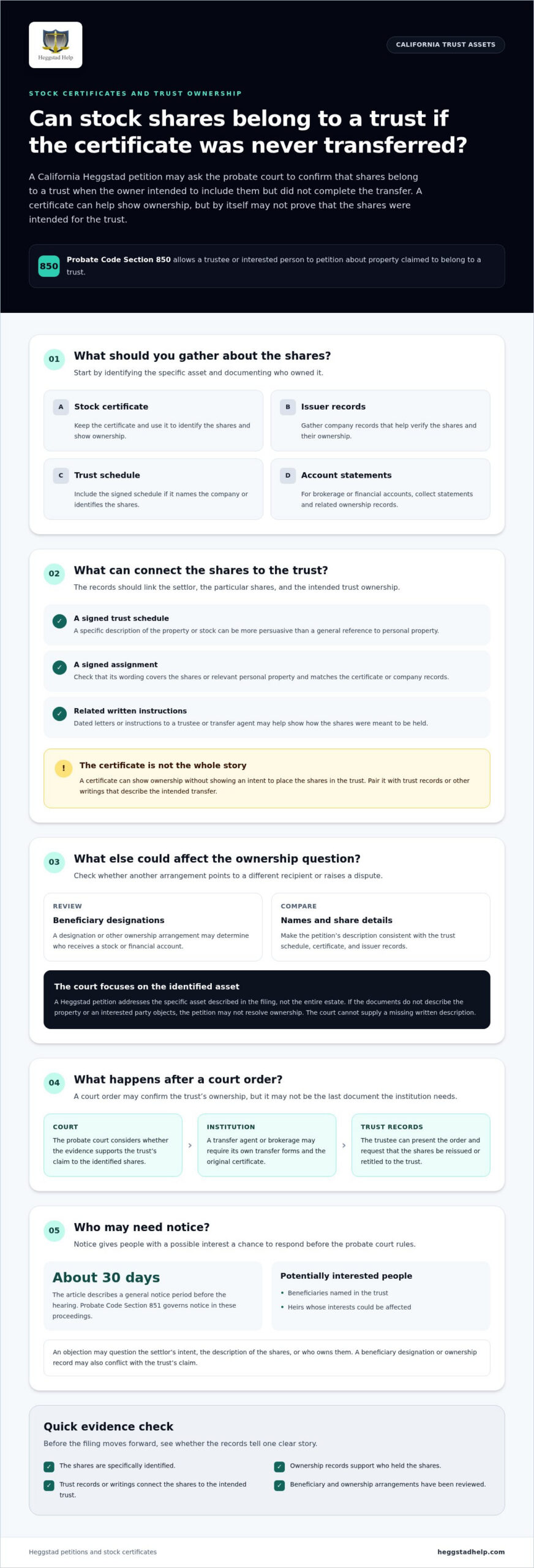
California probate courts look for evidence connecting the specific property to the settlor’s intent. Relevant records may include a signed trust, its schedule of assets, a general assignment, a stock certificate, or correspondence describing how the shares should be held. The documents should identify the asset clearly enough to distinguish it from other property.

For stock, evidence may include a schedule listing the company and shares, an assignment naming the stock, or written instructions to a trustee or transfer agent. A certificate alone shows ownership but may not show that the settlor intended the shares to belong to the trust. Pair it with trust records or other writings that explain the intended transfer.

In Estate of Heggstad (1993), the court recognized that a settlor’s written declaration of holding property as trustee could create a trust without a separate deed. In Kucker v. Kucker (2011), a general assignment could transfer personal property. These decisions show why written intent matters when an asset was never formally transferred.

  • Trust schedule: Include the signed schedule naming the property or identifying the stock. A generic reference to personal property may be less persuasive than a specific description.
  • Assignment: Provide a signed assignment that covers the shares or relevant personal property. Match its language to the certificate and company records.
  • Ownership documents: Gather the certificate, account statements, and issuer records showing the settlor owned the shares.
  • Related writings: Include dated letters or instructions that link the asset to the trust and identify the intended trustee.

Osswald v. Anderson (1996) marks an important limit: a petition needs a writing describing the property; the court cannot create that missing writing. An attorney can organize the evidence so the parties and judge can follow the link between the settlor, the shares, and the trust. Keep originals and present copies with clear labels. For help preparing a Heggstad petition, organize the trust and stock records together.

Notice requirements and potential objections

Notice gives people with a possible interest in the stock a chance to respond before the probate court rules. California Heggstad petitions generally require a notice period of about 30 days before the hearing, according to California Superior Courts. California Probate Code Section 851 governs notice in these proceedings. Interested parties can include beneficiaries and heirs whose shares of the estate could be affected.

Before filing, identify each beneficiary named in the trust and any heirs who may have an interest. Include accurate names and addresses in the petition materials, then follow the court’s notice requirements. A beneficiary’s written consent or waiver may affect whether formal notice is needed, but the petition must still meet the applicable court requirements.

An objection may dispute the settlor’s intent, the stock description, or who owns the shares. For example, a beneficiary might challenge a schedule that lists company shares without identifying the issuer or quantity. Another party may point to a beneficiary designation or ownership record that conflicts with the trust’s claim. Specific records help the court understand the disagreement.

  • Check the asset description: Compare the petition with the stock certificate, issuer records, and trust schedule.
  • Review the claimed ownership: Identify any joint owner, beneficiary designation, or other arrangement affecting the shares.
  • Track notice: Keep copies of filed notices and proof showing when and how each interested party received them.
  • Address objections: Organize the trust documents and ownership records that respond to each disputed point.

A noticed hearing may be set 30 to 60 days after filing, with additional time needed for notice. In counties outside Santa Clara, San Mateo, and Contra Costa, Heggstad petitions often require noticed hearings and may take many months to be heard. Uncontested petitions from those counties can instead be heard ex parte in Santa Clara County, often with a decision 7 to 10 days after filing. Ex parte means the court considers the petition without a formal hearing; it does not mean interested-party notice requirements disappear.
Heggstad Petition for Stock Certificates: Which Assets Qualify

Using Heggstad petitions for stock certificates

A paper certificate may document shares without showing whether the settlor intended them for a trust. A Heggstad petition for stock certificates asks the California probate court to confirm that connection. Under Probate Code Section 850, the petition seeks a determination about property claimed as trust property. The 1993 Estate of Heggstad decision provides the case name associated with this procedure.

Make the petition specific: identify the company, the shareholder named on the certificate, and the shares at issue. Include the trust’s relevant terms and the signed writing that ties those shares to the trust. Probate Code Section 856 allows the court to order property transferred or confirmed when it finds the trust owns it. A signed order can then support the title update.

The next steps depend partly on whether the shares are publicly traded or belong to a private company. For publicly traded shares held as a physical certificate, the transfer agent typically handles reissuance. For private-company shares, review the shareholder agreement and consult company officers about its transfer provisions. The agreement may provide for reissuance, a company buyout, or another mechanism.

  • Before filing: Match the certificate details to the trust schedule and any signed assignment.
  • In the petition: Explain the settlor’s intent and request an order addressing the identified shares.
  • After the order: Present the signed order to the transfer agent or company, and complete its required transfer documents.

A Heggstad order addresses the trust’s claim to the shares; it doesn’t itself print or reissue a new certificate. The transfer agent or private company may require the original certificate and additional documents to update ownership records. If the shares instead belong to the estate, an executor’s authority and the estate transfer process may apply. For help with a petition concerning stock, request Heggstad petition filing assistance.

HEGGSTAD HELP: Heggstad Petition Filing

Heggstad Help, a service of attorney Robert P. Bergman, a Board-Certified Specialist in Estate Planning, Trust, and Probate Law with the State Bar of California Board of Legal Specialization, assists families, attorneys, and their clients with uncontested Heggstad petitions involving assets such as stock certificates.

For trusts located anywhere in the State of California, uncontested petitions can be filed ex parte in the Santa Clara County Probate Court, meaning without a formal hearing. Those petitions are typically granted in 7 to 10 days. Ex parte filings are also available in San Mateo and Contra Costa Counties, subject to each court’s process.

Heggstad Petition Filing can address the court order needed to confirm trust ownership; Trust Asset Title Correction can help with the follow-up title issue. The office handles uncontested petitions, with fixed fees covering filing fees and attorney fees.

For help with an uncontested petition involving stock or another omitted trust asset, contact Heggstad Help.

Prepare the next step for your stock claim

Before pursuing a court order, clarify what you need it to accomplish. Is the immediate goal to establish who can act for the trust, or to enable the company to update its shareholder records? Defining the desired outcome can help keep the petition focused and make the next administrative step easier to plan.

A Heggstad petition for stock certificates can be one part of resolving an asset issue, with the court request shaped around the specific result sought. If you’re ready to discuss that next step, contact HEGGSTAD HELP for assistance. A clear plan can make a complicated process feel more manageable.

Frequently Asked Questions

Can a beneficiary oppose a Heggstad petition?

Yes. A beneficiary can tell the court why they dispute the requested treatment of the shares. To understand the issue, identify whether the disagreement concerns the settlor’s intent, the trust’s terms, or the beneficiary’s own claimed interest. These are distinct questions, and separating them can clarify what the court is being asked to decide.

How Does the California Petition Process Work?

The petitioner asks the probate court to determine a question about a particular asset, and the court considers the request under California procedure. A useful preparation step is to distinguish the court’s ownership decision from the issuer’s administrative work afterward. The court order addresses the legal claim; the company’s records and certificate-handling requirements concern how its share register is updated.

What Do I Need to Know About the Process of Filing a Heggstad Petition?

Make sure the petition describes the requested court action precisely. For stock, compare the issuer’s legal name, share class, and certificate details across available records, and note any differences in spelling or ownership history. Consistent descriptions help clarify which shares the court is being asked to address, especially when a company has multiple classes or similarly named entities.

What Happens If Someone Opposes the Petition?

The court must consider the objection and the parties’ positions before deciding the ownership question. A practical response begins by identifying the exact assertion being challenged, then organizing records that address it. For example, if the dispute concerns the company’s identity, records from the issuer may be more directly relevant than general correspondence about the trust.

What is a Heggstad petition in California probate law?

A Heggstad petition asks the court to determine whether specific property belongs to a trust, even though the ownership records were not formally updated. The request concerns the asset identified in the filing, such as a particular block of company shares. It does not itself complete the issuer’s administrative steps for changing its shareholder records.

Can a Heggstad petition be used to transfer stock certificates into a living trust?

A Heggstad petition may ask a court to recognize stock as trust property when the settlor intended that result but did not complete the transfer. If the settlor is living, the relevant question is whether the shares can be transferred directly under the trust’s and issuer’s procedures. After death, a court petition may address an omitted asset when the supporting records establish the trust’s claim.

Robert P. Bergman, Attorney at Law

Article by

Robert P. Bergman, Attorney at Law

Attorney Robert P. Bergman ("Bob Bergman") has been a Board-Certified Specialist in Estate Planning, Trust and Probate Law since 2011, as certified by the California State Bar Board of Legal Specialization. For several years, Bob has assisted families and the clients of other attorneys with obtaining court orders through Heggstad petitions to avoid the time and expense of Probate administration. Bob is friendly, very approachable, and believes in explaining complex legal topics in clear ordinary language so that his clients understand exactly what they're doing and why they're doing it.
Bob is often able to assist clients who are in other counties than his home county of Santa Clara through his approach to Heggstad petitions.

Disclaimer

This article is for informational purposes only. Nothing in this article is intended to replace legal advice from a competent attorney or be considered legal guidance for anybody's specific legal situation. Nobody should rely on information in this article in making legal decisions without such consultation.

Why to File a Heggstad Petition and When Beneficiaries Can Contest It

A beneficiary’s lack of consent does not automatically prevent a Heggstad petition. A Heggstad petition without beneficiary consent may ask the court…

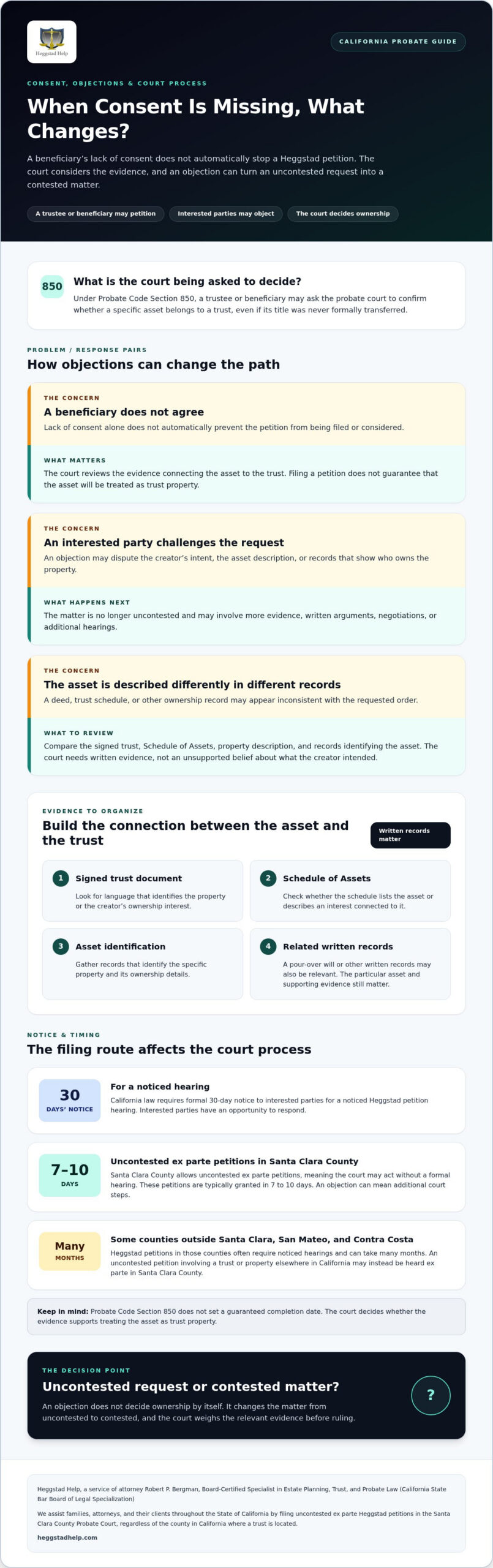
A beneficiary’s lack of consent does not automatically prevent a Heggstad petition. A Heggstad petition without beneficiary consent may ask the court to confirm that an omitted asset belongs to a trust. Beneficiaries and other interested parties can object, and the court may consider written evidence of the trust creator’s intent. Filing a petition does not guarantee that the court will treat the asset as trust property.

If you’re facing this issue, you may be wondering whether an objection will stop the process or lead to a dispute. This article explains when an omitted asset may be brought into a trust, who might file a petition, how beneficiaries can object, and what evidence may support the request. It also explains the difference between an uncontested petition and a contested matter, so you can understand the process and consider your next steps.

Key Takeaways

  • A beneficiary’s lack of consent doesn’t automatically prevent a Heggstad petition, but the court considers whether the evidence supports treating the omitted asset as trust property.
  • Review the trust, property schedules, and other written records for clear evidence that the trust creator intended to include the asset.
  • Beneficiaries and other interested parties can object; for a noticed hearing, California law requires formal 30-day notice to interested parties, according to the California Legislature.
  • Before choosing a filing path, distinguish an uncontested petition from a contested matter, since objections can add court steps and affect timing.

When can an omitted asset be brought into a trust?

A California court may confirm that an omitted asset belongs to a trust if written evidence shows the creator intended to include it. A Heggstad petition asks the probate court to decide that ownership question.

Establishing Trust Ownership

A Heggstad petition is a request for a California probate court to confirm that specific property belongs to a trust, despite incomplete title transfer. Under Probate Code Section 850, a trustee or beneficiary may petition over whether an asset belongs to a trust. What is a Heggstad petition in California probate? It is a court process for establishing trust ownership of an asset that wasn’t formally transferred. If granted, the order can allow the trustee to handle and distribute the asset under the trust, rather than through full probate. The petition identifies the asset and explains why it should be treated as trust property.

Evidence of the Decedent’s Intent

Evidence of intent includes written trust records connecting the decedent to the asset. The court needs more than a family member’s unsupported belief that the property was meant for the trust. Review the signed trust document and its Schedule of Assets for a property description, ownership interest, or other identifying details. In Estate of Heggstad, a listed property interest was mislabeled as a “partnership interest,” but the schedule supported the decedent’s intent. A pour-over will, which directs remaining assets into a trust, may also be relevant. The specific asset and supporting records still matter.

Transferring Unfunded Assets

A successful petition can establish that an asset belongs to the trust even though its title was never formally transferred. For example, a home may have been refinanced without being retitled in the trust’s name, or an asset may have been omitted from transfer paperwork. Gather the trust, property schedule, and records identifying the asset. If the court grants the petition, its order confirms the property as a trust asset. The trustee can then address title correction and manage the asset under the trust, rather than starting full probate for that property.

Alternatives to a Petition

The available alternatives depend on whether the trust creator is living and how clearly the records identify the property. If the creator can still transfer the asset, completing the title transfer may address the issue without asking a court to establish ownership. After death, probate or trust reformation, a court-requested change to trust terms, may be considered if a Heggstad petition does not fit the evidence or circumstances. What are alternatives to a Heggstad petition for transferring assets into a trust? Depending on the case, they may include a lifetime transfer, probate, or trust reformation. Compare the asset’s title with the trust records before choosing a path.

Can a Heggstad Petition Be Contested?

Yes. Beneficiaries and other interested parties can object, and the court considers their evidence before deciding whether to grant the petition. A Heggstad petition without beneficiary consent may proceed, but an objection can make an otherwise uncontested request a contested matter.

The Court Process

The court process gives interested parties a chance to address the requested order. Must beneficiaries receive notice of a Heggstad petition, and can they object? Yes. For a noticed Heggstad petition hearing, California law requires formal 30-day notice to interested parties, according to the California Legislature. At the hearing, a beneficiary may challenge evidence about the asset’s ownership or its connection to the trust. An attorney can organize records and present a Heggstad petition filing to the probate court. If a party objects, the court process may involve further evidence exchange, written arguments, negotiations, or additional hearings. Probate Code Section 850 does not set a guaranteed completion date.

Notice and Objections

Notice informs interested parties about the petition and gives them an opportunity to respond. The petition should clearly identify the asset and the order requested. An objection may dispute the decedent’s intent, challenge the asset description, or present competing ownership records. For example, a beneficiary might point to a deed that conflicts with the trust’s description. When disagreements lead to formal objections, beneficiaries often turn to counsel like JE Law to handle contentious estate disputes. Organize relevant documents and note any inconsistencies so the court can assess the evidence.

County Court Procedures

Santa Clara County allows uncontested ex parte petitions, meaning the court may act without a formal hearing. These petitions are typically granted in 7 to 10 days. If a beneficiary objects, however, the matter is no longer uncontested and may require additional court steps. In counties outside Santa Clara, San Mateo, and Contra Costa, Heggstad petitions often require noticed hearings and can take many months. An uncontested petition involving a trust or property elsewhere in California may instead be heard ex parte in Santa Clara County. Filing a Heggstad petition without beneficiary consent makes it especially important to understand whether an objection has been raised.

Common reasons to file a Heggstad petition

A Heggstad petition may help when an asset was intended for a trust but remained outside it. The problem often appears after the trust creator dies, when a successor trustee reviews the estate and discovers property still titled individually. Probate Code Section 850 allows a trustee or beneficiary to ask the court to resolve whether an asset belongs to a trust. If the court confirms ownership, the trustee may handle that asset under the trust instead of through full probate.

Can a trustee file a Heggstad petition without the beneficiary’s consent? Yes. A trustee may petition the court without first obtaining beneficiaries’ agreement. Beneficiaries can still receive notice and object, so the trustee should be prepared to present records supporting the request.

Common reasons for filing include an unfinished transfer, an asset left off a trust schedule, or a property interest described incorrectly. For example, a trust document may identify an ownership interest that a later record describes differently. A petition may also be considered when the omission is discovered after death or when the trust has become irrevocable. The key question is whether the available records connect the specific asset to the creator’s intent.

Before filing, gather documents that identify both the trust and the property. A practical starting set includes:

  • The signed trust document and any relevant amendments, to show the trust’s terms.
  • A Schedule of Assets or other written trust record identifying the asset or ownership interest.
  • Title records, deeds, or account documents showing how the asset is currently held.
  • A pour-over will, if one exists, as evidence of the creator’s plan for assets left outside the trust.

A successor trustee generally files because that person is responsible for administering trust property. A beneficiary, heir, or other interested person may file in some situations. Keep the original records together and note any differences between the asset’s description in the trust and its current title. This comparison helps clarify the issue the petition asks the court to decide.

Why to File a Heggstad Petition and When Beneficiaries Can Contest It

Common reasons for filing a Heggstad petition

A Heggstad petition can address a mismatch between a living trust’s terms and an asset’s legal title. For example, a decedent may have intended a home or ownership interest to pass through the trust but never completed the transfer. The court can decide whether that specifically identified asset belongs to the trust. If the petition succeeds, the property may avoid full probate. The petition does not determine how every later-discovered estate asset should be distributed.

The process traces to Estate of Heggstad, decided by the California Court of Appeal in 1993. There, a property interest appeared on the trust’s Schedule of Assets, although it was mislabeled as a “partnership interest.” That example shows why the filing should connect the asset’s description in trust records with the property identified in the court request. Compare those descriptions before filing, and flag any mismatch for explanation.

Venue and filing steps also matter. A Heggstad petition generally proceeds in the probate court associated with the successor trustee’s county. The court file is opened in the trust’s name, even when no formal probate estate is opened. In counties outside Santa Clara, San Mateo, and Contra Costa, these petitions often require a noticed hearing and may take many months to be heard. An uncontested petition from another California county can instead be heard ex parte in Santa Clara County, where decisions often come 7 to 10 days after filing. San Mateo and Contra Costa have separate ex parte procedures.

For a noticed hearing, California law requires formal 30-day notice to interested parties, according to the California Legislature. Gather the trust, property description, title records, and documents supporting the requested order; complete notice as required for the chosen filing route. This gives interested parties a chance to respond and helps define the question before the probate court.

If you’re preparing an uncontested petition, review Heggstad petition filing information to understand the filing route and supporting records.

HEGGSTAD HELP: Heggstad Petition Filing

Heggstad Help, a service of attorney Robert P. Bergman, Board-Certified Specialist in Estate Planning, Trust, and Probate Law (California State Bar Board of Legal Specialization), assists families, attorneys, title companies, and their clients throughout the State of California with uncontested Heggstad petitions.

For trusts located across California, the office can file uncontested ex parte petitions in the Santa Clara County Probate Court. It also files ex parte petitions in San Mateo and Contra Costa Counties. Heggstad Petition Filing and Ex Parte Court Order Services address the court request, while Trust Asset Title Correction can help reflect the resulting order in asset records. These services are for uncontested matters.

If you’re considering an uncontested petition, contact HEGGSTAD HELP or visit heggstadhelp.com to discuss the filing.

Take the Next Step With a Clear Plan

Before moving forward, gather the trust paperwork and asset records so the issue can be assessed as a whole. Identify the outcome you need, such as confirming ownership or correcting an asset’s title, and note any disagreement that could affect whether the matter is uncontested.

If you are considering a Heggstad petition without beneficiary consent, focus first on whether the documents clearly support the request and whether the matter is uncontested. A court filing is a significant step, so understanding the purpose of the petition and the evidence behind it can help you make an informed decision about what happens next.

HEGGSTAD HELP handles Heggstad Petition Filing, Ex Parte Court Order Services, and Trust Asset Title Correction. If you’re ready to discuss your situation, contact HEGGSTAD HELP. A clear next step can make a complex trust issue easier to approach.

Frequently Asked Questions

Do I need an attorney to file one?

A Heggstad petition asks a probate court to decide an asset’s ownership based on trust records, so legal assistance is important. The process is not a self-service alternative like a Small Estate Affidavit. An attorney can organize the trust and title documents, identify the order requested, and address court filing and notice requirements. For example, a deed with a different property description may need to be explained alongside the trust paperwork.

What controls the timeline?

The filing county’s court calendar is a major timing factor, and objections can add steps. A court may require additional evidence, written arguments, negotiations, or another hearing if interested parties dispute the request. The petition’s completeness also matters: missing title records or unclear descriptions can prompt requests for clarification. Before filing, assemble the relevant records and identify any disagreement, so the requested order and supporting materials address the issue directly.

What if the asset isn’t specifically listed on the Schedule of Trust Assets?

An asset’s absence from the schedule does not automatically end the inquiry. Other written records, such as an executed trust document, assignment, or pour-over will, may connect the property to the trust creator’s intent. Compare each record’s asset description with current title documents. A general statement that the creator wanted everything in the trust is less useful than records identifying the specific asset or ownership interest.

What should families do after finding an unfunded trust asset?

Preserve the records and avoid assumptions about who owns or can transfer the asset. Gather the trust and amendments, current title or account statements, and any assignment or correspondence concerning the asset. Note how the asset is described in each document and identify any mismatch. Also establish whether the trust creator is living or deceased, as that affects which transfer options may be available.

When might probate still be necessary?

Probate may still be needed if the court does not confirm the asset as trust property or the records do not support the requested finding. It may also be relevant if other estate assets need a separate transfer process. A Heggstad petition addresses only the specifically identified property before the court; it does not automatically transfer every asset discovered later. Distinguish the petition’s target asset from the rest of the estate.

Who has standing to file a Heggstad petition?

A trustee or beneficiary may petition under Probate Code Section 850 to ask the court to resolve whether property belongs to a trust. A successor trustee commonly takes the lead because that person administers the trust, while an heir or another interested person may be able to file in some situations. The petitioner should explain their connection to the trust and identify the specific asset and requested court decision.

Robert P. Bergman, Attorney at Law

Article by

Robert P. Bergman, Attorney at Law

Attorney Robert P. Bergman ("Bob Bergman") has been a Board-Certified Specialist in Estate Planning, Trust and Probate Law since 2011, as certified by the California State Bar Board of Legal Specialization. For several years, Bob has assisted families and the clients of other attorneys with obtaining court orders through Heggstad petitions to avoid the time and expense of Probate administration. Bob is friendly, very approachable, and believes in explaining complex legal topics in clear ordinary language so that his clients understand exactly what they're doing and why they're doing it.
Bob is often able to assist clients who are in other counties than his home county of Santa Clara through his approach to Heggstad petitions.

Disclaimer

This article is for informational purposes only. Nothing in this article is intended to replace legal advice from a competent attorney or be considered legal guidance for anybody's specific legal situation. Nobody should rely on information in this article in making legal decisions without such consultation.

California Trust Asset Petitions: Complete Guide (2026)

What if discovering that a family home or financial account was left in a decedent’s individual name didn’t mean facing 12 to 18 months of stressful…

What if discovering that a family home or financial account was left in a decedent’s individual name didn’t mean facing 12 to 18 months of stressful probate court delays? It’s completely understandable to feel overwhelmed by confusing statutory requirements when you’re trying to manage a loved one’s estate. Fortunately, filing a legal petition for trust assets under California Probate Code Section 850 allows you to transfer omitted property directly into the trust without traditional probate administration.

Whether the trust is located in Los Angeles County, Orange County, or San Diego County, you don’t have to endure local court backlogs. Our office helps families and attorneys throughout the State of California secure clear court confirmation by filing uncontested Heggstad petitions ex parte (meaning without a formal hearing) in Santa Clara County, where orders are typically granted in just 7 to 10 days. In this guide, you’ll learn exactly how to fast-track the title transfer process, avoid steep statutory fees, and distribute property to beneficiaries efficiently.

Key Takeaways

  • Understand how filing a legal petition for trust assets under California Probate Code Section 850 allows you to transfer property that was accidentally left out of a trust without a full probate.
  • Discover how to bypass multi-month court backlogs in Los Angeles County or Riverside County by filing an uncontested Heggstad petition ex parte (meaning without a formal hearing) in Santa Clara County.
  • Identify the essential evidence, such as written intent or a list of assets, required to prove that property legally belongs to the trust.
  • Learn the procedural steps to record a certified court order with the County Recorder to officially correct property titles and finalize trust funding throughout the State of California.

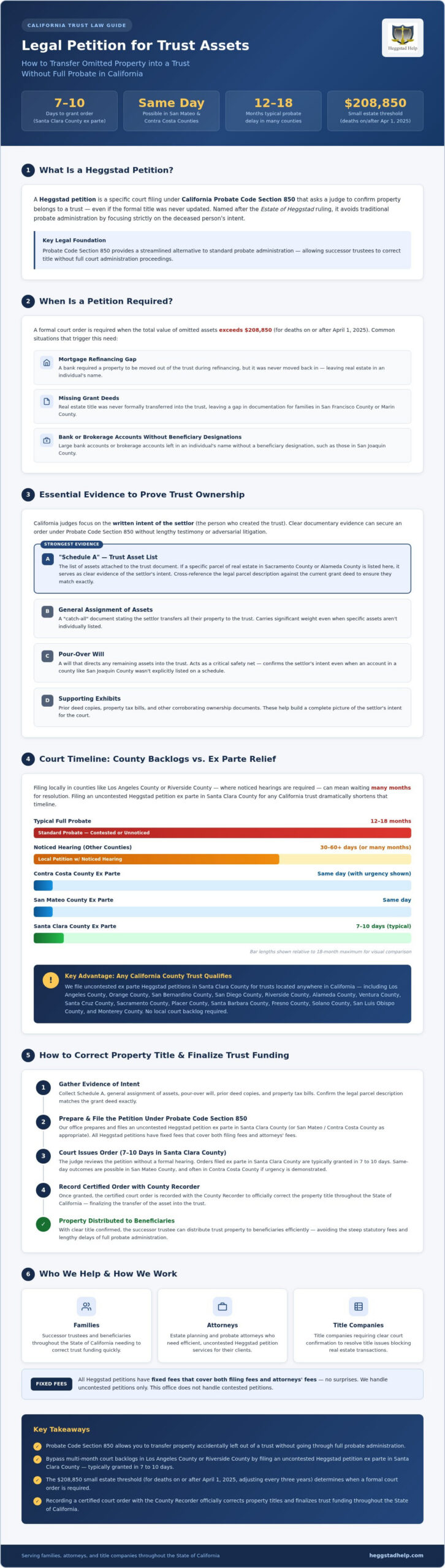
A legal petition for trust assets is a specific court filing that asks a judge to confirm that property belongs to a trust, even if the formal title was never updated. This procedure is grounded in California Probate Code Section 850: A Guide to Real Property Petitions, which provides a streamlined alternative to standard probate administration. While a typical probate in Los Angeles County or Orange County can take over a year, an uncontested petition under Probate Code Section 850 focuses strictly on the deceased person’s intent. This remedy was famously established by the Estate of Heggstad ruling, creating what we now call a Heggstad petition.

Understanding California Probate Code Section 850 and Heggstad Petitions

Under California trust law, a Heggstad petition serves as a vital tool for successor trustees. It allows the court to declare that a specific asset (such as a family home) is trust property because the creator of the trust clearly intended it to be there. We specialize in filing these uncontested Heggstad petitions ex parte (meaning a request made to the court without a formal, noticed hearing) in Santa Clara County, San Mateo County, and Contra Costa County. While a noticed hearing in San Bernardino County might take months, petitions filed ex parte in Santa Clara County are typically granted in just 7 to 10 days. In San Mateo County, these can often be granted the same day.

When Is a Legal Petition Necessary for Trust Property?

Title transfer roadblocks often appear after a mortgage refinancing, where a bank requires a property to be moved out of a trust but it’s never moved back in. If the total value of omitted assets exceeds the California small estate threshold of $208,850 (for deaths on or after April 1, 2025), a formal court order is required to avoid full probate. This process is essential for families in San Francisco County or Marin County dealing with real estate with missing grant deeds, brokerage accounts without beneficiary designations, or large bank accounts left in an individual’s name. Filing in Santa Clara County provides a faster resolution for families throughout the State of California.

Essential Evidence Needed to Prove Trust Asset Ownership

When you file a legal petition for trust assets, the court’s primary focus is the written intent of the settlor (the person who created the trust). California judges don’t require a full trial if you provide clear documentary evidence showing that an asset was meant to be trust property. Providing this proof allows the court to issue an order under California Probate Code § 850 without the need for lengthy testimony or adversarial litigation. Success often depends on how well you organize these foundational documents.

The Critical Role of Trust Schedules and General Assignments

The most powerful piece of evidence is usually "Schedule A," which is the list of assets attached to the trust document. If a specific parcel of real estate in Sacramento County or Alameda County is listed on this schedule, it serves as clear evidence of the settlor’s intent. A general assignment of assets also carries significant weight. This document acts as a catch-all, stating that the settlor transfers all their property to the trust. It’s helpful to cross-reference the legal parcel description on your trust exhibits against the current grant deed to ensure they match exactly, as this prevents technical delays in the State of California court system.

Pour-Over Wills and Supporting Documentation

A pour-over will (a specific type of will that directs any remaining assets into a trust) acts as a critical safety net for your petition. Even if an account in San Joaquin County wasn’t explicitly listed on a schedule, the will confirms the settlor wanted all their property to follow the trust’s terms. You should also gather supporting exhibits like prior deed copies and property tax bills to corroborate ownership. For a detailed breakdown of what to collect, see our guide on Successor Trustee Duties for an Unfunded Trust: The California Guide. If you have these records ready, we can help you secure a court order to finalize the trust funding efficiently.

The Court Process: County Backlogs vs. Santa Clara County Ex Parte Relief

The speed at which you resolve a legal petition for trust assets depends heavily on where the filing occurs. In many parts of the State of California, probate courts are severely congested. If you file a noticed petition (a request requiring formal notice to all interested parties and a scheduled courtroom appearance) in Los Angeles County, Orange County, or Riverside County, you’ll likely wait four to six months just for your first hearing date. During this time, the estate remains in limbo, which can be financially devastating if a pending home sale is frozen by these probate delays.

Hearing Delays Across California Superior Courts

Similar backlogs affect families in Alameda County and Sacramento County, where noticed hearing waits often reach several months. In regions like San Diego County, Fresno County, and San Bernardino County, the timeline is equally taxing. These delays aren’t just frustrating; they’re expensive. Because we focus strictly on uncontested matters, we help families avoid the adversarial atmosphere of these crowded courtrooms. By bypassing the standard noticed hearing process, we ensure that your trust administration doesn’t stall. All our Heggstad petitions use fixed fees that cover both filing fees and attorneys’ fees, so you don’t have to worry about unpredictable costs.

Filing Ex Parte in Santa Clara County for Accelerated Orders

We provide a faster path by filing uncontested Heggstad petitions ex parte (meaning a request for a court order without a formal, in-person hearing) in the Santa Clara County Probate Court. While other counties require noticed hearings, Santa Clara County allows us to secure orders for a legal petition for trust assets in typically 7 to 10 days. We also assist clients in San Mateo County, where orders can often be granted the same day. In Contra Costa County, we can secure same-day orders if we can demonstrate "urgency" to the court. If you want to avoid months of waiting, you can start your expedited petition process today.

California Trust Asset Petitions: Complete Guide (2026)

How to Correct Property Title and Finalize Trust Funding

Securing a signed order for your legal petition for trust assets is a major milestone, but the process isn’t complete until the title is officially corrected. Once the judge signs the order, you must move from the legal phase into the administrative phase to ensure the property is marketable (meaning it can be sold or insured by a title company). This final stage involves specific filings with the County Recorder and the County Assessor to reflect the trust’s ownership interest.

Recording the Certified Court Order with County Recorders

You’ll first need to obtain certified copies (official court documents validated by the probate clerk) of the signed order. These must be recorded in the specific county where the real property is situated, such as Solano County or Santa Barbara County. Along with the order, you must submit a Preliminary Change of Ownership Report (PCOR) to avoid unnecessary property tax reassessments. For comprehensive guidance on post-order administration, refer to Heggstad Petition Filing: The California Guide to Recovering Missing Trust Assets in 2026. Recording these documents correctly ensures that the chain of title is clear for future transactions.

Securing Fixed-Fee Legal Representation for California Trusts

Navigating a legal petition for trust assets shouldn’t involve the financial uncertainty of hourly billing or the high costs of statutory probate commissions (fees mandated by the Probate Code based on a percentage of the gross estate). We provide uncontested services on a transparent fixed-fee basis that covers both the court filing fees and all attorney fees. This approach protects the estate’s value while providing a fast resolution through the State of California court system. Whether your trust is based in Placer County or Ventura County, we can help you bypass delays. You can request a free consultation with Robert P. Bergman at HEGGSTAD HELP to begin the process of correcting your trust’s title today.

Secure Your Family Legacy Without Probate Delays

Recovering omitted property doesn’t have to be a multi-year ordeal. By filing a legal petition for trust assets under Probate Code Section 850, you can honor your loved one’s intent while protecting estate funds from high statutory probate fees. Whether your property is in San Diego County or Fresno County, the Santa Clara County Probate Court provides a reliable, expedited path for uncontested filings. Robert P. Bergman, a Board-Certified Specialist with over 40 years of experience, leads our team in securing court orders in typically 7 to 10 days. We use transparent fixed fees that cover all filing and attorney costs, ensuring your family has a clear, predictable road ahead. You can bypass months of probate court delays with an expedited Heggstad petition from HEGGSTAD HELP. Taking this step now allows you to finalize trust funding and distribute assets without the stress of local court backlogs. It’s time to move forward with confidence.

Frequently Asked Questions

What is a legal petition for trust assets under California law?

A legal petition for trust assets is a specialized filing under Probate Code Section 850 that asks a judge to confirm property belongs to a trust. It’s used when a settlor (the trust creator) intended for an asset to be in the trust but didn’t update the formal title. This procedure provides a streamlined alternative to full probate administration, allowing successor trustees to recover omitted real estate or financial accounts efficiently.

How long does it take for a California court to approve a trust asset petition?

Timelines depend on the county and whether the filing is ex parte or requires a noticed hearing. While a noticed hearing in Los Angeles County or Riverside County can take several months, uncontested petitions filed ex parte in Santa Clara County are typically granted in 7 to 10 days. In San Mateo County, these orders are often granted the same day. Filing in Santa Clara County helps families avoid lengthy court backlogs.

Can an asset be transferred to a trust after the owner dies in California?

Yes, you can transfer property after a death through a Heggstad petition, provided there’s written evidence of the owner’s intent. This is crucial when assets exceed the $208,850 small estate threshold for deaths on or after April 1, 2025. Whether the asset is a home in Monterey County or a business interest in Ventura County, this legal petition for trust assets bypasses the 12 to 18 month probate delay.

Can I file a petition in Santa Clara County if the trust property is in another county?

Yes, you can file in Santa Clara County regardless of where the trust property is located. We assist families and attorneys throughout the State of California by filing uncontested ex parte petitions in Santa Clara County Superior Court. This allows clients with property in San Diego County or Orange County to secure a court order much faster than they would by waiting for a noticed hearing in their local county court.

What happens if someone contests a legal petition for trust assets in California?

If a party contests the filing, the matter becomes trust litigation and can no longer proceed through the expedited uncontested process. Our office focuses exclusively on uncontested petitions to keep fees fixed and timelines short. A contested petition requires formal hearings and extensive courtroom time, often taking many months or even years to resolve. We don’t handle these adversarial proceedings, as our goal is efficient, predictable asset recovery.

Robert P. Bergman, Attorney at Law

Article by

Robert P. Bergman, Attorney at Law

Attorney Robert P. Bergman ("Bob Bergman") has been a Board-Certified Specialist in Estate Planning, Trust and Probate Law since 2011, as certified by the California State Bar Board of Legal Specialization. For several years, Bob has assisted families and the clients of other attorneys with obtaining court orders through Heggstad petitions to avoid the time and expense of Probate administration. Bob is friendly, very approachable, and believes in explaining complex legal topics in clear ordinary language so that his clients understand exactly what they're doing and why they're doing it.
Bob is often able to assist clients who are in other counties than his home county of Santa Clara through his approach to Heggstad petitions.

Disclaimer

This article is for informational purposes only. Nothing in this article is intended to replace legal advice from a competent attorney or be considered legal guidance for anybody's specific legal situation. Nobody should rely on information in this article in making legal decisions without such consultation.
California Probate Code Section 850 in California: The Definitive Trust Asset Guide

What if a single forgotten real estate deed didn’t have to trigger a 12-to-18-month probate ordeal? If you’ve recently stepped into the role of…

What if a single forgotten real estate deed didn’t have to trigger a 12-to-18-month probate ordeal? If you’ve recently stepped into the role of successor trustee, discovering that a house or financial account was left in the decedent’s individual name can feel overwhelming. You’re likely worried about complex court rules, probate delays, and statutory fees depleting the family inheritance. Fortunately, California Probate Code Section 850 provides an expedited legal remedy, allowing trustees to transfer omitted assets into a living trust without enduring full probate administration.

You’ll discover the exact documentation required to prove the decedent intended the property to belong to the trust, securing clean, insurable title for refinancing or sale. We’ll also walk through how to bypass prolonged noticed hearings across the State of California, showing you how uncontested filings can confirm trust ownership in days rather than months.

Key Takeaways

  • Learn how California Probate Code Section 850 allows successor trustees to transfer omitted real estate and financial accounts directly into a living trust without full probate.
  • Identify the critical written evidence, such as trust schedules and declarations, prior recorded or unrecorded deeds, assignments of property, etc., required to demonstrate the decedent’s clear intent to trust ownership.
  • Discover how filing an uncontested Heggstad petition ex parte can bypass severe court backlogs in regions like Los Angeles County, Orange County, and San Diego County.
  • Understand the precise steps to obtain an expedited court order, securing clean, insurable real estate title for an impending sale or refinancing.

What Is California Probate Code Section 850 for Living Trusts?

When someone creates a revocable living trust, their primary goal is keeping their family out of the public court system after they pass away. Under the statutory structure of the California Codes, formal probate becomes necessary whenever titled assets remain solely in a decedent’s personal name. California Probate Code Section 850 serves as an expedited legal vehicle designed to remedy this exact dilemma. It allows a successor trustee (the person named to administer the trust) to petition the court for an order declaring that omitted property legally belongs to the trust.

Rooted in the landmark 1993 California appellate decision Estate of Heggstad, an 850 petition asks a probate judge to honor the creator’s true intent. If the creator documented their intention to hold the asset in trust, the court can formally transfer ownership without forcing the estate through an arduous court administration.

When Real Property Is Accidentally Left Out of a Trust

Omitted real estate occurs routinely during typical life events:

  • Refinancing a mortgage: Lenders often require owners to deed their home out of a trust into their individual names during loan processing, yet property owners frequently forget to deed it back.
  • New home acquisitions: Buyers often mistakenly purchase property under their individual names, forgetting to direct the escrow officer to title it into their living trust.

When an un-transferred parcel is identified after death, title insurance companies will refuse to insure future transactions without a formal court decree confirming trust ownership.

Probate Code Section 850 Petitions vs. Full Probate Administration

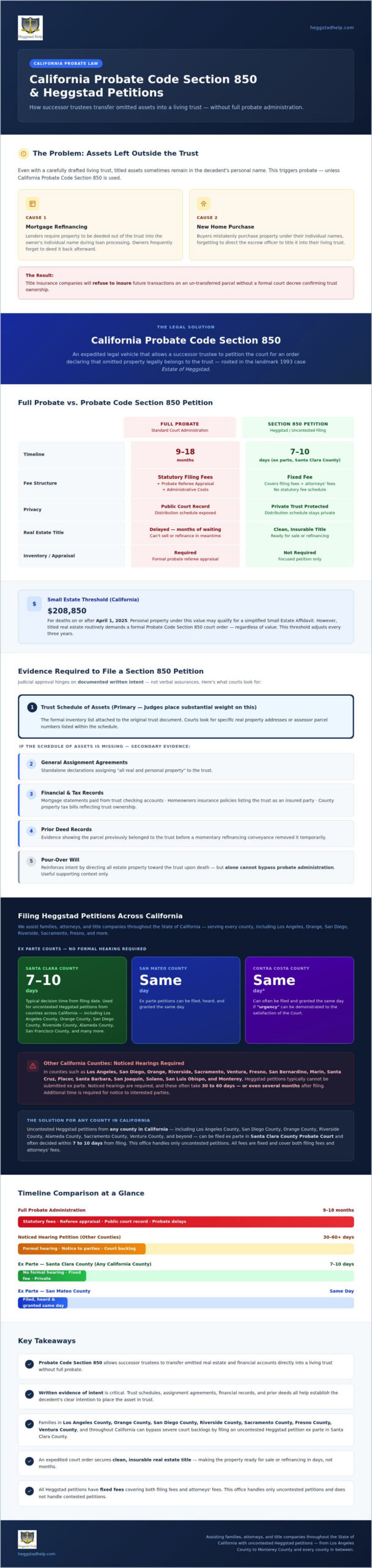
A standard probate proceeding in the State of California takes between 9 and 18 months, requiring statutory filing fees, formal inventory appraisals by a probate referee, and administrative delays. By filing an uncontested petition under California Probate Code Section 850, a trustee avoids these hurdles entirely. This focused legal remedy protects the decedent’s private distribution schedule, bypasses statutory fee schedules, and secures clear, marketable title.

Filing an uncontested petition under California Probate Code § 850 requires presenting undeniable written proof that the decedent intended to hold the property in trust. Judicial approval hinges on documenting this intent rather than relying on verbal assurances. While a pour-over will reinforces this narrative by directing all estate property toward the trust upon death, the will alone cannot bypass probate administration. For personal property valued under California’s small estate threshold of $208,850 (for deaths on or after April 1, 2025), a simplified affidavit may suffice. However, titled real estate routinely demands a formal Section 850 court order.

The Crucial Role of the Trust Schedule of Assets

Judges place substantial weight on the Schedule of Assets (the formal inventory list attached to the original trust document). When reviewing your paperwork, look for specific real property addresses or assessor parcel numbers. If you’re currently balancing administrative obligations, review our breakdown of successor trustee duties for an unfunded trust to quickly verify whether your documentation satisfies local judicial standards.

Supporting Evidence When Assets Are Missing from the Schedule

Missing schedules don’t automatically derail your filing. Clear written intent can still be established using secondary documentation:

  • General assignment agreements: Standalone declarations assigning "all real and personal property" to the trust.
  • Financial and tax records: Mortgage statements paid directly from trust checking accounts, homeowners insurance policies listing the trust as an insured party, and county property tax bills reflecting trust ownership.
  • Prior deed records: Evidence demonstrating the parcel previously belonged to the trust before a momentary refinancing conveyance.

If you need structured guidance on marshaling these exhibits to clear clouded real estate title, consult our comprehensive resource on California Probate Code Section 850 in California.

Probate court dockets vary drastically across the state. In busy metropolitan jurisdictions, severe administrative backlogs leave families waiting months just to appear before a judge. When petitioning under California Probate Code Section 850, understanding local procedural options can save your estate significant time. Our practice focuses exclusively on uncontested petitions, avoiding contentious disputes to deliver smooth, predictable title corrections.

The Problem with Noticed Hearings in Southern California and Central Valley Courts

In jurisdictions like Los Angeles County, Orange County, and San Diego County, Heggstad petitions usually cannot be submitted ex parte (without a formal, in-person hearing). Instead, local rules mandate formal noticed hearings. These hearings are typically set 30 to 60 days out, and frequently take several months in Riverside County, San Bernardino County, Fresno County, and Sacramento County. Such multi-month delays can easily disrupt pending home sales, jeopardize mortgage rate locks, and stall family distributions.

The Ex Parte Alternative in Northern California Probate Courts

Trustees aren’t forced to endure calendar delays in their home counties. We assist attorneys and families statewide by filing uncontested Heggstad petitions ex parte in Northern California courts, regardless of where the decedent lived or where the real estate sits.

Petitions filed ex parte in Santa Clara County are typically granted in just 7 to 10 days. In San Mateo County, uncontested petitions can often be filed, heard, and granted the same day. In Contra Costa County, courts can also grant petitions the same day upon showing urgency. Every petition is managed under a transparent fixed fee covering filing costs and attorney fees. To avoid calendar gridlock and secure clean title rapidly, start your petition with Heggstad Help.

California Probate Code Section 850 in California: The Definitive Trust Asset Guide

Filing an Uncontested 850 Petition to Secure Clean Real Property Title

Correcting an unfunded trust asset shouldn’t feel like entering a courtroom war zone. While contested trust litigation involves lengthy depositions and contentious trials, an uncontested petition under California Probate Code Section 850 serves as an administrative solution. The judicial order confirms real property title directly into the trust, bypassing probate administration entirely. To ensure complete budget certainty during an already difficult transition, our services operate under clear fixed fees covering all court filing costs and legal fees.

Step-by-Step Filing Strategy for Trustees and Title Companies

Securing insurable title follows a precise four-stage administrative trajectory:

  • Assembling documentation: Gather the complete trust instrument, original pour-over will, most recent recorded grant deeds, and asset schedules.
  • Drafting the petition: Prepare verified pleadings articulating clear evidence of intent under California Probate Code Section 850.
  • Ex parte submission: Submit the pleadings for rapid judicial review without scheduling an adversarial court appearance. For an in-depth breakdown of practical preparation tips, review our detailed guide on Heggstad petition filing in California.
  • Recording certified orders: Obtain certified copies of the granted court decree and record them with the appropriate county recorder, officially correcting the chain of title.

Correcting Asset Title Across the State of California

Title defects happen in every corner of the state. We regularly help trustees resolve clouded deeds across Alameda County, San Francisco County, Marin County, and Ventura County. We also assist families managing estate parcels in Monterey County, San Joaquin County, Solano County, and San Luis Obispo County. Obtaining a certified court order creates clean, insurable title, completely satisfying title underwriters, escrow officers, lenders, and future buyers.

Resolve Omitted Trust Assets Without Probate Delay

Discovering that real estate was left out of a trust shouldn’t force your family into a year-long court ordeal. Exercising your rights under California Probate Code Section 850 allows successor trustees to establish rightful ownership, correct clouded deeds, and protect estate distributions without enduring formal probate administration.

Led by attorney Robert P. Bergman, a Board-Certified Specialist in Estate Planning, Trust and Probate Law practicing since 1980, our office assists families and attorneys throughout the State of California. By submitting uncontested filings ex parte in Santa Clara County, petitions are typically granted in just 7 to 10 days. Every matter is handled under transparent fixed fees that cover court filing costs and legal representation, giving you complete financial certainty. When you’re ready to secure clean, insurable title quickly, request assistance with an uncontested Heggstad petition to finalize your trust administration with total peace of mind.

Frequently Asked Questions

What is the main difference between a Heggstad petition and California Probate Code Section 850?

A Heggstad petition is simply a specific, practical application of California Probate Code Section 850. The statute provides broad legal authority to resolve property ownership questions involving trusts, estates, or conservatorships. In contrast, a Heggstad petition specifically requests an expedited court order declaring that an omitted asset legally belongs to a trust based on the decedent’s clear written intent.

How long does it take the court to grant an 850 petition in California?

Approval timelines depend heavily on whether your petition requires a noticed hearing or proceeds ex parte. Traditional noticed hearings in Los Angeles County or Orange County often take several months due to severe calendar backlogs. Conversely, filing an uncontested petition ex parte in Santa Clara County is typically granted in 7 to 10 days, while San Mateo County petitions can be heard and granted the same day.

Can an 850 petition transfer assets if the trust schedule is completely blank?

Yes, an 850 petition can still succeed even if the trust schedule is entirely blank. California judges evaluate the totality of written evidence demonstrating the creator’s true intent. Supporting proof can include a comprehensive general assignment of assets, prior recorded grant deeds showing temporary refinancing conveyances, or financial statements proving trust funds paid the mortgage, insurance, and property taxes.

Do I have to file my 850 petition in the county where the real property is located?

No, you don’t necessarily have to file in the specific county where the real property sits. Successor trustees managing parcels across the State of California, from San Diego County to Sacramento County, can file uncontested Heggstad petitions ex parte in the Santa Clara County Probate Court. This strategic venue option allows trustees to bypass local hearing delays and resolve title defects in days.

Can California Probate Code Section 850 be used for assets other than real estate?

Yes, California Probate Code Section 850 applies to virtually any titled property accidentally left outside a trust. Trustees frequently use this petition for substantial brokerage accounts, closely held business shares, partnership interests, and valuable personal property. While personal property valued under California’s small estate threshold of $208,850 may qualify for an affidavit, Section 850 provides a binding judicial decree for larger assets.

Robert P. Bergman, Attorney at Law

Article by

Robert P. Bergman, Attorney at Law

Attorney Robert P. Bergman ("Bob Bergman") has been a Board-Certified Specialist in Estate Planning, Trust and Probate Law since 2011, as certified by the California State Bar Board of Legal Specialization. For several years, Bob has assisted families and the clients of other attorneys with obtaining court orders through Heggstad petitions to avoid the time and expense of Probate administration. Bob is friendly, very approachable, and believes in explaining complex legal topics in clear ordinary language so that his clients understand exactly what they're doing and why they're doing it.
Bob is often able to assist clients who are in other counties than his home county of Santa Clara through his approach to Heggstad petitions.

Disclaimer

This article is for informational purposes only. Nothing in this article is intended to replace legal advice from a competent attorney or be considered legal guidance for anybody's specific legal situation. Nobody should rely on information in this article in making legal decisions without such consultation.