
A single missing signature on a deed doesn’t have to mean two years of probate court delays and thousands of dollars in lost fees. If you’ve discovered an asset was left out of a trust in Los Angeles County, the prospect of facing the 18-month backlog at the Stanley Mosk Courthouse is understandably daunting. Most families worry about the high statutory costs and the complex paperwork required to fix title issues. However, filing a **Heggstad petition **offers a streamlined path to confirm the asset belongs to the trust, effectively bypassing the traditional probate marathon.
We believe that legal solutions should be accessible and reassuring rather than cold or detached. In this 2026 guide, you’ll learn exactly how to recover property and correct real estate titles using this specialized court order. We’ll also cover critical updates, such as the California small estate thresholds of $208,850 for deaths on or after April 1, 2025, and $239,700 for those occurring on or after April 1, 2026. This overview provides a clear, logical progression from procedural confusion to a successful resolution for your trust assets.
Key Takeaways
- Bypass the 18-month probate backlog at Stanley Mosk by using a Heggstad petition to confirm trust ownership of missing assets.
- Gather written evidence like an asset list (Schedule A) or a General Assignment to prove the decedent’s intent to include the property in their trust.
- Benefit from transparent, fixed-fee pricing that covers both filing and attorney fees for your ex parte (expedited) court order.
- Identify if you meet the 2026 small estate threshold of $239,700 (or $208,850 for 2025) to determine the most efficient path for asset recovery.
Understanding the Heggstad Petition in Los Angeles County
Discovering that a family home or a significant bank account was never officially transferred into a trust is a common hurdle for many Los Angeles County families. If you find yourself in this position, you don’t necessarily have to resign yourself to the two-year probate process at the Stanley Mosk Courthouse. A **Heggstad petition **is a specific legal request that asks the court to declare that an asset belongs to a trust, even if the formal title transfer was never completed. This process relies on proving that the person who created the trust intended for that specific asset to be included, despite the clerical error on the deed or account title.
The court prioritizes "intent" over technicalities. If your loved one listed their home on a "Schedule A" (a list of assets attached to the trust) or signed a "General Assignment" stating all their property belongs to the trust, the law often views these documents as sufficient proof. You might encounter this need in several typical scenarios. Perhaps a house was refinanced and the bank required it to be taken out of the trust but it was never put back. Maybe a brokerage account was opened years after the trust was formed and the owner simply forgot to link it. In these cases, a petition can correct the title without the need for a full probate administration.
The Legal Basis: California Probate Code Section 850
The authority for this procedure comes from California Probate Code Section 850. This statute allows the court to "transfer" property to a trustee if there is clear evidence of the decedent’s wishes. The entire concept grew from the landmark Estate of Heggstad case in 1993. That ruling established that a written declaration of trust by the owner of the property is enough to create a trust in that property, even if they don’t sign a separate deed. Our team at Heggstad Help assists attorneys and clients throughout California to use this precedent to fix title errors efficiently.
Why LA Families Choose Heggstad Over Probate
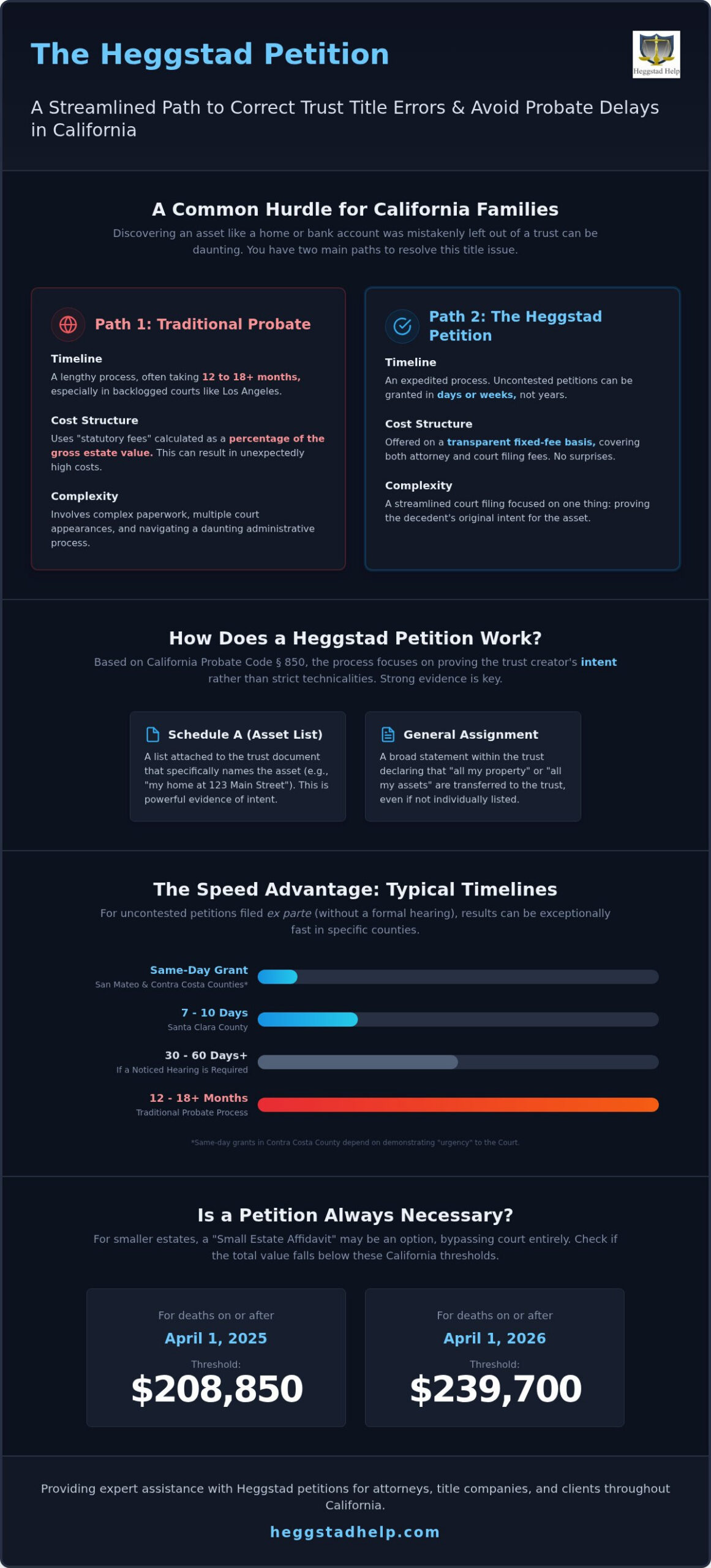
Choosing this path is primarily about saving time and protecting the estate’s value. While a full probate in Los Angeles can drag on for 12 to 18 months, an ex parte (i.e., no format hearing) expedited Heggstad petition can be resolved in as little as 7 to 10 days, if filed in a county like Santa Clara County through our office at Heggstad Help. If the estate is small, you might consider a Small Estate Affidavit instead. However, the thresholds are strict: $208,850 for those dying on or after April 1, 2025, and $239,700 for those dying on or after April 1, 2026. For real estate, which usually exceeds these amounts, a petition is the standard solution.
Cost transparency is another major factor. Traditional probate fees are "statutory," meaning they are calculated as a percentage of the gross value of the estate. This can lead to massive bills for a single house. We provide Heggstad petition filing with fixed fees that cover both the filing and attorney fees, ensuring you know exactly what the process costs from the start. While Los Angeles County has its own pace, our expertise in other counties allows for even faster results. For example, we often see petitions granted in 7 to 10 days in Santa Clara County, or even the same day in San Mateo and Contra Costa Counties when we can demonstrate urgency to the court.
Navigating the Los Angeles County Probate Court System (Stanley Mosk)
Filing legal documents in a county with over 10 million residents requires an exacting focus on local procedure. When you submit a **Heggstad petition **in Los Angeles County, you aren’t just navigating state law; you’re entering a system that handled 12,051 estate and trust filings in the 2024-2025 fiscal year alone. This volume is larger than the probate caseloads of Orange, Riverside, San Bernardino, and San Diego counties combined. Because of this massive scale, the court system is divided into districts, but almost all trust-related petitions are funneled into the Central District.
Determining the correct venue is your first hurdle. Generally, you must file in the county where the successor trustee of the decedent’s trust is located, even if that is not Los Angeles County. If a successor trustee is from outside of California, in any county where the decedent owned real property is a proper county for venue for a Heggstad petition for. Getting this right is vital because an incorrectly filed petition will be transferred or dismissed, costing you months of time and unnecessary filing fees.
The Role of the Stanley Mosk Courthouse
The Stanley Mosk Courthouse, located at 111 N. Hill St., Los Angeles, CA 90012, serves as the hub for probate matters in the county. Its probate departments are some of the busiest in the world. Judges here manage hundreds of cases simultaneously, which means they have very little patience for incomplete filings. Precision isn’t just a preference; it’s a requirement for a successful outcome in this high-volume environment.
One specific requirement often overlooked by those filing without specialized help is the mandatory local form PRO-010. This is the Probate Case Cover Sheet and Certificate of Grounds for Assignment. It functions as a roadmap for the court clerk, confirming exactly why the case belongs in the Central District rather than a regional branch. If you’re managing this process, remember that all filings in 2026 must be submitted electronically through an approved e-filing service provider. Mistakes on these digital forms can lead to immediate rejections by the clerk’s office.
Avoiding Procedural Delays in LA County
In the Los Angeles system, the "probate note" is either your best friend or your worst enemy. These are notes written by court staff who review your petition several days before your hearing. They highlight missing information or legal flaws that the judge will want you to address. If you don’t check these notes and fix the issues before you appear, the judge will likely "continue" (postpone) your hearing by another 60 to 90 days.
You can view these notes online through the court’s portal, and you should also check for tentative rulings. For those who can’t make it to downtown LA, the court allows remote appearances via LACourtConnect, which doesn’t require a reservation. While the process is rigorous, our team specializes in managing these ex parte court order services to ensure your paperwork is perfect the first time, helping you bypass the common delays that plague unrepresented filers.
Eligibility and Evidence: Does Your LA Property Qualify?
Determining whether your missing asset qualifies for a simplified transfer depends almost entirely on the "paper trail" left behind by the decedent. To succeed with a Heggstad petition Los Angeles filing, you must provide the court with clear, written evidence that the property was intended to be part of the trust. The most common piece of evidence is the "Schedule A," which is the list of assets typically attached to the back of a trust document. If the property address or account number is clearly written on this list, your chances of a successful petition are high. You can review the full Heggstad petition requirements California to see how these evidence standards apply across the state.
Beyond the asset list, judges also look for a "General Assignment" (a legal document stating that all of the person’s assets are transferred to their trust). Even if a specific house isn’t named, a well-drafted General Assignment can act as a safety net. Another helpful tool is a "Pour-Over Will" (a specific type of will that directs any assets left outside of a trust to be "poured" into it upon death). While a Pour-Over Will usually triggers a full probate, it serves as powerful secondary evidence of intent when used in a Heggstad filing.
Real estate presents unique challenges, particularly when a deed was signed but never recorded with the Los Angeles County Registrar-Recorder. If you find an unrecorded deed in a file cabinet or safe deposit box, it serves as nearly indisputable evidence of intent. The court can use your petition to "validate" that deed, effectively backdating the transfer to the trust. This is a common fix for families who realized too late that a title company or attorney missed a filing step years ago.
Common Evidence Used in LA Probate Courts
Success at the Stanley Mosk Courthouse often comes down to the details. Judges look for specific trust language, such as a clause where the creator says, "I hereby transfer my residence at 123 LA Street to my trust." They may also look for estate planning notes, letters to financial advisors, or even emails that discuss moving an account into the trust.
When a Heggstad Petition Might Not Work
This process isn’t a "cure-all" for every missing asset. If there’s absolutely no written mention of the asset in the trust documents or supporting papers, the court cannot guess at the decedent’s intent. Additionally, if other heirs or beneficiaries contest the petition, the case moves from an uncontested matter to trust litigation. At Heggstad Help, we specialize in uncontested ex parte filings, we always provide transparent, fixed fees that cover both filing and attorney fees so you know the cost upfront. If your case is straightforward, we can often secure orders in 7 to 10 days in Santa Clara County, or even the same day in San Mateo and Contra Costa Counties, depending on the court’s schedule.
If you’re unsure if your evidence is strong enough, we can review your documents to see if you qualify for our specialized petition services.
Why a Specialist Matters for Your Heggstad Petition Filing
When filing a **Heggstad petition, **working with a Board-Certified Specialist in Estate Planning, Trust and Probate Law provides a distinct advantage. Judges and court staff recognize this certification as a mark of high expertise, which can lead to a smoother review process. Attorney Robert P. Bergman has specialized in estate planning, including asset recovery and title correction since 1980, bringing over 40 years of specialized experience to every case. This deep familiarity with the system helps prevent the "probate notes" (court corrections) that often sideline unrepresented families for months. Working with a specialized Heggstad petition lawyer rather than a general probate attorney can make the critical difference between a swift resolution and months of unnecessary delays.
The "Ex Parte" Advantage
One of the primary ways we help families avoid the 12 to 18 month probate wait is through ex parte (expedited court hearing) services. An ex parte filing allows us to bypass the standard 60 to 90 day notice period in specific circumstances. For instance, we typically see petitions granted in 7 to 10 days in Santa Clara County. In San Mateo and Contra Costa Counties, we can often have a petition filed and granted on the same day if we can prove the necessary urgency to the court.
Correcting the Title After the Order
The process doesn’t end when the judge signs the order. To truly fix the problem, the court order must be recorded with the County Recorder in the county where the property is located. This title correction ensures that the property is legally held in the name of the trust, allowing the trustee to sell or distribute it as intended.
We believe in complete transparency regarding costs. All of our Heggstad petitions are handled with fixed fees that cover both the filing fees and the attorney fees. This approach eliminates the stress of unpredictable billing and ensures you know the total investment required to recover your family’s assets. Whether the estate is just above the 2026 small estate threshold of $239,700 (or $208,850 for deaths after April 1, 2025) or involves high-value real estate, our goal is a logical, efficient resolution. For Southern California families dealing with unfunded trusts in Los Angeles, understanding your options early can make a significant difference in both time and cost.
Contact Robert P. Bergman for a consultation on your Heggstad petition
Take the First Step Toward Asset Recovery
Recovering a home or account left out of a trust doesn’t have to be an endless battle with the legal system. By choosing a **Heggstad petition, **you can often avoid the high statutory fees and the 18-month wait time often found at the Stanley Mosk Courthouse. Whether you’re dealing with an unrecorded deed or a missing brokerage account, the right evidence can secure a court order that corrects the title and honors your loved one’s true intent.
Robert P. Bergman is a California Board-Certified Specialist with over 40 years of probate experience and an exclusive focus on asset recovery. This specialized knowledge allows for a logical path through complex procedural hurdles, often utilizing ex parte filings to expedite your resolution. We provide complete transparency with fixed fees that cover everything from filing to attorney costs, ensuring you can move forward with confidence. Get Expert Help with Your Heggstad Petition today. You have the tools to protect your family’s legacy, and we’re here to guide you every step of the way.
Frequently Asked Questions
How long does a Heggstad petition take in Los Angeles County?
An uncontested petition in Los Angeles usually takes 2 to 4 months from the initial filing to the final court order. This is significantly faster than the 12 to 24 months required for a full probate administration at the Stanley Mosk Courthouse. Regardless, we can avoid even the 2-to-4 month delay by filing in Santa Clara County, with results in as little as 7 to 10 days.
Where is the Los Angeles probate court located?
All probate matters are filed at the Stanley Mosk Courthouse. The address is 111 N. Hill Street, Los Angeles, CA 90012. Most trust-related petitions are heard within the Central District’s specialized probate departments. Because this is one of the busiest courts in the world, ensure your paperwork is submitted electronically through an approved e-filing service provider to avoid immediate rejection by the clerk’s office.
Can I file a Heggstad petition without a lawyer in LA?
While you can legally file on your own, the high volume of cases in Los Angeles means the court has very little tolerance for procedural errors. Small mistakes on local forms like the PRO-010 can trigger probate notes (written corrections from court staff) that delay your hearing by several months.
What happens if the house was never deeded to the trust?
If a house was never deeded to the trust, the court can issue an order transferring the title if you can prove the decedent intended for the property to be a trust asset. The court looks for written evidence, such as the property being listed on a Schedule A (the list of assets attached to the trust). If the total value of assets outside the trust is below the small estate threshold, which is $239,700 for deaths on or after April 1, 2026, or $208,850 for deaths after April 1, 2025, you might have other options, but real estate almost always requires a court order.

Article by
Robert P. Bergman, Attorney at Law
Attorney Robert P. Bergman ("Bob Bergman") has been a Board-Certified Specialist in Estate Planning, Trust and Probate Law since 2011, as certified by the California State Bar Board of Legal Specialization. For several years, Bob has assisted families and the clients of other attorneys with obtaining court orders through Heggstad petitions to avoid the time and expense of Probate administration. Bob is friendly, very approachable, and believes in explaining complex legal topics in clear ordinary language so that his clients understand exactly what they're doing and why they're doing it.
Bob is often able to assist clients who are in other counties than his home county of Santa Clara through his approach to Heggstad petitions.
Disclaimer
This article is for informational purposes only. Nothing in this article is intended to replace legal advice from a competent attorney or be considered legal guidance for anybody's specific legal situation. Nobody should rely on information in this article in making legal decisions without such consultation.


