
The fastest way to transfer your late spouse’s home might actually be the wrong choice if you want to protect the long-term integrity of your estate plan. When you discover that a major asset was left out of a trust, the natural reaction is to find the quickest exit from the legal system. If you’re currently facing the stress of a potential 12 to 18-month probate delay, you aren’t alone in feeling overwhelmed by the complexity of California’s probate code.
By filing a Heggstad petition for surviving spouse California (a legal request to include assets in a trust that were intended to be there), you can often avoid the exhaustive formal probate process entirely. This guide will show you how to choose the right shortcut to recover missing assets in as little as two to six months. We’ll compare the Heggstad Petition against the Spousal Property Petition; ensuring you select the path that clears your title while strictly following your spouse’s original trust instructions.
Key Takeaways
- Discover how to bypass the standard 12 to 18-month probate process by choosing the most efficient legal shortcut for your specific situation.
- Understand why a Heggstad petition for surviving spouse California is often the superior choice for maintaining the creditor protections and long-term goals established in your spouse’s trust.
- Learn to identify the “clear and convincing evidence” (the high legal standard of proof) required by courts to prove that an asset was intended to be trust property.
- Use a step-by-step framework to decide between transferring property directly to yourself or recovering it into the trust for the benefit of future heirs.
Navigating California’s Probate Shortcuts: Heggstad and Spousal Petitions
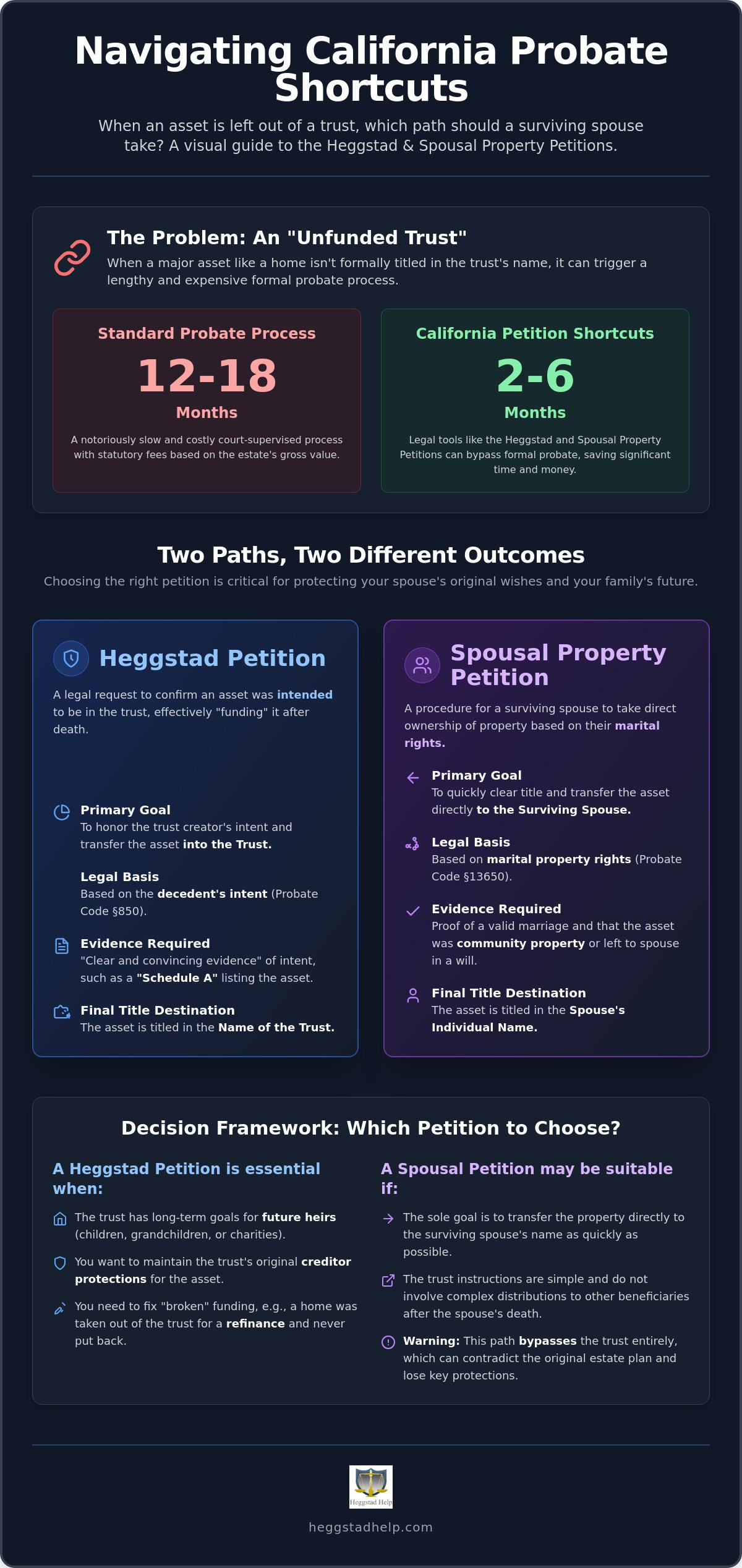
When a loved one passes away, families often discover that a primary residence or a brokerage account was never formally transferred into their living trust. This creates what professionals call an “unfunded trust” (a trust document that exists but doesn’t technically own the assets it was meant to protect). In 2026, failing to address this title error before a death typically forces the estate into a full probate administration. This traditional path is notorious for 12 to 18-month court delays and statutory fees (legal costs set by state law) that can consume a significant portion of the estate’s gross value.
Fortunately, California law provides specific “shortcuts” to avoid these hurdles. The two most common tools are the Spousal Property Petition and the Heggstad petition for surviving spouse California. While both aim to bypass a long probate, they serve different masters. One focuses on marital rights, while the other focuses on the specific instructions left behind in a trust. Choosing the wrong one could inadvertently lead to higher taxes or the loss of trust-based protections for your heirs.
What is a Heggstad Petition (PC 850)?
A Heggstad Petition, filed under California Probate Code Section 850, is a legal request asking the court to confirm that an asset belongs in a trust despite a missing deed or title transfer. This procedure stems from the landmark case Estate of Heggstad, which established that a written declaration of trust is often sufficient evidence of intent. If you can show the court that your spouse intended the asset to be trust property, perhaps by pointing to a “Schedule A” (the list of assets typically attached to the back of a trust), you can recover that asset into the trust’s name without a year-long wait.
What is a Spousal Property Petition (PC 13650)?
The Spousal Property Petition, initiated via Judicial Council Form DE-221, is a separate procedure under Probate Code Section 13650. It’s designed specifically for assets passing to a surviving spouse or registered domestic partner. Unlike a Heggstad petition for surviving spouse California, this method doesn’t “fix” a trust. Instead, it moves the property directly into the surviving spouse’s individual name. While it’s often the fastest route to clear title, it bypasses the trust’s instructions entirely, which may not be the ideal outcome for long-term estate planning or protecting assets from future creditors.
Heggstad vs. Spousal Petition: Key Differences in Eligibility and Evidence
The choice between these two petitions isn’t just about speed; it’s about the legal foundation of the claim. A Heggstad petition is rooted in the decedent’s intent (the specific wishes of the person who created the trust). In contrast, the Spousal Property Petition is rooted in marital property rights. This distinction dictates exactly what you must prove to a judge to gain control of the asset.
To succeed with a Heggstad petition for surviving spouse California, you must provide “clear and convincing evidence” (a high legal standard of proof) that the decedent intended the asset to be part of the trust. This usually requires showing the court a “Schedule A” (the list of assets attached to the trust) or a general assignment of all property. A Spousal Property Petition has a different hurdle; it requires evidence of a valid marriage and proof that the asset was community property or specifically bequeathed to the spouse in a will. This Guide to 850 Petitions provides additional context on these evidentiary standards.
The final destination of the title also differs significantly. A Heggstad order transfers the asset into the name of the Trust, whereas a Spousal Property Petition transfers it into the spouse’s individual name. If you’re unsure which path fits your goals, consulting with a specialist can help clarify the most advantageous route for your family.
When a Heggstad Petition is the Mandatory Choice
There are specific scenarios where a Spousal Property Petition simply won’t work. If the trust dictates that an asset should eventually pass to children, grandchildren, or a charity after the surviving spouse passes, you must use a Heggstad petition to ensure the asset reaches the trust. It’s also the essential tool for fixing “broken” funding. This often happens when a homeowner refinances a mortgage and the lender requires them to move the property out of the trust name, but the owner forgets to move it back. For a deeper look at this process, see our Petition to Transfer Real Property to Trust: The California Heggstad Guide.
The Limitations of the Spousal Property Petition
While the Spousal Property Petition is a valuable shortcut, it has rigid boundaries. It cannot be used to fund a bypass trust (a trust designed to minimize estate taxes) or a credit shelter trust. By moving property directly to the spouse individually, you risk losing the tax-saving protections and the specific distribution controls the decedent worked hard to establish. If the goal is to preserve the decedent’s specific legacy and protect the asset from future creditors, the Heggstad route is usually the necessary path.
Decision Framework: Which Petition Should a Successor Trustee Choose?
Choosing between these options requires a methodical evaluation of the decedent’s ultimate goals. A successor trustee’s primary duty is to ensure the estate plan functions as intended. If you’re managing a Heggstad petition for surviving spouse California, your first step is identifying the final beneficiary. If the asset needs to stay within a trust to provide for children from a prior marriage or to utilize specific tax shelters, the Spousal Property Petition is likely a strategic error. It bypasses the trust entirely, moving title directly into the spouse’s individual name.
Reviewing the trust’s “Schedule A” or a general assignment of assets is the next critical phase. These documents provide the foundational evidence required under California Probate Code § 850. Tax considerations also play a role. Transferring separate property directly to a spouse via a petition might forfeit certain trust-based tax advantages, such as a full step-up in basis, that a Heggstad filing would preserve by keeping the asset within the trust structure.
Can You File Both Petitions Simultaneously?
In complex cases where title is murky or beneficiaries are likely to disagree, you might file both petitions simultaneously. This “belt and suspenders” approach can be effective in contested estates where the path of least resistance varies by county. A specialized attorney evaluates which petition offers the highest probability of success based on local court tendencies, ensuring you don’t waste months on a filing the judge might reject.
The Speed Factor: Ex Parte Court Orders
Speed is often the deciding factor for families. While a standard petition takes several months to clear the court calendar, an ex parte (expedited) court order can significantly shorten the timeline. This is particularly vital for a successor trustee unfunded trust assets California who needs to sell a property or manage a fluctuating brokerage account immediately. If you need to clear title without waiting for a standard court date, filing an ex parte petition is the most direct solution to your procedural hurdle.
Why Funding the Trust via Heggstad Often Wins Long-Term
Choosing a Heggstad petition for surviving spouse California often provides a more robust legal foundation than a simple transfer to an individual name. While it’s tempting to take the path of least resistance, keeping an asset within the trust structure preserves the decedent’s specific wishes and maintains the integrity of the long-term estate plan. Trust-held assets generally offer superior creditor protection compared to property held individually. If a surviving spouse faces a lawsuit or financial complication, assets nestled inside a properly drafted trust are often shielded from those external pressures in ways that personally owned property is not.
A fully funded trust also simplifies the eventual transfer to the next generation. When the second spouse passes away, assets already titled in the trust’s name can be distributed to heirs immediately, bypassing the court system entirely. Navigating these nuances requires a steady hand and a deep understanding of probate law. A Board-Certified Specialist is essential for a successful Heggstad petition filing, as they understand the specific local court requirements that can make or break a title correction case.
Avoiding the ‘Accidental’ Probate of the Second Spouse
One of the most significant risks of the Spousal Property Petition is the “accidental” probate. When an asset is transferred directly to a surviving spouse, it is no longer governed by a trust. If that spouse fails to update their own estate plan or move the asset into their own trust, the property will inevitably face a full probate administration when they pass away. This creates a secondary, avoidable legal hurdle for the children or heirs. By using a Heggstad petition for surviving spouse California now, you ensure the asset is correctly titled once and for all, preventing future legal headaches for your family.
Next Steps for Surviving Spouses
The path forward begins with a thorough review of your current legal documents. You should gather your original trust agreement, any amendments, and the current deeds for any real property in question. Robert P. Bergman, who has been practicing since 1980, provides the specialized knowledge necessary to evaluate these documents and determine the most efficient path forward. Requesting a consultation allows for a personalized assessment of your assets, ensuring your spouse’s legacy is preserved exactly as they intended. Taking action now prevents the complications of an unfunded trust from becoming a burden for the next generation.
Securing Your Family Legacy Through Informed Title Correction
Choosing the correct legal path to recover missing assets requires balancing immediate needs with long-term protection. While the Spousal Property Petition offers a simplified route for some, the Heggstad petition for surviving spouse California remains the gold standard for maintaining the specific instructions and tax-saving structures of a living trust. Correcting title errors (the process of aligning legal ownership with trust instructions) now prevents the “accidental probate” that often occurs when assets are left in an individual’s name rather than being properly funded into the trust.
Robert P. Bergman is a Board-Certified Specialist in Estate Planning, Trust and Probate Law who has been practicing in California since 1980. With his exclusive focus on Heggstad and Trust Title Correction, he provides the calm competence necessary to navigate complex court requirements. You don’t have to face the court’s backlogs alone when a seasoned expert can guide you toward a faster resolution. Schedule a consultation with a Board-Certified Specialist to fix your unfunded trust today.
You have the power to resolve these title complications and ensure your spouse’s estate plan functions exactly as they intended. Taking action today provides the clarity and peace of mind your family deserves.
Frequently Asked Questions
Is a Heggstad Petition faster than a Spousal Property Petition in California?
Generally, a Spousal Property Petition is resolved in two to four months, while a standard Heggstad petition typically takes two to six months. However, the Heggstad petition for surviving spouse California can be accelerated using an ex parte (expedited) application if there is an urgent need to manage the asset. The right choice depends on whether you need the asset to remain in the trust for tax planning or if immediate title transfer is the priority.
Can I use a Spousal Property Petition if the house was the decedent’s separate property?
Yes, you can use a Spousal Property Petition for separate property (property owned before marriage or inherited individually) if the decedent’s will specifically leaves that asset to you. If there’s no will, the asset may still pass to you through intestate succession (state laws governing who inherits when there is no will). You must provide clear evidence to the court that you are the legal successor to that specific separate property.
Does a Heggstad Petition require a court hearing?
Yes, a standard Heggstad Petition requires a formal court hearing where a judge reviews the evidence of the decedent’s intent to include the asset in the trust. The court requires that all interested parties receive legal notice of this hearing. If the situation is urgent, a specialist may file an ex parte petition to obtain a court order more quickly, which can potentially bypass the standard multi-month wait for a scheduled hearing date.
What happens if I choose the wrong petition for my California probate case?
Choosing the wrong procedure can lead to significant delays and the loss of trust-based protections. If you use a Spousal Property Petition for an asset that was intended to stay in a trust, you may accidentally trigger a future probate for your own heirs or lose vital creditor protections. A judge might also deny the petition, forcing you to pay a second $435 filing fee to start the correct process from scratch.
How much does a Heggstad Petition cost compared to a Spousal Property Petition?
Both petitions are significantly more affordable than full probate because they don’t use statutory fees (fixed percentages of the gross estate value). In 2026, the standard filing fee for both a Spousal Property Petition and a Heggstad petition for surviving spouse California is $435. Attorney fees for these shortcuts are typically billed at an hourly or flat rate, which is usually much lower than the thousands of dollars required for a full probate administration.

Article by
Robert P. Bergman, Attorney at Law
Attorney Robert P. Bergman ("Bob Bergman") has been a Board-Certified Specialist in Estate Planning, Trust and Probate Law since 2011, as certified by the California State Bar Board of Legal Specialization. For several years, Bob has assisted families and the clients of other attorneys with obtaining court orders through Heggstad petitions to avoid the time and expense of Probate administration. Bob is friendly, very approachable, and believes in explaining complex legal topics in clear ordinary language so that his clients understand exactly what they're doing and why they're doing it.
Bob is often able to assist clients who are in other counties than his home county of Santa Clara through his approach to Heggstad petitions.
Disclaimer
This article is for informational purposes only. Nothing in this article is intended to replace legal advice from a competent attorney. Nobody should rely on information in this article in making legal decisions without such consultation.


