
Imagine discovering that your parents’ most valuable asset, their family home, was never actually titled in their trust. It’s a common oversight that often leads to the realization that a full probate process, which is the court-supervised procedure for distributing a deceased person’s estate, could cost your family tens of thousands in statutory fees and over a year of delays. It is incredibly frustrating to feel like a simple paperwork error might drain the inheritance your loved ones worked so hard to build. However, understanding exactly when to use a Heggstad petition can provide a specialized legal shortcut to bypass these administrative hurdles entirely.
You likely feel the weight of your responsibility as a successor trustee (the person designated to manage trust assets after the original trustee passes away) and want to fulfill your duties without getting bogged down in California’s complex court system. This 2026 strategic guide will show you how to rescue an inheritance from the delays and costs of full probate administration. We’ll examine the specific legal scenarios where “clear and convincing evidence” of a decedent’s intent can be used to transfer title to the trust quickly, often saving ten to twelve months of time. By the end of this article, you’ll know how to leverage Probate Code Section 850 to protect your family’s legacy and save thousands in unnecessary expenses.
Key Takeaways
- Identify the specific legal triggers for when to use a Heggstad petition to confirm that real estate or financial accounts belong in a trust despite technical title errors.
- Understand how California Probate Code Section 850 acts as a specialized alternative to full probate, significantly reducing the administrative burden on successor trustees.
- Determine if your documentation, such as a formal Schedule of Assets or a general assignment, meets the “Written Intent” requirement necessary for a successful court order.
- Evaluate the strategic advantages of the Heggstad process, including enhanced privacy for the estate and a faster path to title correction compared to traditional, public court proceedings.
Understanding the Heggstad Petition as a Probate Alternative
A Heggstad petition is a specialized legal request filed under California Probate Code Section 850. Its primary purpose is to ask the court to confirm that a specific asset, such as a family home or a brokerage account, belongs to a trust even if the formal title was never updated before the owner passed away. This procedure acts as a vital safety valve for families who discover that a loved one’s estate plan was left incomplete. Knowing when to use a Heggstad petition is essential because it allows the California Superior Court to prioritize the clear, written intentions of the trustor (the person who created the trust) over technical errors in a deed or title document.
In these proceedings, the petitioner, who is usually the successor trustee, presents evidence to the court showing that the deceased person intended for the asset to be trust property. If the court is satisfied with the “clear and convincing evidence” provided, it issues a court order that transfers the title into the trust. This effectively funds the trust retroactively, allowing the trustee to manage or sell the asset without the oversight of a probate judge.
The Legal Origin: Estate of Heggstad (1993)
The authority for this process comes from a landmark California appellate case known as the Estate of Heggstad. In 1993, the court ruled that a written declaration of trust, which specifically listed a property on an attached schedule, was sufficient to transfer that property into the trust even without a recorded deed. This ruling changed the legal landscape for successor trustee unfunded trust assets California cases. It established that the decedent’s intent, when documented in writing, is the most critical factor in determining trust ownership.
Heggstad Petition vs. Full Probate
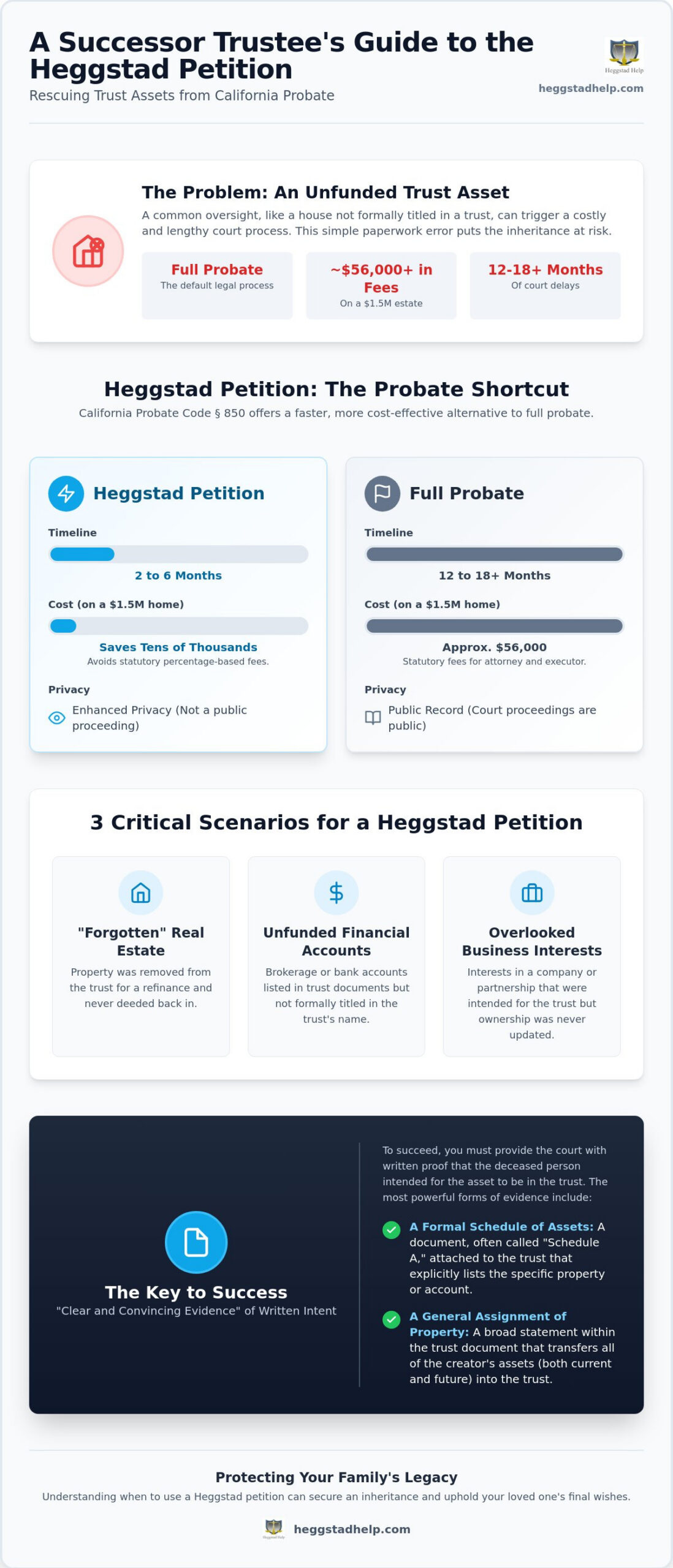
Choosing a Heggstad petition over full probate administration offers significant advantages in both speed and cost. While a full probate often lasts 12 to 18 months, a Heggstad petition is typically resolved within two to six months. This efficiency is particularly valuable for families who need to sell real estate or access funds quickly to pay for estate expenses.
The financial impact is equally substantial. Probate involves statutory fees (legal fees set by California law based on the gross value of the estate). For a $1.5 million home, these mandatory fees can reach approximately $56,000 when accounting for both the attorney and the executor. A Heggstad petition avoids these rigid percentages, which can save a family tens of thousands of dollars in administrative costs. Understanding when to use a Heggstad petition is the first step toward protecting the value of an inheritance from the high costs of traditional court oversight.
Three Critical Scenarios: When to File a Heggstad Petition
Identifying when to use a Heggstad petition often starts with a review of the decedent’s most valuable holdings. While many people assume this process is only for those who have already passed away, it actually serves as a versatile tool for resolving title defects in several distinct circumstances. These scenarios typically involve assets that were clearly intended for the trust but remain legally tethered to the individual’s name due to administrative oversight or timing issues.
The “Forgotten” Real Estate Problem
Real property is the most frequent trigger for a petition because its value almost always exceeds the California small estate threshold. A common scenario involves a homeowner who refinances their mortgage. During the refinancing process, lenders often require the property to be “pulled out” of the trust and placed back into the individual’s name to secure the loan. If the owner forgets to deed the property back into the trust after the loan closes, the asset remains stuck in their individual name at the time of death. In these cases, the court looks at the original trust documents to confirm the property was intended to be trust-owned.
Beyond Real Property: Personal Assets and Accounts
The scope of this legal tool extends far beyond physical land. It’s equally effective for transferring brokerage accounts, bank accounts, or business interests that lack a “transfer on death” (TOD) or “payable on death” (POD) designation. If an asset is listed on a “Schedule A” (the document attached to the trust listing intended assets) but was never formally retitled, a Heggstad petition filing can recover that missing property. This is a crucial step for successor trustees who find themselves managing a partially funded trust.
A highly strategic but less discussed application involves pre-death title correction. If a trustor is still alive but has become mentally incapacitated, a successor trustee can use an ex parte court order to fix title errors. This proactive approach ensures the trust is properly funded before a death occurs, preventing future probate entirely. Similarly, the petition can resolve “incomplete transfers” where a deed was signed but the trustor passed away before it could be recorded with the county. If you find yourself in one of these time-sensitive situations, exploring ex parte court order services may be the most efficient path forward.
Eligibility and Evidence: Can You Use Probate Code 850?
Determining when to use a Heggstad petition requires a careful evaluation of the evidence available to prove the decedent’s intent. Under California Probate Code Section 850, the court doesn’t simply take your word for it; you must provide “clear and convincing evidence” that the asset was meant to be trust property. This legal standard is higher than a typical civil case, making the quality of your documentation the deciding factor in a successful filing.
Before proceeding, it’s vital to compare the asset’s value against the 2026 California small estate thresholds. For estates where personal property, excluding real estate, is valued under $208,850, a Small Estate Affidavit might be a simpler alternative. However, because most California real property exceeds these limits, a Heggstad petition remains the primary tool for houses and land. Additionally, a “Pour-Over Will” (a specific type of will that directs any remaining assets into a trust) serves as powerful secondary evidence, reinforcing the trustor’s global intent to avoid probate.
Essential Evidence for a Successful Filing
A Board-Certified Specialist evaluates your case by looking for specific “links” between the asset and the trust. Strong evidence typically includes:
- The original Trust Agreement and any amendments.
- A formal “Schedule A” or “Schedule of Assets” listing the property.
- A General Assignment of Assets, which acts as a “catch-all” transfer document.
- Unrecorded deeds or relevant correspondence with financial institutions.
If your evidence seems “weak,” such as a vague mention in a letter, a specialist can help determine if supplementary metadata or digital drafts can bridge the gap. If you aren’t sure if your documents qualify, you can request a review of your trust asset title correction options to see if a petition is viable.
The Role of the Successor Trustee
As a successor trustee, you have a fiduciary duty (a legal obligation to act in the best interest of beneficiaries) to recover any assets that belong in the trust. Waiting too long to file can complicate the process, as “interested parties,” such as heirs who might inherit through a traditional probate, must be notified of your petition. These parties have the right to object, so moving quickly while evidence is fresh and witnesses are available is a strategic necessity. Prompt action helps fulfill your duties and ensures the inheritance is distributed according to your loved one’s actual wishes.
Strategic Advantages of the Heggstad Process over Full Probate
Choosing when to use a Heggstad petition is often a decision driven by a desire for efficiency and privacy. Unlike a full probate administration, which requires multiple court hearings and a public inventory of all estate assets, the Heggstad process is a targeted legal action. It focuses solely on confirming the trust’s ownership of specific property. This surgical approach results in a drastic reduction in court appearances, sparing the family from the emotional and administrative burden of a year-long legal proceeding.
Privacy remains a significant advantage for many California families. Because full probate is a public record, any curious party can view the details of an inheritance and the value of the estate. In contrast, Heggstad orders are more discreet, providing a faster path to a clear title (a title free from any legal claims or doubts) without exposing the entire estate to public scrutiny. This allows the successor trustee to resolve “clouded” title issues quickly, ensuring the property can be sold or distributed to beneficiaries according to the trustor’s original timeline.
The financial benefits are equally compelling. Probate fees in California are statutory (set by law) and calculated based on the gross value of the estate assets. By successfully using a Heggstad petition, the estate avoids these rigid percentage-based fees, preserving a larger portion of the inheritance for the intended heirs. It’s a logical path forward for those who value both speed and fiscal responsibility.
Why a Specialized Heggstad Attorney Matters
Generalist probate lawyers often default to the traditional probate process because they lack the specialized experience required for complex title corrections. Robert P. Bergman, a Board-Certified Specialist in Estate Planning, Trust and Probate Law, focuses exclusively on Heggstad filings and ex parte court order services. This high level of specialization ensures that petitions are drafted with the precision necessary to meet the “clear and convincing” evidence standard on the first attempt, avoiding the common pitfalls that can lead to court delays.
Taking the First Step: The Consultation
Successor trustees should act promptly to prevent assets from becoming locked in legal limbo, which can happen if creditors or other heirs file competing claims. For an initial review, you should gather the trust agreement, any amendments, and the specific title documents for the asset in question. Taking this first step ensures you fulfill your fiduciary duties while securing the most efficient path toward when to use a Heggstad petition for your family’s benefit.
Securing Your Trust’s Legacy with Precision
Navigating the aftermath of a loved one’s passing is difficult enough without the added stress of discovering an unfunded trust. As we’ve explored, the Heggstad process serves as a powerful remedy for technical title defects; it allows you to honor the decedent’s true wishes while avoiding the public and costly nature of full probate. Understanding exactly when to use a Heggstad petition ensures that a single clerical error doesn’t dismantle years of careful estate planning. By focusing on clear evidence of intent, you can protect the estate’s value and expedite the distribution of assets to beneficiaries.
Success as a successor trustee depends on acting with both speed and specialized knowledge. Robert P. Bergman is a Board-Certified Specialist in Estate Planning, Trust and Probate Law who has practiced since 1980, focusing exclusively on California Heggstad filings and title correction. This level of dedication means your case is handled with the calm competence required to navigate the Superior Court system efficiently. Don’t let your inheritance remain in legal limbo. You can Request a Specialized Heggstad Petition Review with Robert P. Bergman today to confirm your path forward. Taking this step brings the clarity and resolution your family deserves.
Frequently Asked Questions
Can I file a Heggstad petition if there is no Schedule of Assets?
Yes, you can still file even if a formal Schedule of Assets is missing. While a specific list is the most direct evidence of intent, California courts also accept a “General Assignment of Assets” or specific “catch-all” language within the trust document itself. Success depends on presenting other written proof, such as bank correspondence or digital drafts, that clearly shows the trustor’s plan to include the property in their trust.
How long does the Heggstad petition process take in California in 2026?
The Heggstad petition process typically takes between two and six months to reach a final resolution. This timeline is a major advantage for families, as it’s significantly faster than the 12 to 18 months required for a full probate administration. The exact duration often depends on the specific county’s court calendar and whether any interested parties, such as heirs or creditors, file an objection to the petition.
What happens if a Heggstad petition is denied by the court?
If the court denies your petition, the asset in question will generally have to go through the full probate process. This means the property will be subject to the standard, court-supervised procedure for distributing a deceased person’s estate. However, a denial is often preventable if the initial filing is prepared by a specialist who understands exactly when to use a Heggstad petition to meet the high “clear and convincing” evidence standard required by judges.
Is a Heggstad petition cheaper than a full probate case?
Yes, this process is almost always more cost-effective because it avoids the mandatory statutory fees associated with probate. In California, probate attorneys and executors are paid a legal percentage of the estate’s gross value, which can reach tens of thousands of dollars for a single family home. By using this specialized petition, you bypass those rigid, percentage-based costs and preserve a much larger portion of the inheritance for the beneficiaries.
Can I use a Heggstad petition for a bank account that has no beneficiary?
You can use a Heggstad petition for bank accounts, brokerage accounts, or business interests that lack a designated “transfer on death” beneficiary. The legal requirement remains the same: you must provide written evidence that the trustor intended for the account to be held within the trust. A general assignment of assets or a trust schedule that references the account is often sufficient for the court to grant a title transfer order.

Article by
Robert P. Bergman, Attorney at Law
Attorney Robert P. Bergman ("Bob Bergman") has been a Board-Certified Specialist in Estate Planning, Trust and Probate Law since 2011, as certified by the California State Bar Board of Legal Specialization. For several years, Bob has assisted families and the clients of other attorneys with obtaining court orders through Heggstad petitions to avoid the time and expense of Probate administration. Bob is friendly, very approachable, and believes in explaining complex legal topics in clear ordinary language so that his clients understand exactly what they're doing and why they're doing it.
Bob is often able to assist clients who are in other counties than his home county of Santa Clara through his approach to Heggstad petitions.
Disclaimer
This article is for informational purposes only. Nothing in this article is intended to replace legal advice from a competent attorney. Nobody should rely on information in this article in making legal decisions without such consultation.


