
Imagine discovering that your loved one’s home was never officially deeded into their trust, potentially triggering a multi-year court battle just as you begin to grieve. It’s a heart-wrenching realization for families searching for unfunded trust after death California solutions to avoid "probate" (the court-supervised process of distributing assets). You likely feel overwhelmed by the prospect of high legal fees and complex terminology, especially when assets exceed the $208,850 small estate threshold.
We understand that you want to honor your loved one’s wishes without the burden of a standard probate administration. You can actually bypass these delays by utilizing a Heggstad Petition under Probate Code Section 850 to transfer missing assets in as little as 7 to 10 days. This guide explains how this specialized petition corrects the title in California quickly, providing a clear path to resolution while keeping your family’s inheritance out of the public court system.
Key Takeaways
- Learn why identifying effective unfunded trust after death California solutions is critical for assets exceeding the $208,850 threshold to prevent unnecessary court delays.
- Understand how Probate Code Section 850 allows you to confirm trust ownership of real property by documenting the decedent’s clear intent to include those assets.
- Discover the procedural advantages of filing a Heggstad Petition to correct title issues without the high costs or public nature of full probate administration.
- See how filing ex parte in favorable jurisdictions can result in a court order being granted in as little as 7 to 10 days.
Understanding the Unfunded Trust after Death in California
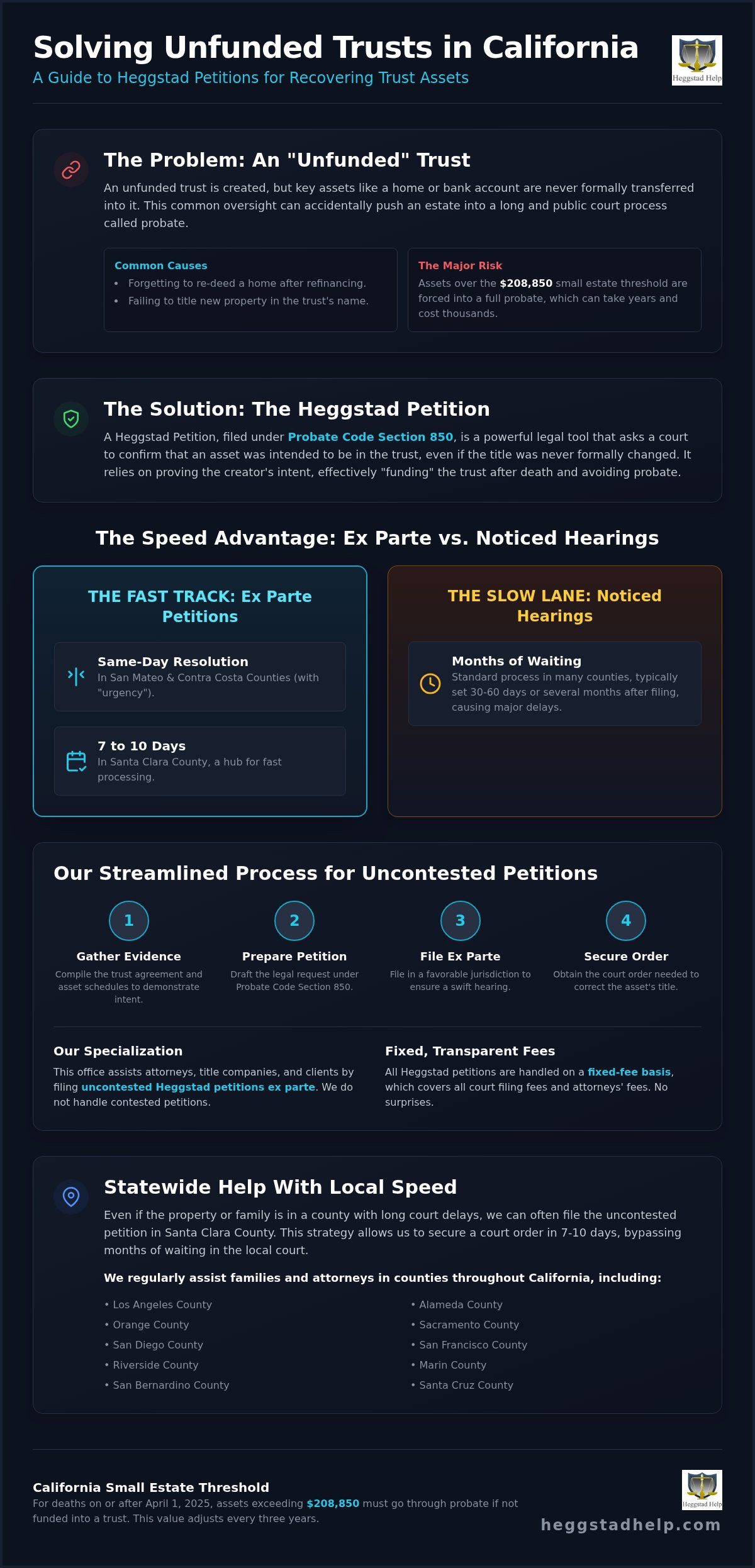
An unfunded trust occurs when a settlor creates the legal framework but fails to transfer title to specific assets. While understanding What is a Living Trust? is a vital first step, the trust only functions if it actually holds the property. If a house or account remains in the decedent’s individual name, it’s technically "outside" the trust structure. This oversight is a primary reason families seek unfunded trust after death California solutions. Without a swift remedy, any asset exceeding the current small estate threshold of $208,850 (for deaths on or after April 1, 2025) must pass through full probate. Identifying California trust funding mistakes early helps you avoid the public, costly court process that follows an incomplete estate plan.
Why Assets are Left Out of California Trusts
Assets often fall through the cracks during routine financial transactions. A common scenario involves refinancing a home; lenders frequently require owners to move the property out of the trust temporarily. If the owner doesn’t re-deed the home back into the trust after the loan closes, the property remains unfunded. Similarly, people often buy new real estate and forget to specify the trust on the deed. Legally, a trustee only controls assets where the title is explicitly held in their name as trustee. It’s a technicality with massive consequences. Navigating the successor trustee duties for an unfunded trust in California requires pinpointing these missing titles to determine if a petition under the relevant Probate Code Section is necessary to correct the error.
The Heggstad Petition in California: A Faster Solution than Probate
When you’re searching for unfunded trust after death California solutions, the most effective tool is often a petition filed under Probate Code Section 850. Commonly known as a Heggstad Petition, this legal request asks the court to confirm that an asset belongs in a trust despite a lack of formal title. This process relies on proving the decedent’s intent to include the property. You can find a detailed breakdown in this Guide on Heggstad Petition filing in California. While standard probate can take over a year, this specialized petition provides a streamlined alternative for families in Los Angeles County, Orange County, and San Diego County who face significant local court backlogs.
The primary advantage of this approach lies in the filing method. Most attorneys default to a noticed hearing (a formal proceeding that requires 30 days of notice and often months of waiting for an open calendar slot). However, we specialize in ex parte filings (emergency or "one-sided" applications that don’t require the same lengthy notice periods). As explained in this resource regarding , moving quickly is essential to protect estate assets. Securing these unfunded trust after death California solutions through an ex parte order ensures that property title is corrected before market conditions shift. If you’re dealing with a time-sensitive real estate closing, Heggstad Help can assist in securing these orders rapidly.
Ex Parte Petitions vs. Noticed Hearings: The Speed Advantage
Court efficiency varies significantly by jurisdiction. In Santa Clara County, for instance, ex parte petitions are typically granted in 7 to 10 days. Other regions offer even faster resolutions. In San Mateo County, the court often allows petitions to be filed, heard, and granted on the same day. Similarly, in Contra Costa County, the court may grant an order the same day if you can demonstrate sufficient "urgency" (a compelling legal or financial reason for immediate action, including the health of the trustor of the trust). These accelerated timelines allow you to fulfill the decedent’s wishes without the exhaustive delays of a traditional probate case.
How to File a Heggstad Petition in California for Your Trust
Gathering evidence is the first priority. You must compile the original trust agreement and any attached schedules of assets that demonstrate the decedent’s clear intent to include the property. While the California Courts guide to wills, estates, and probate provides general context, a Heggstad Petition requires specific documentation to satisfy a judge. This is especially critical when assets exceed the $208,850 small estate threshold, as failing to provide sufficient evidence triggers the full probate process. Once the evidence is ready, the next step involves filing the petition ex parte in a favorable jurisdiction like Santa Clara County. This procedural maneuver allows you to bypass standard hearing backlogs and often results in a granted order within 7 to 10 days.
The final step is recording the certified court order with the County Recorder to update the title of the real property. This act legally transfers the asset into the trust, allowing the successor trustee to manage or sell the property without further court intervention. For families seeking reliable unfunded trust after death California solutions, HEGGSTAD HELP offers fixed fees that cover both court filing costs and attorney fees for uncontested matters. We prioritize transparency, ensuring you know the total cost upfront while we handle the complex procedural requirements on your behalf.
Specialized Legal Help for Uncontested Petitions
Successful title correction depends on precision and speed. Our office exclusively focuses on uncontested petitions; we don’t handle contested trust litigation or disputes between beneficiaries. We frequently assist families, attorneys, and title companies in Riverside County, San Bernardino County, and Sacramento County who need to resolve title errors without the high cost of hourly billing. To ensure your paperwork meets strict court standards, you should consult a California estate planning specialist for Heggstad filings. Proper drafting the first time prevents additional delays and ensures the decedent’s true wishes are fulfilled quickly.
Securing Your Family’s Inheritance with Speed and Precision
An unfunded trust doesn’t have to lead to years of probate or exhaustive fees, even when assets exceed the $208, 850 small estate threshold. By proving intent and utilizing a Heggstad Petition, you can correct the title in California and avoid full probate. This path ensures real property is transferred according to your loved one’s wishes without the public delays of local courts. When seeking effective unfunded trust after death California solutions, working with a specialist ensures the process is handled correctly.
Robert P. Bergman is a Board-Certified Specialist in Estate Planning, Trust and Probate Law who resolves uncontested petitions in 7 to 10 days. We serve all California counties, providing a high-speed alternative for families statewide. Contact HEGGSTAD HELP for a Fixed-Fee Heggstad Petition Quote today. You don’t have to face these hurdles alone; we’re here to help you move forward with confidence.
Frequently Asked Questions
Can I move a house into a trust after death in California?
Yes, you can transfer a home into a trust after the owner has passed away by filing a Heggstad Petition under Probate Code Section 850. This legal procedure allows the court to confirm that the decedent intended the property to be trust property even if the deed was never finalized. It’s an essential option among unfunded trust after death California solutions to avoid a lengthy probate.
How long does a Heggstad Petition in California take?
The timeline for a Heggstad Petition varies significantly depending on the county and filing method used. While a standard noticed hearing (a formal court proceeding with mandatory notice periods) can take several months, an ex parte filing (an expedited request) is much faster. In Santa Clara County, for instance, these petitions are typically granted in as little as 7 to 10 days.
What is the cost of a Heggstad Petition in California?
Costs involve court filing fees and attorney fees. While many firms bill hourly, which can become unpredictable, HEGGSTAD HELP provides fixed fees for uncontested petitions. This arrangement covers both the mandatory court filing fees and all professional legal services. This transparent approach helps families manage expenses while seeking unfunded trust after death California solutions without the high costs of a full probate administration.
What happens if a deed was not recorded to a trust in California?
If a deed was not recorded, the asset remains in the decedent’s individual name rather than the trust’s name. If the value of this property exceeds the current $208,850 small estate threshold, it generally triggers a full probate case. However, you can use a petition under Probate Code Section 850 to correct the title and move the asset into the trust retroactively.

Article by
Robert P. Bergman, Attorney at Law
Attorney Robert P. Bergman ("Bob Bergman") has been a Board-Certified Specialist in Estate Planning, Trust and Probate Law since 2011, as certified by the California State Bar Board of Legal Specialization. For several years, Bob has assisted families and the clients of other attorneys with obtaining court orders through Heggstad petitions to avoid the time and expense of Probate administration. Bob is friendly, very approachable, and believes in explaining complex legal topics in clear ordinary language so that his clients understand exactly what they're doing and why they're doing it.
Bob is often able to assist clients who are in other counties than his home county of Santa Clara through his approach to Heggstad petitions.
Disclaimer
This article is for informational purposes only. Nothing in this article is intended to replace legal advice from a competent attorney or be considered legal guidance for anybody's specific legal situation. Nobody should rely on information in this article in making legal decisions without such consultation.


