
You’ve just discovered an unrecorded deed or a "forgotten" asset that was never officially transferred into the trust. The realization that this single oversight could trigger a 12-month probate delay in the State of California, specifically in Los Angeles County, Orange County, or San Diego County, is enough to cause any Successor Trustee significant anxiety. It’s frustrating to feel stuck when you’re so close to finishing, but a common Heggstad petition (a legal request to include assets in a trust after death) mistake is assuming that a full probate is your only option. We understand the confusion surrounding Probate Code Section 850 requirements and the pressure to resolve these title errors quickly.
This guide will help you identify common Heggstad petition mistakes to avoid unnecessary delays. While noticed hearings in California often take months, we assist families and attorneys by filing uncontested petitions ex parte in Santa Clara County, San Mateo County, and Contra Costa County. This approach typically secures a court order in 7 to 10 days in Santa Clara County, while San Mateo County petitions can be granted the same day. Using fixed fees, you can bypass the traditional probate timeline and resolve title issues for properties in Sacramento County, Marin County, or Santa Cruz County.
Key Takeaways
- Identify trust title errors where property was never formally deeded into the trust and use Probate Code Section 850 to confirm these assets post-death.
- Avoid common Heggstad petition mistakes by gathering clear evidence of intent, such as trust schedules and general assignments, before filing your petition.
- Navigate around the multi-month “noticed hearing” delays found in San Diego County or San Bernardino County by leveraging ex parte filing venues in Northern California.
- Resolve title issues for a fixed fee that includes both filing and attorneys’ fees, preventing costly delays in property sales or tax filings in California.
Identifying Common Trust Title Errors in California
A trust title error is a discrepancy where the legal title to a property remains in the decedent’s individual name, despite their clear intent to hold it in a trust. This is most frequently seen as the "Forgot to Fund" mistake. In this scenario, a settlor (the person who established the trust) successfully created their estate plan but never formally executed or recorded the deed to transfer their real property into the trust.
Defective deeds also create significant hurdles. These documents might contain incorrect legal descriptions, name mismatches, or missing signatures that prevent a clean transfer of title. One of the most common Heggstad petition mistakes is failing to audit these documents until a crisis occurs. In busy regions like Los Angeles County or San Francisco County, these errors often go unnoticed for years. They typically only surface when a Successor Trustee attempts to sell the property, causing the title company to flag the discrepancy. To resolve this, we rely on the legal precedent found in the Estate of Heggstad, which allows the court to confirm trust ownership based on documented intent.
The $208,850 Threshold: Heggstad vs. Small Estate Affidavit
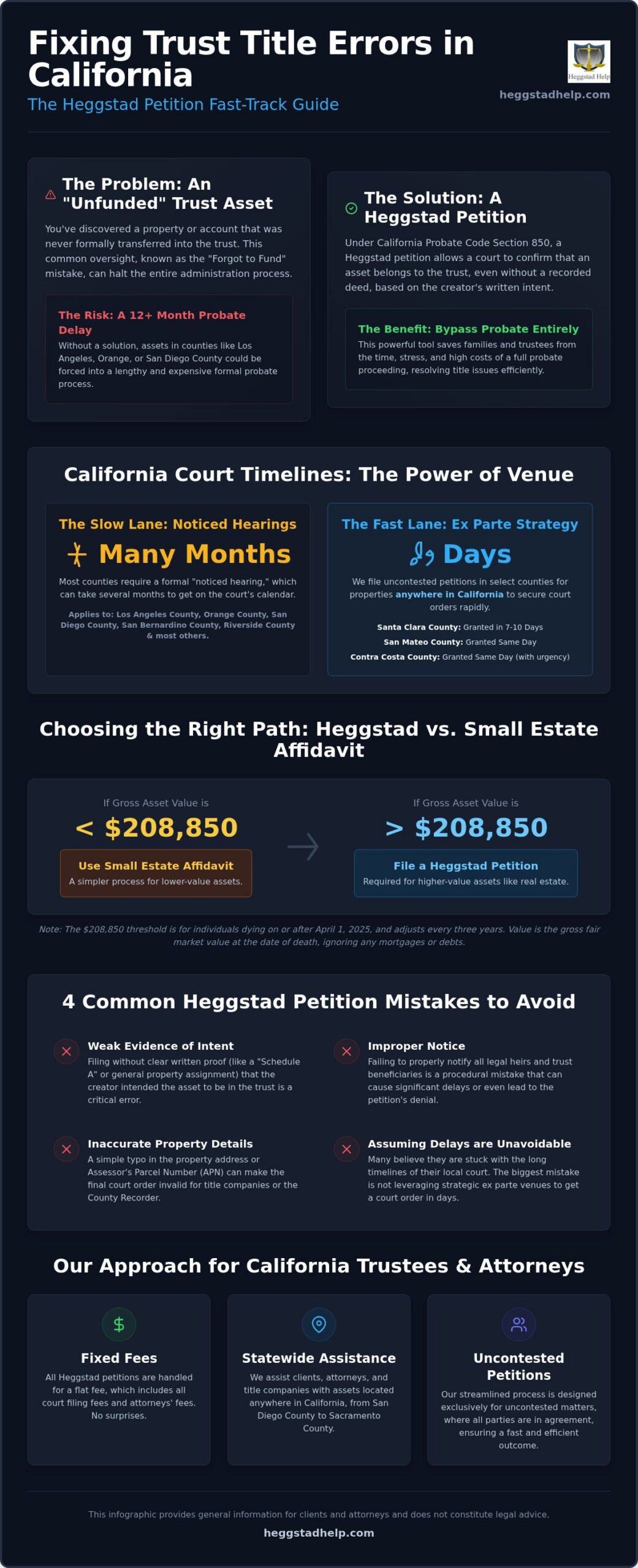
If the "forgotten" assets are relatively low in value, you might consider a Small Estate Affidavit. For individuals dying on or after April 1, 2025, the threshold for this affidavit in California is exactly $208,850. If the asset value is even slightly above this limit, you’re required to seek a court order under Probate Code Section 850. This threshold is adjusted every three years, making it vital to use the correct figures for the date of death.
Another of the common Heggstad petition mistakes involves miscalculating the gross fair market value. You must use the value at the time of death, regardless of mortgages. If the property exceeds the $208,850 limit, a Heggstad Petition in California is the necessary tool to avoid a full probate. Understanding this threshold helps you choose the correct procedural path and avoids the mistake of filing the wrong paperwork for high-value California real estate.
How to Fix Trust Title Errors Using a Heggstad Petition
To resolve a title discrepancy, you must engage with the specific legal procedure outlined in the California Probate Code § 850. This statute provides the mechanism for a Successor Trustee to request a court order confirming that an asset is part of the trust estate, even if the deed wasn’t recorded. It’s a powerful tool that saves families from the exhaustive 12-month probate process.
Success begins with gathering evidence of "intent." You’ll need to carefully review the trust’s "Schedule A" (the list of assets) or a general assignment of all property. One of the most common Heggstad petition mistakes is failing to provide sufficient written proof that the settlor intended for the specific property to be trust-owned. If the documentation is vague or missing, the court might be hesitant to grant the order. Once the evidence is secured, you’ll generally draft and file the petition in the appropriate California Superior Court.
While you might expect to wait months in San Diego County, Riverside County, or Los Angeles County, our office helps clients by filing uncontested petitions ex parte in Santa Clara County, even for trusts that are being administered in those counties! This allows us to obtain a court order in 7 to 10 days for property located anywhere in the State of California.
The Role of the Successor Trustee in Title Correction
The Successor Trustee holds the legal standing to initiate this process. Understanding your Successor Trustee Duties in California is essential, especially regarding the mandatory notice you must provide to all heirs and beneficiaries. Failing to properly notify interested parties is another of the common Heggstad petition mistakes that can stall your case for months.
Precision is your best ally. You must include the exact property address and the Assessor’s Parcel Number (APN) in your filing. A single digit error in the APN can make the resulting court order useless for title companies or the County Recorder. If you’re feeling overwhelmed by the technical requirements, our Heggstad Petition Filing services provide a reliable way to ensure your documents are court-ready and accurate.
Navigating California Courts: Timelines and Venue Strategies
The venue you choose for filing significantly impacts how quickly you can transfer title. Many Successor Trustees assume they must file in the county where the property is located, but one of the common Heggstad petition mistakes is failing to utilize more efficient courts. Filing a noticed hearing in Orange County, Riverside County, or San Bernardino County often results in a 3 to 6 month wait. These backlogs stall property sales and delay distributions to beneficiaries.
Our office assists families, attorneys, and title companies in San Diego County, Sacramento County, and Los Angeles County by utilizing the ex parte (with no formal hearing) advantage in specific Northern California venues. Professional drafting is essential; if the petition isn’t perfect, California title companies may refuse to honor the resulting court order. By using Santa Clara County for filings, we achieve results in 7 to 10 days for clients across the State of California.
County-Specific Timelines for Heggstad Petitions
Timelines vary drastically across the State of California. In Santa Clara County, uncontested ex parte petitions are typically granted in just 7 to 10 days. For those requiring even faster results, San Mateo County petitions can often be filed, heard, and granted the same day. Similarly, Contra Costa County allows for same-day grants if you can demonstrate "urgency" to the Court. These rapid turnarounds provide a stark contrast to the months of waiting required in southern counties.
Bypassing the ‘Noticed Hearing’ Delay
A standard noticed hearing is usually set 30 to 60 days after filing, though backlogged counties may schedule them several months later. We often use Santa Clara County as a strategic shortcut for clients in Alameda County, Marin County, or Santa Cruz County. Avoiding common Heggstad petition mistakes like improper venue selection can save you months of frustration. If you want to avoid the long probate wait, explore our Ex Parte Court Order Services to fast-track your petition today.
Taking Action: Correcting Title to Trust Property Today
Unresolved title errors carry a heavy hidden cost. When a Successor Trustee delays correcting a deed, they risk losing a potential buyer for a home in San Francisco County or Santa Cruz County. These errors also complicate tax filings, as the State of California requires clear title to establish a step-up in basis for the beneficiaries. A fixed-fee Heggstad Petition is a logical alternative to a full probate administration; it covers both filing fees and attorneys’ fees, providing financial certainty that a statutory probate cannot offer.
Navigating these filings requires a steady hand. One of the common Heggstad petition mistakes involves failing to properly link the settlor’s intent to the specific legal description of the property. Working with a Board-Certified Specialist in Estate Planning, Trust and Probate Law who has been practicing since 1980 ensures that these technical requirements are met. This specialized knowledge is what allows us to assist families in recovering missing assets without the anxiety of a 12-month court delay. We focus exclusively on uncontested petitions to maintain an efficient and predictable path forward for our clients.
Why Specialized Legal Help Matters
A Heggstad Petition expert in California knows how to navigate the specific local rules of the Superior Court. Unlike a generalist probate lawyer, a specialist focuses on the procedural nuances that ensure a court order is accepted by title companies. This includes ensuring the final order is recorded correctly to fix the chain of title permanently. If you’re dealing with an unfunded trust, taking action now prevents further legal complications and ensures the decedent’s wishes are finally honored.
Finalizing Your Trust Assets Without the Probate Wait
Identifying "forgotten" assets and avoiding common Heggstad petition mistakes is the first step toward a successful trust administration. By understanding the $208,850 threshold and utilizing strategic venues like Santa Clara County, you can bypass the months of delays typical in Los Angeles County, Orange County, or Riverside County. Robert P. Bergman, a Board-Certified Specialist, provides the calm competence you need to navigate these procedural hurdles. We offer fixed fees for all uncontested petitions, ensuring you don’t face unexpected legal costs. While other counties take many months for noticed hearings, our ex parte filings in Santa Clara County typically secure results in just 7 to 10 days.
You’re only one step away from resolving these title errors and protecting the decedent’s legacy. Whether you’re a Successor Trustee in San Diego County or an attorney in Sacramento County, we’re here to help you move forward. Fix your trust title errors quickly with a Heggstad Petition from HEGGSTAD HELP and finalize your distribution with confidence.
Frequently Asked Questions
Can I fix a trust title error if the settlor has already died?
Yes, you can fix a title error after the settlor has passed away. In fact, most Heggstad petitions are filed post-death to avoid a 12-month probate administration in the State of California. This legal procedure confirms that property belongs in the trust despite a missing deed. It’s a common way to resolve "forgotten" assets in Los Angeles County or Orange County, ensuring beneficiaries receive their inheritance quickly.
What documents are required to prove ‘intent’ for a Heggstad Petition in California?
To succeed, you must provide written evidence that the settlor intended the asset to be trust property. This typically includes the trust’s "Schedule A" (the initial list of assets) or a general assignment of property. One of the common Heggstad petition mistakes is failing to include these specific written declarations. Having these documents ready is essential for families in San Diego County or San Francisco County seeking a court order.
How much does it cost to fix a title error with HEGGSTAD HELP?
We provide fixed fees for all uncontested Heggstad petitions throughout the State of California. This single price covers both the court filing fees and the attorneys’ fees, providing financial predictability for Successor Trustees. Whether you’re managing property in Riverside County or San Bernardino County, our fixed-fee model eliminates the anxiety of hourly billing while ensuring your petition is handled by a Board-Certified Specialist who has been practicing since 1980.
Is a Heggstad Petition faster than a full California probate?
A Heggstad Petition is significantly faster than a full probate, which often takes 12 months or longer in the State of California. While noticed hearings in counties like Alameda County or Marin County can take several months, our strategy uses ex parte (with no formal hearing) filings. By filing in Santa Clara County, we typically secure a court order in 7 to 10 days, allowing you to fund the trust immediately.
Do I need to live in Santa Clara County to use the 7-10 day filing strategy?
You don’t need to live in Santa Clara County to benefit from this expedited timeline. We assist clients and attorneys throughout the State of California, from Sacramento County to Santa Cruz County, by utilizing Northern California courts for uncontested filings. This strategy allows us to bypass the backlogs in Southern California and achieve a 7 to 10 day turnaround for your petition, regardless of where you or the real property is located.

Article by
Robert P. Bergman, Attorney at Law
Attorney Robert P. Bergman ("Bob Bergman") has been a Board-Certified Specialist in Estate Planning, Trust and Probate Law since 2011, as certified by the California State Bar Board of Legal Specialization. For several years, Bob has assisted families and the clients of other attorneys with obtaining court orders through Heggstad petitions to avoid the time and expense of Probate administration. Bob is friendly, very approachable, and believes in explaining complex legal topics in clear ordinary language so that his clients understand exactly what they're doing and why they're doing it.
Bob is often able to assist clients who are in other counties than his home county of Santa Clara through his approach to Heggstad petitions.
Disclaimer
This article is for informational purposes only. Nothing in this article is intended to replace legal advice from a competent attorney or be considered legal guidance for anybody's specific legal situation. Nobody should rely on information in this article in making legal decisions without such consultation.


