
The Complete Guide to HEGGSTAD HELP: Bypassing Probate in California

What if a single missing signature on a deed didn’t have to cost your family eighteen months of court delays and thousands of dollars in statutory…

What if a single missing signature on a deed didn’t have to cost your family eighteen months of court delays and thousands of dollars in statutory probate fees? Most successor trustees assume that if a house or account was left out of a living trust, a full probate is the only path forward. It’s a heavy, anxious realization to face when you’re already managing the loss of a loved one. This Complete guide to HEGGSTAD HELP explains why that “obvious” path is often a costly mistake.

We understand the frustration of finding conflicting title documents that seem to trap an estate in the court system. You’ll learn how to use a Heggstad Petition (a specific court request to confirm property as trust assets) to bypass the traditional probate process entirely. By leveraging California Probate Code 850, it’s possible to resolve these oversights in as little as two to six months rather than the standard year or longer. This guide previews the evidence required to prove the decedent’s intent and outlines the steps to transfer title to beneficiaries legally and efficiently.

Key Takeaways

  • Discover how the “Intent vs. Title” principle allows the court to honor a decedent’s wishes and confirm trust ownership even when a formal deed transfer was missed.
  • This Complete guide to HEGGSTAD HELP reveals how to identify common title errors, such as the “Refinance Trap,” that often lead to unnecessary probate delays.
  • Learn the specific steps for gathering evidence, including the use of trust schedules and written declarations, to build a compelling case for the California Probate Court.
  • Explore how specialized ex parte services can fast-track your petition, offering a rapid resolution for time-sensitive situations like a pending home sale or property transfer.
  • Understand the advantage of working with a Board-Certified Specialist to navigate complex procedural hurdles and avoid the high costs of a traditional twelve-month probate.

What is a Heggstad Petition and How Does It Work?

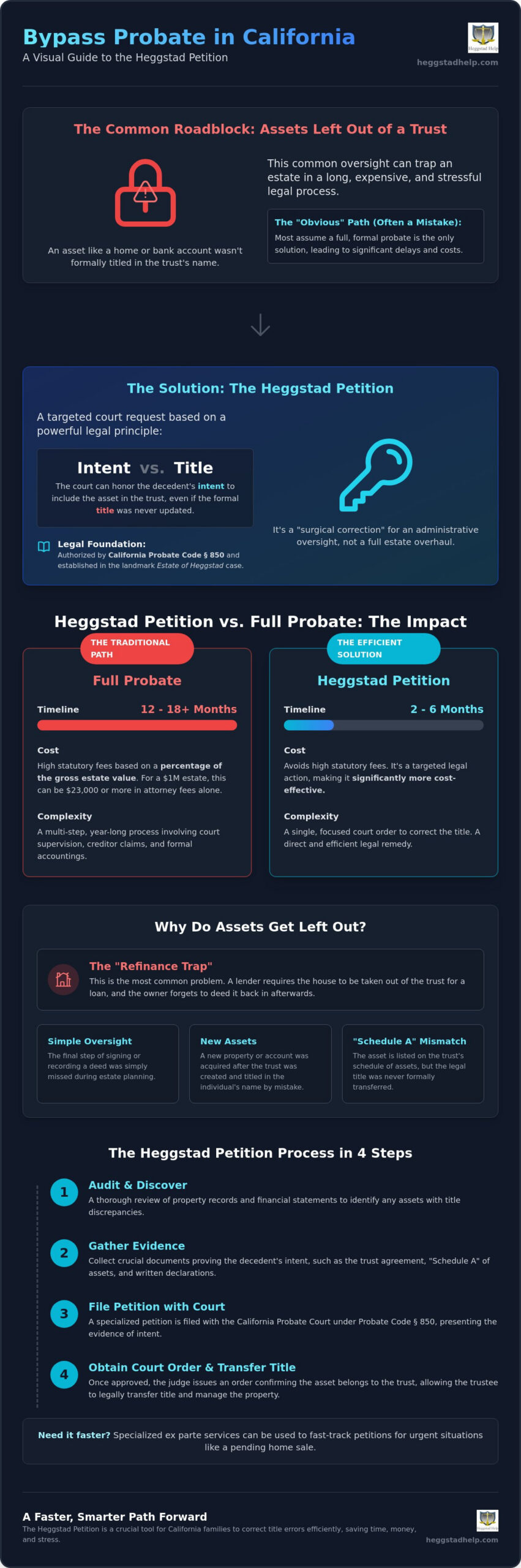
A Heggstad Petition is a specialized legal request filed with the California Probate Court. It asks a judge to confirm that a specific asset, such as a family home or a brokerage account, belongs to a trust even if the formal title was never updated. This Complete guide to HEGGSTAD HELP focuses on the core principle of “Intent vs. Title.” If the person who created the trust (the settlor) clearly intended for an asset to be included, the court has the power to fix the title error without requiring a full probate.

This process applies to both real property and personal property. If a parent forgot to deed their house to the trust or failed to name the trust as a beneficiary on a large bank account, this petition serves as the legal remedy. It effectively bypasses the multi-step, year-long probate process by addressing the title issue through a single, targeted court order. It’s a surgical correction for an administrative oversight.

The Legal Foundation: California Probate Code 850

The authority for this procedure comes from California Probate Code Section 850. This section provides a mechanism for successor trustees to claim property that is technically held in the decedent’s individual name. The practice is named after the landmark 1993 case, Estate of Heggstad. This case established that a written declaration of trust is sufficient to include an asset in that trust, creating a unique “California-only” shortcut for families facing complex title hurdles.

Heggstad Petition vs. Full Probate: A Speed Comparison

Speed is the most significant advantage. While a traditional California probate often takes twelve to eighteen months to resolve, a Heggstad petition is frequently completed within two to six months. Beyond the time savings, this approach avoids the high statutory attorney fees associated with full estate administration. Instead of paying a percentage of the gross estate value, families can use this petition to transfer title to beneficiaries legally and quickly. It’s a far more efficient path for estates that are otherwise well-organized but for a few missing deeds.

Common Reasons Trust Assets Are Left Out of Title

Even the most meticulously drafted estate plan fails if the assets aren’t properly “funded” (the process of transferring title from an individual to the trust). This Complete guide to HEGGSTAD HELP addresses the reality that many families face: a valid trust document exists, but the “suitcase” is empty because the deeds were never signed or recorded. Whether due to a simple oversight or a complex financial transaction, these title gaps create a legal hurdle that prevents the successor trustee from managing the property without court intervention.

The Refinance Trap: A Successor Trustee’s Most Common Problem

Lenders frequently require homeowners to move their property out of a trust and back into their individual names to secure a mortgage or refinance. Banks often prefer individual title because it simplifies their internal risk assessments and loan processing. While the homeowner usually intends to deed the house back into the trust immediately after the loan closes, this final step is frequently forgotten. This creates a “broken chain” in the trust’s history. A house left out of a trust after a refinance is not a lost cause; it is a title error that California law is designed to correct.

Identifying “Loose” Assets After a Death

The first task for a family is to perform a thorough audit of all property records and financial statements. You should look for property tax statements or grant deeds that don’t list the trust as the owner. If a decedent purchased a new home or opened a brokerage account after the trust was created, they might have accidentally used their individual name instead of the trust name. Using a successor trustee guide is essential during this stage to ensure no discrepancies are missed.

Another frequent complication involves “Schedule A” (the list of assets intended for the trust). Sometimes an asset is clearly listed on this schedule, yet no formal deed or transfer document was ever executed. In these cases, California Probate Code § 850 provides the legal bridge to move those assets into the trust. If you discover a significant asset was left out of the title, you can schedule a consultation to determine if a petition is the right path forward for your specific situation.

The Heggstad Petition Process in California

Understanding the procedural requirements of a Heggstad petition requires a methodical approach. This Complete guide to HEGGSTAD HELP breaks the process down into four distinct phases to ensure the court recognizes the decedent’s intent. Unlike a full probate, which involves multiple hearings and inventory filings, this process is focused on a single objective: confirming trust ownership.

  • Step 1: Gathering Evidence of Intent. This involves locating the original trust document, any “Schedule A” asset lists, or general assignment of assets.
  • Step 2: Drafting the Petition. A formal legal document must be prepared, detailing the specific assets and the legal grounds for the transfer under California law.
  • Step 3: Filing and Notice. Once filed, you must serve formal notice to all heirs and beneficiaries. This is a strict legal requirement to ensure transparency.
  • Step 4: The Court Hearing. A probate judge reviews the evidence. If the judge is satisfied, they sign a court order confirming the asset belongs to the trust.

Evidence Required for a Successful Filing

The most critical piece of evidence is often the “General Assignment” or “Schedule of Assets” included in the trust package. These documents act as a clear declaration that the settlor intended for their property to be trust-owned. If a specific list doesn’t exist, we look for other written declarations or evidence of intent. Even in complex cases where a deed was never recorded, a well-documented petition can bridge the gap. If you’re unsure if your documentation is sufficient, you can contact us for a petition review to evaluate your evidence.

Recording the Final Court Order

Winning the case in court is the penultimate step. Once the judge signs the order, it must be recorded with the County Recorder in the county where the real property is located. This recorded order effectively acts as a deed; it officially changes the title from the decedent’s name to the trust. This allows the trustee to legally sell the property or distribute it to beneficiaries without further court oversight. It’s the final piece of the puzzle that restores the trust’s funding and protects the family’s inheritance.
The Complete Guide to HEGGSTAD HELP: Bypassing Probate in California

How HEGGSTAD HELP Corrects Trust Titles Faster

Resolving a title discrepancy requires more than just filling out forms; it requires a deep understanding of how California probate judges evaluate evidence of intent. This Complete guide to HEGGSTAD HELP highlights a specialized approach that prioritizes speed and precision. Unlike general practice firms that manage a wide variety of civil matters, we focus exclusively on surgical title corrections. By narrowing our scope to California Probate Code 850 petitions, we’ve developed a streamlined workflow that eliminates the administrative bloat often found in traditional law offices.

Our process is built on a “Plain English” philosophy. We recognize that successor trustees are often navigating these legal hurdles while grieving, which is why we translate complex procedural jargon into clear, actionable steps. We don’t handle full probate administrations, which allows us to dedicate our entire technical infrastructure to recovering missing trust assets and correcting deeds efficiently.

The Advantage of a Board-Certified Specialist

Robert P. Bergman is a Board-Certified Specialist in Estate Planning, Trust and Probate Law, a rare credential that signifies a high level of expertise recognized by the State Bar of California. With over 40 years of experience practicing since 1980, he has encountered nearly every possible title complication, from ancient “refinance traps” to modern digital evidence of intent. A specialist is better equipped to anticipate court objections and draft petitions that meet the “clear and convincing” evidentiary standard required by California law on the first attempt.

Urgent Title Corrections for Pending Real Estate Sales

The most stressful scenario for a trustee occurs when a house is in escrow and a title company suddenly discovers the property was never deeded into the trust. In these high-stakes moments, a standard court date months away isn’t an option. HEGGSTAD HELP specializes in ex parte court order services (immediate court intervention for urgent matters) to address these crises. By seeking an emergency hearing, we can often secure the necessary court order in a fraction of the usual time, preventing sales from falling through and protecting the estate’s financial interests. If you’re facing a title roadblock, you can contact HEGGSTAD HELP for a consultation on your California trust asset to find a path forward.

Take Decisive Action to Protect the Trust Estate

Discovering that a family home or significant account was left out of a trust doesn’t have to trigger a year-long probate nightmare. By understanding the “Intent vs. Title” principle and utilizing California Probate Code 850, you can correct these technical oversights and transfer property to beneficiaries in a fraction of the usual time. This Complete guide to HEGGSTAD HELP has outlined how surgical legal petitions can bypass the high fees and delays of full estate administration.

Robert P. Bergman has been serving California successor trustees since 1980. As a Board-Certified Specialist in Estate Planning, Trust and Probate Law, he provides a level of precision that generalist attorneys often lack. Our firm maintains a specialized focus on Probate Code 850 petitions to ensure your family’s assets are secured legally and efficiently. You don’t have to navigate these complex procedural hurdles alone.

Request a Consultation with a California Heggstad Specialist today to begin the title correction process. We’re here to provide the steady, knowledgeable hand you need to resolve these complications and move forward with confidence.

Frequently Asked Questions

How much does a Heggstad Petition cost in California?

The initial court filing fee for a Heggstad petition in California is $435. While this fee is standard across all 58 counties, the primary financial advantage is the avoidance of statutory probate fees, which can exceed 4% of the gross value of the estate. This Complete guide to HEGGSTAD HELP emphasizes that while total legal costs depend on the complexity of the title issue, the process remains significantly more affordable than a full, year-long estate administration.

Can I file a Heggstad Petition if the asset isn’t listed on Schedule A?

You can still file a petition even if a specific asset was omitted from Schedule A (the itemized list of property intended for the trust). Success in these cases relies on meeting the “clear and convincing evidence” standard, meaning the evidence must leave no substantial doubt about the decedent’s intent. A general assignment of assets or a pour-over will can often serve as the necessary proof to show the settlor intended for all their property to be held within the trust.

How long does the Heggstad process take compared to probate?

A typical Heggstad petition is resolved within two to six months, which is a major time savings compared to the twelve to eighteen months required for a traditional California probate. For time-sensitive situations, such as a property currently in escrow, ex parte court order services (emergency requests for immediate judicial relief) can be used to seek a faster resolution. This streamlined path allows for a legal title transfer without the exhaustive multi-step requirements of a full probate case.

Do I need a lawyer to file a Heggstad Petition under Probate Code 850?

California law doesn’t strictly require an attorney to file under Probate Code 850, but the procedural requirements are highly technical. This Complete guide to HEGGSTAD HELP notes that judges require specific evidentiary foundations and strict adherence to notice requirements for all heirs and beneficiaries. Because a single procedural error can lead to a petition being denied, many successor trustees choose to work with a Board-Certified Specialist to ensure the filing is handled correctly the first time.

What happens if an heir objects to the Heggstad Petition?

If an heir or beneficiary files a formal objection, the petition becomes a contested matter. The court will typically schedule additional hearings and may allow for discovery (the formal legal process of gathering evidence and testimony). While most petitions are straightforward corrections of administrative oversights, a contest turns the case into a more complex litigation matter where the petitioner must provide robust evidence to uphold the decedent’s original intent for the trust.

Robert P. Bergman, Attorney at Law

Article by

Robert P. Bergman, Attorney at Law

Attorney Robert P. Bergman ("Bob Bergman") has been a Board-Certified Specialist in Estate Planning, Trust and Probate Law since 2011, as certified by the California State Bar Board of Legal Specialization. For several years, Bob has assisted families and the clients of other attorneys with obtaining court orders through Heggstad petitions to avoid the time and expense of Probate administration. Bob is friendly, very approachable, and believes in explaining complex legal topics in clear ordinary language so that his clients understand exactly what they're doing and why they're doing it.
Bob is often able to assist clients who are in other counties than his home county of Santa Clara through his approach to Heggstad petitions.

Disclaimer

This article is for informational purposes only. Nothing in this article is intended to replace legal advice from a competent attorney or be considered legal guidance for anybody's specific legal situation. Nobody should rely on information in this article in making legal decisions without such consultation.
Tips for Heggstad Petition Success: A Successor Trustee’s Guide

What if the difference between a 12-month probate nightmare and a swift court order is just one specific piece of evidence? You’re likely feeling the…

What if the difference between a 12-month probate nightmare and a swift court order is just one specific piece of evidence? You’re likely feeling the immense pressure of managing a loved one’s estate, only to find that a primary residence or bank account was never formally titled in the trust’s name. It’s a common complication that often leads to fear of court rejection and confusion over complex legal procedures. Finding the right tips for HEGGSTAD HELP success begins with understanding that you aren’t just “fixing” a mistake. Instead, you’re proving an intent that already existed through documented evidence.

This guide provides the specific evidence and procedural steps required to ensure your Heggstad petition is granted by a California court, helping you meet the “clear and convincing evidence” standard required in 2026. We’ll examine the essential documentation you need, such as the “Pour-Over” Will and the Schedule of Assets, to bypass full probate administration and secure a corrected title for real property. By following a methodical path, you can navigate these procedural hurdles with calm competence and resolve the estate’s title issues efficiently.

Key Takeaways

  • Understand that success is defined by proving the decedent’s clear intent through documented evidence rather than simply attempting to “fix” a clerical title error.
  • Identify the critical role of a “Schedule A” (the asset list attached to a trust) and General Assignments in establishing that an asset belongs within the trust estate.
  • Avoid common procedural failures, such as improper notice to heirs or vague property descriptions, by following professional tips for HEGGSTAD HELP success.
  • Ensure your petition includes the official Assessor’s Parcel Number (APN) to provide the court with the precise legal description required for a valid real property title correction.
  • Discover how a Board-Certified Specialist can utilize “Ex Parte” services (expedited court orders) to resolve title issues quickly, especially when a property sale is currently pending.

Success in a Heggstad petition is defined by a single outcome: obtaining a formal court order that confirms an asset belongs in a trust despite a failure to update the title. For a Successor Trustee, this process is the primary tool for correcting an oversight that would otherwise force a property into probate. When seeking tips for HEGGSTAD HELP success, you must realize the court isn’t just looking for a mistake to fix. They’re looking for proof of the decedent’s intent. Under California Probate Code Section 850(a)(3)(B), the legal framework exists to transfer property when a trustor (the person who created the trust) clearly intended for the asset to be included but passed away before the deed was recorded. The Successor Trustee carries the responsibility of initiating this petition and presenting the facts to the judge.

Why Intent Matters More Than the Deed

A signed trust document can carry more weight than a missing deed if it contains specific language identifying the property. This precedent was established in the Estate of Heggstad case, which proved that a written declaration of trust is sufficient to create a trust in those assets. It’s vital to distinguish between a “Declaration of Trust” (the document stating assets are held for beneficiaries) and a “Deed of Trust” (the document used to secure a mortgage). To win, you must meet the “clear and convincing evidence” standard. This means the evidence must leave no substantial doubt in the judge’s mind. If the trust agreement specifically lists the address or legal description, you’ve already cleared a major procedural hurdle.

The Goal: Avoiding Full Probate Administration

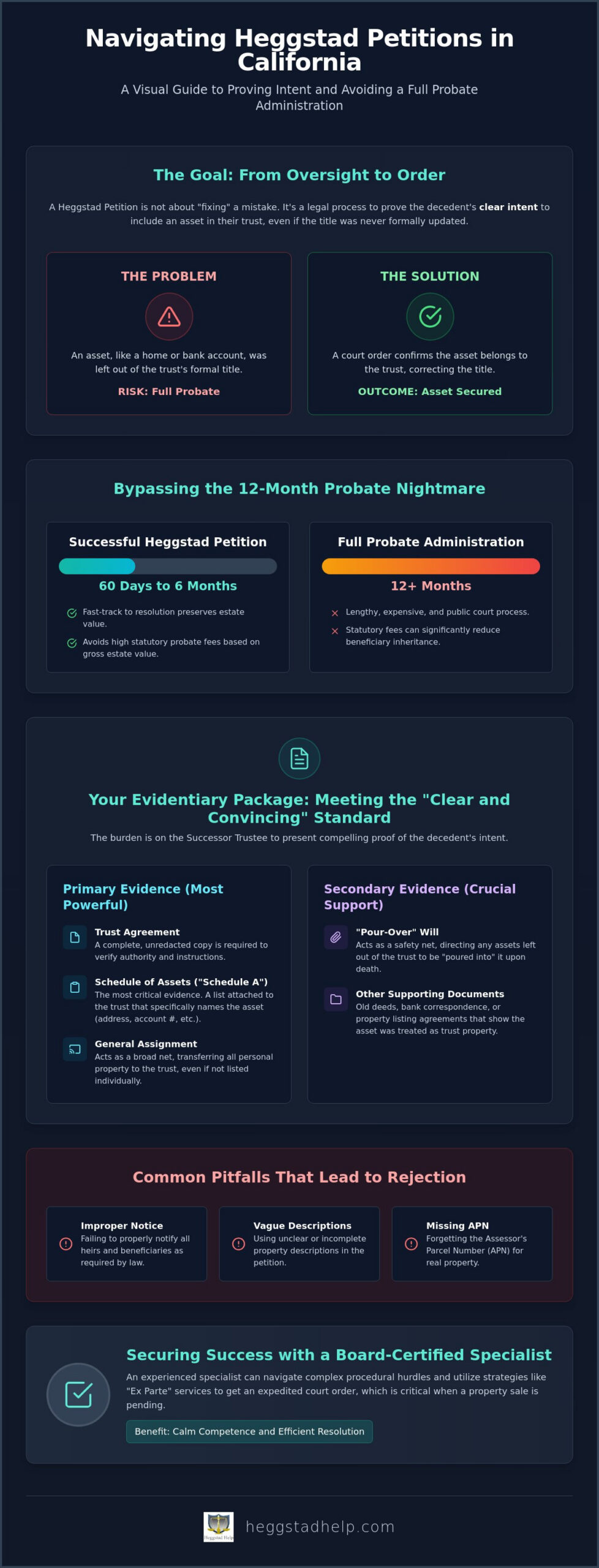
The ultimate objective is to bypass the lengthy and expensive probate process. A successful Heggstad petition typically resolves within 60 days to six months. This is a massive improvement over the 12-month timeline often seen in full probate administration. By securing this court order, you avoid the rigid requirements of statutory probate fees. These fees are calculated based on the gross value of the estate, often leading to high costs that can be avoided through this specialized petition. It’s the “fast track” to resolution that preserves the estate’s value for the beneficiaries and provides the Successor Trustee with immediate authority to manage or sell the asset.

Essential Documentation to Ensure Your Petition is Granted

Securing a court order requires more than just a signed petition; it requires a compelling evidentiary package. Evidence is everything. One of the most effective Tips for HEGGSTAD HELP success is to treat your documentation like a trial exhibit. Under California Probate Code § 850, the burden is on the Successor Trustee to prove that the trustor (the person who created the trust) intended for the asset to be trust property. This begins with providing a complete, unredacted copy of the Trust Agreement. Judges need to see the entire document to verify the trustee’s authority and the specific funding instructions left by the decedent.

The Power of the Schedule of Assets

The “Schedule A” or “Exhibit A” is often the most critical piece of evidence. This is the list of assets typically attached to the back of the trust document. If this list specifically names the real property address or the account number in question, your path to success is much clearer. If the schedule is blank or missing, don’t panic. You can often rely on a “General Assignment” (a document that transfers all of a person’s interest in their assets to the trust) to bridge the gap. These documents act as a broad net. They capture assets that were intended for the trust but didn’t get their own specific deed.

Secondary Evidence for “Loose” Assets

When the Schedule A is insufficient, we look for secondary evidence. A “Pour-over” Will (a document designed to catch any assets left out of a trust) acts as a safety net. It states that any assets not already in the trust should be transferred there upon death. While the Will itself doesn’t transfer the title, it provides the judge with a clear roadmap of the decedent’s final wishes. Implementing these Tips for HEGGSTAD HELP success by gathering every scrap of written intent can be the difference between a quick court order and a rejected petition. You should also look for:

  • Old deeds or expired listing agreements showing the property was once in the trust.
  • Bank correspondence or mortgage statements addressed to the trust.
  • Brokerage statements or handwritten notes from the decedent regarding the asset.

Collecting these items before you begin the Heggstad petition filing ensures you’re prepared for the court’s scrutiny. Providing a logical progression of evidence makes it easier for the judge to rule in your favor.

Common Pitfalls: Why California Heggstad Petitions Fail

While Probate Code 850 petitions offer a streamlined path to title correction, they aren’t immune to technical failure. Many successor trustees encounter setbacks because they underestimate the court’s requirement for procedural precision. One of the most vital tips for HEGGSTAD HELP success is to avoid the trap of improper notice. California law is strict; you must notify all “interested parties,” including every legal heir and named beneficiary. If even one person is omitted from the service list, the judge will likely continue the hearing, causing a delay of several months while you attempt to rectify the oversight.

Another frequent cause of rejection is the use of vague property descriptions. Simply listing a street address is rarely enough for a permanent title correction. You must provide the official Assessor’s Parcel Number (APN) and the full legal description as it appears in the County Recorder’s records. If these details don’t match exactly, the court cannot issue a valid order to transfer the title. This guide to Heggstad petitions highlights how these small clerical errors can derail an otherwise solid case. Without a written “declaration of trust” to support your claim, relying on oral testimony alone is almost always a recipe for failure.

Technical Errors That Cause Rejection

Using “do-it-yourself” forms for a complex petition often leads to jurisdictional errors. Filing in the wrong California county or failing to follow specific local court rules can result in an immediate dismissal. Accuracy in these filings is non-negotiable. If you want to ensure your documentation survives judicial scrutiny, a professional Heggstad Petition Filing can help you meet every technical requirement from the start.

Addressing Objections from Heirs

Transparency with beneficiaries is your best defense against unexpected delays. When a petition is contested, your strategy must shift to address the specific objections raised by heirs. If an heir believes the asset was intentionally left out of the trust, the court requires even stronger evidence of the decedent’s intent. Maintaining clear communication with all parties reduces the likelihood of a formal objection, which is one of the best tips for HEGGSTAD HELP success in a complicated family dynamic.

Tips for Heggstad Petition Success: A Successor Trustee’s Guide

Securing Your Success with a Board-Certified Specialist

Navigating the complexities of California probate law requires more than just a basic understanding of the code; it demands specialized expertise. One of the most effective tips for HEGGSTAD HELP success is to engage a Board-Certified Specialist in Estate Planning, Trust and Probate Law. This designation is rare, held by only a small percentage of California attorneys. It signifies a verified level of experience and a high success rate in handling specific procedural hurdles. Robert P. Bergman has been practicing in this field since 1980, providing a steady hand for successor trustees who are often overwhelmed by the stress of managing a decedent’s estate.

Time is often a critical factor, especially when a real estate transaction is already in progress. If a house sale is pending and you discover a title error, waiting several months for a standard hearing isn’t an option. In these urgent scenarios, we utilize Ex Parte Court Order Services to seek expedited relief from the court. This specialized approach allows for urgent title corrections, ensuring that the trust can fulfill its obligations without losing a buyer or facing unnecessary financial penalties.

Specialist vs. Generalist: The Success Gap

Generalist probate lawyers often handle a wide variety of cases, from simple wills to contested litigation. They may not file Heggstad petitions frequently enough to stay current with the specific judicial preferences of individual California counties. A specialist, however, understands the nuanced “clear and convincing evidence” standard required in 2026. They know exactly how to structure the petition to satisfy the court’s requirements on the first attempt. This focused knowledge reduces the risk of court rejection and prevents the 12-month delays associated with full probate administration.

A Clear Path Forward for Successor Trustees

The journey from identifying a missing asset to receiving a signed court order typically spans 60 days to six months. While this is significantly faster than traditional probate, it still requires methodical preparation and organized filing. By focusing exclusively on asset transfers and title corrections, HEGGSTAD HELP provides a streamlined resolution for your estate’s complications. You can move forward with confidence, knowing the asset is legally confirmed as trust property. Get expert help with your Heggstad petition today to evaluate your case’s chances of success and secure the court order you need.

Resolving Your Trust Title Issues with Confidence

Success as a successor trustee depends on your ability to present clear evidence of the decedent’s intent while strictly adhering to California’s procedural mandates. By prioritizing accurate legal descriptions and ensuring all interested parties receive proper notice, you significantly reduce the risk of court rejection. These fundamental tips for HEGGSTAD HELP success transform a complex legal hurdle into a manageable administrative task, protecting the estate from the high costs and lengthy delays of full probate. Navigating the court system is much simpler when you move from a place of documented evidence rather than guesswork.

When you’re facing tight deadlines or a pending property sale, the guidance of a specialist is invaluable. Robert P. Bergman brings over 40 years of California legal experience to every case, offering the specialized focus required for a successful Heggstad petition filing. As a Board-Certified Specialist in Estate Planning, Trust and Probate Law, he provides the calm competence needed to secure your court order efficiently. You can take the first step toward resolving these title issues today.

Schedule a Consultation with a California Heggstad Specialist

You don’t have to navigate these complex procedural hurdles alone. With the right documentation and expert support, you can move forward with the peace of mind that your loved one’s wishes are being honored and the estate is protected.

Frequently Asked Questions

Can I file a Heggstad petition if there is no written list of assets?

Yes, you can still file a petition even if a specific “Schedule A” list is missing. In these cases, we rely on a “General Assignment” of assets or specific language within the trust agreement that declares the trustor’s property belongs to the trust. These documents serve as critical evidence of intent. Gathering secondary evidence, such as bank correspondence or previous deeds, can also help bridge the gap and satisfy the court’s requirements.

How long does a successful Heggstad petition take in California?

A typical Heggstad petition process is generally completed within 60 days to six months from the initial filing. This timeline depends on the court’s current backlog and whether any heirs or beneficiaries file an objection. Compared to the 12-month duration of a full probate administration, this process is significantly faster. It provides a “fast track” for successor trustees to correct title errors and manage assets without enduring years of court oversight.

Is a Heggstad petition guaranteed to succeed if I have a trust?

No, a Heggstad petition isn’t guaranteed to succeed simply because a trust exists. The court requires “clear and convincing evidence” that the decedent specifically intended for the asset in question to be part of the trust. Success often depends on the quality of your documentation and the absence of formal objections from heirs. Following professional tips for HEGGSTAD HELP success, such as providing precise legal descriptions and proper notice, greatly increases your chances of approval.

What happens if the court denies my Heggstad petition?

If the court denies the petition, the asset must usually go through full probate administration to transfer the title. For smaller estates with personal property valued under $208,850 in 2026, a Small Estate Affidavit might be an alternative. However, for real property, a denial typically means a long delay and higher statutory fees. Understanding the common pitfalls discussed earlier can help you avoid this outcome and keep the asset within the trust’s control.

Do I need a lawyer for a Heggstad petition, or can I do it myself?

While you aren’t legally required to hire an attorney, the technical complexity of Probate Code 850 makes professional guidance essential. Technical errors in the legal description or failing to notify all interested parties can lead to immediate rejection. Utilizing specialized tips for HEGGSTAD HELP success from a Board-Certified Specialist ensures your filing meets local judicial preferences. This expertise reduces stress and helps you navigate the complex procedural hurdles that often trip up self-represented petitioners.

Robert P. Bergman, Attorney at Law

Article by

Robert P. Bergman, Attorney at Law

Attorney Robert P. Bergman ("Bob Bergman") has been a Board-Certified Specialist in Estate Planning, Trust and Probate Law since 2011, as certified by the California State Bar Board of Legal Specialization. For several years, Bob has assisted families and the clients of other attorneys with obtaining court orders through Heggstad petitions to avoid the time and expense of Probate administration. Bob is friendly, very approachable, and believes in explaining complex legal topics in clear ordinary language so that his clients understand exactly what they're doing and why they're doing it.
Bob is often able to assist clients who are in other counties than his home county of Santa Clara through his approach to Heggstad petitions.

Disclaimer

This article is for informational purposes only. Nothing in this article is intended to replace legal advice from a competent attorney or be considered legal guidance for anybody's specific legal situation. Nobody should rely on information in this article in making legal decisions without such consultation.
Evidence Required for Heggstad Petition in California: A 2026 Guide

Imagine discovering that your family home was inadvertently left out of a trust because of a simple refinancing error or a forgotten deed. It’s a…

Imagine discovering that your family home was inadvertently left out of a trust because of a simple refinancing error or a forgotten deed. It’s a common scenario that often leads to a deep sense of anxiety, especially when you realize that the trust document alone isn’t enough for the County Recorder to transfer the title. You’re likely worried that this administrative oversight will force you into a grueling 12 to 18-month probate process, but gathering the proper evidence required for Heggstad petition California filings can provide a much faster resolution.

We understand how overwhelming it feels to face complex procedural hurdles while grieving. The good news is that with the right documentation, you can often confirm trust ownership and clear the title in just two to six months. This guide will show you exactly how to demonstrate clear and convincing evidence (the high legal standard of proof required by a judge) to satisfy the court. We will walk through the essential documents you need, such as the pour-over will and written declarations of intent, to bypass a full probate administration and successfully protect the assets your loved one intended to leave behind.

In addition to resolving estate issues, if your family is also managing the legal complexities of a personal injury case in Southern California, you can learn more about Law Offices of Michael D. Payne to ensure your rights are fully protected.

Key Takeaways

  • Master the “clear and convincing” legal standard used by California courts to verify a settlor’s intent to hold property within a trust.
  • Compile a comprehensive checklist of primary documents, including the original Trust Agreement and General Assignments, which constitute the essential evidence required for Heggstad petition California cases.
  • Learn how to utilize secondary evidence, such as property tax records and insurance policies, to prove trust ownership when formal deeds are missing.
  • Navigate the 2026 procedural landscape by understanding the requirements for verified petitions and mandatory notice to all interested parties.
  • Position yourself to secure a court order that corrects title errors quickly, allowing for the immediate sale or distribution of trust assets, which can then be expertly listed in Southern California by Gregg Perrah | FirstTeam Real Estate.

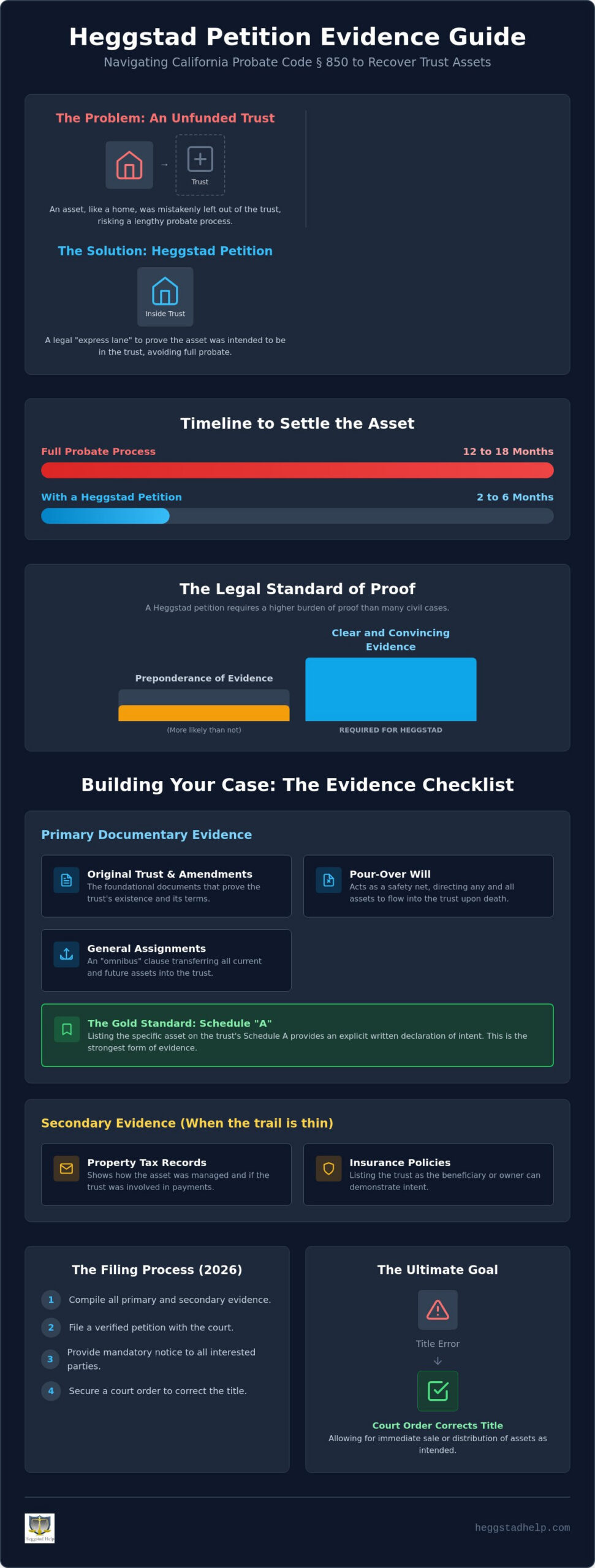
At the heart of every successful filing is the concept of “intent to fund,” which serves as the legal bedrock for proceedings under California Probate Code Section 850. This principle asserts that if a person clearly intended for an asset to be part of their trust, the court has the authority to honor that wish even if the formal title transfer was never completed. The evidence required for Heggstad petition California cases must demonstrate this intent through a “clear and convincing” standard, which is a higher burden of proof than a simple preponderance of evidence. Essentially, a Heggstad petition functions as a legal express lane for confirming trust assets without the need for a full, year-long probate administration.

Courts distinguish between express intent, such as a written statement in a trust document, and implied intent, which might be gathered from how the decedent managed the asset during their lifetime. While the trust itself is the primary evidence, judges look for a clear paper trail that connects the specific property to the trust’s purpose. If the documentation is vague, the petition may face delays or denials, which is why precision in your evidentiary record is vital. If you have been named a successor trustee managing unfunded trust assets in California, understanding this evidentiary standard is the first step toward fulfilling your legal duties and avoiding personal liability.

Even for those outside of California, the importance of proactive legal counsel remains; for example, you can explore Estate Planning with Massingill Attorneys & Counselors at Law to ensure your assets are protected and correctly titled from the start.

The Role of California Probate Code 850

While the landmark 1993 case Estate of Heggstad originally focused on real property, California Probate Code Section 850 has since expanded these protections to include various asset types, such as bank accounts or business interests. The court requires a formal petition because it needs a legal basis to “correct” the public record. This process ensures that the County Recorder or financial institutions can recognize the trust as the rightful owner despite the initial lack of a recorded deed.

The “Schedule A” Requirement

Most trust documents include a “Schedule A,” which is a list of assets meant to be held by the trust. Listing a property here is considered the “gold standard” of evidence because it provides an explicit written declaration of intent. If your Schedule A is blank or missing the specific asset, the case becomes more complex; however, it’s not impossible. In these instances, we must rely on other documents, such as general assignments or pour-over wills, to fill the evidentiary gap and prove the settlor’s wishes to the court. For those managing specialized assets like senior care facilities, you can discover Assisted Living Real Estate Group for expert brokerage services in California.

Primary Documentary Evidence Checklist for Your Petition

Gathering the evidence required for Heggstad petition California filings involves more than just finding a copy of the trust. You need to assemble a comprehensive record that leaves no doubt about the settlor’s intent. Start by locating the original Trust Agreement along with any subsequent amendments. These documents prove the trust exists and define its scope. Without the complete set of amendments, the court cannot be certain of the final distribution wishes, which may lead to delays.

A pour-over will serves as a critical safety net in this process. Even if the will doesn’t name the specific property in question, it demonstrates a clear testamentary intent that all assets should flow into the trust upon death. This document supports the legal standard established under California Probate Code § 850, providing the court with a logical path to confirm trust ownership. When combined with other documents, it builds a “constellation of evidence” that generalist attorneys often overlook.

Key documents to include in your evidentiary packet:

  • Original Trust Agreement: The foundational document establishing the trust’s existence.
  • Trust Amendments: Any updates that might affect the asset in question.
  • General Assignments: Documents signed at the time of trust creation that transfer personal and real property into the trust.
  • Pour-over Will: The backup document that directs assets to the trust.

Comprehensive Transfer Deeds

Many estate plans include a general assignment, also known as an “omnibus” clause. These documents state that the settlor intends to transfer all currently owned and future assets into the trust. If you find one of these, it can often overcome the lack of a specific grant deed for a piece of real estate. For a detailed walkthrough of the process, see our guide on Heggstad Petition Filing.

The Unrecorded Deed

Sometimes a deed was signed and notarized but never actually filed with the County Recorder. This unrecorded deed is powerful evidence of a “completed gift” to the trust. If you discover such a document, keep it in its original form. It provides the judge with physical proof that the transfer was intended and nearly finished. If you’re unsure how to present this to a judge, consulting a specialist in trust asset title correction can prevent costly procedural errors.

Secondary Evidence: Proving Intent When the Paper Trail is Thin

Property titles often slip through the cracks during major life events, such as a home refinance. To ensure these transitions are handled with precision, you can discover Integrity Estates Realty for professional real estate and mortgage brokerage services in California. Successfully gathering the evidence required for Heggstad petition California cases often involves looking beyond the deeds to substantiate the settlor’s (the person who created the trust) intent. This category of secondary evidence focuses on how the decedent actually managed the asset during their lifetime. For instance, property tax records showing that the trust paid the annual assessments provide a strong logical link between the asset and the trust entity. Similarly, homeowners insurance policies that list the trust as an “Additional Insured” demonstrate that the settlor viewed the trust as the rightful owner of the property.

The “Refinance Trap” is a frequent culprit in title errors. Lenders often require a property to be transferred out of a trust and back into the individual’s name to finalize a loan, but the deed is rarely moved back afterward. In these cases, bank loan applications that list the property as a trust asset serve as persuasive proof of intent. Written correspondence, such as emails or letters between the decedent and their estate planning attorney regarding the transfer, can also be submitted to the court to clarify the decedent’s final wishes. If you are struggling to piece together these records, our team can assist with trust asset title correction to ensure no account or property is left behind.

Bank and Brokerage Statements

Financial records offer a monthly snapshot of how an account was treated. If bank or brokerage statements were consistently issued in the name of the trust, it proves the settlor considered those funds to be trust property. We also look for “Pay on Death” (POD) or “Transfer on Death” (TOD) designations that point toward the trust. These designations (instructions to a bank to pay funds to a specific beneficiary upon death) act as clear indicators of the owner’s distribution plan.

Just as financial records are vital in probate, documenting the impact of a physical injury is crucial for legal recovery; for those seeking assistance with accident claims in California, mraccident.com offers expert personal injury representation.

Declarations from Third Parties

When physical documents are missing, testimony from professionals can bolster your case. Declarations (written statements made under penalty of perjury) from the drafting attorney or the family CPA can provide the context a judge needs to rule in your favor. In uncontested filings, “Heir Declarations” from beneficiaries stating that they acknowledge the asset was intended for the trust can significantly smooth the path toward a court order. This collaborative approach helps the court feel confident that the evidence required for Heggstad petition California filings meets the necessary legal threshold. For a comprehensive overview of your obligations when assets are missing from the trust, review the complete guide on successor trustee duties for an unfunded trust in California to understand how to marshal assets and correct title errors efficiently.

In cases where estate planning involves beneficiaries residing abroad, the Law Offices of Peg Yang, P.C. provides specialized U.S. immigration legal services to support a diverse global clientele.

Comprehensive legal protection often extends beyond estate planning; for families also navigating the aftermath of an accident, Oberg Law Office serves as a dedicated resource for personal injury representation, ensuring that every legal detail is managed with the same level of care required in probate court.

In a similar vein, achieving a clean financial slate often involves addressing tax burdens; the Law Offices of Matthew T. Desrochers, P.C. provides specialized guidance on the IRS Fresh Start Initiative for those seeking comprehensive debt relief.

For businesses looking to further optimize their financial recovery, Trump Tariff Relief assists with filing an IEEPA tariff refund claim to reclaim overpaid duties based on recent legal developments.

For business owners managing corporate assets, it is vital to explore Fiduciary Administration and Compliance Fees to mitigate risks associated with 401(k) plan administration and error correction.

Similarly, individuals navigating legal challenges in international jurisdictions, such as criminal defense matters in South America, can find specialized support through Abogado Penal Temuco in the Araucanía Region of Chile.

Furthermore, for individuals navigating different legal challenges such as criminal allegations in the Midwest, the Law Office of Kevin Bessant & Associates provides aggressive defense for felony and misdemeanor charges in Michigan.

Similarly, for those requiring specialized legal support in South America, Meriño y Abogados Asociados provides expert defense for high-complexity criminal cases in Chile, ensuring comprehensive protection across international borders.

In addition to these specialized legal and financial resources, establishing a long-term strategy with retirement planning services Ontario from Evergreen Wealth Management can help individuals in Canada secure their legacy and avoid the need for complex probate corrections.

Furthermore, for those who wish to utilize their inheritance to build a new custom home or develop real estate in Hungary, Nagy Házépítő Kft. provides professional general contracting services to help families create high-quality residential properties.

Evidence Required for Heggstad Petition in California: A 2026 Guide

Procedural Evidence and the 2026 Filing Process

Even with a robust paper trail, the court requires strict adherence to specific procedural protocols to finalize the transfer. The journey begins with filing a Verified Petition, which is a formal legal document where every claim is made under penalty of perjury (a sworn statement that the facts are true). In 2026, California courts have increased their scrutiny of these filings, making the precision of the evidence required for Heggstad petition California cases the deciding factor in whether a petition is granted or continued (delayed to a future date). A well-organized petition doesn’t just present facts; it anticipates the court’s questions before they are asked.

Once the petition is filed, you must satisfy the Notice Requirement. This involves providing evidence to the court that all legal heirs and trust beneficiaries have been formally notified of the proceedings. The court won’t grant an order without proof that every interested party has had the opportunity to review the request. At the hearing, the judge will review your evidence package to ensure it meets the necessary legal standards. If the judge is satisfied, they will issue a court order confirming the trust’s ownership. The final step is recording this order at the County Recorder’s office, which officially clears the title for sale or distribution. If you are already working with a buyer but escrow has been frozen because a house not in trust can’t sell California real estate without court intervention, a Heggstad petition is often the fastest path to resolving the title issue and closing the transaction.

Following the legal resolution and title clearance, maintaining the home’s infrastructure becomes a priority for the new owners or trustees; for example, you can discover Peninsula Air Conditioning (PenAir) to understand how to properly size and maintain air conditioning systems to preserve the property’s value.

Once the title is clear, the next step is often preparing the property for the market. To understand the impact of high-quality presentation, you can learn more about Houzpics | Real Estate Photographers in Hilton Head, SC and see how professional photography serves as a vital resource for showcasing real estate assets effectively.

Navigating 2026 Court Backlogs

Current court schedules in many California counties are heavily impacted, often resulting in hearing dates set several months into the future. Maintaining “Evidence Readiness” is critical to avoid the frustration of multiple hearing dates. Before your scheduled appearance, the court will issue Probate Notes (a public list of deficiencies or questions from the probate examiner). Clearing these notes immediately is essential. If your evidence required for Heggstad petition California filings is incomplete or disorganized, you risk being sent back to the end of a very long line.

Why a Board-Certified Specialist is Vital

Presenting a case to a probate judge requires more than just filling out paperwork; it requires an understanding of local rules that vary from county to county. Robert P. Bergman has been practicing since 1980 and is a Board-Certified Specialist in Estate Planning, Trust and Probate Law. This specialized expertise ensures your evidence is presented in a way that satisfies even the most meticulous judges. By focusing exclusively on Heggstad Petition Filing and title corrections, we help you avoid the “Probate Trap” of a 12-month administration and move directly toward a successful resolution.

Securing Your Legacy with Comprehensive Evidence

Navigating the complexities of trust funding doesn’t have to be a source of constant anxiety. By organizing the evidence required for Heggstad petition California filings, you’re taking the most important step toward avoiding a lengthy probate and honoring your loved one’s final wishes. Whether you’re relying on a primary Schedule A or piecing together a “constellation of evidence” through secondary records like property taxes and insurance policies, the goal remains the same: proving clear and convincing intent to the court. This principle of clear documentation is equally vital for high-value international estates, such as those handled by Vermittlung historischer Immobilien OHG when mediating the sale of historical castles and manor houses in Germany.

Success in these matters often depends on the precision of your filing and a deep understanding of local court rules. Robert P. Bergman is a Board-Certified Specialist in Estate Planning, Trust and Probate Law who has been practicing since 1980. With an exclusive focus on California Heggstad Petitions, he knows exactly how to present your documentation to satisfy the court’s requirements in 2026. Contact HEGGSTAD HELP today for a specialized review of your trust evidence and let us help you clear the title to your family’s assets. You’ve worked hard to protect your family, and we’re here to ensure that protection remains intact.

Frequently Asked Questions

Is a Heggstad petition possible if the house was never listed in the trust?

Yes, it’s often possible to succeed even if the property wasn’t explicitly listed on a Schedule of Assets. Courts can look to “General Assignments” or “Omnibus” clauses within the trust that state the settlor’s intent to hold all their real and personal property in the trust. We can also use secondary evidence, such as bank loan applications or homeowners insurance policies, to demonstrate that the decedent treated the home as a trust asset during their lifetime.

What is the most important piece of evidence for a Heggstad petition?

The most critical evidence is a written declaration of trust that identifies the property and expresses the settlor’s intent to hold it as a trust asset. This usually includes the signed Trust Agreement and any attached schedules. In 2026, California judges prioritize clear and convincing proof of the creator’s wishes over minor clerical errors. Having the original, signed documents is the best way to satisfy the court’s evidentiary requirements.

Can I use a Heggstad petition for bank accounts or just real estate?

You can use this process for a wide range of assets beyond real estate, including bank accounts, brokerage accounts, and business interests. While the original case law focused on a home, California Probate Code Section 850 now covers various asset types. If you can provide the evidence required for Heggstad petition California filings, such as monthly statements addressed to the trust, you can successfully transfer these accounts without a full probate administration.

How long does it take to gather evidence and get a court order in 2026?

The entire process generally takes between two and six months from the date of filing. Gathering your documents usually takes a few weeks, but the court’s calendar is the primary factor in the timeline. Because many California counties face significant backlogs in 2026, it’s vital to have a complete, error-free evidence package ready for the first hearing to avoid being pushed back several months for a second date.

What happens if a beneficiary objects to the Heggstad petition evidence?

If a beneficiary or heir files a formal objection, the case may move toward a contested hearing where the judge examines the evidence more closely. The court will determine if the evidence of intent meets the “clear and convincing” legal standard despite the disagreement. Because objections can lead to delays, we ensure that the evidence required for Heggstad petition California cases is robust and that all notice requirements are strictly followed to minimize the chance of a successful challenge.

Robert P. Bergman, Attorney at Law

Article by

Robert P. Bergman, Attorney at Law

Attorney Robert P. Bergman ("Bob Bergman") has been a Board-Certified Specialist in Estate Planning, Trust and Probate Law since 2011, as certified by the California State Bar Board of Legal Specialization. For several years, Bob has assisted families and the clients of other attorneys with obtaining court orders through Heggstad petitions to avoid the time and expense of Probate administration. Bob is friendly, very approachable, and believes in explaining complex legal topics in clear ordinary language so that his clients understand exactly what they're doing and why they're doing it.
Bob is often able to assist clients who are in other counties than his home county of Santa Clara through his approach to Heggstad petitions.

Disclaimer

This article is for informational purposes only. Nothing in this article is intended to replace legal advice from a competent attorney or be considered legal guidance for anybody's specific legal situation. Nobody should rely on information in this article in making legal decisions without such consultation.
Common Mistakes in California Heggstad Petitions: A Successor Trustee’s Guide

Did you know that a properly executed Heggstad petition can often resolve title issues in just 60 to 90 days, while a full California probate can…

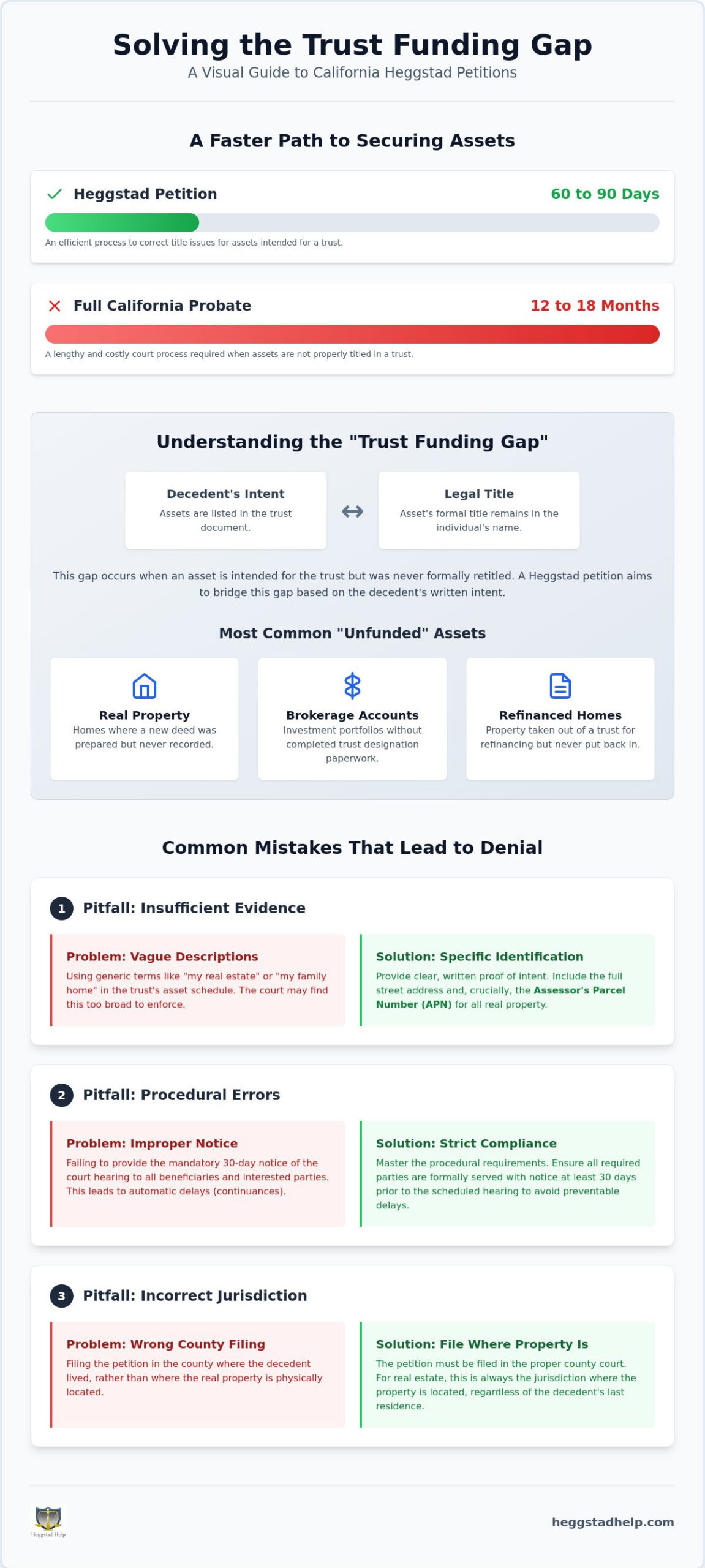
Did you know that a properly executed Heggstad petition can often resolve title issues in just 60 to 90 days, while a full California probate can drag on for 12 to 18 months? It’s a powerful tool for successor trustees, but the margin for error is surprisingly thin. Many people assume that because a house was mentioned in a trust document, the transfer is a mere formality. However, failing to account for common mistakes Heggstad petition filers often encounter can lead to a flat denial from the court, forcing you back into the lengthy probate process you worked so hard to avoid.

We understand the stress of managing a decedent’s estate when titles are missing or outdated. It’s natural to feel overwhelmed by the technical requirements of Probate Code 850 (the specific law that allows a judge to transfer property into a trust after death). This guide will help you identify the critical procedural and evidentiary pitfalls that cause these petitions to fail in California courts. You’ll learn how to present clear evidence of intent and satisfy the strict notice requirements of the judicial system. By understanding these nuances, you can ensure a successful transfer of real property into the trust while minimizing unnecessary legal delays and court costs.

Key Takeaways

  • Identify the “Trust Funding Gap,” which is the mismatch between legal title and trust intent, and why a Heggstad petition is the most efficient remedy for un-titled assets.
  • Learn how to avoid the common mistakes Heggstad petition filers make by providing specific evidence, such as property addresses and assessor’s parcel numbers, rather than vague descriptions.
  • Master the procedural requirements, such as the mandatory 30-day notice to all beneficiaries, to prevent avoidable court continuances (delays in your hearing).
  • Determine the correct California jurisdiction for your filing to ensure your petition is heard in the proper county court where the property is located.
  • Understand the advantage of working with a Board-Certified Specialist to navigate the nuances of specialized trust asset title correction and ex parte court orders.

Why Heggstad Petitions Fail: Identifying the “Trust Funding Gap”

When a person creates a revocable living trust, their primary goal is to ensure their assets pass to beneficiaries without the delay and expense of a full probate. However, a trust is only effective if it is properly “funded.” If an asset is not formally retitled into the name of the trust, a “Trust Funding Gap” occurs. This term describes the discrepancy between the decedent’s clear intent to include an asset in their estate plan and the actual legal title on record at the time of their death. If the title remains in the decedent’s individual name, the asset is technically outside the trust’s reach.

The primary remedy for this gap is a petition filed under California Probate Code Section 850, which provides the modern statutory framework for these filings. This legal procedure is widely known as a Heggstad petition, named after the landmark case Estate of Heggstad. This case established that a written declaration of trust can be sufficient to transfer property even if the formal deed was never recorded. While this is a powerful tool, you must remember that a court order is not an automatic right. It’s a formal request to a judge; common mistakes Heggstad petition filers make often involve assuming the court will simply approve the request without rigorous proof of intent.

The Most Common Assets Left Out of California Trusts

In our specialized practice, we frequently see specific assets fall through the cracks of a traditional estate plan. These include:

  • Real property: This includes primary residences or rental units where a deed was prepared but never actually recorded with the County Recorder.
  • Brokerage accounts: Many investment portfolios remain in an individual’s name because the owner failed to complete the trust designation or “transfer on death” (a designation that names a beneficiary) paperwork.
  • Refinanced homes: This is a particularly frequent issue. Lenders often require a property to be moved out of a trust and into an individual’s name during the refinancing process. If the owner passes away before retitling the property back into the trust, the asset remains legally “unfunded.”

If you find yourself managing an estate with these “forgotten” assets, identifying the gap is the first step toward a resolution. Avoiding the common mistakes Heggstad petition candidates face requires a methodical approach to gathering evidence and presenting a clear, logical case to the California court system.

The Evidence Trap: Why a Trust Schedule Isn’t Always Enough

A frequent misconception among successor trustees is the belief that any mention of an asset within the trust documents guarantees a successful court order. In reality, evidentiary insufficiency is one of the most common mistakes Heggstad petition filers encounter. California judges require clear and convincing evidence of the decedent’s intent to hold a specific asset in trust. If your documentation is vague or contradictory, the court may determine that the legal requirements have not been met, leaving the property stuck in probate.

The “Vague Schedule” mistake is a primary culprit for petition denials. If a trust’s “Schedule A” (the list of assets intended for the trust) simply states “real estate” or “my family home” without providing a specific street address or Assessor’s Parcel Number (APN; the unique number assigned to a property by the county tax assessor), the court may find the description too broad to enforce. Similarly, the “Missing Link” error occurs when a trustee fails to provide a document that explicitly connects the trust agreement to the specific asset in question. Without this direct link, the judge cannot legally confirm that the property belongs to the trust estate.

Reliance on oral testimony is another pitfall. While family members may recall the decedent’s desire to “put the house in the trust,” California courts prioritize written evidence over verbal recollections. Inconsistent documentation can also derail your case; for example, if a deed was signed in an individual’s name after the trust was created, the court might view this as a deliberate choice to remove the asset from the trust. If you are unsure if your current documentation is sufficient, consulting with a specialist in trust asset title correction can help clarify your standing before you file.

The Gold Standard of Evidence for Probate Code 850

To avoid these evidentiary traps, successor trustees should aim for a “gold standard” of proof that leaves little room for judicial doubt. This typically includes:

  • Detailed Property Descriptions: Your petition should include the full legal description found on the most recent deed along with the APN to ensure the court can identify the exact parcel of land.
  • Referenced Exhibits: Ensure that any asset list is clearly referenced within the body of the trust agreement itself, establishing it as an integral part of the estate plan.
  • Supporting Declarations: Written statements from the original drafting attorney or witnesses who were present during the trust’s creation can provide the necessary context to confirm the decedent’s intent.

Procedural Errors That Stall Heggstad Petitions in California Courts

Even if you have gathered the “gold standard” of evidence discussed previously, procedural slips can derail your progress. These common mistakes Heggstad petition applicants make often result in a “continuance” (a court order delaying the hearing to a future date), which can add months to the resolution of the estate. While the court is generally helpful, judges cannot overlook statutory requirements regarding how a case is filed and who is notified.

Jurisdictional mistakes are a frequent hurdle. Generally, a petition under Probate Code 850 must be filed in the county where the real property is located or where the trust is currently administered. Filing in the wrong venue can lead to a dismissal, forcing you to restart the process from scratch. Additionally, the language in your proposed order must be precise. If the order lacks a full legal description or the specific “title correction” wording required by the County Recorder, you may find yourself with a court order that cannot be used to actually transfer the deed.

For trustees facing a pending sale, failing to utilize the “Ex Parte” (an expedited or emergency) procedure is a critical error. If a property is already in escrow, a standard court date may be too far in the future, risking a breach of contract. We specialize in managing the Heggstad petition filing process to ensure these time-sensitive procedural requirements are met without the need for multiple court appearances.

Navigating California’s Strict Notice Requirements

The most frequent reason for a stalled petition is defective notice. California law requires that all “interested persons” receive a formal 30-day notice of the hearing. This group includes all current beneficiaries and, crucially, any legal heirs who would have inherited if there were no trust (even if they were intentionally disinherited). You must use the correct Judicial Council form, DE-120 (Notice of Hearing—Decedent’s Estate or Trust), and ensure the proof of service is filed with the court well before the hearing date. A single missing recipient or a late mailing can push your resolution back by 60 to 90 days, significantly increasing the stress of the administration.

If you encounter difficulties in locating specific heirs or beneficiaries to fulfill these legal obligations, you may visit HubHound to access professional investigative services that can help track down necessary parties and ensure your filing moves forward without delay.

Common Mistakes in California Heggstad Petitions: A Successor Trustee’s Guide

Securing a Successful Court Order: Best Practices for Successor Trustees

Successor trustees often start the estate administration process with a generalist attorney, but a Heggstad filing is a specialized legal instrument that requires a surgical approach. While many probate lawyers are proficient in full court administrations, they may lack the specific experience needed to navigate the unique evidentiary hurdles of a Probate Code 850 petition. A Board-Certified Specialist in Estate Planning, Trust and Probate Law understands exactly how to frame the decedent’s intent to satisfy a skeptical judge. This level of precision is the best defense against the common mistakes Heggstad petition applicants frequently make, such as providing insufficient proof of asset funding.

This requirement for specialized knowledge isn’t limited to California; for those managing estates with assets in other jurisdictions, consulting an estate planning attorney New York can ensure that similar title issues are addressed according to local probate laws and that your overall estate plan is secure.

If you are facing a looming deadline, such as a pending real estate sale, the timing of your filing is critical. Utilizing professional Heggstad petition filing services ensures that your “Order Confirming Trust Assets” is drafted with the exact legal descriptions required by the County Recorder. This prevents the order from being rejected after you’ve already left the courtroom. For urgent cases, we often leverage ex parte procedures (emergency court applications) to confirm assets quickly; this allows you to meet escrow deadlines without the typical 90-day wait.

The Successor Trustee Checklist for Asset Recovery

  • Locate Original Documents: Find the original signed trust agreement and all subsequent amendments immediately; these are the foundation of your evidence.
  • Gather Asset Records: Collect the most recent deeds for real property or account statements for brokerage accounts that were left in the individual’s name.
  • Validate Evidence: Consult with a specialist to determine if your documentation meets the “clear and convincing” standard required by California law before you pay filing fees.

Next Steps: Correcting the Title Without Full Probate

The path forward involves drafting a petition that specifically requests a title correction under Probate Code 850. Once the judge signs the order, it must be recorded with the California County Recorder’s office in the county where the property is located. This recording acts as the final bridge, officially moving the property from the decedent’s name into the trust. If you feel overwhelmed by the technical requirements, contact Heggstad Help for a specialized review of your trust asset recovery case. We focus exclusively on these filings to help you avoid the common mistakes Heggstad petition filers encounter and secure the assets for your beneficiaries.

Take Decisive Action to Resolve Your Trust Funding Gap

Navigating the complexities of California Probate Code 850 requires more than just a signed trust document; it demands a precise alignment of evidence and procedure. By identifying the trust funding gap early and avoiding the common mistakes Heggstad petition filers often make, such as providing vague property descriptions or failing to notify all legal heirs, you can successfully bypass the lengthy probate process. This methodical approach ensures that real property is transferred quickly, preserving the estate’s value and honoring the decedent’s true intent.

If you’re feeling the pressure of a pending sale or the weight of managing missing titles, you don’t have to face the court system alone. Robert P. Bergman is a Board-Certified Specialist in Estate Planning, Trust and Probate Law who has been practicing in California since 1980. With a specialized focus on trust asset title correction and Heggstad filings, our firm offers the expertise required to secure a recordable court order without unnecessary delays. Get Expert Help with Your Heggstad Petition to ensure your estate administration remains on the right track. You can resolve these title issues and move forward with the peace of mind that the estate is finally complete.

Frequently Asked Questions

Can I file a Heggstad petition if there is no written schedule of assets?

Yes, you can still file a petition even if there is no formal schedule of assets (the list of property intended for the trust) attached to the document. While a “Schedule A” provides the clearest evidence, California courts may accept a general assignment of all the decedent’s property to the trust. You must provide other written evidence of the creator’s intent to avoid the common mistakes Heggstad petition filers make when documentation is sparse.

How long does the Heggstad petition process take in California?

The Heggstad petition process typically takes between 60 and 90 days to reach a final court order in California. This timeline is significantly more efficient than a full probate administration, which often lasts 12 to 18 months or longer. The exact duration depends on the specific county court’s calendar and whether your initial filing is procedurally perfect, as any errors in notice can lead to a continuance (a court-ordered delay of your hearing).

What happens if a Heggstad petition is denied by the judge?

If a judge denies your petition, the asset must generally go through a full California probate process to transfer the title to the beneficiaries. However, if the denial is “without prejudice,” the court is allowing you to refile the petition after you have gathered better evidence or corrected procedural flaws. Understanding the common mistakes Heggstad petition applicants face before you file is the best way to prevent this outcome and the associated costs of a full probate.

Is a Heggstad petition cheaper than a full California probate?

Yes, a Heggstad petition is a much more cost-effective alternative to a full probate administration. In California, probate fees are statutory (legal fees calculated as a fixed percentage of the gross estate value), which can be quite expensive for real property. Because a petition is a targeted legal request rather than a comprehensive estate oversight, the legal fees and court costs are substantially lower, allowing more of the estate’s value to pass directly to the heirs.

Do I need to notify disinherited family members about the Heggstad petition?

Yes, you are legally required to provide formal notice to all legal heirs, including those who were intentionally disinherited. California law dictates that all “interested persons” (individuals who would have inherited the property under state law if the trust did not exist) must receive a 30-day notice of the hearing. Skipping this step is a major procedural error that will cause the judge to delay your case until all parties are properly served and proof of service is filed.

Robert P. Bergman, Attorney at Law

Article by

Robert P. Bergman, Attorney at Law

Attorney Robert P. Bergman ("Bob Bergman") has been a Board-Certified Specialist in Estate Planning, Trust and Probate Law since 2011, as certified by the California State Bar Board of Legal Specialization. For several years, Bob has assisted families and the clients of other attorneys with obtaining court orders through Heggstad petitions to avoid the time and expense of Probate administration. Bob is friendly, very approachable, and believes in explaining complex legal topics in clear ordinary language so that his clients understand exactly what they're doing and why they're doing it.
Bob is often able to assist clients who are in other counties than his home county of Santa Clara through his approach to Heggstad petitions.

Disclaimer

This article is for informational purposes only. Nothing in this article is intended to replace legal advice from a competent attorney or be considered legal guidance for anybody's specific legal situation. Nobody should rely on information in this article in making legal decisions without such consultation.
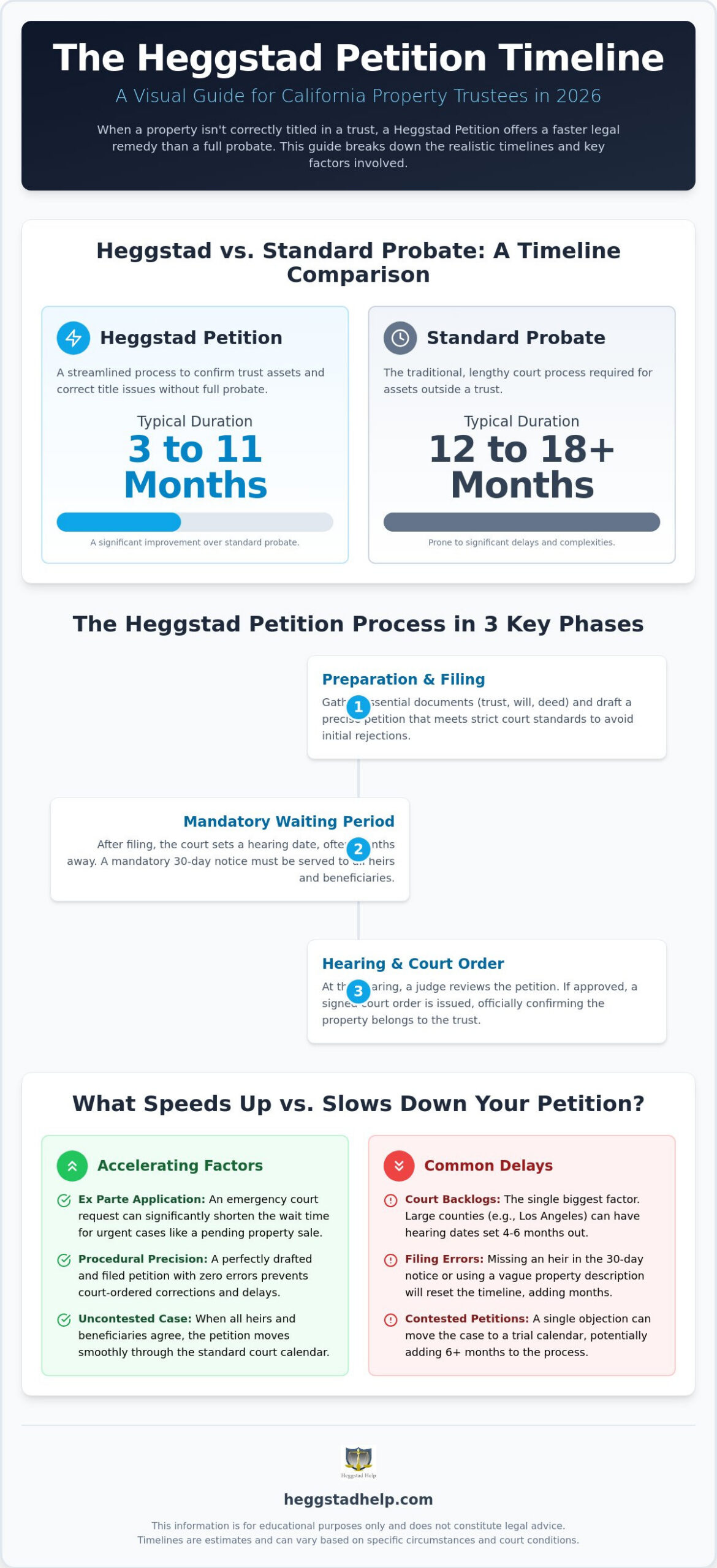
How Long Does a Heggstad Petition Take in California? 2026 Timeline Guide

You finally have a signed contract for the family home, but a title search reveals the property was never officially deeded into the trust. Suddenly,…

You finally have a signed contract for the family home, but a title search reveals the property was never officially deeded into the trust. Suddenly, your real estate transaction is on hold while you face the daunting prospect of a traditional probate. You’re likely wondering how long does a Heggstad petition take in California and whether it can save your sale before the buyer walks away. In most cases, this specialized legal tool (a petition filed under Probate Code section 850) offers a much faster resolution than a full probate, which currently averages 12 to 18 months in the California court system.

We understand the anxiety that comes with court delays and the confusion over varying county backlogs. It’s frustrating to feel like your life is on hold because of a simple administrative oversight. This guide provides a realistic 2026 timeline for the Heggstad process, showing you how to navigate the 3 to 11 month window effectively. You’ll learn which factors influence specific wait times and how an ex parte (emergency) hearing might expedite your case. By understanding these procedural steps, you can move forward with the confidence that your title issues will be resolved as quickly as the law allows.

Key Takeaways

  • A Heggstad petition offers a streamlined path to title correction, typically concluding in less than a year compared to the 12 to 18 months required for a standard California probate.
  • The primary factor in how long does a Heggstad petition take in California is the specific county court’s backlog, with processing times generally ranging from 3 to 11 months.
  • You can potentially accelerate the timeline through an ex parte application (an emergency court request) if you are facing an urgent property sale or significant financial hardship.
  • Precision in the initial filing is critical, as a single error in notifying heirs or beneficiaries can reset the mandatory 30-day notice clock and add months to the process.
  • Utilizing a Board-Certified Specialist ensures your petition is structured correctly the first time, preventing court-ordered amendments that would otherwise delay asset distribution.

The Realistic Heggstad Petition Timeline in California

A Heggstad petition is a Probate Code 850 procedure used to confirm trust assets without full probate. This legal mechanism allows successor trustees to transfer assets that were intended for the trust but were never formally titled in the trust’s name. It is based on the legal precedent set by the Estate of Heggstad, which recognized that a clear statement of intent in trust documents can sometimes override the lack of a recorded deed. While the specific duration depends on your local court, a Heggstad petition typically takes between 3 and 10 months from the initial filing to receiving a signed court order. This is a substantial improvement over a standard California probate, which often takes 12 to 18 months at minimum.

Phase 1: Document Preparation and Filing

The first stage involves gathering the necessary evidence to prove the decedent’s intent. You’ll need to locate the original trust document, the pour-over will, and the most recent property deed. If these documents aren’t readily available, the preparation phase can stretch from days into weeks. Once we have the evidence, we draft the petition to meet the strict evidentiary standards of the local probate court. Precision matters here. If the petition lacks specific language required by a particular judge, the court may issue a probate note requesting corrections, which can add weeks to your timeline. After the paperwork is finalized, we file the petition with the Superior Court in the county where the property is located.

Phase 2: The Mandatory Waiting Period

After filing, the court assigns a hearing date. This is the primary variable when determining how long does a Heggstad petition take in California. Most courts are scheduled months in advance. During this time, you must comply with a mandatory 30-day notice requirement. This means every legal heir and beneficiary named in the trust or will must receive formal notice of the hearing. If you miss a single person, the judge will likely continue, or postpone, the hearing, effectively resetting your timeline. You can learn more about these specific requirements in our guide to Heggstad petition filing. Understanding how long does a Heggstad petition take in California requires looking at county-specific backlogs, as some jurisdictions process these requests much faster than others.

Factors That Speed Up or Delay Your Heggstad Petition

While the standard timeline provides a helpful baseline, the specific answer to how long does a Heggstad petition take in California often depends on local court efficiency. Large jurisdictions like Los Angeles or Alameda County frequently struggle with significant caseloads, which can result in hearing dates being set four to six months after your initial filing. In contrast, smaller or more well-funded counties might offer dates in as little as eight to ten weeks. Staffing levels are a primary driver of these variances, though some courts have begun utilizing remote hearings (video conference appearances) to help manage backlogs and provide more flexible scheduling options.

The Impact of Procedural Precision

Procedural errors are the most common reason for unexpected delays. If you fail to identify and serve a single legal heir or beneficiary during the mandatory 30-day notice period, the judge will likely refuse to sign the order at your hearing. This oversight forces a continuance, effectively resetting your notice clock and adding at least another month to the process. Furthermore, vague property descriptions are the leading cause of “Probate Notes” (written deficiencies or objections issued by court examiners). If your petition’s legal description doesn’t perfectly align with the county recorder’s records, the court will halt the proceedings until you file a formal supplement to correct the record.

Uncontested vs. Contested Petitions

The vast majority of Heggstad petitions are uncontested, meaning all parties agree that the decedent intended for the asset to be part of the trust. These cases typically move through the system according to the court’s standard calendar. however, if an heir objects to the petition, the case may be moved to a contested trial calendar. A single objection can transform a relatively short process into a lengthy legal dispute, potentially adding six months or more to the resolution. Identifying potential family conflicts early is essential for maintaining a predictable timeline. Working with an expert to ensure your filing is bulletproof can help discourage meritless objections and facilitate a smoother trust asset title correction.

A Board-Certified specialist provides a distinct “specialist advantage” by anticipating these hurdles before they occur. By ensuring every document meets the specific evidentiary standards of your local probate department, you avoid the clerical errors that typically cause two to three months of unnecessary delays. This level of preparation is the most effective way to manage expectations regarding how long does a Heggstad petition take in California while protecting the interests of the beneficiaries.

How to Expedite the Process: Ex Parte Court Orders

While the standard court calendar often dictates how long does a Heggstad petition take in California, certain urgent circumstances allow for a faster resolution. An ex parte order (an emergency court request made with short notice to interested parties) can sometimes be heard in a matter of days rather than months. These requests are designed for situations where waiting for a standard hearing would cause irreparable harm, which refers to legal or financial damage that cannot be easily undone. HEGGSTAD HELP focuses specifically on these ex parte court order services to assist families facing time-sensitive hurdles.

Using Ex Parte for Real Estate Sales

The most frequent justification for an expedited hearing is a pending real estate sale. It’s common for successor trustees to discover that a home was never deeded into the trust only after the property enters escrow. If the buyer threatens to walk away due to title issues, the estate faces a clear financial loss. In these instances, we can file an ex parte petition alongside the standard Heggstad filing. If the judge finds the emergency is genuine, they may issue an order confirming the trust’s ownership immediately, allowing the sale to close on schedule. This effectively bypasses the usual four to six month wait time common in larger California counties.

The Limits of Expedited Requests

It’s vital to understand that judges are exceptionally strict regarding what constitutes a true emergency. A simple desire to finish the process quickly isn’t enough to jump the line. Beyond real estate sales, justifications might include an immediate need for funds to pay for a beneficiary’s medical care or the imminent loss of a favorable interest rate. Because an ex parte request asks the court to act before the typical 30-day notice period ends, your petition must be legally bulletproof. Any ambiguity in your evidence of intent or errors in your paperwork will result in an immediate denial. Success in these urgent matters requires a high level of professional precision to ensure the court feels confident granting the order on an accelerated basis.

How Long Does a Heggstad Petition Take in California? 2026 Timeline Guide

Preparation: The Key to a 90-Day Resolution

The total duration of your case often hinges on the quality of your initial submission. While court backlogs are a reality, the fastest resolutions occur when a petition is filed with zero clerical or evidentiary errors. When determining how long does a Heggstad petition take in California, you must account for the court’s review process. A perfectly prepared petition allows the probate examiner to clear the case for the judge’s signature without requesting additional information. This precision is why working with a Board-Certified Specialist in Estate Planning, Trust and Probate Law is critical for speed. Robert P. Bergman utilizes decades of experience to ensure your filing anticipates local court preferences, often securing a signed order at the very first hearing.

Gathering Your Essential ‘Heggstad Checklist’

Efficiency begins with document collection. To start your petition, we typically require four specific items. If you’re missing an original deed or the trust document has been misplaced, we can often utilize secondary evidence or recorded copies to maintain the timeline. Having these ready allows us to draft the petition immediately:

  • The Complete Trust Agreement: Including all signed amendments.
  • The Pour-Over Will: This document often contains the critical language of intent needed for the court.
  • The Current Property Deed: Or the most recent account statement for financial assets.
  • The Death Certificate: A certified copy is required to establish the court’s jurisdiction.

Why ‘Doing it Yourself’ Often Doubles the Timeline

Successor trustees who attempt a DIY filing frequently encounter “Probate Notes.” These are written deficiencies issued by court staff days before the hearing. If you receive a note regarding a notice error or a vague property description, the judge will likely continue the hearing to a future date. In busy counties, this functions as a 60-day setback, effectively doubling your wait time. Professional trust asset title correction California ensures that these common hurdles are cleared before the paperwork ever reaches the clerk’s desk. By getting it right the first time, you avoid the administrative loops that complicate the question of how long does a Heggstad petition take in California, allowing you to fund the trust and distribute assets as the decedent intended.

Take Control of Your Trust Timeline

Navigating the legal complexities of a missing trust asset doesn’t have to be a year-long ordeal. By understanding how long does a Heggstad petition take in California, you can make informed decisions that protect your family’s inheritance and your peace of mind. Whether you’re facing a standard 3 to 11 month court window or require an emergency ex parte order to save a pending real estate sale, the key to success lies in procedural precision. A single notice error or a vague property description can easily derail your timeline and force a lengthy continuance that stretches for months.

Robert P. Bergman is a California Board-Certified Specialist in Estate Planning, Trust and Probate Law who has been practicing since 1980. With an exclusive focus on Heggstad petitions and title correction, our firm provides the steady hand you need to avoid the pitfalls of a full probate. Schedule a consultation with Board-Certified Specialist Robert P. Bergman to expedite your Heggstad petition today. We’re here to help you resolve these title issues quickly and correctly so you can move forward with total confidence.

Frequently Asked Questions

Is a Heggstad petition faster than probate in California?

Yes, a Heggstad petition is significantly faster than a traditional probate proceeding. While a full California probate typically requires 12 to 18 months to conclude, a Heggstad petition generally wraps up within 3 to 11 months. This efficiency exists because the process bypasses the time-consuming requirements of formal probate, such as the four-month creditor claim period and the mandatory appointment of a probate referee for asset appraisals.

Can I sell a house while a Heggstad petition is pending?

You can certainly list the property and enter into a purchase agreement, but you cannot legally transfer title to the buyer until the court order is signed and recorded. Most buyers are willing to wait if they see a clear legal path forward. In urgent situations, your attorney can file for an ex parte order to speed up the process. This is a common strategy when trying to manage how long does a Heggstad petition take in California during a time-sensitive real estate transaction.

What is the fastest a Heggstad petition can be completed?

The fastest a Heggstad petition can realistically be completed is approximately 60 to 90 days. This accelerated timeline is only possible in counties with minimal backlogs and requires a filing with no errors. You must still account for the mandatory 30-day notice period required for all heirs and beneficiaries. Proper preparation is the most effective way to minimize how long does a Heggstad petition take in California for your specific case.

Do I have to appear in court for a Heggstad hearing?

In most cases, the successor trustee doesn’t need to physically step into a courtroom. Your attorney typically handles the hearing on your behalf; additionally, many California probate courts now utilize remote appearance technology or clear petitions based on the written record before the hearing date even arrives. If the paperwork is handled by a specialist, the judge may sign the order without requiring any oral testimony or personal attendance.

What happens if a Heggstad petition is denied due to timing?

If a petition is denied due to timing, it usually means the hearing has been continued, or postponed, to a future date. This typically happens because the 30-day notice wasn’t served correctly or the court’s calendar was overbooked. If the court determines that the evidence of intent is insufficient and denies the petition on its merits, you’ll likely be forced to start a full probate administration. This reset can add a year or more to your total resolution time.

Robert P. Bergman, Attorney at Law

Article by

Robert P. Bergman, Attorney at Law

Attorney Robert P. Bergman ("Bob Bergman") has been a Board-Certified Specialist in Estate Planning, Trust and Probate Law since 2011, as certified by the California State Bar Board of Legal Specialization. For several years, Bob has assisted families and the clients of other attorneys with obtaining court orders through Heggstad petitions to avoid the time and expense of Probate administration. Bob is friendly, very approachable, and believes in explaining complex legal topics in clear ordinary language so that his clients understand exactly what they're doing and why they're doing it.
Bob is often able to assist clients who are in other counties than his home county of Santa Clara through his approach to Heggstad petitions.

Disclaimer

This article is for informational purposes only. Nothing in this article is intended to replace legal advice from a competent attorney or be considered legal guidance for anybody's specific legal situation. Nobody should rely on information in this article in making legal decisions without such consultation.

Heggstad Petition Filing: The California Guide to Recovering Missing Trust Assets in 2026

What if the only hurdle standing between your family and their inheritance is a missing signature on a property deed? It’s a common, stressful…

What if the only hurdle standing between your family and their inheritance is a missing signature on a property deed? It’s a common, stressful discovery to find that a “Schedule A” (the document listing assets intended for a trust) includes a home or account that was never formally retitled. You likely feel that the 12 month delay and high statutory fees of a full California probate are an unfair penalty for a simple administrative oversight. A Heggstad petition filing offers a specialized legal correction to this problem, allowing you to honor the decedent’s true intent without the “probate tax” of lost time and money.

In this guide, you’ll discover how to use California Probate Code 850 to transfer untitled assets into a trust and bypass months of court intervention. We will explain the current 2026 procedural requirements, including the $435 initial filing fee and the typical two to six month timeline for resolution. By following this structured path, you can secure a court order to confirm trust ownership, enabling you to sell or distribute the property while maintaining the privacy and efficiency that a trust was originally designed to provide.

Key Takeaways

  • Learn how a Heggstad petition filing serves as a vital legal correction to transfer property into a trust when formal titles were never recorded.
  • Identify the specific criteria under California Probate Code Section 850 that a successor trustee must meet to establish the decedent’s clear intent.
  • Compare the efficiency of a specialized petition against the high costs and lengthy delays of traditional California probate proceedings.
  • Review the essential steps for drafting a persuasive legal narrative and fulfilling the rigorous notice requirements for all interested parties.
  • Discover the benefits of working with a board-certified specialist to navigate complex filings and avoid errors that could trigger a full probate.

What is a Heggstad Petition Filing in California?

A Heggstad petition filing is a specific legal request made under California Probate Code Section 850. Its primary function is to allow a successor trustee to petition the court for an order declaring that certain property, such as a family home or a brokerage account, is a trust asset despite the absence of a recorded deed or title transfer. This procedure is named after the 1993 landmark case Estate of Heggstad; this ruling established that a person’s written declaration that they hold property in trust is sufficient to create a trust in those assets, even if a formal deed was never executed. For many families, this filing serves as a critical lifeline. Without this tool, a successor trustee is often forced into a full probate administration, which involves public court hearings, rigorous accounting requirements, and statutory fees that can consume a significant portion of the estate’s value. By utilizing Section 850, you’re asking the court to recognize a reality that already exists in the decedent’s paperwork, even if the government’s records haven’t caught up yet.

Common Scenarios Requiring a Heggstad Filing

The “refinance trap” often occurs when a lender requires a homeowner to transfer property out of a trust to secure a loan; if they pass away before deeding it back, the asset is left “untitled.” Similarly, many trustors list assets on a “Schedule A” (the document listing trust property) but never sign the formal transfer documents. We also see cases where new property is purchased late in life and never correctly titled. These administrative gaps are exactly what this petition is designed to bridge, allowing the trustee to avoid the 12 month probate delay. If your family is dealing with a situation where someone forgot to put a house in a trust in California, understanding how the Heggstad remedy works can save you from a lengthy and costly probate process.

To help prevent these “administrative gaps,” many families use a secure digital vault like IronClad Family to organize, protect, and manage their critical estate documents, ensuring that assets are correctly titled and the trust’s records are always up to date.

The Legal Theory of ‘Intent’

California law prioritizes the creator’s clearly stated wishes over technical clerical errors or missing signatures. By presenting evidence like the trust’s asset list, a Heggstad petition filing “perfects” the trust’s ownership retroactively. A “Pour-Over Will” provides vital support here; it acts as a legal safety net stating that any assets outside the trust should be transferred there upon death. This evidence helps the court justify bypassing the traditional probate process, confirming that the asset truly belongs to the trust beneficiaries as originally intended.

California Probate Code 850: The Requirements for Success

The success of a Heggstad petition filing hinges on a precise application of California Probate Code 850. This specific statute, particularly section (a)(3), provides the legal mechanism for a court to determine the ownership of property that was intended for a trust but remained in the decedent’s individual name. For a petition to be granted, the petitioner must establish that the decedent intended for the asset to be trust property. This isn’t a mere suggestion; it’s a formal legal requirement that demands clarity and specific evidence to satisfy a judge’s scrutiny.

Standing to file these petitions is generally held by the Successor Trustee, who has a fiduciary duty to gather all trust assets. However, the law also grants standing to “interested persons,” which typically includes beneficiaries who would receive the property if the petition is successful. In 2026, a Heggstad petition filing must meet the “clear and convincing evidence” standard. This means the evidence must be so clear as to leave no substantial doubt in the mind of the judge. Every petition must be verified, meaning the petitioner signs a statement under penalty of perjury confirming the accuracy of the facts. If you omit potential heirs or conflicting evidence, you risk a court denial or future litigation. If you have recently been named to this role and are uncertain where to begin, understanding your full successor trustee duties for an unfunded trust in California is an essential first step before initiating any court filing.

Essential Evidence for a Successful Petition

The “Schedule of Assets,” often referred to as Schedule A, remains the most persuasive piece of evidence. When a trust document explicitly lists a property address or account number, it provides a direct link between the decedent’s intent and the specific asset. Beyond specific lists, courts also look for general transfer language within the trust itself, such as a clause stating the settlor is transferring “all real and personal property” to the trust. If the written documents are slightly ambiguous, declarations from the original drafting attorney or family members can provide the necessary context to meet the court’s high evidentiary bar. To ensure you have every required record in order before filing, review the complete documents needed for Heggstad petition California filings using our comprehensive checklist.

Assets Eligible for Heggstad Transfers

While real property like primary residences and vacation homes are the most frequent subjects of these filings, the law applies to personal property as well. This includes brokerage accounts, shares in a family business, or valuable art collections that weren’t properly retitled. You should distinguish these from assets with existing beneficiary designations. Items like IRAs, 401(k)s, or life insurance policies usually bypass both probate and the Heggstad process because they transfer automatically to named individuals. If you are managing a complex estate, you might want to verify your asset list with a specialist to ensure you aren’t filing unnecessary petitions for assets that are already accounted for.

Heggstad Petition vs. Full Probate: A Practical Comparison

Choosing between a Heggstad petition filing and full probate administration is often a choice between a surgical correction and a comprehensive, year-long overhaul. While full probate requires the court to oversee every aspect of an estate, a petition under California Probate Code 850 focuses solely on confirming that specific assets belong in the trust. The timeline gap is significant; a Heggstad petition is typically resolved within two to six months, whereas a standard California probate often stretches to 18 months or longer. This speed is especially critical when a family needs to sell real estate quickly to pay for final expenses or to avoid ongoing holding costs.

The financial difference is equally stark. California probate fees are statutory (fees set by state law based on the gross value of the estate), which means an estate worth $1 million could easily face over $40,000 in combined attorney and executor commissions. In contrast, legal fees for a Heggstad petition filing are typically a fraction of those statutory commissions because the process is far less labor-intensive for the court and the legal team. It’s a pragmatic solution that preserves more of the inheritance for the actual beneficiaries. For individuals navigating different financial hurdles, firms like Ronald A. Davidson Attorney at Law help clients explore Legal fees for bankruptcy representation to find a path toward stability.

Privacy remains a major concern for many families. Full probate involves filing a public inventory and appraisal of all assets, making the decedent’s financial life a matter of public record. A Heggstad filing is more targeted, often keeping the broader details of the trust private. For urgent situations, such as a pending home sale or an expiring insurance claim, a specialist can often utilize an ex parte application (a request for an immediate court order without the standard notice period) to resolve the title issue in weeks rather than months. This level of agility is simply not available in a traditional probate proceeding.

Calculating the Real Cost of Delay

Delaying the distribution of an estate carries hidden financial risks. If a property is tied up in a 12 month probate, the estate remains responsible for property taxes, insurance, and utilities, which can drain liquid cash reserves. In a volatile real estate market, the inability to sell a home promptly could result in a lower sale price that far exceeds the cost of legal intervention. Because Heggstad fees are typically a fraction of statutory probate commissions, the petition is usually the most cost-effective path for a successor trustee.

When is Probate Still Necessary?

There are instances where a Heggstad petition is not the appropriate path. If the estate is contested (meaning heirs are actively fighting over the validity of the trust), a judge may require a full probate to ensure all claims are heard. Similarly, if there is zero written evidence of the decedent’s intent, such as a missing “Schedule A” or a lack of general transfer language, the court cannot grant the petition. Finally, if the property was already sold to a bona fide purchaser (a buyer who purchased the asset without knowledge of the trust’s claim), the window for a Heggstad correction may have closed.

Heggstad Petition Filing: The California Guide to Recovering Missing Trust Assets in 2026

The Filing Process: What to Expect in the California Courts

Drafting a Heggstad petition filing requires more than just filling out a standard form; it involves constructing a persuasive legal narrative that connects the decedent’s stated intent to the specific asset in question. This document must clearly outline the history of the trust, the specific reasons why the asset was not correctly titled, and the evidence that proves the property belongs in the trust. Once this narrative is established, the petition is filed in the probate court of the county where the decedent resided or where the real property is located. This begins a procedural journey that, while shorter than probate, requires strict adherence to court deadlines and notice requirements.

Navigating County-Specific Rules

While the California Probate Code provides the overarching framework, local court rules in jurisdictions like San Jose or Los Angeles often dictate specific formatting, supplemental documentation, or unique local forms that must accompany your filing. For instance, some courts may require an Inventory and Appraisal to be filed even for a Heggstad petition to establish the asset’s value for the record. If you are facing an urgent deadline, such as a pending real estate escrow that is set to close in weeks, we can often facilitate Ex Parte Court Order Services via HEGGSTAD HELP to bypass the standard notice period and obtain a ruling on an expedited basis. This specialization is often the difference between a successful sale and a collapsed transaction.

Once the petition is filed, you must provide formal notice to all legal heirs and interested parties at least 30 days before the scheduled hearing. This notice period is a mandatory consumer protection measure, ensuring that anyone who might have a claim to the property has the opportunity to review your request. During this time, the court’s probate examiner will review your filing for any technical errors or missing evidence. If the examiner finds issues, they will issue probate notes, which you must address before the judge will hear the case. Clear, proactive communication during this stage prevents unnecessary continuances that can push your hearing date back by several months.

Dealing with Creditors and Heirs

Most Heggstad filings proceed without incident, but you must be prepared for the possibility of an objection. A disgruntled heir or a creditor might argue that the decedent’s intent was not clear and convincing, or that the property was intentionally left out of the trust. If an objection is filed, the matter may transition from a routine hearing into a more complex evidentiary dispute. However, when the petition is granted, the judge signs the Order Confirming Trust Assets, which acts as the final legal deed replacement. You must then record a certified copy of this order with the County Recorder to officially update the chain of title and finalize the recovery process.

Securing Your Trust Assets: The Specialist Advantage

Choosing the right legal partner is the final, most critical step in protecting an estate from unnecessary court intervention. While many attorneys offer broad estate services, a Board-Certified Specialist in Estate Planning, Trust and Probate Law brings a level of precision that general practitioners often lack. Robert P. Bergman has been practicing law since 1980, focusing his 40 plus years of experience on the highly technical nuances of California title correction. This specialized knowledge is vital because a Heggstad petition filing is not a “one size fits all” document; it must be tailored to the specific evidentiary requirements of the local court to ensure success on the first attempt.

Attempting a “do it yourself” approach or hiring a generalist carries significant risks. A single procedural error, such as failing to provide the mandatory 30 day notice to a specific heir or omitting a necessary declaration of intent, can lead to a court denial. If your petition is rejected, the property remains outside the trust, often triggering the very 12 to 18 month probate process you were trying to avoid. By securing expert guidance, you ensure that the legal narrative is robust enough to meet the “clear and convincing” standard required by California judges in 2026. A successor trustee managing unfunded trust assets in California can also benefit from reviewing the complete guide to successor trustee duties for an unfunded trust to fully understand their fiduciary obligations before proceeding.

The HEGGSTAD HELP Approach

Our firm maintains an exclusive focus on Heggstad petitions and trust asset recovery. We don’t handle general civil litigation or contested trust battles; instead, we dedicate our resources to the streamlined correction of titled assets. This narrow focus allows us to handle the “heavy lifting” of court filings and county recordings with calm competence. We manage every detail, from drafting the initial petition to facilitating Ex Parte Court Order Services when a family faces an urgent deadline. Our goal is to reduce the successor trustee’s stress by providing a clear, logical path toward a court order.

Getting Started with Your Consultation

To begin the process of recovering missing trust assets, you should gather three primary documents: the full Trust Agreement (including all amendments), the decedent’s Will (specifically the “Pour-Over Will”), and the most recent Deed for any real property in question. During an initial assessment, we review these documents to determine if your case meets the Heggstad criteria. We look for the “gold standard” of evidence, such as a Schedule of Assets or general transfer language, to build a winning case. Before your consultation, you may also want to review the full list of documents needed for a Heggstad petition in California to ensure you arrive prepared with everything required for a successful filing. If you’re ready to resolve these title issues and protect the estate’s value, you can Contact HEGGSTAD HELP for a specialized review of your California trust assets today.

Finalizing Your Trust Asset Recovery and Protecting the Estate

Finding that a major asset was left out of a trust shouldn’t mean your family is stuck in a year-long probate battle. By initiating a Heggstad petition filing, you can correct these administrative errors and honor the true intent of the trust’s creator. This process not only saves significant time and statutory fees but also maintains the privacy and efficiency that estate planning was intended to provide. Whether you are dealing with a property pulled out during a refinance or an account that was never retitled, a structured legal path exists to bring those assets home. Families who discover that someone forgot to put their house in a trust in California will find that this targeted remedy can resolve the title issue without the burden of a full probate proceeding.

Navigating the specific evidentiary requirements of the California courts requires a steady, experienced hand. Robert P. Bergman is a Board-Certified Specialist in Estate Planning, Trust and Probate Law with over 40 years of experience focusing exclusively on title corrections and ex parte orders. If you’re ready to move forward and secure the assets your family depends on, Schedule a Consultation with Board-Certified Specialist Robert P. Bergman today. You don’t have to face these procedural hurdles alone; expert guidance can transform a complex legal obstacle into a manageable resolution.

Frequently Asked Questions

How long does a Heggstad petition filing take in California?

A Heggstad petition filing typically takes between two and six months to resolve. This timeframe depends heavily on the court’s current backlog and the specific county where the petition is filed. If you face an urgent situation, such as a pending real estate sale, we can often utilize ex parte court order services to expedite the ruling and avoid a collapsed escrow.

Can I file a Heggstad petition if there is no ‘Schedule A’ in the trust?

Yes, you can still file a petition even without a formal “Schedule A” (the document listing trust assets) if the trust contains general transfer language. If the document states the creator intended to hold “all my real and personal property” in the trust, the court may accept this as sufficient evidence of intent. Supporting declarations from the drafting attorney or family members can also strengthen your case when a specific list is missing.

What is the average cost of a Heggstad petition compared to probate?

The legal fees for a Heggstad petition are generally a fraction of the statutory commissions required for a full probate. In a standard California probate, fees are set by law as a percentage of the gross estate value (the total value before debts), which can be quite high. A Heggstad filing avoids these mandatory percentages, making it a much more cost-effective way to correct title issues and preserve the inheritance.

Does a Heggstad petition work for out-of-state property?

No, a California court does not have the jurisdiction to transfer title for real property located in another state. If the decedent owned a home in Nevada or Florida that wasn’t in the trust, you would likely need to file an ancillary probate (a secondary probate process) in that specific state. However, a California Heggstad petition can often be used for personal property, such as brokerage accounts or business interests, regardless of where the institution is headquartered.

What happens if the Heggstad petition is denied by the court?

If the court denies the petition, the asset must typically go through the full probate process to be distributed to heirs or beneficiaries. This often happens if the judge finds the evidence of the decedent’s intent to be insufficient or ambiguous. Because a denial triggers the very delays and costs you’re trying to avoid, it’s vital to ensure the initial petition is comprehensive and meets the “clear and convincing” evidentiary standard.

Do I need to go to court personally for a Heggstad hearing?

In most cases, the successor trustee doesn’t need to appear in court personally for the hearing. Your attorney will represent the trust and present the evidence to the judge on your behalf. If the petition is “verified” (signed under penalty of perjury) and the probate examiner has no outstanding questions, the judge may even grant the order without requiring a formal oral argument.

Can a Heggstad petition be filed before someone dies?

No, a Heggstad petition cannot be filed while the trust creator is still alive. This is a remedial procedure designed to fix title errors after a death has occurred and the trust has become irrevocable. If the creator is still living and has the mental capacity to sign documents, they should simply execute a new deed or transfer document to move the asset into the trust properly.

Is a Heggstad petition the same as a Small Estate Affidavit?

No, these are two distinct legal procedures with different requirements. A Small Estate Affidavit is used for estates with personal property valued under the 2026 threshold of $208,850 and doesn’t involve a court hearing or a judge’s order. A Heggstad petition is a formal court filing used specifically to transfer assets (often high-value real estate) into a trust by proving the decedent’s original intent.

Robert P. Bergman, Attorney at Law

Article by

Robert P. Bergman, Attorney at Law

Attorney Robert P. Bergman ("Bob Bergman") has been a Board-Certified Specialist in Estate Planning, Trust and Probate Law since 2011, as certified by the California State Bar Board of Legal Specialization. For several years, Bob has assisted families and the clients of other attorneys with obtaining court orders through Heggstad petitions to avoid the time and expense of Probate administration. Bob is friendly, very approachable, and believes in explaining complex legal topics in clear ordinary language so that his clients understand exactly what they're doing and why they're doing it.
Bob is often able to assist clients who are in other counties than his home county of Santa Clara through his approach to Heggstad petitions.

Disclaimer

This article is for informational purposes only. Nothing in this article is intended to replace legal advice from a competent attorney or be considered legal guidance for anybody's specific legal situation. Nobody should rely on information in this article in making legal decisions without such consultation.
