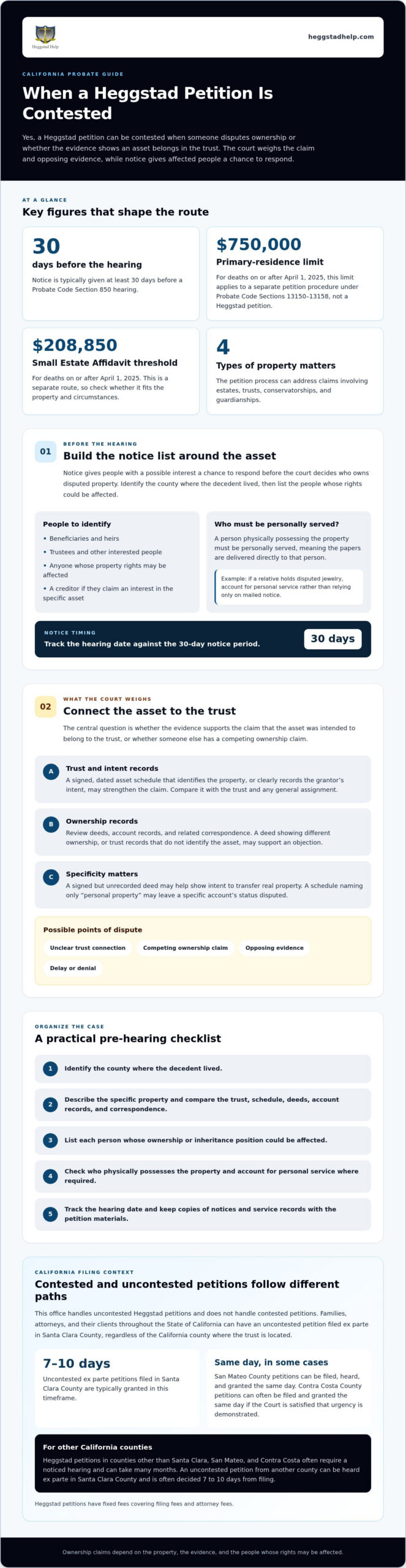
A Heggstad petition can be contested when someone disputes whether the property belongs in the trust or has a competing claim to it. The California Probate Code 850 petition process lets the court consider a claim to bring an omitted asset into a trust, and the petition must explain the facts supporting that claim. Interested persons must receive notice of the hearing, and a person physically possessing the property must be personally served.
It’s understandable to worry that a petition will settle the dispute automatically, but the court must weigh the claim and any opposing evidence. A signed, dated trust asset schedule that identifies the property or clearly records the grantor’s intent may strengthen the petition. This article explains when a challenge can arise, who must receive notice, and the kinds of estate, trust, conservatorship, and guardianship property disputes a Probate Code Section 850 petition can address. It also clarifies how a focused petition differs from full estate administration, so you can better understand the process ahead.
Key Takeaways
- A challenge may turn on whether the evidence shows the asset was intended to belong to the trust, or whether someone else has a competing ownership claim.
- Before a hearing, identify interested people and anyone physically holding the property so notice requirements can be addressed.
- Probate Code Section 850 can address property claims involving trusts, estates, conservatorships, and guardianships, but the dispute must fit the petition process.
- Gather trust documents, deeds, account records, and related correspondence to help clarify the property’s ownership history and the grantor’s intent.
Can a Heggstad Petition Be Contested?
Yes. A Heggstad petition can be contested if a trustee, beneficiary, heir, or another interested party disputes ownership or the evidence that an asset belongs in the trust. The court considers the claim to the property and its supporting documents, including evidence of the grantor’s intent.
For deaths on or after April 1, 2025, the California Legislature lists a $750,000 limit for transferring a decedent’s primary residence by petition under Probate Code §§ 13150-13158. That is a separate procedure from a Heggstad petition, so identify the property and the legal route being considered before filing.
Deadlines and Response Options
Deadlines and response options are the filing and hearing dates that shape when parties can present their positions. The petition’s hearing schedule matters because notice gives affected parties an opportunity to respond before the court decides ownership.
Interested parties can challenge the claim with evidence, such as a deed showing different ownership or trust records that do not identify the asset. After service, California Probate Code Section 851.1 allows petitioners to begin formal discovery, a process for obtaining relevant information. Sections 852-854 address continuances, jurisdiction challenges, and pausing a petition when a related civil case is pending. Appeal options depend on the order and applicable procedure, so parties should promptly assess the order’s effect and any filing deadline.
Risks, Defenses, and Alternatives
The central risks are an unclear connection between the trust and the property, opposition from an interested party, delay, or denial. A precise description of the asset and dated records supporting the claim can help clarify the case. If an interested party objects, the matter is not an uncontested ex parte petition.
For an omitted asset, compare the trust, any signed asset schedule, a general assignment, and deeds or account records. For example, a signed but unrecorded deed may help show intent to transfer real property, while a schedule naming only “personal property” may leave a specific account’s status disputed. Parties may resolve a disagreement through agreement instead of litigating ownership. A separate small-estate procedure may fit some property claims; for deaths on or after April 1, 2025, California’s Small Estate Affidavit threshold is $208,850. Check whether that route matches the asset and circumstances.
Notice requirements for beneficiaries, heirs, and creditors
Notice gives people with a possible interest a chance to respond before the probate court decides who owns disputed property. In a Probate Code Section 850 matter, the ruling may affect ownership, so identifying interested parties early helps prevent a hearing from proceeding without someone directly affected.
Venue matters, too. A California Heggstad petition is filed in the county where the decedent lived. Before filing, identify that county and list beneficiaries, heirs, trustees, and anyone else whose property rights could be affected. A creditor may need attention if the creditor claims an interest in the specific asset; a general debt alone does not establish an ownership claim.
California Probate Code Section 851 governs hearing notice. Notice is typically given at least 30 days before the hearing. A party physically possessing the property must be personally served, meaning the papers are delivered directly to that person. For example, if a relative holds disputed jewelry, identify that person and account for personal service rather than relying only on mailed notice.
Build a notice list around the asset and the court order being requested. Compare the trust documents with the petition, then identify each person whose ownership or inheritance position could be affected. Record each person’s contact information and connection to the property so the notice requirements can be addressed accurately.
- Identify the county where the decedent lived.
- List beneficiaries, heirs, trustees, and other interested people.
- Determine whether anyone physically possesses the asset.
- Track the hearing date against the 30-day notice period.
Keep copies of notices and service records with the petition materials. That file helps show which parties were notified and supports orderly consideration at the hearing. For a practical overview of Heggstad petition considerations, review the filing information before organizing the notice list.
Property disputes involving estates, trusts, conservatorships, and guardianships
According to the California Legislature, California Probate Code Sections 850-859 address the conveyance or transfer of property claimed to belong to a decedent or another person. Evidence such as trust documents, deeds, account records, and related correspondence can help show ownership or the grantor’s intent during the California Probate Code 850 petition process.
Disputes Over Estate and Trust Property
A property dispute can arise when an estate, trust, conservatorship, or guardianship claims an asset held or claimed by someone else. Identifying the specific property and the competing claims helps distinguish an ownership petition from the administration of an entire estate.
For example, a decedent may have signed a deed transferring a home to a living trust, but never recorded it. The trustee may seek an order recognizing the home as trust property, while an heir may argue that the property remained in the estate. Probate Code Section 856 allows a court to order a person holding property to transfer it to the rightful owner.
Conservatorship and guardianship matters can also involve property claimed for a protected person. Identify the asset, who holds it, and each interested party’s claim. If related litigation is already pending, that may affect how the court handles the petition. HEGGSTAD HELP focuses on Heggstad petitions, not contested trust litigation or general civil litigation.
Evidence of Ownership or Entitlement
Evidence of ownership or entitlement connects the claimant, the property, and the claimed right. The court needs facts and supporting records for the requested transfer, not only a statement that the grantor intended to fund a trust.
The Estate of Heggstad case, reported at 16 Cal.App.4th 943, applied Probate Code Section 850 to real property not formally transferred before the grantor died. A signed and dated schedule of trust assets, a general assignment, or a signed but unrecorded deed may help show intent. Match each document to a precise asset description, such as the property address or account record.
Gather the trust instrument, relevant amendments, deeds, account records, and correspondence related to the transfer decision. Compare names and property descriptions across the documents. A Heggstad petition should show which asset was intended for the trust and the basis for the claimant’s request.
What a California Probate Code 850 petition is
A Probate Code Section 850 petition asks the probate court to resolve a specific claim about property ownership or possession. It can help determine whether an asset belongs to a trust, an estate, or another person.
Purpose of a Probate Code 850 Petition
A Heggstad petition addresses identified property; it is not a request to administer an entire estate. For example, a trustee may ask the court to recognize a home as trust property when title remained in the decedent’s name. The petition must set out facts linking the asset to the trust and supporting the requested court order.
This distinction helps interested parties understand what the court is being asked to decide. The petition should identify the property precisely, explain the basis for treating it as trust property, and include supporting records. A deed, trust provision, or account record may help establish how the asset was held.
Who May File a Petition
Depending on the circumstances, a personal representative, trustee, interested person, conservator, or guardian may file a Probate Code Section 850 petition. The petitioner’s role should connect to the property claim, such as a trustee seeking an asset for a trust or a conservator asserting a protected person’s interest.
The petition must allege facts and legal grounds supporting the requested order. Explain how a signed trust document, deed, or other record relates to the asset, and identify who currently holds or claims it. Organize the records by property so the court and interested parties can follow the claim.
Under Probate Code Section 856, the court may order a person holding property to transfer it to the rightful owner. Probate Code Section 859 allows double damages when someone wrongfully takes or conceals property covered by that provision. The requested remedy should match the facts alleged and evidence presented.
To organize a property claim and its supporting documents, review Heggstad petition filing options.
HEGGSTAD HELP: Heggstad Petition Filing
Heggstad Help, a service of attorney Robert P. Bergman, assists families, attorneys, and their clients throughout California with uncontested Heggstad petitions. Mr. Bergman is a Board-Certified Specialist in Estate Planning, Trust, and Probate Law by the State Bar of California Board of Legal Specialization.
For trusts located anywhere in California, petitions can be filed ex parte (without a formal hearing) in Santa Clara County Probate Court. Santa Clara County petitions are typically granted in 7 to 10 days. San Mateo County petitions can be filed, heard, and granted the same day; Contra Costa County petitions can often be granted the same day when the court is satisfied urgency exists. The office handles uncontested petitions, not contested petitions.
Heggstad Petition Filing can help address an omitted trust asset, while Trust Asset Title Correction can help resolve a title issue after the court process. If your matter is uncontested, contact Heggstad Help to discuss the next step.
Choose a Practical Next Step
The California Probate Code 850 petition process becomes more manageable when you define the decision you need: which property is at issue, who claims it, and what outcome would resolve the title question? Before moving forward, write down any disagreement that remains and the specific point each party disputes. That can help focus the next discussion on the property claim, rather than unrelated trust or estate concerns.
If you’re helping a family member or advising a client, keep the immediate objective in view: determine whether the matter is uncontested and organize the information needed to evaluate the requested court order. For an uncontested matter, Ex Parte Court Order Services may be relevant to the filing plan. A contested ownership dispute requires a different assessment, so distinguish disagreement over evidence from a question about the filing itself.
Heggstad Help offers focused assistance with eligible petition filings and related title correction. Contact Heggstad Help to discuss your petition and identify a practical next step. A clear question and an organized record can help you move forward with greater confidence.
Frequently Asked Questions
Do I need an attorney to file one?
The right approach depends on your role, the property, and whether anyone objects. An attorney can help you understand the California Probate Code 850 petition process and prepare a claim that connects the requested order to the supporting records. For example, bring the trust, relevant amendments, and any deed or account documents to a discussion about the property at issue.
What Are the Filing Fees and Attorney Costs Associated with the Petition?
A clean petition means no interested parties object, all interested parties waive notice of a hearing, and all interested parties consent to the petition. Additional fees may apply; see the Fees and Costs page for details.
What if the asset isn’t specifically listed on the Schedule of Trust Assets?
Even if an asset is omitted from a trust schedule, other records may support the grantor’s intent. Compare the schedule with a signed assignment, deed, account records, or correspondence created during estate planning. For example, a schedule may refer to “all property” while a separate deed names the home. Check whether the documents identify the same asset and connect it to the trust.
What is a California Probate Code Section 850 petition and when is it used?
The California Probate Code 850 petition process provides a way to ask the court to resolve a specific property ownership or possession claim. It may apply when a trustee, estate representative, conservator, guardian, or interested person claims an asset belongs to someone else. A petition should identify the property, explain the factual basis for the claim, and state the court order requested.
Which California probate court has jurisdiction over an 850 petition?
For a decedent’s estate matter, the petition is generally filed in the probate court in the county where the decedent lived. The appropriate filing location can depend on the petitioner and the property dispute. For example, a trust’s location alone does not establish where every petition belongs. Identify the decedent’s county of residence and the nature of the claim when assessing venue.
What forms and supporting documents are required to file a section 850 petition?
A Heggstad petition sets out the facts supporting the claim and includes documents that support those facts. Depending on the asset, relevant records may include the trust and amendments, a deed, account statements, or a signed assignment. Describe the property clearly and organize the records so each supports a point in the petition. Notice and service documents may also be required.

Article by
Robert P. Bergman, Attorney at Law
Attorney Robert P. Bergman ("Bob Bergman") has been a Board-Certified Specialist in Estate Planning, Trust and Probate Law since 2011, as certified by the California State Bar Board of Legal Specialization. For several years, Bob has assisted families and the clients of other attorneys with obtaining court orders through Heggstad petitions to avoid the time and expense of Probate administration. Bob is friendly, very approachable, and believes in explaining complex legal topics in clear ordinary language so that his clients understand exactly what they're doing and why they're doing it.
Bob is often able to assist clients who are in other counties than his home county of Santa Clara through his approach to Heggstad petitions.
Disclaimer
This article is for informational purposes only. Nothing in this article is intended to replace legal advice from a competent attorney or be considered legal guidance for anybody's specific legal situation. Nobody should rely on information in this article in making legal decisions without such consultation.