
You’ve just discovered that your family’s most valuable asset, the family home, was accidentally left out of the trust, and now a title company is rejecting your authority to sell it. It’s a frustrating complication that often surfaces during a refinance or after a sudden passing, leaving families feeling overwhelmed by the prospect of a year-long court battle. If the estate exceeds the small estate threshold, which is $208,850 for deaths on or after April 1, 2025, and $239,700 for deaths on or after April 1, 2026, you might worry that the Heggstad petition process California provides is your only remaining hope to avoid a full probate.
We understand how stressful this uncertainty feels, but mastering these legal steps allows you to transfer forgotten assets into your trust and secure a valid court order (a legal document from a judge confirming ownership) without the crushing weight of statutory fees. This guide for a Heggstad Petition in California will show you how to navigate Probate Code Section 850 and leverage strategic filing locations to obtain clear title to real property. You’ll learn how to bypass the typical 12 month probate delay and potentially resolve your case in as little as seven to 10 days.
Key Takeaways
- Discover how the Heggstad petition process California provides can reduce a 12-month probate wait to just 7 to 10 days by utilizing strategic filing venues like Santa Clara County.
- Identify if your assets qualify for simpler transfers by referencing the small estate thresholds of $208,850 (for deaths on or after April 1, 2025) and $239,700 (for deaths on or after April 1, 2026).
- Learn how to secure an ex parte order (a court ruling granted without a formal hearing) to achieve same-day results for urgent title corrections in San Mateo and Contra Costa Counties.
- Master the specific requirements of Probate Code Section 850 to prove the decedent’s intent and successfully transfer real property into a trust after a death.
- Understand the benefits of a fixed-fee service model that provides cost certainty by covering both filing and attorney fees while bypassing high statutory probate costs.
Understanding the Heggstad Petition in California
A Heggstad petition is a specialized legal tool used to confirm that an asset belongs in a trust, even if the formal title transfer was never completed. This complication frequently arises when a homeowner creates a trust but neglects to record a new deed with the county recorder’s office. When the settlor (the person who created the trust) passes away, the Successor Trustee is responsible for initiating the Heggstad petition process California provides to correct this oversight. Without this legal intervention, the asset remains stuck in the decedent’s individual name, which often triggers the very probate process the trust was originally designed to avoid.
Before moving forward, it’s vital to determine if a simpler Small Estate Affidavit might apply. However, these simplified procedures are only available for estates falling below specific financial limits. In 2026, you must consider two distinct figures: the $208,850 threshold (for deaths on or after April 1, 2025) and the $239,700 threshold (for deaths on or after April 1, 2026). If the real property or the combined value of the estate exceeds these amounts, a petition under Probate Code Section 850 becomes the most effective path to secure the asset.
The Legal Basis: Probate Code Section 850
The modern petition is rooted in the landmark 1993 appellate case, Estate of Heggstad. This ruling established that a written declaration of trust is sufficient to transfer property, even if a formal deed was never recorded. This principle is now codified under Probate Code Section 850, which allows the court to "perfect" the title. The cornerstone of any successful filing is "settlor intent," which requires proving the creator of the trust clearly intended for the asset to be included in the trust estate.
We look for specific evidence to satisfy the court’s requirements. A "Schedule A" (the list of assets typically attached to the back of a trust) or a specific mention of the property address within the trust document itself serves as vital proof. When we present this evidence through the Heggstad petition process California courts require, the judge can issue an order confirming trust ownership, effectively funding the trust after the settlor has passed away.
Heggstad Petition vs. Probate in California
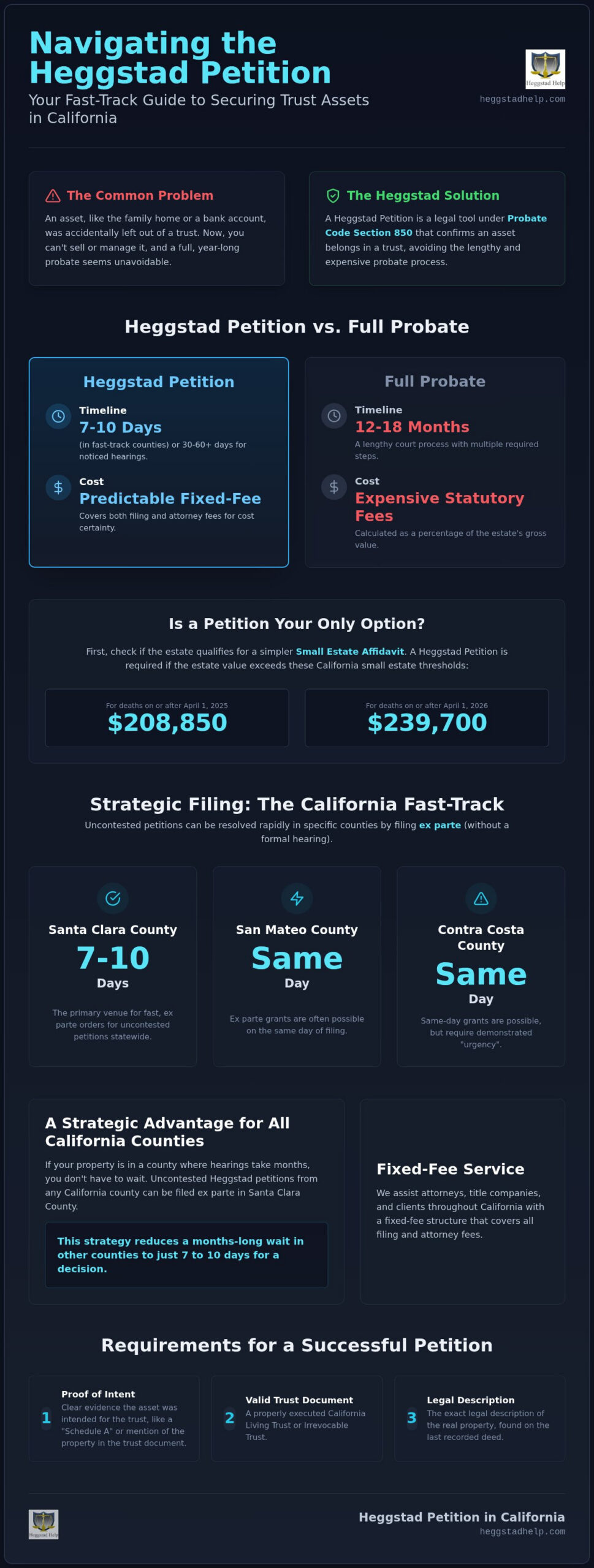
Choosing a petition over a full probate administration offers significant advantages in both speed and cost. A traditional probate often drags on for 12 to 18 months, whereas a Heggstad petition is typically resolved in 30 to 60 days. In certain "fast-track" counties, the timeline is even more compressed. We regularly secure orders in seven to 10 days in Santa Clara County. In San Mateo and Contra Costa Counties, we can often obtain same-day grants if we can demonstrate urgency to the court. For a detailed breakdown of these differences, see our Heggstad Petition vs. Probate in California: 2026 Comparison Guide.
The financial difference is equally stark. Probate fees are statutory, meaning they are calculated as a percentage of the estate’s gross value, which can be incredibly expensive. Our firm assists attorneys, title companies, and families throughout the state using a fixed-fee structure that covers both filing and attorney fees. If you’re dealing with a county where noticed hearings take many months, remember that uncontested petitions from those other counties can often be heard ex parte (without a formal hearing) in Santa Clara County, where they are typically decided within 7 to 10 days of filing.
Requirements for a Successful Heggstad Petition in California
Success in the Heggstad petition process California provides depends on your ability to present a clear, documented connection between the asset and the trust. Courts aren’t looking for a perfect track record of paperwork; they are looking for evidence that the decedent intended for the property to be managed by the Successor Trustee. You’ll need a validly executed California Living Trust or Irrevocable Trust document as your foundation. Additionally, you must provide the exact legal description of the real property, which is usually found on the last recorded deed. It’s equally important to verify that the asset wasn’t intentionally excluded or transferred out of the trust for a specific reason, such as a sale that never closed.
Proving Settlor Intent to the Court
Proving intent is the most critical hurdle in this procedure. Settlor intent is the documented desire of the trust creator to hold an asset within their estate plan. The most powerful piece of evidence is the "Schedule of Assets" or "Schedule A" typically attached to the back of the trust document. If the property address or legal description appears there, your case is significantly stronger. However, judges also consider secondary evidence. This might include bank statements showing trust funds were used for property taxes, letters of instruction to an attorney, or even draft deeds that were never signed. This guide to the Heggstad petition process explains how courts weigh these different types of evidence to reach a decision.
Document Checklist for Filing
To initiate the filing, you must prepare a specific set of documents for the court. This includes the Petition itself, the Notice of Hearing, and a Proposed Order that the judge will sign if the petition is granted. Accuracy is paramount here. A minor typo in the legal description can lead to title company rejections later, even if the judge signs your order. You can find a complete list of what you’ll need in our Documents Needed for Heggstad Petition in California: A Complete Filing Checklist.
We assist attorneys, title companies, and families across the state using a fixed-fee structure that covers both filing and attorney fees. This approach eliminates the stress of unpredictable hourly billing while ensuring your paperwork meets the strict standards of the Probate Code. In counties like Santa Clara, San Mateo, and Contra Costa, we can often file these petitions ex parte, which means we skip the long wait for a formal hearing. This can reduce the timeline to just 7 to 10 days in Santa Clara County, or even same-day in San Mateo and Contra Costa if there is demonstrated urgency. If you’re managing an estate that exceeds the small estate thresholds of $208,850 (for deaths on or after April 1, 2025) and $239,700 (for deaths on or after April 1, 2026), taking these steps now prevents a much longer probate. For those looking for a streamlined resolution, you might consider professional help with your Heggstad petition to ensure every requirement is met from day one.
Strategic Venue Selection: Fast-Track Counties in California
Many families assume they must file a petition in the county where the real property is located. However, the Heggstad petition process California courts follow is actually more flexible. The choice of venue, which is the specific court where your case is heard, is perhaps the most significant factor in how quickly you can clear title. While some probate courts are backed up for months, others have established procedures that allow for a resolution in days rather than weeks. This strategic choice is especially important if the estate value is above the small estate thresholds of $208,850 (for deaths on or after April 1, 2025) and $239,700 (for deaths on or after April 1, 2026).
Ex Parte Advantages in the Bay Area
The primary speed advantage comes from filing "ex parte," which is a legal term for obtaining a court ruling without a formal noticed hearing. In Santa Clara County, uncontested petitions are typically granted within seven to 10 days of filing. San Mateo and Contra Costa Counties offer even more rapid results, with the potential for same-day grants. It is important to note that Contra Costa County usually requires a demonstration of "urgency" to skip the standard court calendar. By comparison, other California counties often require noticed hearings that can take 30 to 60 days just to get on the calendar, plus additional time for legal notice. Contested petitions, where someone objects to the transfer, will naturally take longer regardless of the location.
Statewide Filing Strategy
You aren’t necessarily restricted to the county where the house sits. A Heggstad petition can often be filed in the county where the trustee resides. This means if a trustee lives in Northern California but the forgotten property is in Los Angeles or San Diego, we can often use the Santa Clara jurisdiction to secure an order in about a week. This strategy bypasses the months of waiting common in larger Southern California probate departments. Even if a noticed hearing is eventually required, the timeline is usually 30 to 60 days, which is far better than the 12 to 18 months required for a full probate.
Our firm assists attorneys, title companies, and families throughout California using a fixed-fee structure that covers both filing and attorney fees. We understand the specific requirements for a successful Heggstad petition and how to leverage local court rules to your advantage. Whether you are a professional fiduciary or a family member trying to settle an estate, choosing the right venue can mean the difference between a quick title correction and a long, expensive court process. If you need to move quickly, we can help you determine the best filing strategy for your specific situation across any California county.
Step-by-Step: The Heggstad Petition Process in California
The Heggstad petition process California requires begins with a methodical evaluation of your existing trust documents and property records. We first determine if the asset and your trust meet the specific criteria established in Probate Code Section 850. This initial review is vital because if the estate value falls below certain limits, you might qualify for a Small Estate Affidavit instead. Specifically, these thresholds are $208,850 for deaths on or after April 1, 2025, and $239,700 for deaths on or after April 1, 2026. If the real property value exceeds these amounts, a formal petition is the most reliable way to transfer the asset without a full probate.
Once we confirm the petition is the correct path, we move into the drafting phase. This involves creating a legal document that incorporates the exact legal description of the property and clear evidence of the settlor’s intent. After drafting, the petition is filed with the Superior Court. Depending on the county, we then provide notice to all interested parties and heirs as mandated by the Probate Code. This ensures everyone with a legal interest in the estate is informed of the request to transfer the asset into the trust.
Phase 1: Drafting and Filing
Precision during the drafting phase prevents future headaches. One of the most common errors we see is an inaccurate legal description of real property. If the description on the petition doesn’t perfectly match the last recorded deed, a title company may reject the eventual court order. We mitigate this risk by performing a thorough title search before filing. Our fixed-fee structure simplifies this stage by covering both the court filing fees and all attorney fees. For a detailed breakdown of these expenses, you can review our guide on California Heggstad Petition Cost: Fees, Legal Expenses, and Savings in 2026.
Phase 2: The Hearing and Final Decree
The path to a final decree depends on whether the court requires a noticed hearing or allows an ex parte application. In a noticed hearing, which is standard in many California counties, the timeline is typically 30 to 60 days plus the time required to serve notice. During the hearing, the judge reviews the evidence of intent to ensure the transfer follows the decedent’s wishes. If the judge is satisfied, they issue a "Heggstad Order," which is a valid court order confirming trust ownership. In fast-track counties like Santa Clara, we often secure these orders in as little as seven to 10 days. The final, essential step is recording a certified copy of this order with the County Recorder to officially update the deed and clear the title.
Navigating these procedural requirements demands attention to detail and an understanding of local court preferences. If you want to ensure your filing is handled with professional precision, you can secure professional help with your Heggstad petition to move your case forward without unnecessary delays.
Finding Expert Help for Your Heggstad Petition in California
Facing a title rejection or a stalled real estate closing is an incredibly stressful experience for any Successor Trustee. While many probate lawyers handle general estate administration, few specialize in the rapid ex parte (without a formal hearing) procedures that characterize the Heggstad petition process California allows. Robert P. Bergman has been a Board-Certified Specialist in Estate Planning, Trust and Probate Law since 1980. This certification means he has met rigorous standards of experience and peer review that generalist attorneys often haven’t achieved, particularly regarding the nuances of Probate Code Section 850.
Specialized experts know that while many counties require a noticed hearing taking 30 to 60 days plus notice time, specific venues like Santa Clara County offer a significantly faster route. We regularly file uncontested petitions ex parte in Santa Clara, obtaining orders in just seven to 10 days. We also leverage same-day grant opportunities in San Mateo and Contra Costa Counties when urgency is demonstrated. Even if your property is located in a county where hearings take many months, we can often file in Santa Clara if the trustee resides there, securing a faster resolution for your family and avoiding the 12 to 18 month probate wait.
Fixed-Fee Transparency
Most legal fees in probate matters are either statutory (set by law as a percentage of the estate’s gross value) or billed by the hour, which can lead to unpredictable costs. We believe Successor Trustees and beneficiaries deserve more predictability. Our fixed-fee structure covers both the attorney fees and the court filing fees, ensuring you know exactly what the estate will pay from the very beginning. This transparency is especially helpful when managing expenses for estates that exceed the small estate thresholds of $208,850 (for deaths on or after April 1, 2025) and $239,700 (for deaths on or after April 1, 2026). By choosing a fixed-fee model, you protect the estate’s assets from the high costs typically associated with traditional probate administration.
Next Steps for Successor Trustees
If you’ve discovered an asset that was never properly titled in the trust, you don’t have to accept a lengthy court delay. You can start the resolution process by gathering your trust documents and the most recent deed for a free initial evaluation. We assist attorneys, title companies, and clients throughout California to correct title issues and secure clear ownership. To get started, schedule your consultation for a Heggstad Petition in California with Robert P. Bergman today and see if your case qualifies for our fast-track ex parte services.
Secure Your Family’s Legacy Without the Probate Wait
Correcting a title error doesn’t have to mean entering a year-long legal maze. By understanding the Heggstad petition process California offers, you can move assets into a trust efficiently and affordably. This is particularly vital if the estate value is above the small estate thresholds of $208,850 (for deaths on or after April 1, 2025) and $239,700 (for deaths on or after April 1, 2026). In these cases, a petition under the Probate Code is often your most effective path to avoiding a full probate and ensuring the decedent’s wishes are honored.
Strategic filing remains your greatest advantage. While some counties face significant backlogs, utilizing the ex parte procedures in Santa Clara County can result in a turnaround of just seven to 10 days. Robert P. Bergman, a Board-Certified Specialist since 1980, provides the calm competence needed to navigate these complex court requirements. With a fixed-fee structure that covers all filing and attorney costs, you can resolve title issues with complete financial certainty and peace of mind.
Take the first step toward clearing your property title and fulfilling your role as a Successor Trustee today. You can bypass the traditional probate system and secure a court order that protects the estate’s value. Get a Fixed-Fee Quote for Your Heggstad Petition in California
Frequently Asked Questions
How long does the Heggstad petition process take in California?
The timeline depends largely on the county where you file your petition. In Santa Clara County, uncontested petitions are typically granted within seven to 10 days, while San Mateo and Contra Costa Counties can offer same-day grants if you can demonstrate a specific urgency. In most other counties, the court requires a noticed hearing that can take 30 to 60 days plus additional time for notice, though we can often bypass these months of waiting by filing in Santa Clara County if the trustee resides there.
Can I file a Heggstad petition if there is no Schedule A in the trust?
Yes, you can still file a Heggstad Petition in California even if a formal Schedule A (the list of assets intended for the trust) is missing. While a schedule is excellent evidence, the court will consider other proof of settlor intent, such as bank statements, letters of instruction, or specific property addresses mentioned within the trust document itself. The key is providing enough documentation to convince a judge that the trust creator truly intended for the asset to be part of the trust estate.
What is the cost of a Heggstad petition in California compared to probate?
A petition is significantly more affordable than a full probate, which typically costs between 4% and 7% of the estate’s gross value in statutory fees. For the Heggstad petition process California families use to avoid these costs, we provide a fixed-fee structure that covers both the court filing fees and all attorney fees. This model provides cost certainty and prevents the estate from being depleted by the high statutory percentages required in traditional probate administrations.
Do I need to go to court for a Heggstad petition in Santa Clara County?
For uncontested cases in Santa Clara County, a formal court appearance is usually not required. These petitions are regularly filed ex parte (a legal term for a ruling granted without a formal hearing), meaning the judge reviews the written evidence and signs the order in chambers. This streamlined approach is one of the primary reasons we can secure a valid court order in as little as seven to 10 days for our clients and the title companies we assist.
Does a Heggstad petition work for bank accounts and brokerage accounts?
Yes, this procedure is effective for a wide variety of assets, including bank accounts, brokerage accounts, and partnership interests. While many people associate a Heggstad Petition in California with real estate, it can be used for any asset that was intended to be in the trust but remained in the decedent’s individual name. If you can show clear intent through trust language or account records, the court can order the financial institution to transfer the account into the trust’s name.
What happens if a Heggstad petition is contested by an heir?
If an heir or interested party files a formal objection, the case loses its uncontested status and cannot be handled through the rapid ex parte process. The matter will be moved to the regular probate calendar for a noticed hearing, which significantly lengthens the timeline. Contested petitions require a more complex legal strategy and will take longer than the standard 30 to 60 days required for a typical noticed hearing, as the court must weigh the conflicting evidence presented by both sides.
Is a Heggstad petition available for properties located outside of California?
No, the Heggstad petition is a specific procedure based on the California Probate Code and only applies to assets that would otherwise be subject to the California probate system. If the decedent owned real property in another state that was left out of the trust, you’ll likely need to follow that state’s specific "ancillary probate" or equivalent procedures. We recommend consulting with an attorney in the state where the property is located to determine their specific requirements for trust asset transfers.
What is the small estate limit for a Heggstad petition in 2026?
A petition is usually only necessary if the estate value exceeds the small estate threshold, which allows for a simpler transfer process without a court order. In 2026, you must be aware of two specific limits: the $208,850 threshold (for deaths on or after April 1, 2025) and the $239,700 threshold (for deaths on or after April 1, 2026). If the assets are valued below these amounts, you can likely use a Small Estate Affidavit; if they are above these figures, the Heggstad petition process California provides becomes your primary tool to avoid full probate.

Article by
Robert P. Bergman, Attorney at Law
Attorney Robert P. Bergman ("Bob Bergman") has been a Board-Certified Specialist in Estate Planning, Trust and Probate Law since 2011, as certified by the California State Bar Board of Legal Specialization. For several years, Bob has assisted families and the clients of other attorneys with obtaining court orders through Heggstad petitions to avoid the time and expense of Probate administration. Bob is friendly, very approachable, and believes in explaining complex legal topics in clear ordinary language so that his clients understand exactly what they're doing and why they're doing it.
Bob is often able to assist clients who are in other counties than his home county of Santa Clara through his approach to Heggstad petitions.
Disclaimer
This article is for informational purposes only. Nothing in this article is intended to replace legal advice from a competent attorney or be considered legal guidance for anybody's specific legal situation. Nobody should rely on information in this article in making legal decisions without such consultation.


