
A missing deed doesn’t have to mean your family is trapped in probate court for the next year. You might feel overwhelmed discovering that a home was left out of a living trust, especially when facing the prospect of a 12 to 18 month delay. It’s a common frustration to see a trust exist but realize the deed remains in the individual’s name. Understanding what happens if a house is not in a trust when someone dies California is critical to protecting the estate from high statutory fees. This guide reveals how you can bypass a full probate through a Heggstad petition (a legal procedure under Probate Code Section 850 that asks a judge to recognize the asset as part of the trust). We’ll explain how to secure a fast court order to confirm trust ownership and why fixed-fee legal help is the most efficient path forward.
Key Takeaways
- Understand that an “unfunded” house (an asset not properly deeded to the trust) remains part of the probate estate and cannot be transferred to beneficiaries until the title is legally corrected.
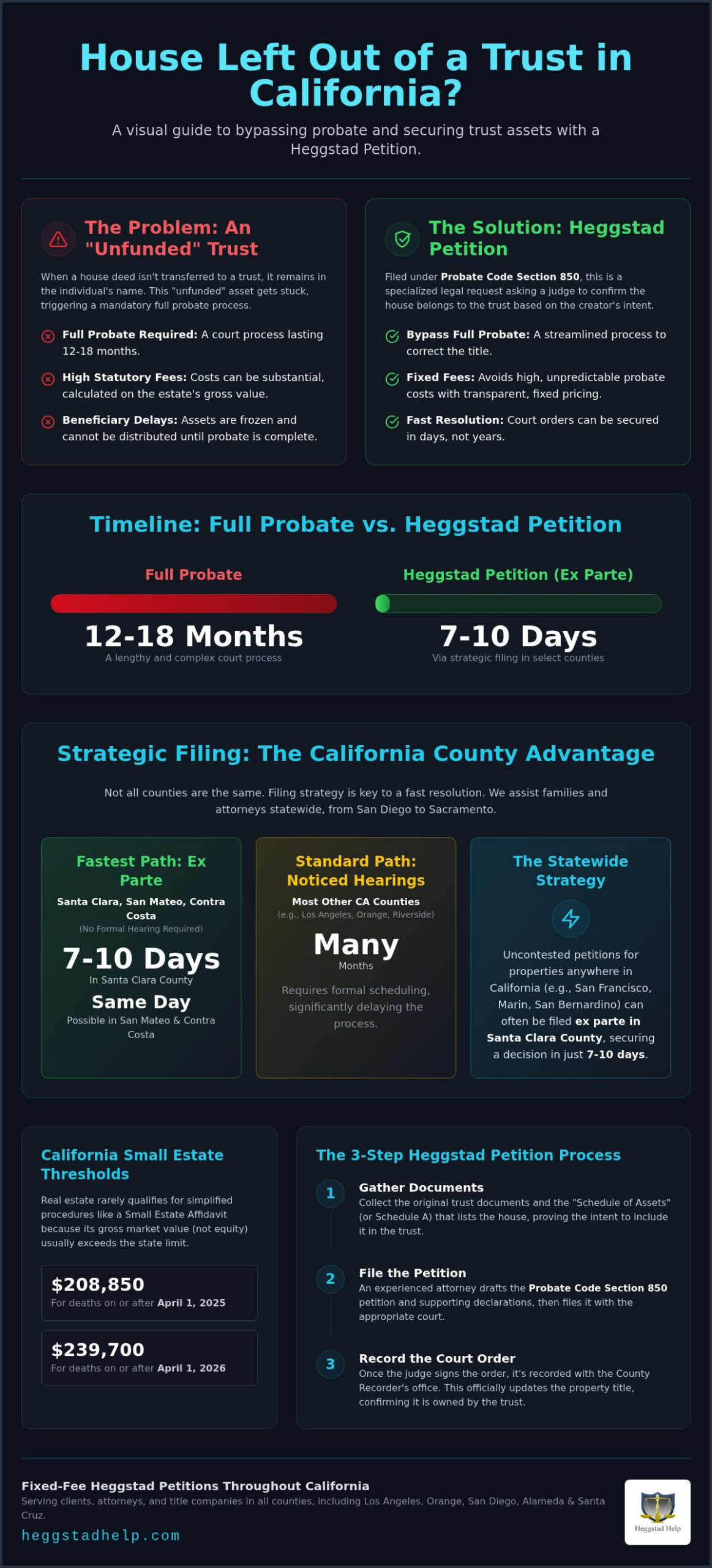
- Learn how a Heggstad petition, filed under Probate Code Section 850, bypasses the 12 to 18 month probate process by asking a judge to confirm the home as trust property based on the decedent’s intent.
- Discover how to secure a court order in as little as 7 to 10 days by filing ex parte (without a formal hearing) in Santa Clara County, a strategy available for properties located throughout the state.
- Identify the specific legal steps to resolve what happens if a house is not in a trust when someone dies California, including how to use a “Schedule of Assets” to avoid high statutory probate fees.
The Legal Reality of an Unfunded House in California
When someone passes away, families often assume that having a trust document is enough to manage the estate. However, the legal reality changes significantly when the deed to a home was never transferred into the trust’s name. An unfunded trust is a trust that exists on paper but does not legally own the assets intended for it. In this scenario, the property is technically an "unfunded" asset that remains part of the decedent’s probate estate.
Understanding what happens if a house is not in a trust when someone dies California is vital because, without court intervention, the title cannot be transferred to beneficiaries by the successor trustee alone. The county recorder’s office still sees the individual as the owner, which usually triggers a mandatory full probate in California. We support families and attorneys across the state, including those in Los Angeles, Orange, and Riverside, who need to file Heggstad petitions to correct these title errors. The Probate process is the standard court procedure used to settle a person’s debts and distribute their remaining assets as governed by the California Probate Code.
The California Small Estate Threshold in 2026
While some smaller assets can be transferred using simplified procedures, real estate rarely qualifies. For deaths occurring on or after April 1, 2025, the Small Estate Affidavit threshold is $208,850. Since most homes in California exceed these limits, a house usually requires more than a simple affidavit to transfer. Consider these points:
- The house value is calculated at gross market value, not equity.
- Successor trustees lack authority to sign deeds for property not officially owned by the trust.
- Title companies won’t issue insurance without a court order or probate.
Avoiding Full Probate with a Heggstad Petition in California
A Heggstad petition, filed under Probate Code Section 850, is a specialized legal request that asks the court to confirm a house belongs in a trust based on the decedent’s clear intent. This is the primary solution for what happens if a house is not in a trust when someone dies California. Rather than suffering through a year of California probate, this procedure allows a judge to "transfer" the title retroactively. We regularly assist families in Los Angeles, Orange, and San Diego by securing these court orders. This process typically costs a fraction of statutory probate fees and concludes significantly faster than a full probate administration in California.
Strategic Filing: The Santa Clara County Advantage
Timing is everything when managing an estate. In Santa Clara County, uncontested Heggstad petitions are often granted ex parte (without a formal hearing) in just 7 to 10 days. Similarly, San Mateo and Contra Costa Counties can often grant these orders the same day, provided urgency is demonstrated in Contra Costa. While other counties like Riverside, San Francisco, or San Bernardino often require noticed hearings that take many months, we can often have those uncontested petitions heard ex parte in Santa Clara County and decided within 7 to 10 days. Knowing what happens if a house is not in a trust when someone dies California helps you choose the fastest path. Our firm provides ex parte court order services throughout the entire state of California using fixed fees that cover both filing and attorney fees.
How to Transfer Your House to the Trust After Death
Recovering a home for a trust requires a methodical approach. First, you must gather the original trust documents and any "Schedule A" (a list of assets intended to be held by the trust) that specifically names the house. While the California Courts Self-Help Guide to Probate outlines the standard path for estates, a Heggstad petition offers a specialized shortcut. You’ll need to engage a specialized Heggstad petition attorney in California to draft the legal petition and supporting declarations. This documentation proves to the court that the decedent intended the home to be trust property despite the title error.
Once the court reviews the evidence, it issues a signed order confirming the house is trust property. You then record this order with the County Recorder to update the title. Our firm handles these filings state-wide, assisting clients in Alameda, Sacramento, and Santa Cruz with fixed fees that cover both attorney time and court filing costs. This transparency is vital for understanding what happens if a house is not in a trust when someone dies California, as it provides a predictable path to resolution without the variable costs of a full probate.
Why Work with a California Board-Certified Specialist?
Robert P. Bergman is a Board-Certified Specialist in Estate Planning, Trust and Probate Law with decades of specialized experience. Choosing a specialist ensures your 850 petition in California is drafted to meet the specific requirements of local courts, whether you’re in San Francisco or Marin. We provide a steady, knowledgeable hand to reduce the stress of navigating the California Probate Code. Our expertise ensures your petition is accurate, increasing the likelihood of a swift, favorable outcome.
Take Control of Your Family’s Estate Recovery
Discovering that a deed was never recorded into a trust can feel like a legal roadblock, but it doesn’t have to lead to a year of court delays. By understanding what happens if a house is not in a trust when someone dies California, you can choose a faster path through a Heggstad petition. This process confirms the decedent’s intent and updates the title without the high costs of full probate. Robert P. Bergman, a Board-Certified Specialist in Estate Planning, Trust and Probate Law, helps families in Los Angeles, Orange, and San Diego secure ex parte orders in as little as 7 to 10 days through strategic filings in Santa Clara County. Ready to bypass the probate process? Get a Fixed-Fee Quote for Your Heggstad Petition today. You have the tools to protect your inheritance and we’re here to guide you every step of the way.
Frequently Asked Questions
Can I sell a house that was left out of a trust in California?
You cannot sell a house left out of a trust until the title is legally corrected. Most California homes exceed the Small Estate Affidavit threshold of $208,850 for deaths on or after April 1, 2025. To address what happens if a house is not in a trust when someone dies California, you must file a Heggstad petition under Probate Code Section 850.
How much does a Heggstad Petition cost compared to full probate?
A Heggstad petition is significantly more cost-effective because it bypasses statutory probate fees. In a full probate, fees are calculated as a percentage of the gross estate value. For instance, a $1 million estate triggers roughly $46,000 in combined statutory fees for the attorney and executor. Our firm offers fixed fees for Heggstad petitions state-wide, providing a predictable and lower-cost alternative to the expensive probate process.
What happens if the house is not listed on a Schedule A?
You can still succeed even if the house isn’t on a Schedule A, provided other evidence of intent exists. A general assignment of all assets or specific trust language often suffices to prove the decedent’s wishes. Courts in counties like San Bernardino or Alameda look for clear and convincing evidence that the decedent meant for the property to be trust-owned, even if the deed was never recorded.
Is a Heggstad Petition possible if there is no written evidence of intent?
A Heggstad petition usually requires some form of written evidence to prove intent. While a Schedule A is standard, a signed "General Assignment" is often accepted. While counties like Riverside or San Diego often require noticed hearings taking many months, we can instead have uncontested petitions from those counties heard ex parte in Santa Clara County and decided within 7 to 10 days.

Article by
Robert P. Bergman, Attorney at Law
Attorney Robert P. Bergman ("Bob Bergman") has been a Board-Certified Specialist in Estate Planning, Trust and Probate Law since 2011, as certified by the California State Bar Board of Legal Specialization. For several years, Bob has assisted families and the clients of other attorneys with obtaining court orders through Heggstad petitions to avoid the time and expense of Probate administration. Bob is friendly, very approachable, and believes in explaining complex legal topics in clear ordinary language so that his clients understand exactly what they're doing and why they're doing it.
Bob is often able to assist clients who are in other counties than his home county of Santa Clara through his approach to Heggstad petitions.
Disclaimer
This article is for informational purposes only. Nothing in this article is intended to replace legal advice from a competent attorney or be considered legal guidance for anybody's specific legal situation. Nobody should rely on information in this article in making legal decisions without such consultation.


