California Trust Funding Mistakes: A 2026 Checklist to Avoid Probate

Did you know that 40% of do-it-yourself trusts in California are unfunded? Discovering a family home was never titled in the trust is stressful, but…

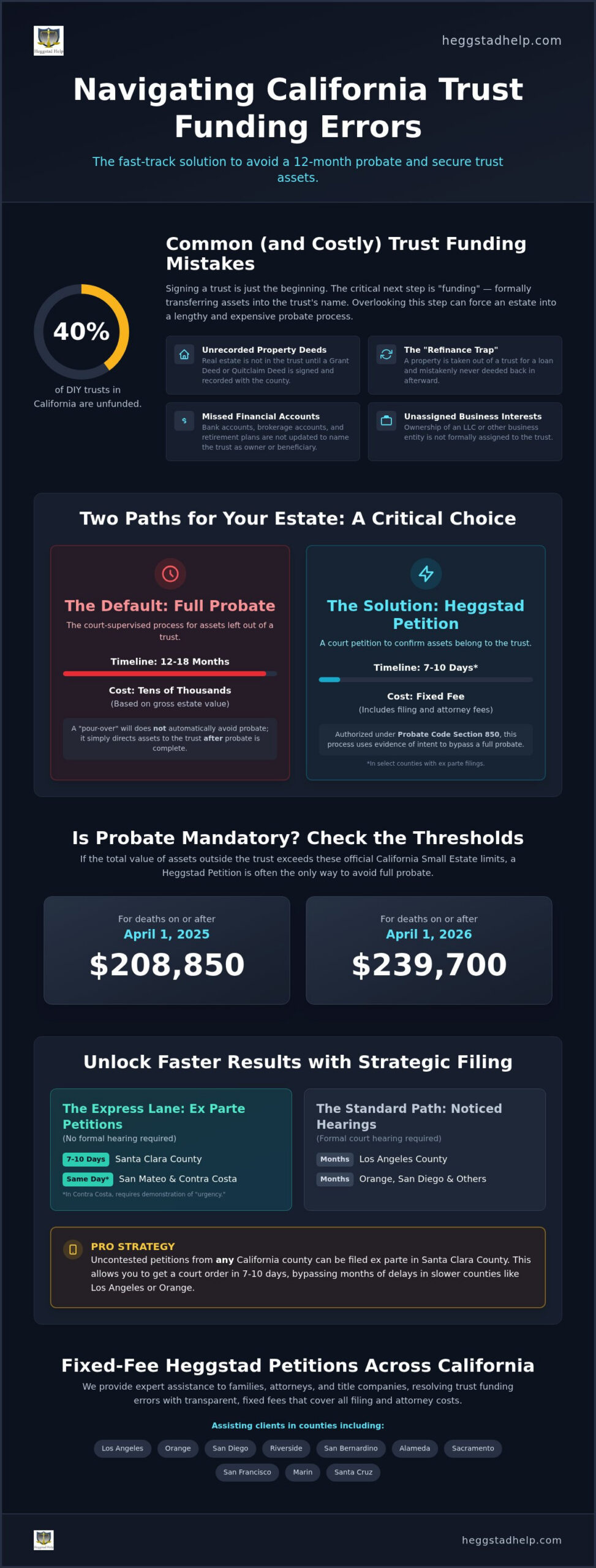
Did you know that 40% of do-it-yourself trusts in California are unfunded? Discovering a family home was never titled in the trust is stressful, but California trust funding mistakes don’t have to lead to a 12-month probate.

This guide explains how a Heggstad petition in California (a filing under Probate Code Section 850) transfers assets into a trust quickly. While Los Angeles, Orange County, or San Diego courts often require months of waiting, we help families and attorneys statewide by filing ex parte (without a formal hearing). Orders in Santa Clara County take 7 to 10 days, while San Mateo and Contra Costa can be granted the same day if urgency is shown. We resolve these errors with fixed fees covering both filing and attorney fees.

Key Takeaways

  • Identify common California trust funding mistakes like failing to record a Grant Deed for real property or neglecting to update retirement account beneficiaries.
  • Learn how a Heggstad petition, filed under Probate Code Section 850, can confirm trust ownership of assets even if the formal title transfer was never completed.
  • Discover how to bypass the standard 12-month probate process by using specialized ex parte court order services that can be granted in as little as 7 to 10 days.
  • Understand how to use fixed-fee legal services to correct title errors for properties located in any California county, including Los Angeles, Orange, and San Diego.

Identifying Common Trust Funding Mistakes in California

Many families believe that signing a trust document is the final step in their estate plan. However, what it means to fund a trust actually involves the physical transfer of title from your individual name into the name of the trust. Common California trust funding mistakes occur when this administrative step is overlooked. For example, you might acquire a new brokerage account or a second home in Riverside but forget to update the ownership records. Relying solely on a "Schedule A" (the list of assets often attached to a trust) is a risky strategy because banks and County Recorders require a formal change in legal title to recognize the trust’s authority.

Real Estate and Financial Asset Title Omissions

Whether you own a home in San Francisco or Orange County, a signed trust document alone won’t transfer real estate. You must record a Grant Deed or Quitclaim Deed to finalize the process. A frequent issue we see is the "refinance trap." This happens when a lender moves your home out of the trust to process a loan and you forget to deed it back in afterward. Similarly, neglecting to update beneficiary designations on life insurance or retirement accounts leaves those assets vulnerable. If the total value of assets left outside the trust exceeds the $208,850 threshold for deaths on or after April 1, 2025., a full probate is typically required. Even complex business interests like an LLC must be formally assigned to the trust to avoid multi-year court delays. We assist clients in Los Angeles, San Diego, and throughout California with fixed fees to correct these title errors efficiently.

When California trust funding mistakes occur, the primary casualty is the estate’s efficiency. Assets left in an individual’s name must generally pass through Probate Court (the court-supervised process of distributing a decedent’s estate). This isn’t just a minor paperwork hurdle; it’s a 12 to 18 month commitment that involves mandatory statutory fees for both attorneys and executors. These fees are calculated based on the gross value of the estate, often costing families in Los Angeles, San Diego, or Orange County tens of thousands of dollars before any distribution occurs.

To determine if you can avoid this process, you must look at the specific California small estate thresholds. For deaths occurring on or after April 1, 2025, the limit is $208,850. If the total value of assets outside the trust exceeds this figure, a full probate is typically mandatory unless a specialized legal remedy is utilized.

Probate Court Delays and Asset Recovery

Many people mistakenly assume a "pour-over" will (a backup will that transfers assets into a trust) solves funding errors automatically. It doesn’t. A pour-over will still requires a formal probate proceeding to be effective. This delay places immense stress on a successor trustee (the person in charge of the trust after death), particularly if they need to manage or sell a home in San Bernardino or Sacramento. Successor trustees dealing with missing assets in California can often find relief through Probate Code Section 850. This law allows for property transfer petitions that confirm trust ownership without the year-long wait.

California Trust Funding Mistakes: A 2026 Checklist to Avoid Probate

Solving Funding Errors with a Heggstad Petition

A Heggstad petition is a specialized legal request filed under Probate Code Section 850. It asks the court to confirm that an asset belongs in a trust even if the formal title transfer wasn’t completed. To succeed, the court requires "clear intent" showing the decedent meant for the asset to be part of their estate plan. This is often established if the property is listed on a schedule of assets or mentioned specifically within the trust’s purpose. When California trust funding mistakes are identified after death, this petition serves as the primary tool to avoid a full 12-month probate administration.

HEGGSTAD HELP provides these filing services for a fixed fee that covers both the filing and attorney fees. This transparency helps successor trustees manage costs while resolving title issues for clients throughout the entire state. If the petition is granted, the resulting court order allows the trustee to take legal title immediately. This process is essential when assets exceed the Small Estate Affidavit threshold of $208,850 for deaths occurring on or after April 1, 2025.

Procedural Advantages in Santa Clara, San Mateo, and Contra Costa Counties

Timing is critical. In counties like Los Angeles, Orange, or San Diego, noticed hearings often take many months. Strategic filing offers a faster path. Uncontested petitions from those counties can instead be heard ex parte (without a formal hearing) in Santa Clara County, where they’re typically granted in 7 to 10 days. In San Mateo and Contra Costa Counties, orders can often be filed and granted the same day, provided "urgency" is demonstrated in Contra Costa. This specialized approach ensures that assets are recovered quickly and efficiently.

Secure Your Estate Without the Probate Delay

Correcting California trust funding mistakes doesn’t have to be a multi-year ordeal. While an unrecorded deed or forgotten account can trigger probate if the estate exceeds the $208,850 limit for deaths on or after April 1, 2025, a Heggstad petition provides a faster resolution. By filing under Probate Code Section 850, you can bypass the standard 12-month court process and secure assets in weeks.

Robert P. Bergman, a Board-Certified Specialist with over 40 years of experience, offers fixed fees for all California Heggstad filings, including rapid 7 to 10 day results in Santa Clara County. Fix your trust funding mistake with a Heggstad Petition today and gain the peace of mind that comes with a properly titled estate. We’re here to help you move forward with confidence.

Frequently Asked Questions

What happens if I forgot to put my house in my trust in California?

If you forgot to deed your house into your trust, the property will likely face probate unless you file a Heggstad petition. This is a frequent example of California trust funding mistakes. Because most homes exceed the small estate limit of $208,850 for deaths on or after April 1, 2025, this petition is the only way to avoid a full probate.

How much does a Heggstad petition cost in California in 2026?

Our office handles Heggstad petitions throughout the state using a fixed-fee structure that covers both the court filing fees and the attorney fees. This provides financial certainty for families in Los Angeles, Orange, and San Diego. We don’t use hourly billing for these specific filings, ensuring that successor trustees can manage the estate’s expenses without any unexpected legal costs.

Can I file a Heggstad petition if there is no Schedule A?

You can often file a petition even without a formal "Schedule A" list of assets. The court looks for evidence of "clear intent" within the trust document or other written declarations. If the trust’s purpose or general language indicates that the creator intended for the property to be included, a judge may grant the order. We help clients identify this evidence.

How long does the Heggstad petition process take in Santa Clara County?

In Santa Clara County, uncontested petitions are typically granted ex parte (without a formal hearing) within 7 to 10 days. This is a major strategic advantage. While courts in Riverside or San Bernardino often require noticed hearings that take many months, uncontested petitions from those counties can instead be heard in Santa Clara County. This allows families state-wide to resolve title issues quickly.

What is the difference between a Heggstad petition and an 850 petition?

A Heggstad petition is simply the common name for a legal filing made under Probate Code Section 850. The name comes from a landmark court case that established this specific procedure. While "850 petition" is the technical term found in the Probate Code, both terms refer to the same process of asking a judge to confirm that an asset belongs in a trust.

Is a Heggstad petition possible for bank accounts or just real estate?

Yes, a Heggstad petition works for bank accounts, brokerage accounts, and business interests. If an account was left in the decedent’s name and exceeds the small estate threshold of $208,850 for deaths on or after April 1, 2025, this petition can transfer the funds. It’s a faster alternative to a full probate administration.

Robert P. Bergman, Attorney at Law

Article by

Robert P. Bergman, Attorney at Law

Attorney Robert P. Bergman ("Bob Bergman") has been a Board-Certified Specialist in Estate Planning, Trust and Probate Law since 2011, as certified by the California State Bar Board of Legal Specialization. For several years, Bob has assisted families and the clients of other attorneys with obtaining court orders through Heggstad petitions to avoid the time and expense of Probate administration. Bob is friendly, very approachable, and believes in explaining complex legal topics in clear ordinary language so that his clients understand exactly what they're doing and why they're doing it.
Bob is often able to assist clients who are in other counties than his home county of Santa Clara through his approach to Heggstad petitions.

Disclaimer

This article is for informational purposes only. Nothing in this article is intended to replace legal advice from a competent attorney or be considered legal guidance for anybody's specific legal situation. Nobody should rely on information in this article in making legal decisions without such consultation.

California Ex Parte Court Order: Fast-Track Heggstad Petitions in 2026

What if you could bypass a twelve-month probate delay and fix a missing trust asset in less than two weeks? It’s incredibly frustrating when a title…

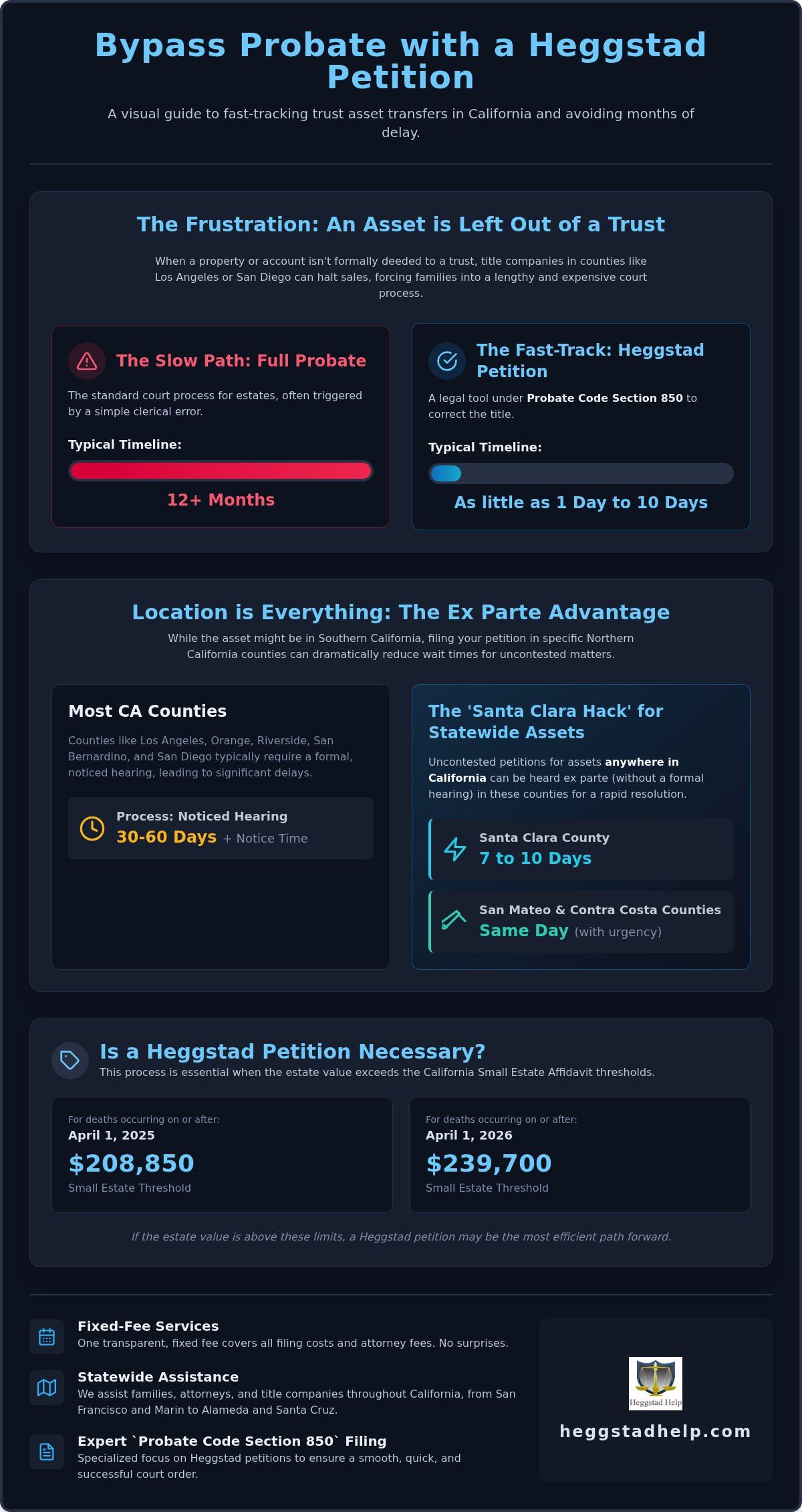
What if you could bypass a twelve-month probate delay and fix a missing trust asset in less than two weeks? It’s incredibly frustrating when a title company refuses to close a sale in Los Angeles or San Diego because a property was never deeded into the trust. You likely feel the weight of this procedural hurdle, especially when navigating the complexities of Probate Code Section 850. We understand that you need a resolution measured in weeks, not years. This is why we help families and attorneys secure a **California ex parte Heggstad court order **(a fast-track legal request handled without a formal, lengthy hearing) to move assets into a trust immediately.

We’ll explain how Heggstad petitions in California can be fast-tracked using fixed-fee legal services. While courts in Orange, Riverside, or San Bernardino may take months, we leverage streamlined procedures in Santa Clara County to get orders granted in 7 to 10 days. In San Mateo and Contra Costa Counties, we can often secure orders the same day. We’ll also clarify the 2026 small estate threshold, specifically the $208,850 limit for deaths on or after April 1, 2025, a so you can determine the most efficient path forward for your estate.

Key Takeaways

  • Learn how to bypass the standard 12-month probate process by using a Heggstad petition to secure a California ex parte court order for missing assets.
  • Discover why choosing the right venue, such as Santa Clara or San Mateo Counties, can reduce your wait time for a court order from several months to as little as 7 to 10 days.
  • Find out how families and attorneys in Los Angeles, Orange, and San Diego can access statewide fixed-fee services that cover both filing and attorney fees.
  • Master the requirements of Probate Code Section 850 to satisfy title company demands and successfully close property sales that are currently stalled.
  • Understand the 2026 small estate threshold, including the $208,850 limit for deaths on or after April 1, 2025.

Understanding Ex Parte Court Orders for Trust Assets in California

An ex parte court order (an expedited order issued by a judge without a lengthy waiting period) provides the fastest path to confirming that an asset belongs in a trust. While many people associate "ex parte" with high-conflict litigation, it’s actually a vital tool for correcting title errors. By securing a California ex parte court order, you can avoid the 12-month probate process that often stalls property sales in Los Angeles or Orange County. In 2026, an ex parte order is superior to a noticed hearing because it resolves uncontested title issues in days rather than months, provided the court has clear evidence of the grantor’s intent.

When is a Heggstad Petition Necessary?

If a loved one intended to place a home in a trust but died before signing the deed, a petition under Probate Code Section 850 is usually required. This process is essential when the estate value exceeds the Small Estate Affidavit threshold. Specifically, for deaths occurring on or after April 1, 2025, the limit is $208,850.  You can determine if your situation fits these criteria by reviewing our California Probate Code Section 850 guide. We assist families throughout the state, from San Diego to Sacramento, with fixed fees that cover both filing and attorney fees.

The Role of Probate Code Section 850

This section of the Probate Code allows a judge to "confirm" trust ownership based on the grantor’s written intent. It effectively "funds" the trust after the creator has passed away. Once the order is signed, the successor trustee can immediately sell or distribute the property. This legal precedent, established by the Estate of Heggstad, ensures that a simple clerical error doesn’t force a family into a full probate administration. Whether the asset is a primary residence or a brokerage account, the court uses this section to align the legal title with the owner’s true wishes.

The Strategic Advantage: Santa Clara, San Mateo, and Contra Costa Procedures

While the asset you need to transfer might be located in Los Angeles or Riverside, the court where you file your petition can drastically change your experience. Choosing the right venue is a critical strategic decision. Many successor trustees assume they must file in the county where the decedent lived or where the real property sits. However, if you’re seeking a California ex parte court order to fix a title error, moving the matter to a faster jurisdiction can save you months of frustration.

In Santa Clara County, uncontested Heggstad petitions are regularly filed ex parte and are typically granted within 7 to 10 days. San Mateo and Contra Costa Counties offer even faster turnarounds, often granting orders the same day if you can demonstrate "urgency," such as a pending home sale that’s about to fall through. Compare this to a noticed hearing in San Diego or Orange County, where you might wait 60 days just for a court date, followed by additional time for notice requirements.

The ‘Santa Clara Hack’ for Statewide Assets

You don’t have to live in Northern California to benefit from these faster timelines. Uncontested petitions for property located anywhere in the state, from Sacramento to San Bernardino, can be heard ex parte in Santa Clara County. This strategy is a game changer for families who need to resolve title issues quickly to satisfy a title company. Our office assists attorneys, title companies, and clients throughout the entire state via Heggstad Help, utilizing fixed fees that cover both filing and attorney fees.

Timelines: Ex Parte vs. Noticed Hearings

The difference in speed is stark. Under California Probate Code 850, the standard noticed hearing process in most counties takes 30 to 60 days plus notice time, often totaling four to five months. If you’re dealing with an estate that exceeds the Small Estate Affidavit threshold of $208,850 for deaths on or after April 1, 2025, you can’t afford to wait. An ex parte filing in Santa Clara provides a resolution in about a week. It’s important to remember that contested petitions, where a beneficiary objects, aren’t eligible for this fast track and will always take longer.

California Ex Parte Court Order: Fast-Track Heggstad Petitions in 2026

Securing Your Order with Expert Heggstad Petition Filing

Navigating the complex nuances of the Probate Code requires a specialist who understands the specific local rules of both Northern and Southern California courts. Robert P. Bergman, a Board-Certified Specialist in Estate Planning, Trust and Probate Law, provides a streamlined process aimed at reducing the stress often felt by successor trustees. Whether the property you’re managing is located in San Francisco, Marin, or Santa Cruz, our primary goal is to secure a clean title and facilitate a quick distribution to beneficiaries. We handle the entire California ex parte court order process with a sense of calm competence, ensuring that procedural hurdles don’t stand in the way of your family’s inheritance.

One of the most significant advantages of working with our office is our transparent pricing. Heggstad Help operates on a fixed-fee basis, which includes both the court filing fees and all attorney fees. This approach ensures you won’t face surprise costs or hidden expenses as we move through the legal system. We believe in providing a steady, knowledgeable hand to guide you through these specialized requirements, treating your case with the individual attention it deserves.

How Heggstad Help Simplifies the Process

We manage every aspect of the Heggstad petition filing in California, from the initial drafting of documents to the final court order. Our team frequently coordinates with title companies to ensure the court order is formatted correctly for immediate recording. This level of detail is crucial for resolving title issues without the need for a full probate. We provide dedicated support for families and attorneys in Alameda, Riverside, and throughout the Central Valley, ensuring that every petition meets the strict standards of the Probate Code Section governing these transfers.

Next Steps for Successor Trustees

If you’ve discovered that an asset was left out of a trust, your first step is to gather the existing trust document and the deed to the unrecorded property. You’ll also want to verify if the estate value falls below the Small Estate Affidavit threshold. This limit is $208,850 for deaths occurring on or after April 1, 2025. If the asset value exceeds this limit, a Heggstad petition is usually your best option. You can consult with a specialist to determine if an ex parte filing in Santa Clara is the right move for your specific case. Contact Robert P. Bergman at the Law Offices of Robert P. Bergman for a fixed-fee quote and a clear path toward resolution.

Take Control of Your Trust Distribution Today

Securing a California ex parte court order trust doesn’t have to be a stressful or drawn-out experience. By leveraging the strategic procedural advantages in Santa Clara County, you can resolve title errors in as little as 7 to 10 days rather than waiting many months in other jurisdictions. This fast-track approach is particularly vital if your estate exceeds the Small Estate Affidavit threshold of $208,850 for deaths on or after April 1, 2025. Whether you’re managing property in San Diego, San Francisco, or Alameda, our statewide fixed-fee service ensures you have total cost certainty from start to finish.

Robert P. Bergman, a Board-Certified Specialist in Estate Planning, Trust and Probate Law, is ready to help you navigate the complexities of the Probate Code with confidence. We provide a steady hand to ensure your trust assets are correctly titled and ready for immediate distribution or sale. Don’t let a missing deed stall your progress for another year. Reach out to our team to Get a Fixed-Fee Quote for Your Heggstad Petition and move forward with the peace of mind you deserve. You’re just a few weeks away from a resolution that protects your family’s legacy.

Frequently Asked Questions

What is an ex parte court order in a California trust case?

An ex parte court order is an expedited legal directive issued by a judge with shortened notice to other parties, or sometimes without any formal hearing at all. In the context of a California ex parte court order, it serves as a fast-track mechanism to confirm that an asset belongs in a trust despite a title error. This process allows a successor trustee to bypass the standard, months-long probate queue and receive a signed order in a matter of days.

Can I file a Heggstad petition ex parte if the property is in Los Angeles?

Yes, you can strategically file your petition in Santa Clara County to secure a faster result, even if the real property is located in Los Angeles, Orange, or San Diego. While Southern California courts often require noticed hearings that take many months, we utilize the streamlined procedures in Santa Clara to obtain orders in 7 to 10 days. This "Santa Clara strategy" is available for uncontested petitions involving assets located anywhere in the state.

How much does a Heggstad petition cost in California in 2026?

Our office handles Heggstad petitions on a fixed-fee basis, which provides total cost certainty by covering both the court filing fees and all attorney fees. While the statewide initial filing fee for probate matters is set by the state (currently $435 under the Government Code), our fixed-fee model ensures you don’t face unpredictable hourly billing. This approach is designed to reduce the financial stress for families in San Bernardino, Riverside, and Sacramento who are already managing complex estate affairs.

What happens if a Heggstad petition is contested?

If a beneficiary or interested party objects to the petition, the matter can no longer be handled through the expedited ex parte process. Contested petitions are moved to a standard litigation calendar, which typically takes 30 to 60 days for an initial hearing plus additional time for notice and discovery. It’s important to note that the 7-day fast track in Santa Clara or the same-day service in San Mateo only applies to uncontested matters where everyone is in agreement.

Do I need to go to court for an ex parte trust hearing?

In many instances, you won’t need to step foot in a courtroom for an uncontested petition. In Santa Clara, San Mateo, and Contra Costa Counties, these matters are frequently handled "in chambers" (meaning the judge reviews the paperwork and signs the order without a public hearing). This is particularly helpful for clients in Marin, Santa Cruz, or Alameda who want to resolve title issues efficiently without the time and expense of a formal court appearance.

Is there a deadline to file an ex parte petition after someone dies?

There is no specific statutory deadline to file, but delaying the process can lead to complications with title companies or pending property sales. If the estate value is below the Small Estate Affidavit threshold of $208,850 for deaths on or after April 1, 2025, you might have other options. However, for real property or larger accounts, filing as soon as possible ensures the successor trustee has the legal authority to manage the assets without a 12-month probate delay.

Robert P. Bergman, Attorney at Law

Article by

Robert P. Bergman, Attorney at Law

Attorney Robert P. Bergman ("Bob Bergman") has been a Board-Certified Specialist in Estate Planning, Trust and Probate Law since 2011, as certified by the California State Bar Board of Legal Specialization. For several years, Bob has assisted families and the clients of other attorneys with obtaining court orders through Heggstad petitions to avoid the time and expense of Probate administration. Bob is friendly, very approachable, and believes in explaining complex legal topics in clear ordinary language so that his clients understand exactly what they're doing and why they're doing it.
Bob is often able to assist clients who are in other counties than his home county of Santa Clara through his approach to Heggstad petitions.

Disclaimer

This article is for informational purposes only. Nothing in this article is intended to replace legal advice from a competent attorney or be considered legal guidance for anybody's specific legal situation. Nobody should rely on information in this article in making legal decisions without such consultation.

Lawyer to Transfer Property Into Trust After Death in California: The Heggstad Solution

Imagine the frustration of settling a loved one’s estate only to discover their home was never deeded into their living trust. This "unfunded…

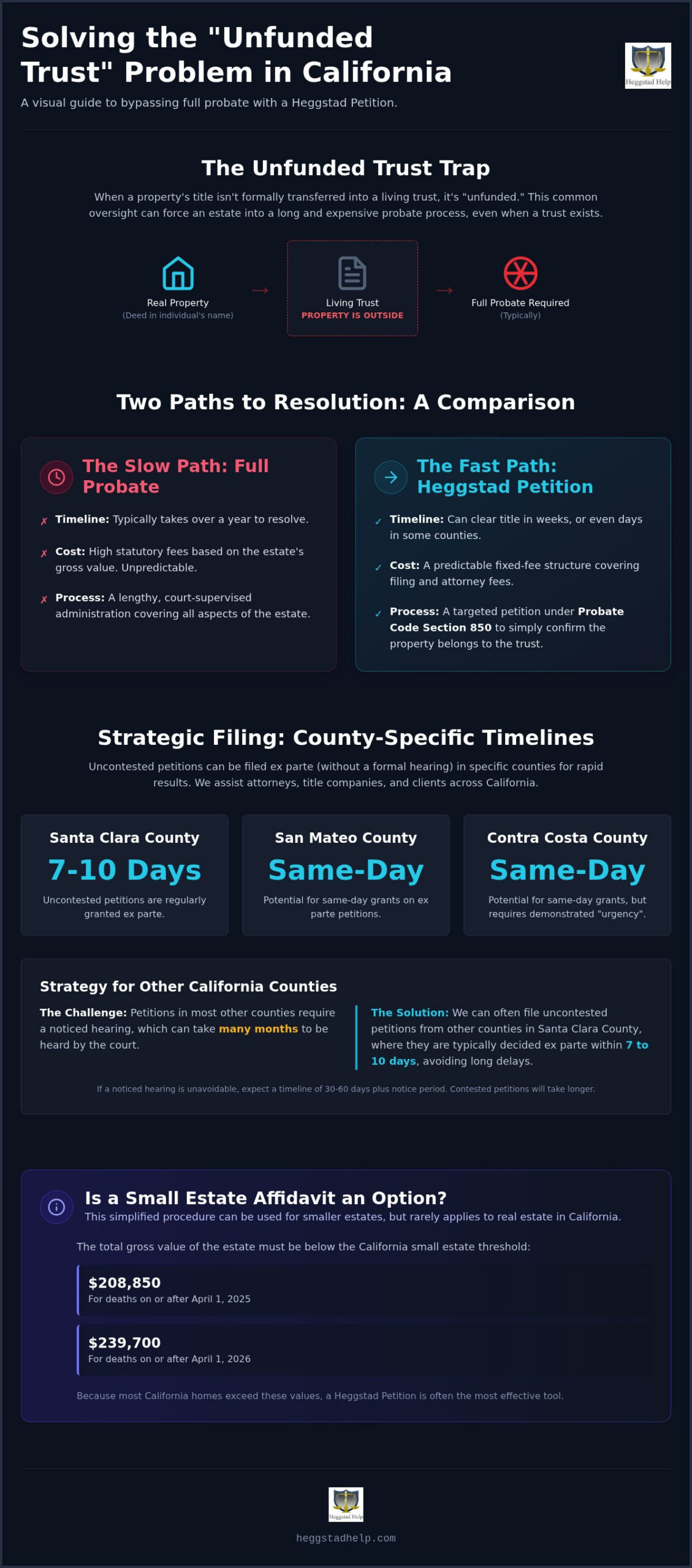
Imagine the frustration of settling a loved one’s estate only to discover their home was never deeded into their living trust. This "unfunded trust," where the trust document exists but doesn’t legally own the property, usually forces families into a full probate process that can drag on for over a year. If you’re looking for a lawyer to transfer property into trust after death California, you’re likely facing high statutory fees and long court delays just to clear title for a sale. It’s an exhausting position to be in, especially when you’re already managing the stress of a loss.

Fortunately, a Heggstad Petition in California offers a faster alternative. By filing a petition under Probate Code Section 850, we can often transfer real estate into a trust without full probate. For smaller assets, you might use an affidavit if the value is below $208,850 for deaths on or after April 1, 2025, or $239,700 for deaths on or after April 1, 2026. We provide fixed-fee services covering both filing and attorney fees throughout the state. In Santa Clara County, we typically see results in 7 to 10 days, while San Mateo and Contra Costa Counties can even grant same-day orders. We can even file out-of-county cases in Santa Clara County to bypass months of waiting for a noticed hearing.

Key Takeaways

  • Understand how a Heggstad Petition, filed under Probate Code Section 850, can legally move assets into an unfunded trust and bypass the standard probate process.
  • Find out how working with a lawyer to transfer property into trust after death California can secure a court order to clear title for a home sale in weeks rather than years.
  • Compare the high statutory fees of full probate against a fixed-fee model that covers both court filing and attorney fees for more predictable estate administration.
  • Learn how to use specialized filing strategies in Santa Clara, San Mateo, and Contra Costa Counties to secure ex parte (without a hearing) orders that avoid lengthy delays.
  • Check if your estate meets the small estate thresholds of $208,850 for deaths on or after April 1, 2025, and $239,700 for deaths on or after April 1, 2026, to use simpler transfer methods.

The Problem of the Unfunded Trust: Why Property is Left Out After Death

When a person creates a living trust, the goal is usually to ensure their assets pass to heirs without the burden of a court-supervised probate. However, a trust is merely a legal entity; it only protects the assets it actually owns. An "unfunded trust" occurs when a legal document exists, but the person failed to transfer the legal title of their property into that trust. If you are searching for a lawyer to transfer property into trust after death California, you’ve likely discovered that the decedent’s home is still in their individual name. This oversight often leads to an emotional and financial crisis for families, as it technically triggers a full probate administration that can take a year or longer to resolve.

Funding failures happen for several common reasons. Sometimes, a homeowner creates a trust but simply forgets to sign and record the grant deed. In other cases, they might purchase a new home or refinance an existing mortgage and neglect to move the title back into the trust after the bank’s requirements are met. The "smoking gun" for resolving these issues is often a document called a General Assignment of Assets. This document expresses the decedent’s clear intent that all their property belongs to the trust. This procedural path is based on the landmark case Estate of Heggstad, which established the precedent that a court can "confirm" assets as trust property if the owner’s intent is well-documented.

Identifying Trust Funding Mistakes in California

To determine if you need a lawyer to transfer property into trust after death California, start by checking the last recorded deed at the County Recorder’s office. If the deed lists the individual’s name rather than the name of the trust, the property is unfunded. You should also examine the trust’s "Schedule A," which is the list of assets intended for the trust. If the property is listed there but the deed is incorrect, you have strong evidence of intent. For more details, see our guide on California Trust Funding Mistakes: How to Identify Them.

When a Small Estate Affidavit Isn’t Enough

California provides simplified procedures for small estates, but real estate rarely qualifies. For deaths on or after April 1, 2025, the small estate threshold is $208,850. For deaths on or after April 1, 2026, that limit increases to $239,700. Because most California homes exceed these values, a simple Small Estate Affidavit cannot be used to transfer the title. Changing the title on real property requires a formal deed or a court order. When an affidavit is unavailable due to these mandatory thresholds, a Heggstad Petition under Probate Code Section 850 becomes the most efficient tool to avoid a full, costly probate.

The Heggstad Petition: Using Probate Code Section 850 to Recover Assets

When a property owner dies without properly deeding their home into their trust, many families assume a year-long probate is the only path forward. However, a California Probate Code Section 850 petition, commonly referred to as a Heggstad Petition, provides a surgical legal solution. If you’re working with a lawyer to transfer property into trust after death California, this specific petition asks the court to "confirm" the asset as trust property. The legal theory is that if the decedent clearly intended for the property to be in the trust, the court has the authority to declare it so, even without a recorded deed. This process allows families to skip the standard 12-month probate timeline entirely, often resolving title issues in just a few weeks.

To succeed, the petitioner must present "clear and convincing evidence" of the decedent’s intent. This is a higher legal standard than a simple "preponderance of evidence," meaning the documentation must be highly persuasive to the judge. When this evidence is presented correctly, the court issues a formal order that functions as a deed. This order is then recorded with the County Recorder, effectively moving the property into the trust as if the deed had been signed before death. It’s an efficient way to clear title, especially if there’s a pending home sale that can’t wait for a traditional probate to conclude.

Legal Grounds for a Probate Code Section 850 Petition

The foundation of this procedure rests on the landmark 1993 Estate of Heggstad ruling. In that case, the court decided that a written declaration of trust was sufficient to transfer real property, even if a separate grant deed wasn’t recorded. Today, we often use a "Comprehensive Transfer Document" or a "General Assignment" as the primary evidence to prove this intent. These documents serve as a clear statement that the owner intended all their assets to be governed by the trust’s terms. For a deeper look at the mechanics, you can read our California Probate Code Section 850: A Guide to Real Property Petitions.

The Role of a Board-Certified Specialist

While any probate attorney can technically file a petition, working with a Board-Certified Specialist ensures the petition is drafted to satisfy both the judge and the title company. Every county has its own Local Rules of Court, which are the specific procedural requirements for that jurisdiction. Missing a single local requirement can lead to months of delays. A specialist understands how to navigate these nuances, especially when seeking an ex parte (without a formal hearing) order. At our firm, we specialize in these filings and offer a fixed-fee structure for Heggstad petitions that covers everything from filing fees to attorney time, providing a predictable path toward resolution.

The timeline for recovery varies significantly by jurisdiction. In Santa Clara County, uncontested petitions are typically granted within 7 to 10 days of filing. In San Mateo and Contra Costa Counties, grants can often be obtained on the same day if we can demonstrate urgency. For clients with property in other parts of California where hearings take many months, we often file in Santa Clara County to take advantage of their efficiency, securing an order in about a week rather than waiting for a distant court’s calendar.

Comparing the Costs: Heggstad Petition vs. Full Probate in California

The financial impact of a funding mistake can be shocking for families. In California, the cost of a formal probate is not based on the complexity of the work, but on the gross value of the assets. Under Probate Code Section 10810, statutory fees are set as a percentage of the estate’s total value, without any deduction for mortgages or debts. If you’re looking for a lawyer to transfer property into trust after death California, understanding this math is vital. For example, a home appraised at $1,000,000 carries approximately $46,000 in combined statutory fees for the attorney and the executor. Even if that home has a $700,000 mortgage, the fees are still calculated on the full million dollars.

In contrast, our firm utilizes a fixed-fee structure for Heggstad Petitions that covers both the court filing fees and attorney fees. This approach typically costs only a small fraction of what a formal probate would require. Beyond the attorney fees, probate also involves several "hidden" costs that a Heggstad Petition avoids. These include bond premiums to insure the executor, publication fees to notify creditors in a local newspaper, and probate referee fees (which are 0.1% of the appraised value of non-cash assets). By using a Heggstad Petition to "confirm" the property as a trust asset, you bypass these mandatory expenses entirely.

Time is Money: The Hidden Cost of Delay

A standard probate in California usually takes between 12 and 18 months, during which time the property is effectively frozen. You cannot easily sell or refinance the home while the court process drags on. A Heggstad Petition moves much faster, often resolving in just a few weeks. In Santa Clara County, we frequently see grants within 7 to 10 days, while San Mateo and Contra Costa Counties can sometimes grant orders on the same day if urgency is shown. This speed is critical for families who need to clear title for a pending sale. You can learn more about this in our guide on Selling a House Left Out of a California Trust.

Fixed-Fee Transparency in Trust Litigation

Successor trustees often feel overwhelmed by the prospect of open-ended legal bills. We address this stress by offering fixed-fee transparency, which includes everything from the initial drafting to the service of notice on heirs. This allows trustees to fulfill their duties without the fear of the "billable hour" trap that often accompanies general probate matters. It’s important to remember that while Small Estate Affidavits are cheaper, they are limited to estates valued below $208,850 (for deaths on or after April 1, 2025) or $239,700 (for deaths on or after April 1, 2026). Since most California real estate exceeds these figures, a fixed-fee Heggstad filing is usually the most cost-effective path forward.

Lawyer to Transfer Property Into Trust After Death in California: The Heggstad Solution

Strategic Filing: Timelines and County-Specific Advantages

While Heggstad Petitions are available statewide, the speed of your case often depends on which court has jurisdiction. We assist clients, title companies, and fellow attorneys throughout the state, but we frequently leverage what we call the "Bay Area Advantage" to bypass long court backlogs. If you’re working with a lawyer to transfer property into trust after death California, it’s vital to know that Santa Clara, San Mateo, and Contra Costa Counties allow uncontested petitions to be filed ex parte (without a formal hearing). This procedural shortcut can save you months of waiting for a standard court date.

The timelines in these specific counties are remarkably efficient. In Santa Clara County, we typically see grants within 7 to 10 days of filing. San Mateo and Contra Costa offer even faster results, with the potential for same-day grants. It’s important to remember that Contra Costa requires us to demonstrate a specific "urgency," such as a looming escrow deadline, to qualify for this speed. A major strategic advantage we offer is that uncontested Heggstad Petitions for properties located in other California counties can often be heard ex parte in Santa Clara County. Instead of waiting for a calendar date in a crowded court elsewhere, we can often secure your order in about a week.

Filing in Other California Counties

When filing in Los Angeles, San Diego, or the Central Valley, the process is usually more methodical and time-consuming. These courts often require a "noticed hearing," which typically takes 30 to 60 days to be scheduled, plus additional time to provide legal notice to all heirs and beneficiaries as required by the Probate Code. In some larger counties, backlogs can stretch this timeline to several months. While we handle these cases statewide using our fixed-fee structure that covers both filing and attorney fees, we always look for the most efficient venue to clear your title quickly.

The Ex Parte Process Explained

An ex parte application is a request for a court order that happens outside the normal, lengthy hearing schedule. It’s designed for situations where a standard noticed hearing would cause unnecessary delay, such as a pending home sale that might fall through if title isn’t cleared immediately. While many counties treat Heggstad matters as standard probate items, the Bay Area courts recognize the efficiency of confirming trust assets quickly. If your estate value is below the small estate thresholds, specifically $208,850 for deaths on or after April 1, 2025, and $239,700 for deaths on or after April 1, 2026, you might use a Small Estate Affidavit for personal property. However, for real property exceeding these limits, this strategic filing is often the only way to avoid the year-long probate "sledgehammer." You can explore more about regional nuances in our guide to the Heggstad Petition in Los Angeles.

If you need to fix a title error quickly and avoid the stress of a long court process, our fixed-fee Heggstad filing services provide a clear, predictable path to resolution.

How to Get Started with a California Trust Lawyer

Starting the process of correcting a title error requires more than just a signed trust document. When you engage a lawyer to transfer property into trust after death California, the first task is to assemble a robust evidentiary file. This file serves as the foundation for your Probate Code Section 850 petition. Beyond the trust itself, we look for "intent" documents that bridge the gap between the decedent’s individual name and the trust entity. Without these documents, the court may lack the "clear and convincing" evidence needed to grant the petition.

Identifying all legal heirs and beneficiaries is a critical procedural step that cannot be overlooked. Even in cases where everyone agrees on the outcome, the Probate Code requires that specific parties receive formal notice of the proceedings. Failing to provide proper notice can lead to the court denying the petition or, even worse, a title company refusing to insure the property later. We coordinate directly with title companies throughout this process to ensure the final court order contains the specific legal descriptions and language required for recording. Once the judge signs the order, it is recorded with the County Recorder; this officially updates the chain of title and allows the successor trustee to sell or distribute the property.

Your Consultation Checklist

Before your initial evaluation, gather as much documentation as possible to streamline the process. A complete package typically includes the original Trust Agreement and all subsequent amendments. You should also locate the most recent grant deed for the property in question and any "Schedule A" or list of assets that was attached to the trust. If the decedent signed a General Assignment or Comprehensive Transfer Document, these are often the most valuable pieces of evidence we can present to the court.

Identifying potential objectors early is also vital for setting realistic expectations. If a family member is likely to contest the transfer, the case may move from a fast ex parte track to a noticed hearing timeline of 30 to 60 days plus notice time. For a deeper dive into these requirements, see our Evidence Required for Heggstad Petition in California: A 2026 Guide. This preparation ensures that your petition is handled with the precision necessary to satisfy the court.

Why Choose Robert P. Bergman and Heggstad Help

Robert P. Bergman is a Board-Certified Specialist with over 40 years of experience who focuses exclusively on title correction and Heggstad Petitions. We don’t just help families; we act as a strategic partner for other attorneys and title companies who need specialized speed. Our fixed-fee structure covers both filing and attorney fees, providing total cost transparency from the start. Whether you are dealing with a small estate near the thresholds of $208,850 (for deaths on or after April 1, 2025) and $239,700 (for deaths on or after April 1, 2026) or a multi-million dollar residence, we provide a clear path forward. Contact Heggstad Help for a Free Evaluation of Your Trust Assets and let us help you avoid the delays of a full probate.

Secure Your Loved One’s Legacy Without the Probate Delay

Discovering that a home was left out of a trust doesn’t have to result in a year of court-supervised probate. By utilizing a Heggstad Petition under Probate Code Section 850, you can bypass the high statutory fees and long delays that typically exhaust an estate’s value. Whether you’re navigating the specific ex parte advantages in Santa Clara County or managing a filing in another part of the state, working with an experienced lawyer to transfer property into trust after death California is the most efficient path to clearing title. This surgical legal approach ensures that the decedent’s intent is honored while protecting the equity for the beneficiaries.

Robert P. Bergman is a Board-Certified Specialist in Estate Planning, Trust and Probate Law who has been practicing in California since 1980. Our firm provides fixed-fee transparency for all filings, helping you avoid the unpredictable costs of traditional litigation. We manage the complex procedural details so you can focus on moving forward with confidence. If you’re ready to resolve these title issues quickly, you can Get a Fixed-Fee Quote for Your Heggstad Petition today. We’re here to provide the steady, knowledgeable hand you need to reach a resolution.

Frequently Asked Questions

What is a Heggstad Petition in California?

A Heggstad Petition is a specialized legal request filed under Probate Code Section 850 that asks a judge to confirm an asset as trust property even if the deed was never recorded. It relies on evidence of the decedent’s intent, such as a written declaration or a General Assignment. This procedure allows a successor trustee to "capture" assets into the trust after death, effectively avoiding the year-long probate process.

How much does a lawyer charge to transfer property into a trust after death?

While many firms charge hourly, we use a fixed-fee structure that covers both the court filing fees and the attorney fees for uncontested matters. This provides successor trustees with predictable costs and avoids the expensive statutory fees required by a full probate. Because probate fees are calculated as a percentage of the gross estate value under the Probate Code, a Heggstad filing is almost always the more cost-effective choice.

Can I sell a house while a Heggstad Petition is pending?

You can list the property and enter into a purchase agreement, but you cannot legally transfer the title to a buyer until the court order is signed and recorded. A lawyer to transfer property into trust after death California can help you navigate this by seeking an expedited order in counties like Santa Clara or San Mateo. Once the order is recorded, it clears the chain of title, allowing escrow to close and the sale to finalize.

What is the small estate limit in California for 2026?

The limit for using simplified small estate procedures depends on the specific date of the decedent’s death. For deaths occurring on or after April 1, 2025, the threshold is $208,850. For deaths occurring on or after April 1, 2026, the threshold increases to $239,700. If the value of the property left out of the trust exceeds these mandatory figures, you must typically use a Heggstad Petition or full probate to transfer the assets.

Do I need to go to court for a Heggstad Petition?

In most uncontested cases, you won’t need to step foot in a courtroom. In Santa Clara, San Mateo, and Contra Costa Counties, we regularly file these petitions ex parte (without a formal hearing). The judge reviews our written evidence and signs the order in chambers. Even in counties that require a noticed hearing, your attorney can usually appear on your behalf, saving you the stress of a personal court appearance.

What happens if a Heggstad Petition is contested by an heir?

If an heir or beneficiary objects to the transfer, the court will schedule a formal hearing to evaluate the evidence of the decedent’s intent. Contested matters move away from the expedited ex parte track and follow a more traditional litigation timeline. While most petitions are successful due to clear written evidence, a contest may require a noticed hearing that takes 30 to 60 days plus additional time for legal notice.

Can a Heggstad Petition fix a brokerage account missing from a trust?

Yes, a petition under Probate Code Section 850 applies to personal property like brokerage accounts and stocks just as it does to real estate. If the decedent listed the account on their trust’s Schedule A but failed to update the beneficiary forms, the court can confirm the account as a trust asset. This allows the trustee to collect the funds directly from the financial institution without a full probate administration.

How long does it take to get a court order to confirm trust assets?

The timeline depends heavily on the county of filing, but it’s significantly faster than the 12 to 18 months seen in probate. In Santa Clara County, we typically see grants within 7 to 10 days of filing. San Mateo and Contra Costa Counties can even provide same-day grants if we demonstrate urgency. In other California counties, a noticed hearing might be required, which generally takes between 30 and 60 days plus notice time.

Robert P. Bergman, Attorney at Law

Article by

Robert P. Bergman, Attorney at Law

Attorney Robert P. Bergman ("Bob Bergman") has been a Board-Certified Specialist in Estate Planning, Trust and Probate Law since 2011, as certified by the California State Bar Board of Legal Specialization. For several years, Bob has assisted families and the clients of other attorneys with obtaining court orders through Heggstad petitions to avoid the time and expense of Probate administration. Bob is friendly, very approachable, and believes in explaining complex legal topics in clear ordinary language so that his clients understand exactly what they're doing and why they're doing it.
Bob is often able to assist clients who are in other counties than his home county of Santa Clara through his approach to Heggstad petitions.

Disclaimer

This article is for informational purposes only. Nothing in this article is intended to replace legal advice from a competent attorney or be considered legal guidance for anybody's specific legal situation. Nobody should rely on information in this article in making legal decisions without such consultation.