
Imagine you’ve just lost a loved one, only to discover that their most valuable asset, such as the family home, was never formally transferred into their living trust. This common oversight often triggers a complex unfunded trust probate California process that can stall an inheritance for over a year. It’s a frustrating realization to find that while the trust documents were signed, the deed remained in the decedent’s (the person who passed away) individual name. You might feel like the estate plan has failed, but this procedural gap doesn’t necessarily mean you’re headed for a full, eighteen month probate ordeal.
We understand you’re likely feeling the weight of potential court costs and the stress of a long, uncertain timeline. This guide will show you how a specialized California trust funding attorney can utilize a Heggstad petition (a legal request to confirm an asset as trust property) to bypass full probate entirely. We’ll explain how this specific filing can correct title issues in as little as 60 to 90 days, providing the successor trustee with clear instructions and a much faster path to resolution than traditional administration.
Key Takeaways
- Identify the common “funding gaps,” such as unrecorded real estate deeds or newly opened bank accounts, that prevent a living trust from functioning as intended.
- Discover how to bypass a 12 to 18-month unfunded trust probate California process by utilizing a specialized Heggstad petition to transfer assets.
- Learn the legal “intent” standard used by courts to confirm that a decedent (the person who passed away) meant for an asset to be trust property.
- Compare the efficiency of an ex parte court order against the high statutory fees and procedural delays of full probate administration.
- Gain clarity on the specific audit and evidence-gathering steps required to correct title issues and protect the successor trustee’s authority.
What is an Unfunded Trust and Why Does it Lead to Probate in California?
An unfunded trust occurs when a valid legal document exists, but the formal transfer of title (the legal ownership record) for specific assets was never completed. Think of a trust as a high-tech safe. You can have the most sophisticated, detailed instructions written on the door, but if the jewelry and cash are sitting on the counter next to it, the safe provides no protection. This procedural oversight often forces families into an unfunded trust probate California proceeding, as the law generally requires that assets be “held” by the trustee to avoid court involvement.
Gaps in trust funding typically arise from forgotten real estate deeds, new bank accounts opened after the trust was established, or errors made during “do it yourself” estate planning. A California trust funding attorney often steps in to audit these omissions, searching for evidence of the decedent’s (the person who passed away) intent to include those assets. This search for intent is rooted in the landmark case of the Estate of Heggstad, which provides the legal framework for correcting these errors without a full probate administration.
The Consequences of Assets Left Out of the Trust
When an asset remains in an individual’s name at the time of their passing, the California Probate Court claims jurisdiction (legal authority) over that property. Without a court order to the contrary, these assets may be distributed according to intestate succession laws (the state’s default rules for inheritance). This creates a significant risk that the decedent’s specific trust instructions will be overridden, potentially leading to distributions that contradict their actual wishes or cause conflict among heirs.
Real Estate and the “Forgotten Deed” Problem
Real estate is the most common asset left out of a trust. A house often “slips out” during a mortgage refinance if a lender requires the property to be moved back into the individual’s name for closing. If the homeowner forgets to record a new deed (the document transferring title) back into the trust afterward, the property is legally unfunded. While a signed trust schedule might list the home, title companies and banks usually require a formal deed or a court order to recognize the trust’s ownership during a sale or transfer.
The Hidden Risks of Unfunded Trust Probate
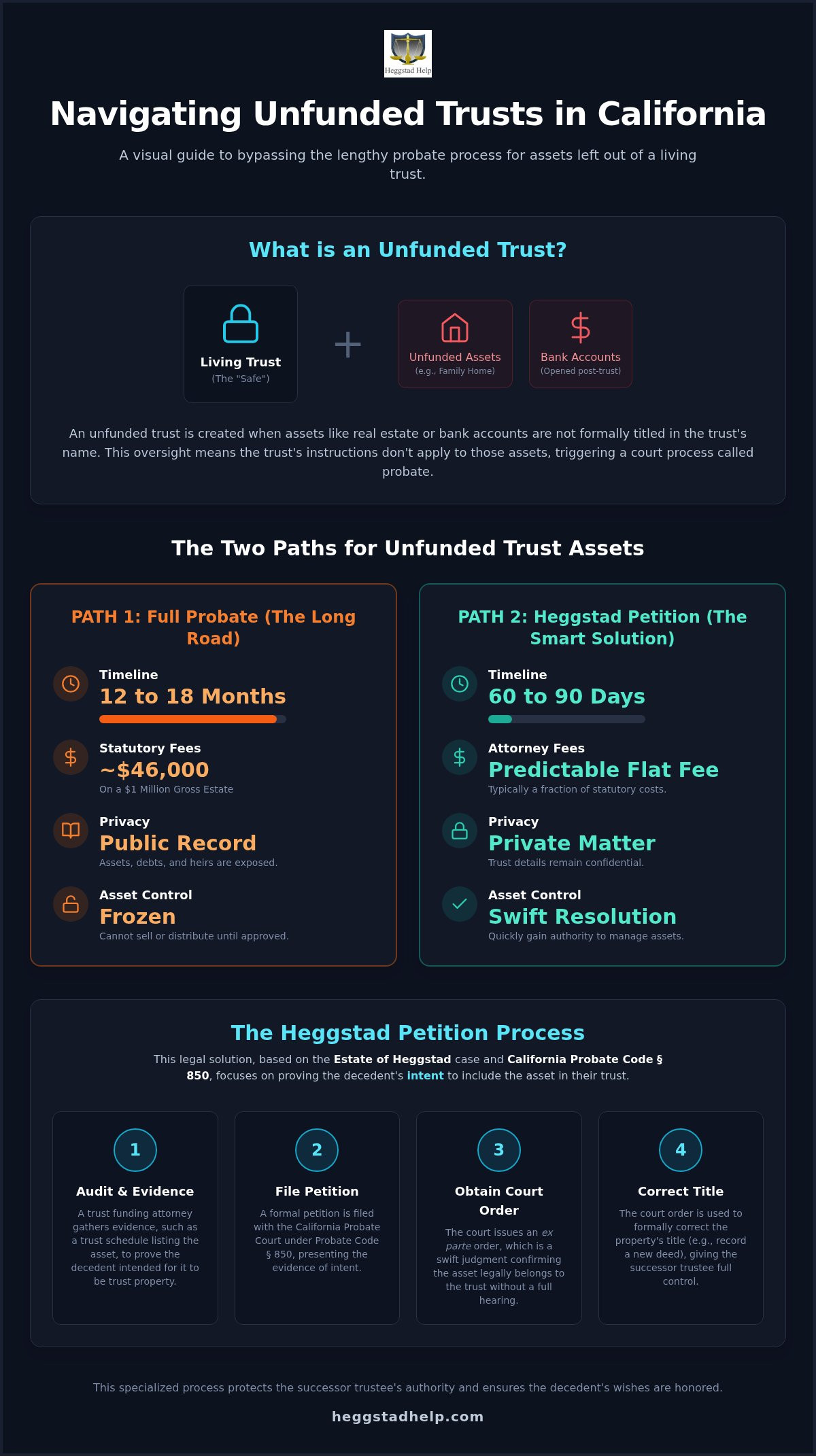
Falling into the “timeline trap” is the most immediate danger for families dealing with an unfunded trust probate California case. While a standard trust administration is designed to be swift, a formal probate proceeding in California typically stretches between 12 and 18 months. During this time, assets are effectively frozen. You cannot sell the real estate or distribute funds to beneficiaries until the court grants final approval. This delay is particularly painful when compared to the 60 to 90 days it usually takes to resolve a Heggstad petition.
The financial impact is equally significant. California law sets statutory fees for attorneys and executors based on the gross value of the estate, not the net value. If a house is appraised at $1 million, the combined fees can reach approximately $46,000, even if there’s a $700,000 mortgage on the property. By contrast, correcting a title through a specialized petition often involves a flat fee that’s a fraction of those costs. Beyond the money, you lose your privacy. A trust is a private document, but probate is a public process. Your family’s assets, debts, and the names of all heirs become part of the public court record for anyone to see.
Why General Probate Attorneys May Not Be Enough
Successor trustees often assume any lawyer can handle the situation, but there’s a distinct difference between a generalist and a California estate planning specialist. A generalist might default to a full probate because they aren’t comfortable with the nuances of California Probate Code 850. This specific statute allows you to bypass the year-long wait, provided your attorney knows how to present the “intent” evidence the court requires. If you’re feeling overwhelmed by the court’s requirements, you can consult with a specialist to see if your assets qualify for this faster route.
The Impact on Beneficiaries
Delayed distributions do more than just stall inheritance; they take an emotional toll on family members who may be relying on those funds for end-of-life expenses or property maintenance. When assets are left in legal limbo, the resulting uncertainty frequently triggers heated disputes among heirs over how the remaining property should be managed or divided. A specialized filing restores order by confirming the trust’s authority and getting the estate back on track quickly.
The Heggstad Petition: California’s Solution for Unfunded Assets
When you discover that a critical asset was left out of a trust, California Probate Code Section 850 provides the specific legal remedy known as a Heggstad petition. This procedural tool allows the court to confirm that an asset belongs to the trust, even if the formal title was never changed. Rather than starting a full unfunded trust probate California case, a specialist uses this petition to ask a judge to “fund” the trust retroactively based on the decedent’s (the person who passed away) clear intentions.
The success of this petition hinges on the “Intent” standard. The court doesn’t just look at the deed; it looks for written evidence that the creator of the trust intended for the asset to be included. A California trust funding attorney gathers specific documentation to build this case, including:
- Trust Schedules: Often called “Schedule A,” these lists specifically name assets intended for the trust.
- General Assignments: A broad legal document where the creator assigns all their property to the trust.
- Written Declarations: Correspondence or other signed notes indicating the asset was meant to be trust property.
Heggstad Petition vs. Full Probate
The primary advantage of this route is speed and simplicity. An uncontested Heggstad petition is typically resolved within 60 to 90 days, requiring only a single court hearing. In contrast, a full probate administration often drags on for 12 to 18 months and involves multiple procedural stages. For a deeper look at the legal requirements for property, you can review the details on an 850 petition California real property filing. This streamlined approach avoids the high statutory fees associated with traditional court-supervised distributions.
Correcting Real Estate Titles Post-Death
If the missing asset is a home or land, the court order resulting from a successful petition serves as the legal authority to correct the deed. In urgent situations, a specialist might use ex parte court orders (emergency requests) to expedite the process. The successor trustee with unfunded trust assets plays a vital role here by acting as the primary source of evidence, providing the attorney with the necessary records to prove intent. If you’re ready to secure a court order and avoid the probate trap, contact Heggstad Help today to begin your title correction.
How a California Trust Funding Attorney Resolves Your Estate
Resolving an unfunded trust probate California case requires a methodical approach that moves from initial discovery to final title recording. A specialized attorney begins with a comprehensive audit (a detailed review of all property records) to determine exactly which assets were left outside the trust’s legal umbrella. Once these gaps are identified, the focus shifts to gathering “Heggstad Evidence,” such as the original trust schedules or signed declarations of intent discussed earlier, to build a persuasive case for the court.
After the evidence is organized, the attorney files the formal petition under Probate Code 850. If the judge is satisfied with the proof of intent, they’ll issue a court order confirming that the assets are indeed trust property. The final, critical step involves trust asset title correction (the formal process of updating public ownership records). The attorney ensures the court order is properly recorded with the county recorder, which officially transfers the deed into the trust and allows the successor trustee to manage or sell the property without further court supervision.
Why Robert P. Bergman and Heggstad Help?
Successor trustees often face a steep learning curve when assets are missing, which is why specialized guidance is essential. Robert P. Bergman is a Board-Certified Specialist in Estate Planning, Trust and Probate Law, a credential held by a small percentage of California attorneys. Since 1980, he’s focused on the complexities of trust law, providing a level of expertise that generalists simply can’t match. Heggstad Help operates with an exclusive focus on Heggstad petitions and ex parte court orders, ensuring your filing is handled with the efficiency and precision required to avoid a 12 to 18-month probate delay.
Immediate Steps for Successor Trustees
The moment you realize an asset was left out of the trust, your priority should be document preservation. Successor trustees should secure all trust schedules and original estate documents immediately to preserve the paper trail needed for court. This includes looking for any “General Assignment” documents or letters from the decedent that mention the specific property. Once you’ve gathered these records, your next step is to consult with a specialist who can determine if a Heggstad petition is the right fit for your situation. Schedule a consultation with a Heggstad specialist to begin the recovery process today.
Securing Your Inheritance Without the Probate Delay
Discovering that a family home or financial account was left out of a living trust can feel like a major setback, but it doesn’t have to lead to a total estate failure. By understanding that California law provides a specific pathway to correct these funding gaps, you can take control of the situation before it spirals into a lengthy unfunded trust probate California proceeding. A successful Heggstad petition transforms a complex title issue into a manageable court order, effectively restoring the decedent’s (the person who passed away) original intent and protecting the interests of every beneficiary involved.
Navigating the nuances of Probate Code 850 requires a steady, experienced hand to ensure the court accepts your evidence of intent. Robert P. Bergman is a Board-Certified Specialist in Estate Planning, Trust and Probate Law with over 40 years of legal experience in California trust law. He focuses exclusively on these specialized filings to help families across the state avoid the stress of traditional administration. You don’t have to face these procedural hurdles alone. Contact Heggstad Help for a specialized review of your unfunded trust assets and let a dedicated problem-solver guide you toward a swift resolution.
Frequently Asked Questions
Can I file a Heggstad petition if there is no written schedule of assets?
Yes, you can still file a petition even without a formal “Schedule A” or asset list. While a written schedule is strong evidence, California courts also accept other forms of proof regarding the decedent’s intent. This might include a “General Assignment” document or specific language within the trust itself declaring that all of the individual’s property is now trust property. A specialist will review all estate documents to find the necessary legal evidence required by the court.
How much does a Heggstad petition cost compared to full probate in California?
A Heggstad petition is generally much more cost-effective because it avoids the statutory fees required for a full probate. In a formal probate proceeding, fees are calculated as a percentage of the gross estate value. For an estate valued at $1 million, those combined fees can reach approximately $46,000. Because a petition is a streamlined filing with typically only one hearing, the legal costs are generally a flat fee that’s significantly lower than those statutory mandates.
What happens if the house was never deeded to the trust before death?
If a house was never deeded to the trust, it remains in the decedent’s individual name and technically triggers an unfunded trust probate California proceeding. However, a Heggstad petition allows you to ask the court to “deem” the property as part of the trust retroactively. Once the judge signs the order, you can record that order with the county recorder to correct the title. This process effectively bypasses the 12 to 18 month probate timeline.
Is a Heggstad petition available for bank accounts and brokerage accounts?
Yes, this legal remedy applies to nearly any asset that was intended for the trust but was never formally retitled. This includes bank accounts, brokerage accounts, and even partnership interests or business shares. If the trust document or a separate assignment shows the decedent intended these accounts to be trust property, the court can issue an order to transfer them. This prevents the need for a full probate administration for those specific financial holdings.
How long do I have to file a Heggstad petition after someone dies?
There’s no specific “expiration date” for filing a Heggstad petition in California, but acting quickly is vital for protecting the estate. Delaying the filing can lead to complications with creditors, property tax reassessments, or maintenance issues. Most successor trustees choose to file as soon as they discover an unfunded trust probate California issue to ensure they can manage or sell the assets. Early action helps maintain the property’s value and provides clarity for all beneficiaries.

Article by
Robert P. Bergman, Attorney at Law
Attorney Robert P. Bergman ("Bob Bergman") has been a Board-Certified Specialist in Estate Planning, Trust and Probate Law since 2011, as certified by the California State Bar Board of Legal Specialization. For several years, Bob has assisted families and the clients of other attorneys with obtaining court orders through Heggstad petitions to avoid the time and expense of Probate administration. Bob is friendly, very approachable, and believes in explaining complex legal topics in clear ordinary language so that his clients understand exactly what they're doing and why they're doing it.
Bob is often able to assist clients who are in other counties than his home county of Santa Clara through his approach to Heggstad petitions.
Disclaimer
This article is for informational purposes only. Nothing in this article is intended to replace legal advice from a competent attorney. Nobody should rely on information in this article in making legal decisions without such consultation.


