Deed Not Recorded to Trust in California: Legal Remedies and the Heggstad Petition

What if the 18-month probate nightmare you’re dreading could be resolved in as little as 60 to 90 days? It’s a common and deeply frustrating…

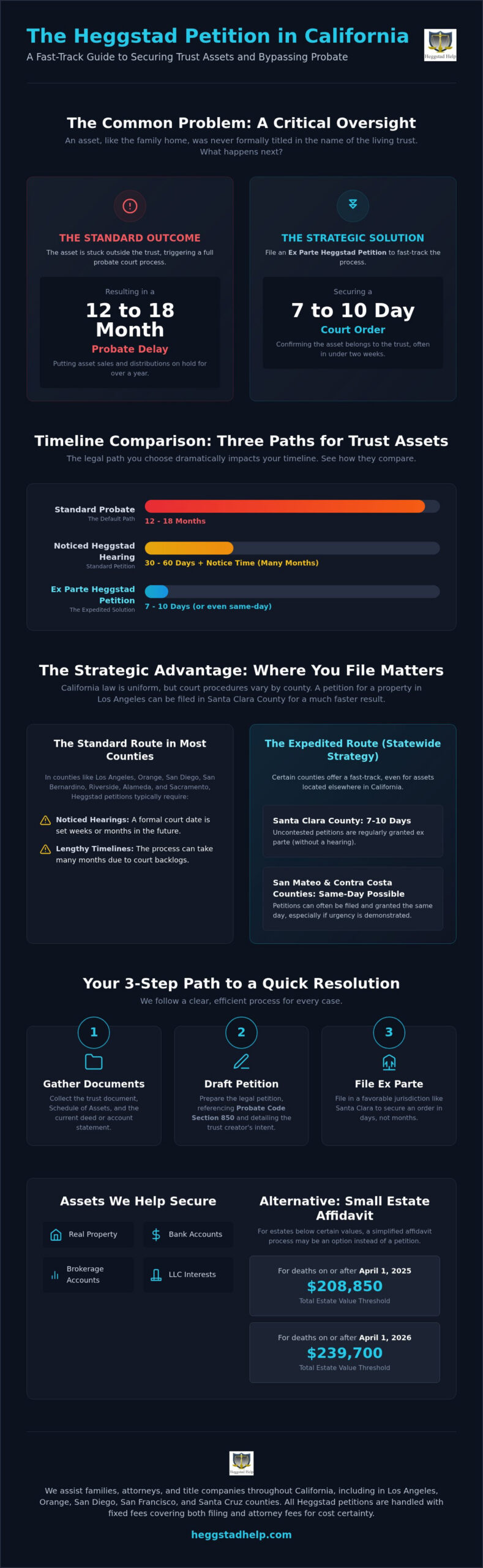
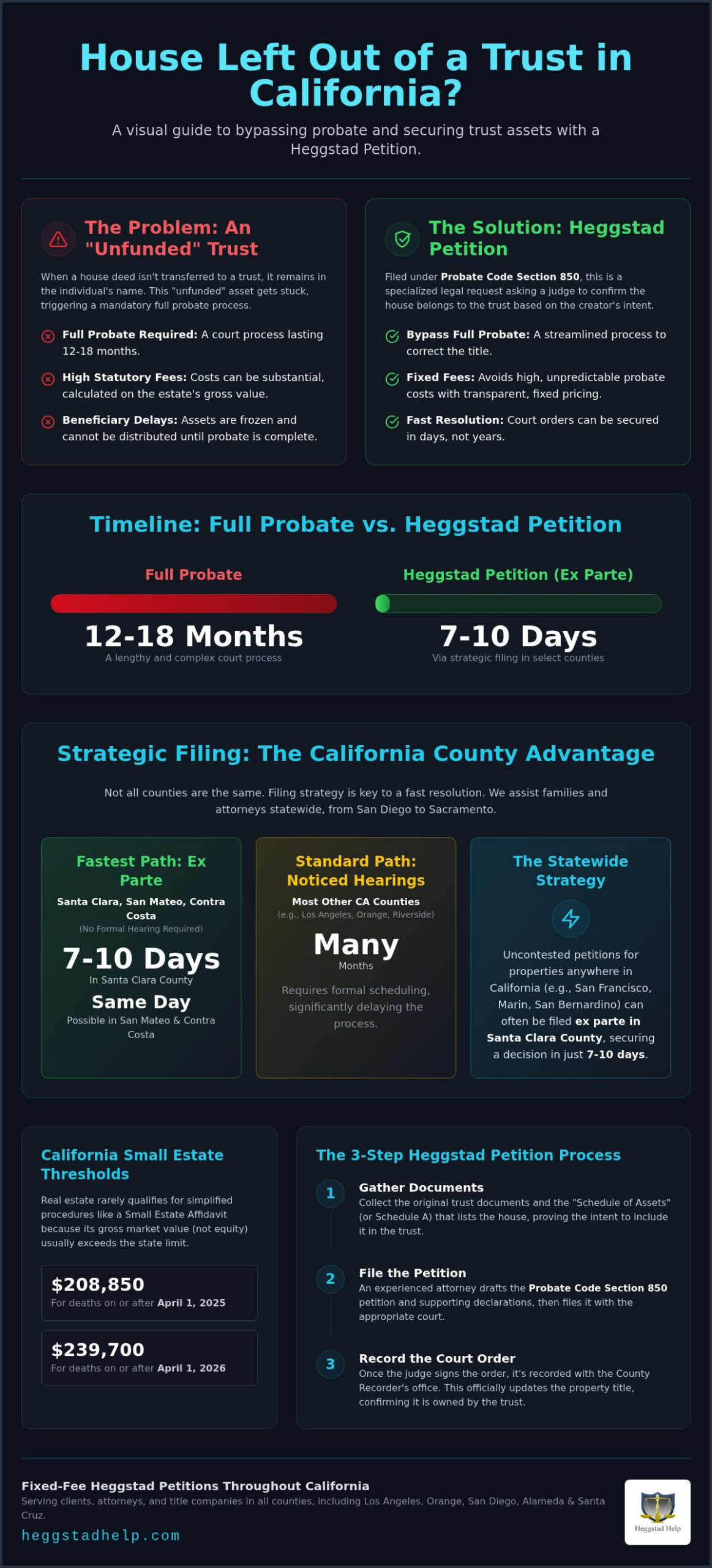
What if the 18-month probate nightmare you’re dreading could be resolved in as little as 60 to 90 days? It’s a common and deeply frustrating discovery to find a deed not recorded to trust California property after a loved one passes away. You’re likely worried that a single clerical oversight will trap the estate in a lengthy court backlog, leading to high statutory fees (the mandatory costs paid to executors and attorneys) and months of uncertainty. It’s natural to feel overwhelmed when legal documents seem to conflict, but a missing recording date doesn’t have to result in a full probate administration.

You can still secure the title to real property and honor the grantor’s original intent without the traditional 12-to-18-month wait. This article explains how to use a Heggstad Petition (a specialized legal request under Probate Code Section 850) to confirm that an asset belongs in a trust. We’ll walk through the process of correcting title defects, avoiding the formal probate process, and ensuring the property is ready for sale or distribution. By understanding this logical bypass, you can navigate these procedural hurdles with calm competence and resolve the estate efficiently.

Key Takeaways

  • Learn why a deed not recorded to trust California property is not a “probate sentence,” as courts prioritize the grantor’s intent (the creator’s original plan) over clerical recording errors.
  • Understand how a Heggstad Petition, which is a specific legal request under Probate Code 850, can bypass the 12-to-18-month probate process by confirming property as a trust asset.
  • Identify the critical documents needed to prove ownership, such as the “Schedule A” (the list of assets attached to a trust) and original signed transfer documents.
  • Discover how specialized title correction services can resolve unrecorded deed issues in approximately 60 to 90 days, facilitating the timely sale or distribution of the estate.

To move real property into a trust, a grantor (the person creating the trust) must execute a Trust Transfer Deed. This document acts as the legal vehicle for changing ownership from an individual’s name to the name of the trust. While the signature of the grantor makes the transfer valid between the parties, the document should be filed with the County Recorder to provide “constructive notice” (a legal term meaning the public is officially aware of the change) to the world. Without this step, the chain of title remains broken in the eyes of the public and the courts.

When a deed not recorded to trust California situation occurs, it’s often the result of simple clerical oversights or a fundamental misunderstanding of the “funding” process. Some homeowners believe that signing the trust agreement itself is sufficient to transfer the house. Others may have prepared the deed but neglected to mail it to the recorder; alternatively, a title company might have failed to record the document following a mortgage refinance. This creates a state of legal limbo where the trust document lists the home as an asset, but the public record shows the decedent as the individual owner.

To avoid these types of administrative gaps, families often seek professional guidance from firms like Northeast Legal Team to ensure their comprehensive estate planning is executed correctly and all assets are properly funded.

Deed of Trust vs. Trust Transfer Deed: Clearing the Confusion

It’s quite common for families to search through recorded documents and find a “Deed of Trust,” mistakenly believing this proves the house is in the trust. In California, a Deed of Trust is actually a mortgage-like security instrument for a loan; it doesn’t transfer ownership to your living trust. To fund a trust, you must use a Grant Deed or a Quitclaim Deed. If you only see a Deed of Trust in the county records, the property likely remains outside the trust’s legal umbrella, regardless of what the name on the mortgage suggests.

The Consequences of an Unfunded Trust

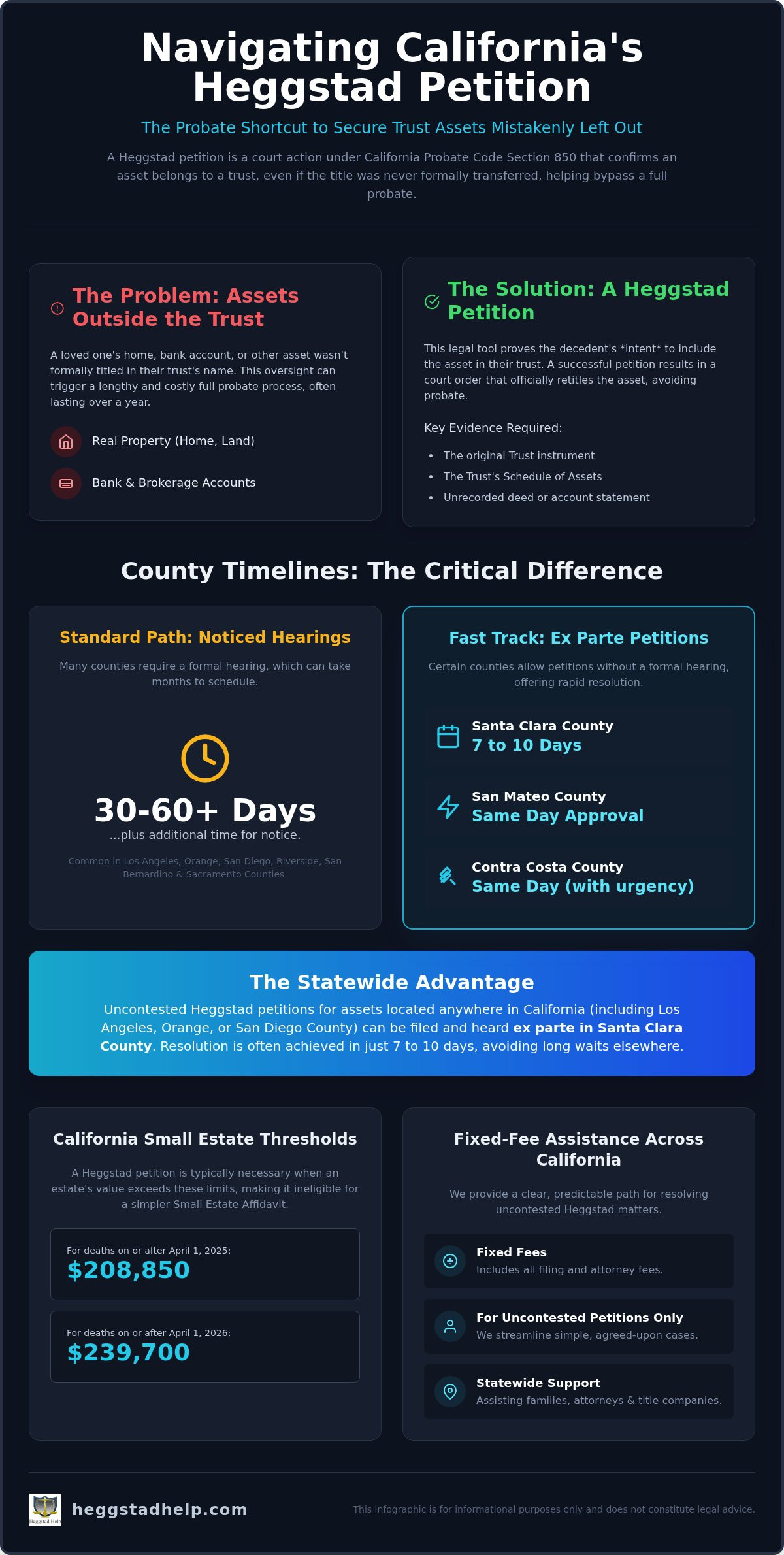
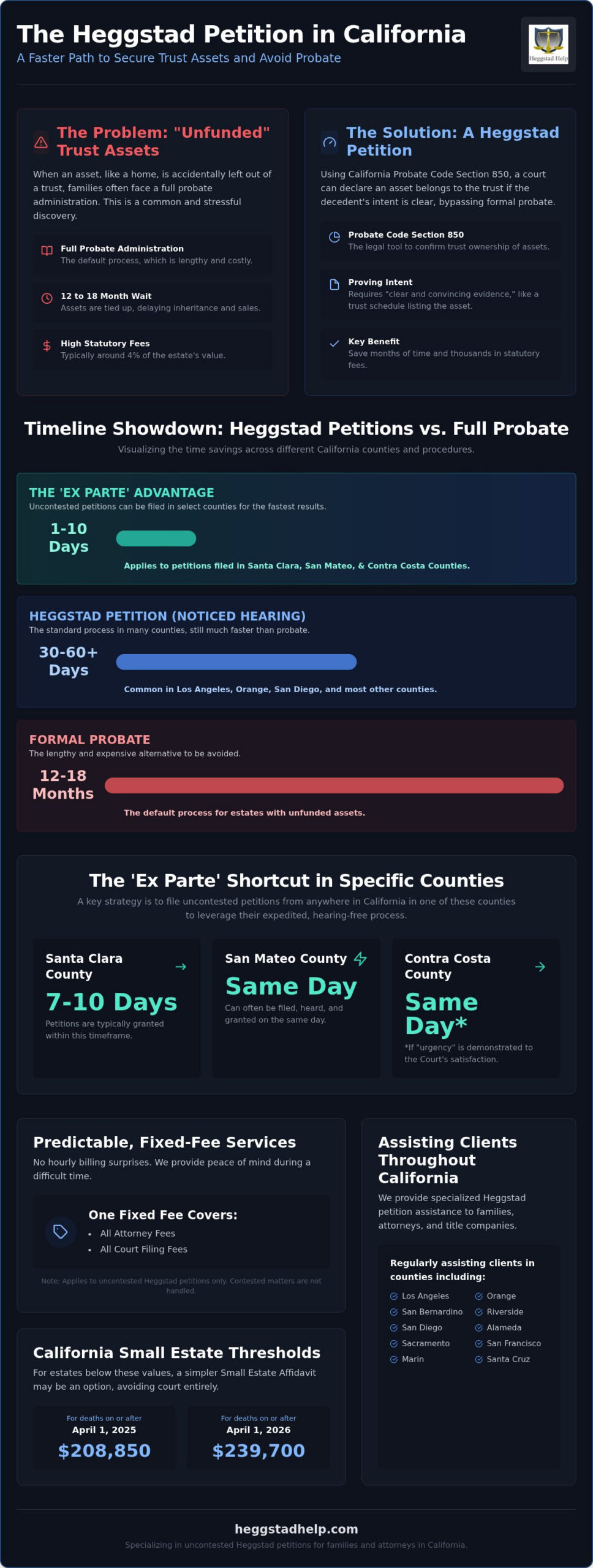
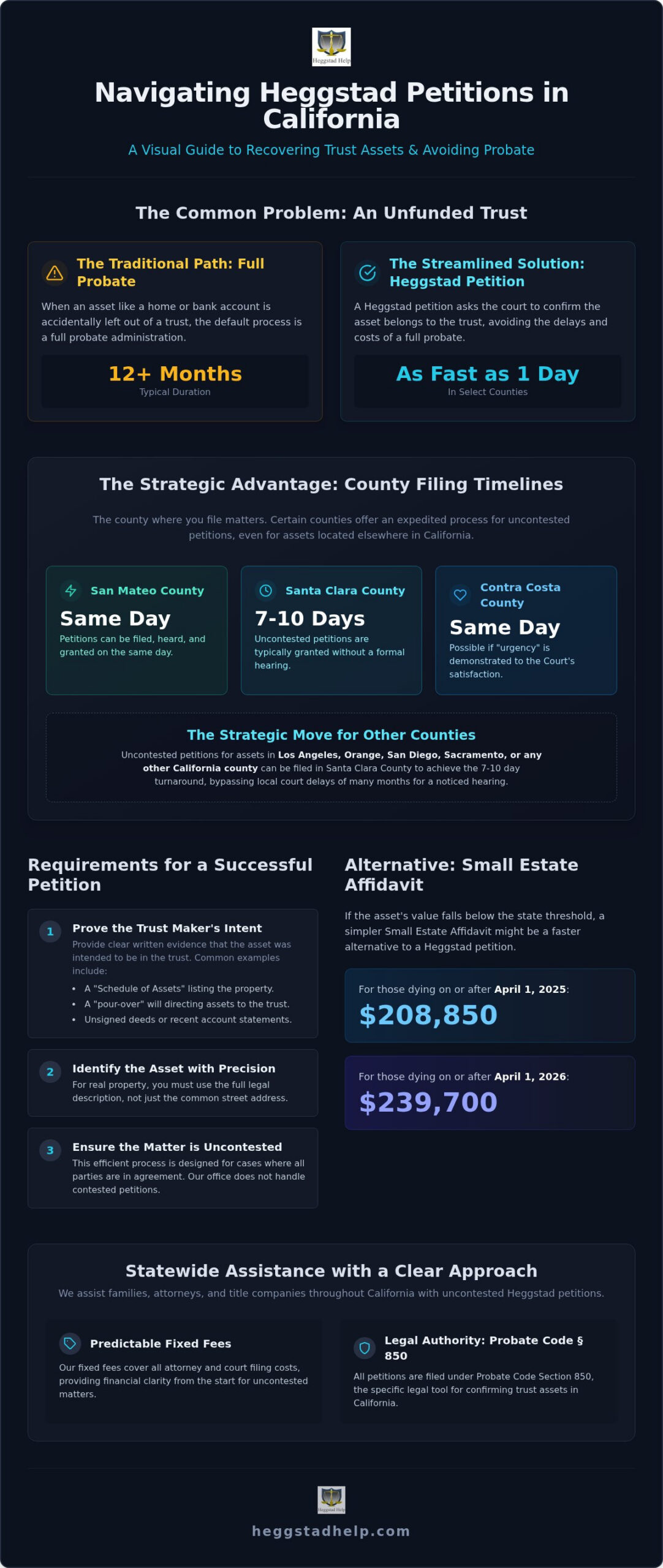
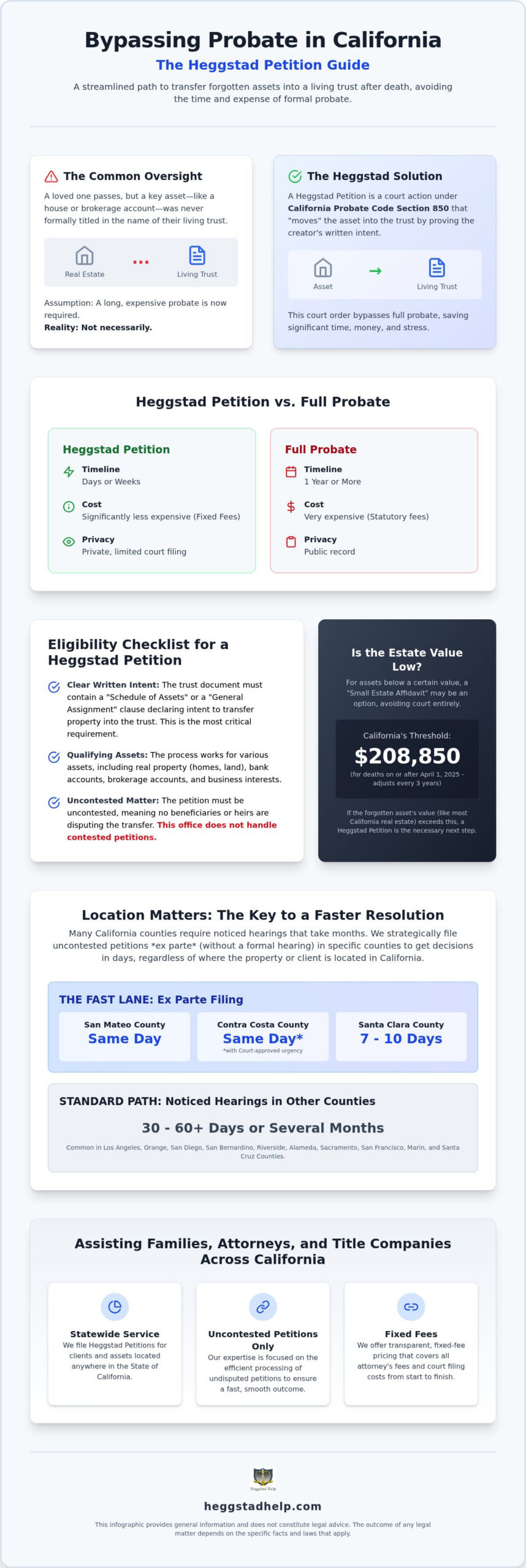
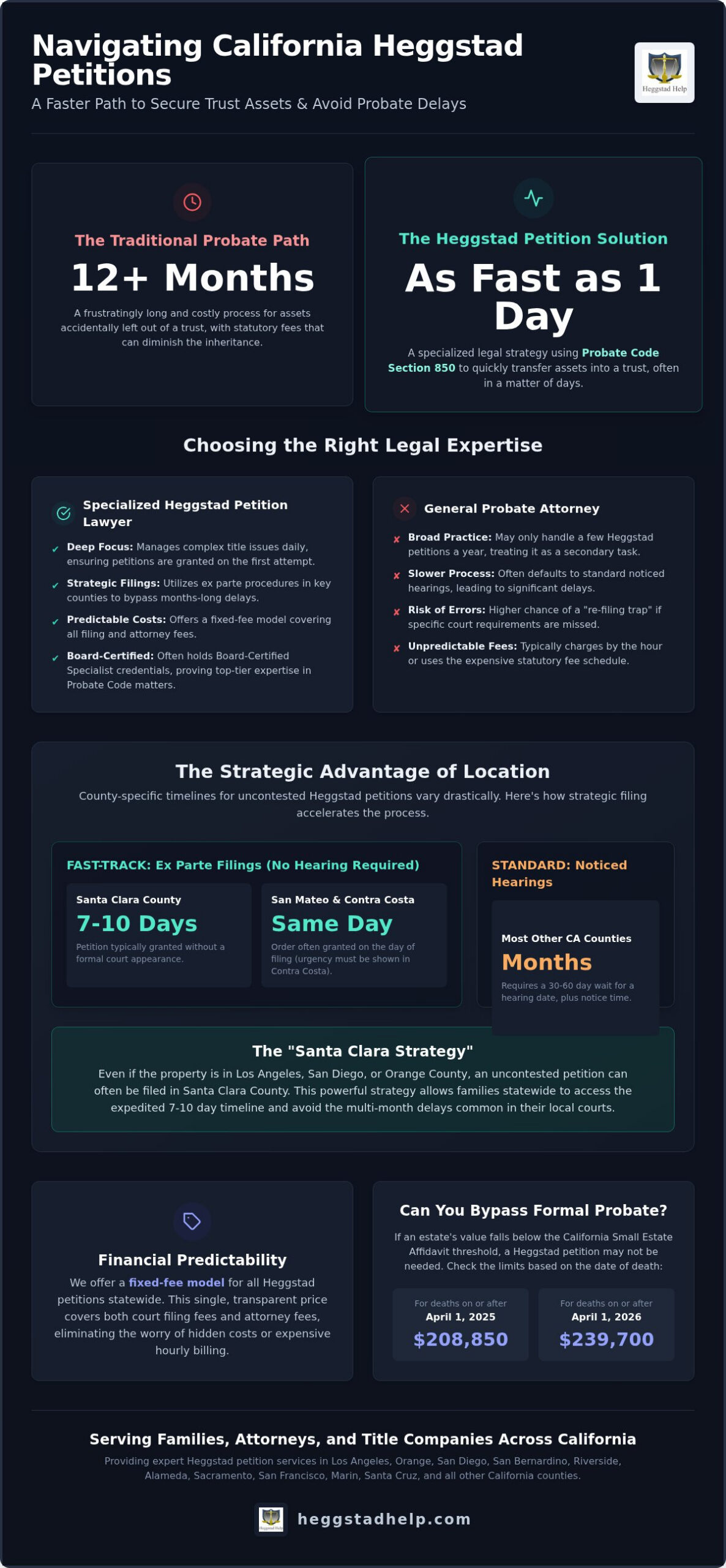
An unrecorded deed leads to what title companies call a “cloud on title” (a defect or dispute that prevents a clean transfer of ownership). This defect makes it impossible to sell or refinance the home until the record is corrected by a court order. If you’ve discovered a deed not recorded to trust California after a death, the primary consequence is that the property is technically stuck in the decedent’s individual name. If the property’s value exceeds the small estate limit, which is currently $208,850 for deaths on or after April 1, 2025, the estate faces the risk of a mandatory full probate administration. An unfunded trust is a legal state where a trust exists but holds no legal title to its intended assets. Understanding the full consequences of incorrect trust property title California families encounter is essential before taking action. Fortunately, the landmark Estate of Heggstad case established that the court can look at the grantor’s intent to fix these funding errors without a full probate.

Myth vs. Reality: Is it Too Late if the Deed Wasn’t Recorded Before Death?

Many families are paralyzed by the fear that a clerical oversight has doomed them to a 12 to 18 month probate process. There’s a persistent myth that if a deed not recorded to trust California property wasn’t processed at the County Recorder’s office before the owner passed away, the asset automatically falls into the probate estate. This misconception suggests that the public record is the final word on ownership. In reality, while recording is the gold standard for public notice, California law recognizes that life is often more complicated than a filing date suggests.

The courts look primarily at the “intent” of the grantor (the individual who established the trust). If you can demonstrate that the decedent intended for the property to be part of their trust, the lack of a recorded deed becomes a fixable technicality rather than a legal dead end. This intent is often found in the trust document itself, specifically within a “Schedule A” (the list of assets intended for the trust). When a property is clearly listed on this schedule, or if a signed but unrecorded deed is found in the decedent’s files, the court has the authority to confirm the property as a trust asset.

The Power of the Grantor’s Intent

The legal landscape regarding unrecorded deeds changed significantly with the landmark Estate of Heggstad case. This ruling established that a written declaration of trust, where the grantor lists specific real property as trust property, is sufficient to create a valid trust even without a separate recorded deed. This principle is codified under California Probate Code 850, which provides a procedural path to ask the court to confirm ownership. Beyond the trust documents, other evidence can support this intent, such as property tax records or insurance policies paid by the trust rather than the individual.

Why “Signing” is Often More Important Than “Recording” for Trusts

There’s a critical legal distinction between the “delivery” of a deed and its “recording.” Under California law, a deed is considered effective once it’s signed and delivered to the trustee. Recording is simply the act of notifying the public. If a grantor signed a deed but it was tucked away in a desk drawer or lost in the mail, the legal transfer between the parties still occurred. It isn’t “lost” property; it’s simply “misplaced” in the eyes of the law. If you find yourself holding a signed document that was never filed, you can still pursue trust asset title correction to avoid the high statutory fees and delays of a full probate administration.

California Probate Code 850: The Remedy for Missing Trust Deeds

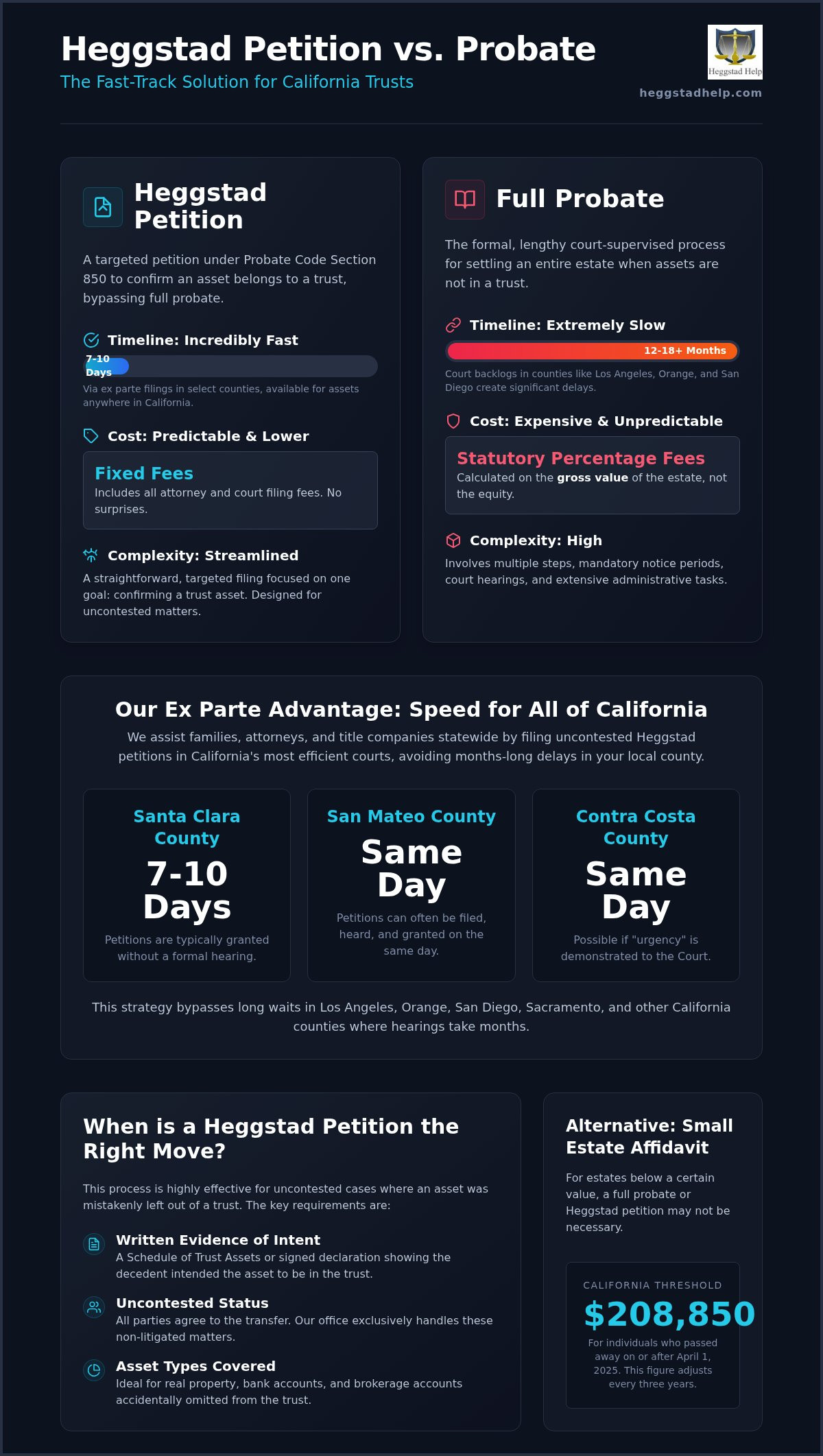
A petition filed under California Probate Code 850 is a formal legal request for the court to confirm property ownership. When a deed not recorded to trust California issue is discovered after a death, the Successor Trustee (the individual tasked with managing trust assets) doesn’t have to settle for a lengthy probate. Instead, they can use this petition to ask a judge to declare that the property is already a trust asset. This specific type of filing is widely known as a “Heggstad Petition,” named after the landmark case that established this remedy. The ultimate goal of this process is to secure a court order that effectively replaces the missing deed. Once this order is recorded with the County Recorder, the title is corrected, and the property can be sold or distributed to beneficiaries.

How the Heggstad Petition Bypasses Full Probate

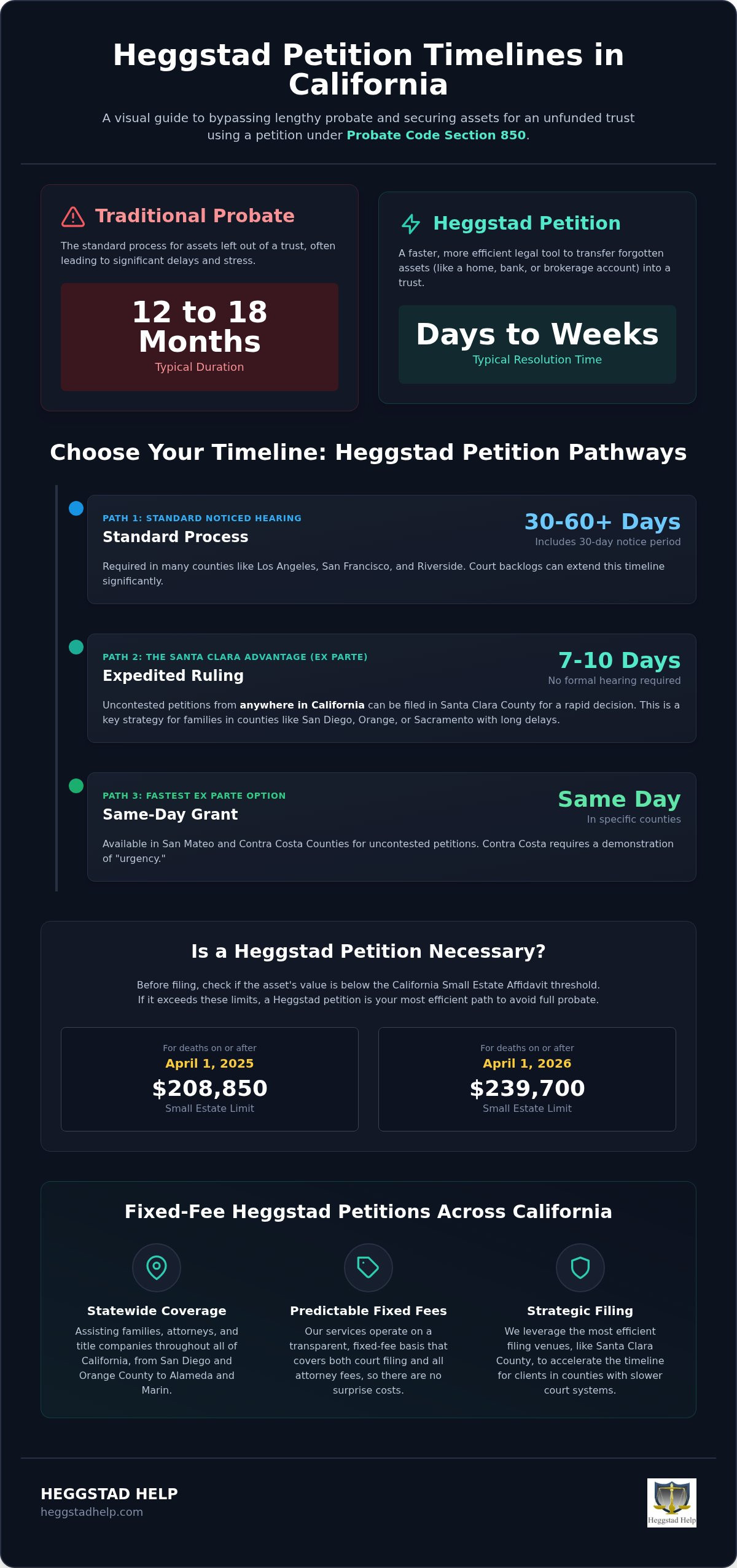
The most immediate benefit of this procedure is the significant reduction in time. While a standard probate administration in California typically lasts between 12 and 18 months, a Heggstad Petition is generally resolved within 60 to 90 days. This speed is especially critical if there’s an urgent need to sell the home or if the family wants to avoid the high statutory fees associated with probate. In California, probate fees are set by law and are based on the gross value of the estate, starting at 4% of the first $100,000 and 3% of the next $100,000. When dealing with a deed not recorded to trust California, an 850 petition allows you to bypass these mandatory costs entirely. For situations involving a pending escrow or other time-sensitive pressures, an Ex Parte Court Order Service may be available to move the process forward even faster.

Legal Requirements for a Successful 850 Petition

To succeed, the petition must present clear evidence of the grantor’s intent. This evidence usually begins with a written “Declaration of Trust” or a “Schedule of Assets” (the list typically found at the back of a trust document) that specifically mentions the property. Even if the property wasn’t explicitly listed, a petition can still be successful if other documents prove the grantor intended for the home to be trust property. Framing these arguments requires a high level of professional precision. A Board-Certified Specialist in Estate Planning, Trust and Probate Law knows how to structure the petition to satisfy the judge’s requirements, ensuring the intent is legally undeniable. This specialized expertise is the difference between a quick resolution and a rejected petition that forces the family back into full probate.

Deed Not Recorded to Trust in California: Legal Remedies and the Heggstad Petition

Steps to Fix an Unrecorded Deed After the Grantor’s Death

When you discover a deed not recorded to trust California property, the path to resolution is methodical and evidence-based. Successor trustees often feel an immediate sense of urgency; however, the most effective first step is a thorough audit of the decedent’s records. This process isn’t merely about finding a single piece of paper. It’s about building a compelling narrative of intent that a judge will find legally indisputable. By following a structured approach, you can transform a title defect into a clear path toward distribution. If you’re also encountering other unfunded assets during this audit, a dedicated resource on successor trustee help for missing assets can guide you through locating and recovering property that was never formally retitled into the trust.

Gathering Evidence of Trust Funding

Start by locating the original trust binder and looking specifically for a “Schedule A” or any list of assets intended for the trust. You should also search for a “General Assignment of Assets,” which is a document frequently included in estate plans to act as a catch-all transfer for personal and real property. These documents are vital because they provide the written proof of intent required by the court. To strengthen your case, you should also look for the following items:

  • Original, signed (but unrecorded) deeds tucked away in physical files or safe deposit boxes.
  • Digital copies of deeds or correspondence in the decedent’s email or cloud storage.
  • Correspondence from the original drafting attorney regarding the intent to record the deed.
  • Homeowners insurance policies or property tax records that list the trust as the owner.

Once you’ve gathered these materials, it’s essential to consult with a specialized attorney to evaluate the strength of your evidence. They’ll help determine if the documentation is sufficient to satisfy the court’s requirements for a Heggstad Petition. If you’re ready to move forward, you can begin a Heggstad Petition filing to secure the title and avoid the high costs of a full probate administration.

The Court Hearing and Final Recording

After the evidence is compiled, a Petition to Confirm Trust Assets is filed in the Superior Court of the county where the property is located. At the hearing, the judge reviews the evidence to ensure it meets the standards for confirming the grantor’s intent. Unlike a full probate that requires multiple hearings over many months, this process is focused and efficient. The judge’s role is to verify that the property was meant to be a trust asset despite the recording error.

If the petition is successful, the judge signs a judicial order. This signed order is the most critical piece of the puzzle because it effectively becomes your “new deed.” You must take a certified copy of this order to the County Recorder’s office for formal filing. Once the order is recorded, the “cloud on title” is cleared, and the property is legally recognized as a trust asset. This final step allows the trustee to sell the home or distribute it to beneficiaries without the shadow of a title defect or the 12 to 18 month delay of a traditional probate.

How Heggstad Help Restores Title to Your California Trust

Discovering a deed not recorded to trust California property creates a specific type of legal crisis that requires a surgical approach. While many law firms offer general probate services, Heggstad Help functions as a specialized “emergency room” for trust funding errors. By focusing exclusively on Heggstad Petition filings and trust asset title correction, the firm avoids the distractions of general civil litigation. This narrow focus ensures that your case is handled with the methodical organization required to bypass the standard probate courts efficiently.

Why Specialization Matters for PC 850 Petitions

Generalist attorneys often treat a Probate Code 850 petition as a secondary task; however, proving the grantor’s intent requires a deep understanding of evolving case law and local court preferences. Robert P. Bergman is a Board-Certified Specialist in Estate Planning, Trust and Probate Law who has been practicing since 1980. This level of experience is critical because a poorly drafted petition risks a summary denial by the judge, which could force your family back into a 12 to 18 month probate administration. Our approach prioritizes transparency through clear communication and a logical progression toward a court order.

Efficiency is the hallmark of our service. While a typical probate case in California involves significant statutory fees and lengthy delays, our specialized title correction process aims for a resolution in approximately 60 to 90 days. We serve clients across all California counties from a central expert hub, ensuring that distance is never a barrier to high-quality legal representation. We understand that successor trustees are often managing these hurdles during a time of grief, so we maintain a service-oriented posture that emphasizes logic and clarity over archaic legalese.

This focus on clarity is shared by financial experts such as Wright CPAs, LLC, who provide the architecture of financial clarity needed to manage the complex tax and accounting requirements of a trust estate.

Contact Heggstad Help Today

Taking the first step toward correcting a title defect doesn’t have to be stressful. We provide a clear, accessible path for successor trustees to submit their estate planning documents for a professional review. Our firm is built on a foundation of calm competence, designed to reduce the anxiety often associated with complex procedural hurdles. If you’ve found an unrecorded deed, we’re here to provide the steady, knowledgeable hand you need to secure the estate’s future.

Request a Consultation with Heggstad Help

Securing Your Family’s Legacy Without Probate Delays

Discovering a deed not recorded to trust California property is a significant procedural hurdle; however, it is one that can be resolved with logical, methodical steps. By prioritizing the grantor’s intent (the original plan for the asset) over clerical recording errors, California law provides a clear bypass through the Heggstad Petition process. This specialized remedy allows you to avoid the high statutory fees and the 12 to 18 month timeline of a full probate administration, often restoring title in just 60 to 90 days. You have the power to protect the estate’s value while honoring the wishes of your loved one.

You don’t have to navigate these complex requirements alone. Robert P. Bergman is a Board-Certified Specialist in Estate Planning, Trust and Probate Law who has been practicing in California since 1980. With an exclusive focus on Heggstad and Probate Code 850 petitions (legal requests to confirm trust ownership), he provides the calm competence needed to correct title defects efficiently. Bypass Probate with a Heggstad Petition: Contact Robert P. Bergman Today. Securing your loved one’s legacy is entirely possible, and the right legal path is closer than you think.

Frequently Asked Questions

Does a living trust have to be recorded in California?

No, a living trust is a private document and does not need to be recorded with the County Recorder. Only the deeds (the specific documents that transfer real property) are recorded to provide public notice of ownership. If you have a deed not recorded to trust California, the public record will still show the property in the decedent’s individual name, which requires a court order to correct after they pass away.

What happens if I found a signed deed that was never recorded?

A signed but unrecorded deed is considered excellent evidence of the grantor’s intent to transfer the property into the trust. Under California law, a deed is technically effective once it’s signed and delivered to the trustee, even if it hasn’t reached the County Recorder’s office. You can use this document as the basis for a Heggstad petition to have the court formally recognize the trust’s ownership.

How much does a Heggstad Petition cost compared to probate?

A Heggstad petition is generally much more cost-effective than a full probate because it avoids mandatory statutory fees. In California, probate fees for executors and attorneys are set by law as a percentage of the gross estate value, starting at 4% of the first $100,000 and 3% of the next $100,000. By resolving the title issue through a single petition, you avoid these escalating costs and the expenses of a year-long court process.

Can I sell the house while the Heggstad Petition is pending?

You can list the property and open an escrow account while the petition is moving through the court system. However, you won’t be able to close the sale or transfer the title to a buyer until the judge signs the court order and it’s recorded with the county. For urgent situations like a pending sale, we can often use Ex Parte Court Order Services to request an expedited hearing from the judge.

What if the property is not listed on the Trust Schedule A?

Success is still possible even if the property is missing from the Schedule A (the asset list attached to the trust). The court will look for other evidence of intent, such as a “General Assignment” of assets or records showing the trust paid for property expenses like taxes or insurance. A specialized attorney knows how to gather and present this secondary evidence to satisfy the court’s requirements.

How long does it take to get a court order confirming trust assets?

It typically takes between 60 and 90 days to obtain a court order confirming that an asset belongs to a trust. This timeline is significantly shorter than a full probate administration, which averages 12 to 18 months in California. The exact duration depends on the specific county’s court backlog and whether your case requires an expedited hearing due to a pending real estate transaction.

Do I need to go to court for a Heggstad Petition?

In the majority of cases, the Successor Trustee isn’t required to attend the court hearing in person. Your attorney will handle the filing and appear before the judge to present the evidence regarding the deed not recorded to trust California. This allows you to manage the practical aspects of the estate while a specialist navigates the procedural requirements of the probate code.

Is a Heggstad Petition the same as a 850 Petition?

Yes, a Heggstad petition is a specific application of California Probate Code Section 850. “Heggstad” is the nickname used by legal professionals in honor of the landmark 1993 court case that established this remedy. While Section 850 covers various types of property disputes, the Heggstad version is the industry standard for confirming that an asset was intended to be part of a trust. For a comprehensive overview of how to identify and resolve these issues, the guide on how to fix trust title errors on California real property provides an in-depth look at the full correction process.

Robert P. Bergman, Attorney at Law

Article by

Robert P. Bergman, Attorney at Law

Attorney Robert P. Bergman ("Bob Bergman") has been a Board-Certified Specialist in Estate Planning, Trust and Probate Law since 2011, as certified by the California State Bar Board of Legal Specialization. For several years, Bob has assisted families and the clients of other attorneys with obtaining court orders through Heggstad petitions to avoid the time and expense of Probate administration. Bob is friendly, very approachable, and believes in explaining complex legal topics in clear ordinary language so that his clients understand exactly what they're doing and why they're doing it.
Bob is often able to assist clients who are in other counties than his home county of Santa Clara through his approach to Heggstad petitions.

Disclaimer

This article is for informational purposes only. Nothing in this article is intended to replace legal advice from a competent attorney or be considered legal guidance for anybody's specific legal situation. Nobody should rely on information in this article in making legal decisions without such consultation.

Transferring a Bank Account to a Trust After Death in California (2026 Guide)

What if the bank’s refusal to release a forgotten account isn’t a final verdict, but simply a procedural hurdle you can clear without a full probate?…

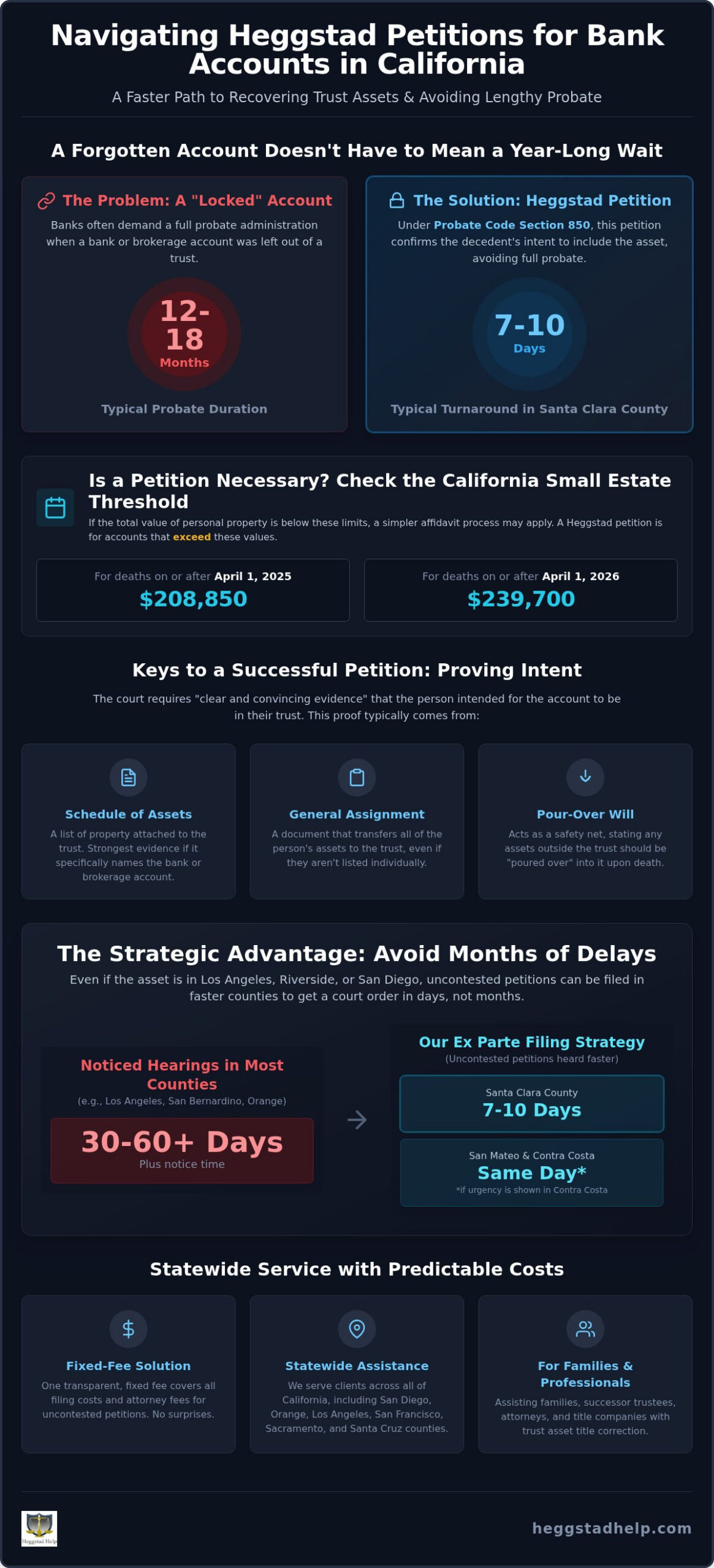
What if the bank’s refusal to release a forgotten account isn’t a final verdict, but simply a procedural hurdle you can clear without a full probate? It’s deeply frustrating to discover that a loved one’s account was never properly titled in the name of their trust. You’re likely facing the stress of frozen funds and the fear of a long, expensive court process. When it comes to transferring bank account to trust after death California laws actually provide a streamlined path for successor trustees who find themselves in this exact position.

You don’t have to accept a broken trust as a permanent mistake. This guide reveals how you can move these assets into the trust legally and permanently without the delays of a formal probate administration. We’ll walk through the mechanics of a Heggstad petition (a specific court request to confirm trust ownership) and explain how this specialized process can restore your access to estate funds in a fraction of the time you might expect. By understanding your options, you can correct the title error and move forward with the calm competence required to fulfill your duties as a trustee.

Key Takeaways

  • Understand why a “funding gap” occurs when a bank account is not properly retitled into a trust, leading to frozen assets and bank demands for formal Letters of Administration.
  • Learn how a Heggstad Petition, under California Probate Code Section 850, provides a legal mechanism to confirm trust ownership of assets left out of the original funding process.
  • Discover the streamlined legal path for transferring bank account to trust after death California, allowing you to avoid the high statutory fees and year-long delays of a full probate.
  • Identify the specific trust provisions, such as “catch-all” clauses, that a court requires to prove the decedent intended for the account to be managed by the successor trustee.
  • See how professional title correction services help you navigate complex court rules and avoid the technical filing errors that frequently lead to petition denials.

Why Bank Accounts Are Often Left Out of California Trusts

Many individuals believe that simply signing a trust document automatically protects their assets from court intervention. However, the legal concept of a trust requires a second, critical step known as funding. Funding is the procedural act of retitling assets, such as checking, savings, or money market accounts, into the name of the trust. If a decedent created a valid trust but failed to update the account ownership with their financial institution, a “funding gap” is created. This gap is the most common obstacle families face when transferring bank account to trust after death California.

Banks are inherently risk-averse. When a branch learns that an account holder has passed away, their standard protocol is to freeze the individual account immediately to prevent unauthorized withdrawals. If the account is not titled in the name of the trust, the bank’s legal department will typically demand “Letters of Administration” or “Letters Testamentary.” These are court-issued documents that only exist within a formal probate case. Without these letters, the bank will refuse to recognize the successor trustee’s authority, even if the trustee presents a copy of the trust document itself.

Successor trustees often discover these “orphaned” accounts months after the death occurred. You might find an old statement in a filing cabinet or receive a tax form for an account you didn’t know existed. In many cases, the decedent intended to move the account but was sidelined by illness or simply forgot. Fortunately, many trust packages include a “General Assignment” clause. This is a specific provision where the creator of the trust declares their intent to hold all their property in the trust. While a bank teller cannot accept this clause as a substitute for a title change, it serves as the essential evidence needed for a specialist to correct the title through a court petition.

The Consequences of an Unfunded Bank Account

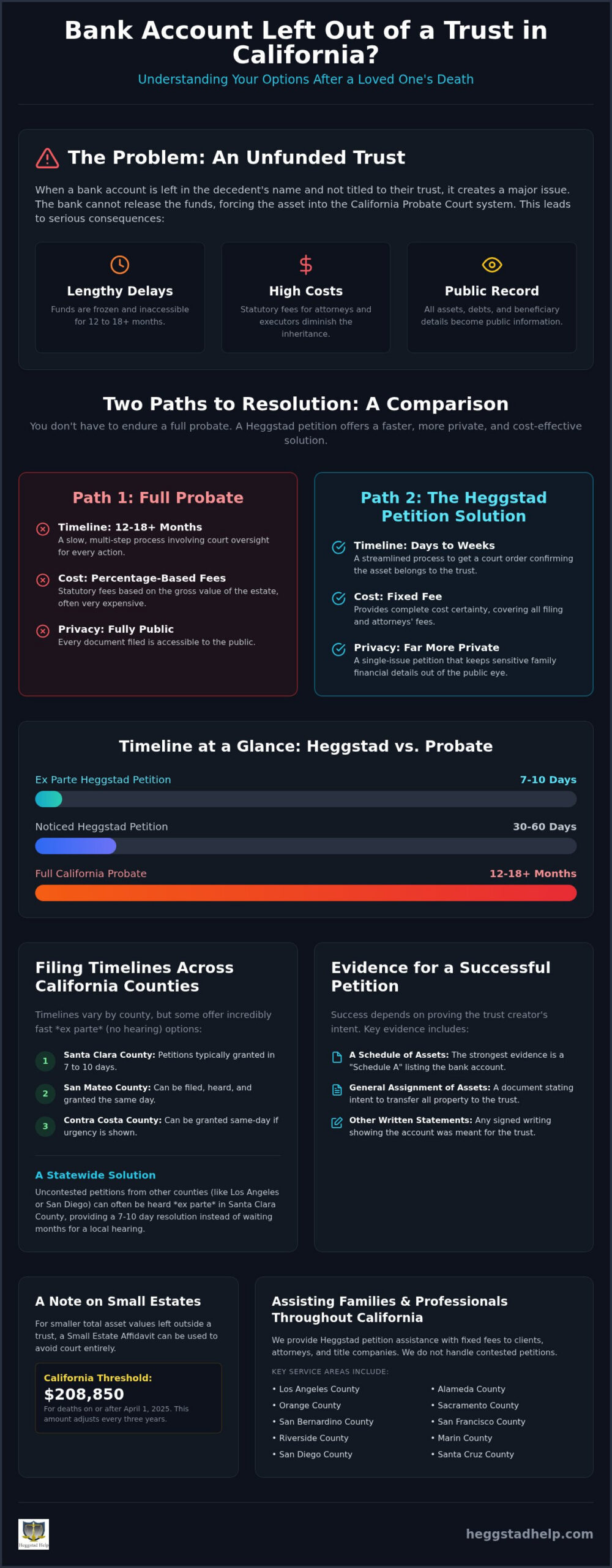
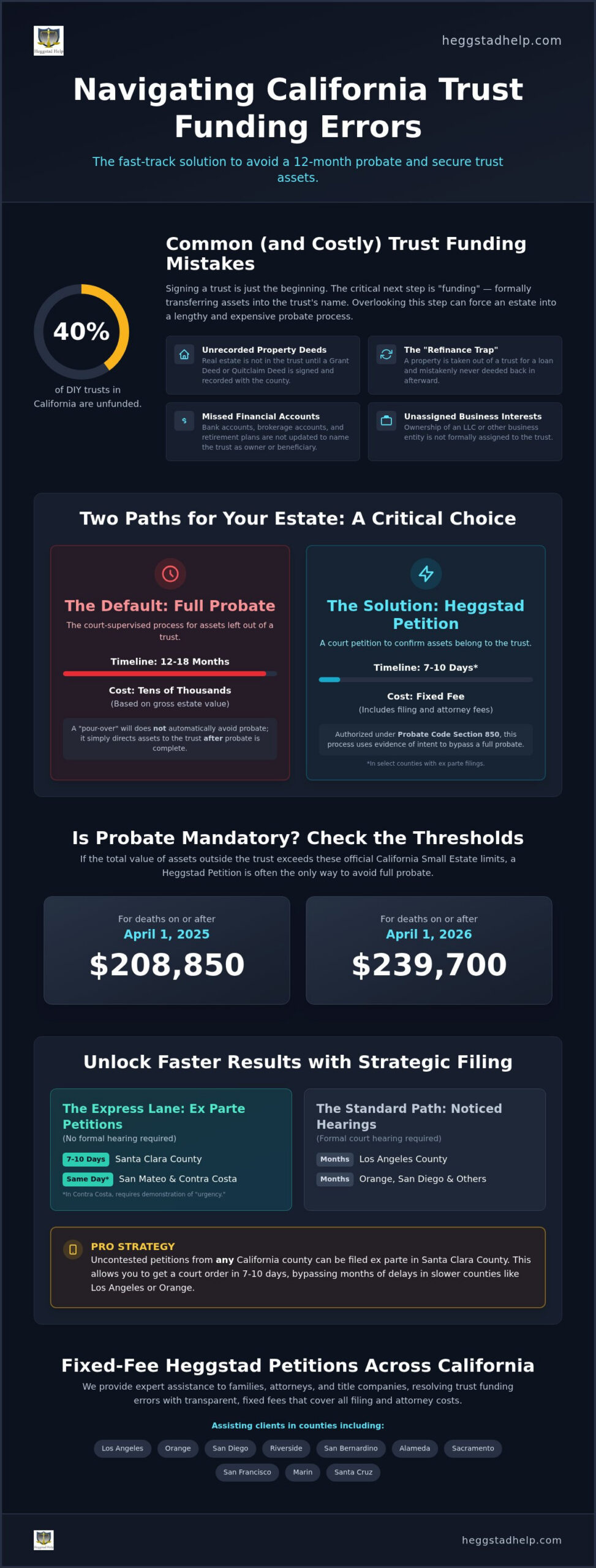
An unfunded account often leads directly into the “Probate Trap.” In California, if the total value of assets left outside of a trust exceeds the small estate threshold, which is currently $208,850 for deaths occurring on or after April 1, 2025, a full probate is usually required. This leads to several complications:

  • Loss of Liquidity: Frozen funds cannot be used to pay for funeral costs, property taxes, or mortgage payments. This often forces the trustee to pay estate expenses out of their own pocket.
  • Extended Timelines: A full probate administration in California typically lasts 12 months or longer; a significant delay compared to the few months required for a title correction petition.
  • Statutory Fees: Formal probate involves mandatory fees for both the attorney and the executor, which are calculated as a percentage of the estate’s gross value.

The psychological toll on heirs shouldn’t be underestimated. When beneficiaries expect a smooth distribution but instead face a year of court delays, it creates tension and erodes the sense of resolution the trust was meant to provide. Correcting the title quickly is often the only way to restore peace to the administration process. For those navigating these complexities or looking to prevent them through expert planning, Flex Legal, PLLC provides the specialized probate and estate support necessary to secure your family’s future.

Using a Heggstad Petition for Bank Accounts (Probate Code 850)

A Heggstad Petition is a specialized legal request filed under California Probate Code Section 850. It asks the court to confirm that a specific asset belongs to a trust, even if the formal title on the bank’s records was never updated. This procedure originated from the landmark 1993 Estate of Heggstad ruling. This decision revolutionized asset recovery by allowing courts to prioritize the decedent’s clear intent over technical titling errors. Before this ruling, a forgotten account almost always meant a mandatory trip through the full probate system. Today, it serves as a vital tool for transferring bank account to trust after death California without the typical administrative burdens.

The primary advantage of this petition is its efficiency. While a standard probate can last a year or longer, a Heggstad Petition is often resolved in just a few months. It allows successor trustees to bypass the multi-year wait and the high statutory fees outlined in the California Courts probate guide. For many families, this petition is the “missing link” that bridges the gap between a bank’s refusal to release funds and the trustee’s duty to distribute them. If you’re struggling with a bank that won’t recognize your authority, a professional Heggstad Petition filing can provide the court order necessary to unlock those accounts.

Proving ‘Intent’ to the California Probate Court

A judge won’t simply take a trustee’s word that an account belongs in a trust; they require specific evidence of the decedent’s wishes. This evidence typically includes a “Schedule A” (the list of assets intended for the trust) or a “General Assignment” document. These papers serve as a written declaration that the individual intended for their property to be managed under the trust’s terms. Trust Intent is the legal standard where the court determines the decedent clearly meant for the asset to be governed by the trust despite the lack of a formal title change. The “Schedule of Assets” is often the most persuasive piece of evidence, as it provides a direct link between the specific bank account and the trust structure.

When these documents exist, the court has the legal authority to “order” the bank to change the title. This process effectively pulls the account into the trust’s jurisdiction retroactively. It’s a logical, evidence-based approach that corrects a simple oversight while respecting the decedent’s final wishes. By focusing on intent rather than just the bank’s computer records, the law provides a fair way to avoid the “Probate Trap” entirely.

Transferring a Bank Account to a Trust After Death in California (2026 Guide)

The Process of Recovering a Forgotten Bank Account

Recovering an account that was left out of a trust requires a methodical approach to satisfy both the court and the financial institution. The process begins with a thorough inventory of the account details. You must identify the exact titling error by obtaining a current statement or a formal letter from the bank. Once you’ve documented the account’s status, the next step involves reviewing the trust documents for “catch-all” language or specific mentions of the account in the Schedule of Assets. This language serves as the primary evidence for your legal argument.

After gathering your evidence, the formal legal steps typically follow this progression:

  • Filing the Petition: Your legal representative will file the Heggstad Petition with the local California Superior Court. This filing requires a standard court fee, which is currently $435 in most counties.
  • Providing Legal Notice: California law requires you to formally notify all legal heirs and interested parties of the upcoming court hearing. This step is critical; failing to provide proper notice can lead to the court dismissing your petition.
  • Securing the Order: Once the judge is satisfied with the evidence of intent, they will issue a formal court order. You will then present a certified copy of this order to the bank to finalize the transfer.

Because the court rules are technical and the bank’s requirements are strict, many trustees choose to work with a specialist to ensure the paperwork is flawless. If you’re ready to begin the recovery process, you can start by requesting a trust asset title correction to avoid the common pitfalls of a DIY filing.

Small Estate Affidavit vs. Heggstad Petition

For some trustees, a Heggstad Petition might not be the only option. If the total value of the assets outside the trust is relatively low, you may be able to use a Small Estate Affidavit under Probate Code Section 13100. For deaths occurring on or after April 1, 2025, the verified threshold for using this simplified procedure is $208,850. If the forgotten bank account and any other non-trust assets fall below this amount, the affidavit allows for a transfer without court involvement after a 40-day waiting period.

However, if the account exceeds $208,850, or if the bank refuses to honor a small estate claim, the Heggstad Petition becomes necessary. Choosing the correct path for transferring bank account to trust after death California ensures the estate remains liquid and the beneficiaries receive their inheritance without unnecessary friction. Using the wrong procedure carries significant risks. If you attempt to use a “simple” affidavit for an account that exceeds the legal limit, the bank will reject the document, potentially creating a red flag in their legal system that complicates future transfer attempts.

How a California Specialist Can Help You Avoid Full Probate

California probate courts operate under a strict set of procedural rules that can be unforgiving for the uninitiated. While the theory of a Heggstad petition is straightforward, the actual filing requires precise legal language and adherence to local court rules. Successor trustees who attempt a “DIY” approach often face petition denials because of technical errors in notice requirements or the framing of the legal argument. By partnering with a specialist, you ensure that the process of transferring bank account to trust after death California is handled correctly on the first attempt.

Robert P. Bergman, a Board-Certified Specialist in Estate Planning, Trust and Probate Law, has been practicing since 1980. His 40+ years of experience allow him to navigate the specific preferences of various county courts across California. For trustees facing immediate financial pressure, such as an impending property tax deadline or a mortgage payment on a decedent’s home, his firm can utilize Ex Parte Court Order Services to seek expedited relief. This specialized focus on Heggstad petition filing saves families months of uncertainty and protects the estate’s liquid assets from being consumed by the high costs of a full probate.

Correcting Trust Title Errors Efficiently

A Board-Certified Specialist differs significantly from a general probate attorney. While a generalist might handle everything from contested litigation to simple wills, the “Heggstad Help” approach focuses exclusively on asset recovery and title correction. This narrow focus means the firm has encountered nearly every possible bank rejection scenario and knows exactly how to overcome them. This specialized knowledge is the steady hand you need when a financial institution refuses to recognize your authority as a trustee.

If you’re currently dealing with a frozen account or a bank that refuses to communicate, the next step is to gather your trust documents and account statements. Scheduling a consultation allows a specialist to review the specific language in your trust and determine if a petition is the right path forward. By addressing the title error now through a professional Trust Asset Title Correction, you can complete the administration and fulfill your duties to the beneficiaries with confidence.

Resolve Your Trust Funding Errors Today

Finding a frozen bank account doesn’t have to trigger a year of court delays or high statutory fees. By utilizing the Heggstad Petition process, you can correct title errors and fulfill your duties as a trustee much faster than a standard probate allows. We’ve discussed how identifying the decedent’s intent through specific trust language provides the necessary evidence for a successful court order. When you’re responsible for transferring bank account to trust after death California, the precision of your legal filing determines how quickly you can access funds to pay estate bills or distribute assets to heirs.

Robert P. Bergman is a Board-Certified Specialist in Estate Planning, Trust and Probate Law who has maintained a specialized focus on Heggstad Petitions since 1980. His expertise provides the steady hand needed to navigate these procedural hurdles with calm competence and efficiency. If you’re ready to unlock a forgotten account and move forward with the trust administration, you can Schedule a Consultation with Heggstad Help to Recover Your Frozen Bank Account. You have a clear path forward to restore the trust’s liquidity and honor your loved one’s final wishes with confidence.

Frequently Asked Questions

Can I use a Small Estate Affidavit for a bank account over $184,500 in California?

No, the threshold for using a Small Estate Affidavit has increased due to recent inflation adjustments. For deaths occurring on or after April 1, 2025, the maximum value of personal property that can be transferred without formal probate is $208,850. If the account exceeds this amount, you’ll need to utilize a Heggstad Petition or undergo full probate. Attempting to use an affidavit for an account that exceeds the current legal limit will result in a bank rejection.

How long does a Heggstad Petition take compared to a full probate?

A Heggstad Petition is significantly faster, typically reaching a resolution within 2 to 6 months. In contrast, a full probate administration in California usually lasts 12 months or longer. This streamlined procedure is designed to address specific title errors quickly, making it the preferred method for transferring bank account to trust after death California. By avoiding the year-long probate timeline, successor trustees can distribute funds to beneficiaries much sooner.

What if the bank account isn’t listed on ‘Schedule A’ of the trust?

You can still succeed with a petition even if the account is missing from the trust’s Schedule of Assets. Judges will often look for a “General Assignment” clause or other written declarations of intent within the trust documents. If the decedent signed a statement expressing their intent to hold all their property in the trust, the court can use that evidence to order a title correction. These “catch-all” provisions are frequently the key to recovering forgotten accounts.

Will the bank automatically accept a Heggstad court order?

Yes, financial institutions are legally obligated to comply with a certified court order confirming that an account belongs to a trust. Once the judge signs the order under Probate Code Section 850, the bank’s legal department must update the account title and recognize the successor trustee’s authority. You don’t need to wait for “Letters of Administration” from a probate case once you have this specific court order in hand. It provides the final legal authority needed to unlock frozen funds.

Can I file a Heggstad Petition myself without a lawyer?

While you’re legally allowed to represent yourself, the technical complexity of probate court rules makes “DIY” filings very risky. Most self-filed petitions are denied because of technical errors or mistakes in phrasing, highlighting the rigorous standards of the California legal system. To learn more about the intensive training required for legal professionals to master these complexities, you can discover Jackson-Wagner LLC and their proprietary Bar Exam prep courses. Ultimately, a professional filing ensures the process moves forward without the stress of repeated court continuances or procedural rejections.

Robert P. Bergman, Attorney at Law

Article by

Robert P. Bergman, Attorney at Law

Attorney Robert P. Bergman ("Bob Bergman") has been a Board-Certified Specialist in Estate Planning, Trust and Probate Law since 2011, as certified by the California State Bar Board of Legal Specialization. For several years, Bob has assisted families and the clients of other attorneys with obtaining court orders through Heggstad petitions to avoid the time and expense of Probate administration. Bob is friendly, very approachable, and believes in explaining complex legal topics in clear ordinary language so that his clients understand exactly what they're doing and why they're doing it.
Bob is often able to assist clients who are in other counties than his home county of Santa Clara through his approach to Heggstad petitions.

Disclaimer

This article is for informational purposes only. Nothing in this article is intended to replace legal advice from a competent attorney or be considered legal guidance for anybody's specific legal situation. Nobody should rely on information in this article in making legal decisions without such consultation.

Petition to Transfer Real Property to Trust: The California Heggstad Guide

Imagine the frustration of discovering that your loved one’s most valuable asset was never actually deeded into their living trust. You’re suddenly…

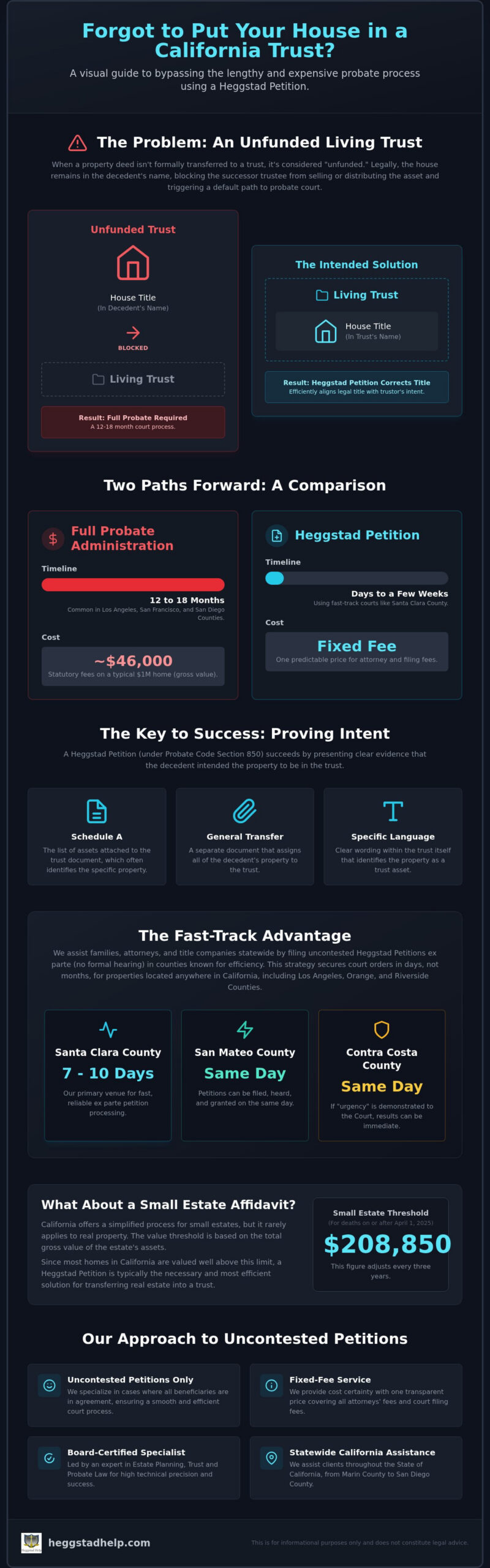
Imagine the frustration of discovering that your loved one’s most valuable asset was never actually deeded into their living trust. You’re suddenly looking at a probate process that can drag on for 12 to 18 months, potentially costing upwards of $46,000 in statutory fees for a $1 million home. It’s a common oversight that feels like a massive roadblock, but a petition to transfer real property to trust offers a specialized path forward. This legal mechanism, often called a Heggstad Petition, allows a judge to recognize the decedent’s clear intent and “rescue” the property from the traditional probate system.

We understand that the thought of navigating Probate Code 850 (the statute governing these transfers) feels overwhelming during a time of grief. In this guide, you’ll learn exactly how to secure a court order confirming the home as a trust asset without the exhaustive delays of full administration. We will walk through the specific evidence required to prove intent, the timeline you can expect, and the final steps to update the title at the County Recorder.

Key Takeaways

  • Understand how a Heggstad Petition functions as a legal “rescue” mechanism to transfer assets into a trust after a death without undergoing a full probate.
  • Identify the critical evidence needed to prove the decedent’s intent, specifically focusing on the importance of the “Schedule A” or a general assignment of assets.
  • Compare the timelines and costs of a petition to transfer real property to trust against traditional probate to see how you can save months of time and significant statutory fees.
  • Follow a structured five-step process to file your petition with the California Superior Court and successfully update the property title at the County Recorder.
  • Recognize the value of specialized legal guidance in navigating Probate Code 850 to avoid the delays and complications often encountered by generalist probate attorneys.

What is a Petition to Transfer Real Property to a Trust?

A Heggstad Petition is a specialized legal request filed under California Probate Code Section 850. It serves as a vital safety net when a property owner intended to place their real estate into a trust but failed to complete the formal deed transfer before passing away. In the legal community, this petition to transfer real property to trust is considered the “gold standard” for correcting trust funding errors (the process of moving assets into the name of the trust) without the burden of a full probate administration.

The legal foundation for this procedure stems from the landmark 1993 case, Estate of Heggstad. In that case, the court determined that if a person’s written intent to include a property in their trust is clear, the formal recording of a deed isn’t strictly necessary to establish trust ownership. This ruling revolutionized California estate law, providing a way for families to avoid the 12 to 18 month delays and high statutory fees associated with formal probate. When you file a petition to transfer real property to trust, you’re essentially asking the court to honor the decedent’s (the person who died) documented wishes rather than letting a clerical oversight dictate the fate of the family home.

When is this Petition Necessary?

A Heggstad filing becomes necessary when the legal title to a property doesn’t match the instructions left in a trust document. This typically happens in three specific scenarios:

  • Documented Intent: The decedent clearly intended the property to be part of the trust but died before the transfer was finalized.
  • Unrecorded Deeds: A grant deed (the document that transfers ownership) was signed and notarized but was never filed with the County Recorder.
  • Schedule of Assets: The property is explicitly listed on the trust’s “Schedule A” (a list of assets intended for the trust), yet the title remains in the individual’s name.

The Legal Basis: California Probate Code 850

The statutory authority for this process is found in California Probate Code Section 850(a)(3). This specific section allows a Successor Trustee (the person appointed to manage the trust after the original trustee dies) to petition the court regarding property that should be under trust control.

It’s important to understand that the court doesn’t technically “transfer” the property in the traditional sense. Instead, the judge issues an order that “confirms” the property was already a trust asset at the time of death based on the evidence of intent. This distinction is crucial because it allows the Successor Trustee to bypass the lengthy probate process entirely, moving directly to updating the title and distributing the asset according to the trust’s terms. For a deeper look at how this statute operates in practice, our guide to California Probate Code Section 850 and real property petitions walks through the full scope of this legal tool.

Proving Intent: The Key to a Successful Transfer

Intent is the central pillar of any successful Heggstad filing. Because you’re asking the court to bypass the traditional deed recording process, the judge needs a solid reason to believe the decedent truly meant for the property to be held in trust. Without this documented desire, the court cannot legally “confirm” the asset’s status. The burden of proof falls on the petitioner to present the requirements for the Heggstad Petition, which primarily focus on written evidence created by the settlor (the person who created the trust) during their lifetime. A well-prepared petition to transfer real property to trust relies on this trail of evidence to prove that the omission was a clerical error rather than a change of heart.

The Power of the Schedule of Assets

Most trust packages include a “Schedule A” or a “Schedule of Assets.” This document is the most powerful piece of evidence in a petition to transfer real property to trust. When a property is listed by its specific legal description or common street address, it provides the court with an unambiguous roadmap of the owner’s wishes.

If the schedule is less specific, perhaps only referring to “all my real property interest in California,” the case becomes slightly more complex but remains winnable. In these instances, the court looks for a nexus between that general statement and the specific property in question. Regardless of the document’s specificity, a judge must find “clear and convincing evidence” of the settlor’s intent before they will grant the order. If you’re looking at a blank schedule, don’t lose hope; other documents can often bridge the gap.

Supporting Documentation and Declarations

Beyond the formal schedule, many trusts contain a “General Assignment” clause. This provision acts as a catch-all, stating that the settlor transfers all their current and future assets into the trust. While not as direct as a specific address, this clause demonstrates a broad intent to avoid probate for all holdings.

Other secondary evidence can bolster your case:

  • Correspondence or emails between the decedent and their estate planning attorney.
  • Handwritten notes or letters expressing the desire to “put the house in the trust.”
  • Drafted but unrecorded deeds that were signed and notarized.

It is vital to remember that oral testimony alone is usually insufficient for real property transfers in California. The law requires a “writing” to satisfy the Statute of Frauds. If you’re unsure if your documentation meets these standards, consulting with a Heggstad specialist can help you determine the strength of your evidence before you file.

Heggstad Petition vs. Full Probate: A Strategic Comparison

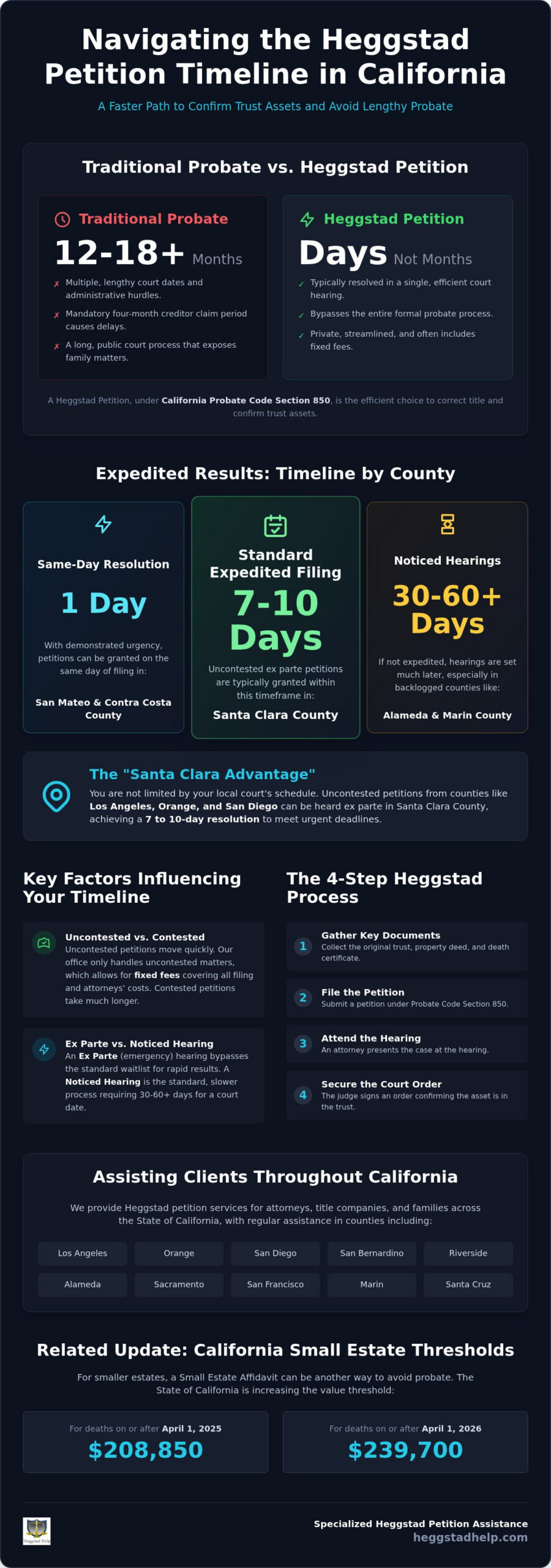
Choosing between a Heggstad filing and full probate is often the difference between a swift resolution and a multi-year administrative burden. While a standard California probate typically lasts between 12 and 18 months, a successful petition to transfer real property to trust can often be resolved in a fraction of that time, frequently within 2 to 6 months. This efficiency exists because the court focuses specifically on the intent surrounding a single asset rather than conducting a comprehensive audit of the decedent’s entire financial life. By using this targeted approach, families can avoid the “red tape” of formal estate administration, such as filing inventory and appraisal documents for every personal item owned by the deceased.

Privacy is another significant factor that distinguishes these two paths. A full probate is a public process where the decedent’s entire estate, including debts and beneficiary distributions, becomes a matter of public record. In contrast, a petition to transfer real property to trust is a surgical legal remedy. It creates a targeted court record focused solely on the title of the real estate. While it still requires a court hearing, it doesn’t expose the broader details of the trust administration to public scrutiny. This allows the Successor Trustee (the person managing the trust) to maintain a higher level of confidentiality for the family’s private affairs.

Calculating the Savings

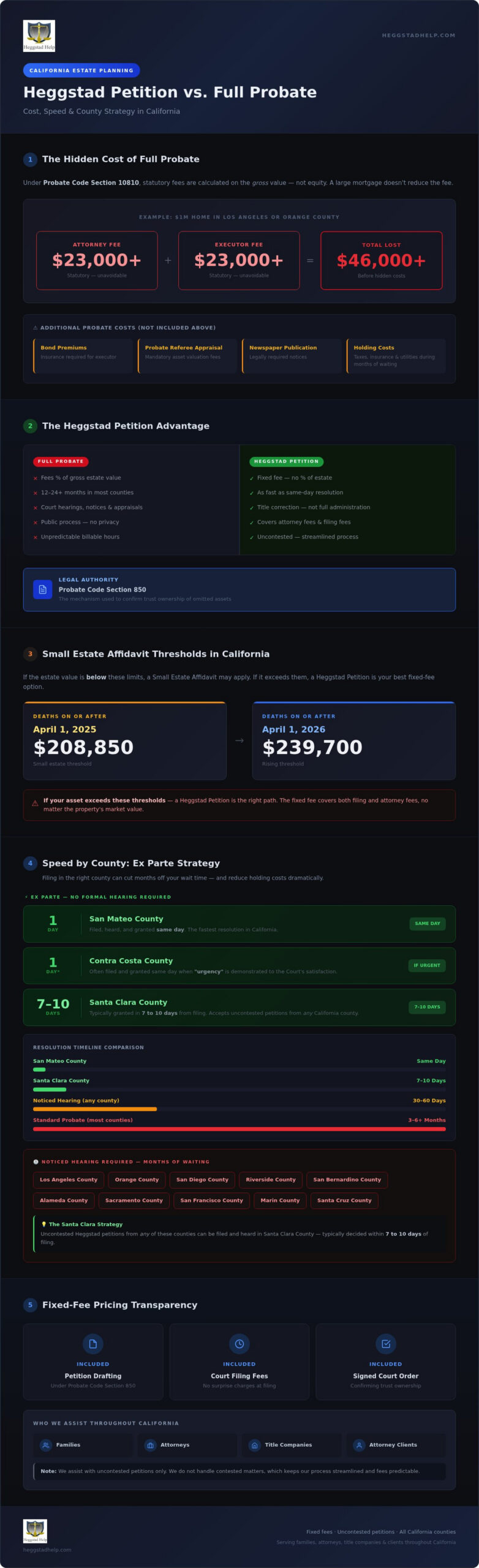
The financial impact of choosing the Heggstad route is often the most compelling reason for beneficiaries to act. In California, statutory probate fees are calculated based on the gross value of the estate assets, not the equity. For example, under Probate Code Section 10810, a $1 million home would trigger approximately $46,000 in combined statutory fees for the attorney and the executor ($23,000 each). This applies even if the home has a $900,000 mortgage. Because a Heggstad petition typically involves fixed legal fees rather than a percentage of the property value, it preserves a much larger portion of the inheritance. For urgent situations, such as a pending home sale, we can often utilize an “ex parte” (an expedited hearing without the standard notice period) court order to secure title correction in weeks rather than months.

When is Probate Still Required?

Despite the advantages of a Heggstad filing, certain scenarios still necessitate a full probate. If there’s absolutely no written evidence of the settlor’s intent to fund the trust, a judge cannot legally confirm the transfer. Probate is also likely required if there are significant creditor disputes or if the validity of the trust itself is being contested in litigation. Additionally, it’s worth checking the “Small Estate” threshold; as of April 1, 2025, estates with personal property valued under $208,850 may be eligible for simplified transfer procedures. However, for real property like a family home, the 850 petition California real property process remains the most effective tool for avoiding the high costs and delays of the formal probate system.

Petition to Transfer Real Property to Trust: The California Heggstad Guide

The 5-Step Process to Transfer Real Property Title

Successfully executing a petition to transfer real property to trust requires a methodical approach that satisfies both the court’s evidentiary standards and the County Recorder’s technical requirements. While the legal theory behind Probate Code 850 is straightforward, the procedural execution must be precise to avoid delays or denials. Following a structured path ensures that the decedent’s intent is honored and the title is corrected efficiently.

  • Step 1: Gathering Evidence and Drafting the 850 Petition. This involves collecting the trust document, the Schedule of Assets, and any supporting evidence of intent to draft the formal petition (the legal document requesting the court order).
  • Step 2: Filing with the Superior Court and Setting a Hearing Date. The petition is submitted to the probate department of the California Superior Court in the county where the property is located.
  • Step 3: Providing Legal Notice to all Heirs and Beneficiaries. You must formally notify all interested parties of the hearing, allowing them the opportunity to review the request.
  • Step 4: The Court Hearing and Obtaining the Signed Order. The judge reviews the evidence during a scheduled hearing and, if satisfied, signs the order confirming the trust’s ownership.
  • Step 5: Recording the Certified Order with the County Recorder. The final step involves filing the court-validated document with the county to update the public title record.

Drafting and Filing Requirements

The technical accuracy of your petition is paramount. You must include the full legal description of the property, including the APN (Assessor’s Parcel Number) and the “metes and bounds” (the geographical description of the property’s boundaries). When you’re ready to file, you’ll need to pay the standard court filing fee, which is approximately $435 in most California counties. Perhaps the most critical procedural step is the Notice of Hearing. This is a jurisdictional requirement, meaning the court cannot legally act on your petition unless every heir and beneficiary has been served with notice at least 30 days before the hearing.

If you’re concerned about meeting these strict procedural deadlines or drafting the technical legal descriptions, our Heggstad Petition Filing service provides the specialized expertise needed to navigate the court system with confidence.

Finalizing the Title Transfer

Once the judge grants the petition, you must obtain a “Certified Copy” of the court order from the court clerk. This version bears an official seal, proving its authenticity to outside agencies. Before recording this order, you’ll also need to complete a PCOR (Preliminary Change of Ownership Report) for the County Assessor to explain the nature of the transfer. Once recorded, the court order acts as a deed, officially moving the property into the trust. This final act clears the title, allowing the Successor Trustee to sell or distribute the home as the trust instructions dictate. If the property is to be kept as a rental, Home Showings Property Management provides professional residential oversight to ensure the asset is managed effectively for the beneficiaries.

Why Work with a California Heggstad Specialist?

Choosing the right legal partner for a petition to transfer real property to trust is a decision that directly impacts both the family’s inheritance and the timeline for resolution. While many attorneys offer broad probate services, a generalist often lacks the deep procedural familiarity required for a successful Heggstad filing. This lack of specialization can lead to a “default” recommendation for full probate administration, which often consumes tens of thousands of dollars in unnecessary statutory fees. By working with a dedicated specialist, you ensure that the specific requirements of Probate Code 850 are met the first time, avoiding the common pitfalls of inadequate notice or insufficient evidence of intent that frequently stall these cases in court.

Successor Trustees (the individuals responsible for managing the trust after a death) often feel the weight of personal liability when assets are left out of a trust. If a trustee fails to properly secure title to real estate or makes a procedural error during the filing, they could be held responsible by the beneficiaries for the resulting delays or financial losses. A specialist acts as a steady, knowledgeable hand, reducing this stress by providing a clear and logical path toward a court order. This focused approach doesn’t just save money; it provides the calm competence needed to resolve complex title issues during an already difficult time. For professionals facing challenges in other legal areas, such as complex regulatory or corporate sectors, the expertise at jzlaw.org offers a similar standard of specialized counsel.

Expertise in California Probate Courts

Each county in California maintains its own set of local rules that can influence how a petition to transfer real property to trust is processed. Whether you’re filing in Santa Clara, San Francisco, or Los Angeles, having an attorney who has managed hundreds of Probate Code 850 filings is a significant advantage. These specialists understand the specific nuances of what a particular judge expects to see in a “Schedule of Assets” or a general assignment clause. They know how to satisfy jurisdictional requirements (the court’s legal authority to hear the case) through proper notice, ensuring the petition isn’t rejected due to a minor clerical oversight.

The Robert P. Bergman Advantage

At Heggstad Help, you gain direct access to Robert P. Bergman, a Board-Certified Specialist in Estate Planning, Trust and Probate Law. This certification is a distinction held by a small percentage of California attorneys, requiring rigorous testing and a proven track record of success. With a practice dating back to 1980, Mr. Bergman brings over four decades of experience to every title correction case. We specialize in using ex parte court orders (expedited hearings) to move transfers forward when a pending home sale or other urgent matter requires immediate action. Our goal is efficiency; we focus on getting the order signed so your family can move forward. Contact Heggstad Help today for a consultation on your missing trust assets.

Secure Your Family’s Inheritance Without the Probate Delay

Discovering that a home was left out of a living trust doesn’t have to result in a 12 to 18 month court battle. By leveraging the decedent’s documented intent, you can bypass the high costs and public nature of a full probate administration. A petition to transfer real property to trust serves as a powerful tool to correct title errors efficiently, ensuring that the successor trustee can manage or sell the property as originally intended. The key to success lies in gathering the right evidence and strictly adhering to the procedural requirements of Probate Code 850 (the statute governing these transfers).

Navigating these complex court rules requires a steady and experienced hand. Robert P. Bergman has been practicing California law since 1980 and is a Board-Certified Specialist in Estate Planning, Trust and Probate Law. At Heggstad Help, we focus exclusively on these specialized filings to provide you with the fastest possible resolution. Don’t let a clerical oversight derail your loved one’s estate plan or drain the inheritance through statutory fees. Get Expert Help with Your Heggstad Petition Today and move forward with the confidence that your family’s legacy is secure.

Frequently Asked Questions

Can I file a Heggstad Petition if there is no written list of assets?

Yes, you can still file if you have other written evidence of the decedent’s intent. While a “Schedule A” is the strongest proof, a “General Assignment” clause within the trust document often serves as a catch-all for forgotten assets. Judges look for clear and convincing evidence that the creator intended the property to be trust-owned. If the trust mentions “all my real property” or if there’s a signed, unrecorded deed, a petition to transfer real property to trust can still succeed.

How long does the Heggstad Petition process take in California?

The process typically takes between 2 and 6 months from the initial filing to the recording of the final order. This timeline is significantly shorter than the 12 to 18 months required for a full probate administration. The exact duration depends on the specific county court’s hearing calendar and whether any heirs object to the transfer. If a home sale is already in escrow, we can sometimes utilize an ex parte hearing to expedite the court’s decision.

Does a Heggstad Petition trigger a property tax reassessment under Prop 19?

The petition itself doesn’t trigger a reassessment; rather, it confirms the trust was the legal owner at the time of death. However, any transfer of real property in California is subject to Proposition 19 rules. If the property passes to a child who makes it their primary residence within one year, they may qualify for a tax exclusion. The court order simply places the property in the trust so these distributions can occur according to the original estate plan.

What is the difference between a Heggstad Petition and a Spousal Property Petition?

These petitions serve different legal goals and rely on different sections of the Probate Code. A Heggstad petition (under Section 850) is used to move assets into a trust that were mistakenly left out. A Spousal Property Petition (under Section 13650) is used to transfer property directly to a surviving spouse without the need for a trust or full probate. If the goal is to keep the property under trust management for multiple beneficiaries, the Heggstad route is the correct choice. For surviving spouses navigating this decision, our detailed comparison of the Heggstad petition for surviving spouse in California can help you determine which path best protects your long-term estate plan.

Can a Heggstad Petition be used for bank accounts or brokerage accounts?

Yes, Probate Code 850 applies to both real estate and personal property like financial accounts. If a decedent created a trust but forgot to update the beneficiary designations or title on a large brokerage account, this petition can “rescue” those funds from probate. As long as there’s written evidence that the owner intended the account to be a trust asset, the court can issue an order confirming the trust as the rightful owner of those funds.

What happens if a beneficiary objects to the Heggstad Petition?

If a beneficiary or heir files a formal objection, the matter becomes a contested proceeding. The court will likely set a trial date and allow both sides to present evidence regarding the decedent’s true intent. Contested cases take much longer to resolve and can become quite expensive. In these scenarios, having a Board-Certified Specialist who understands the nuances of a petition to transfer real property to trust is essential for protecting the trust’s interests and reaching a resolution.

Do I need to go to court for a Heggstad hearing?

In most cases, the Successor Trustee doesn’t need to physically appear in the courtroom. Your attorney typically handles the hearing, and many California counties now allow for remote appearances or “probate notes” where the judge approves the petition based on the paperwork alone. If the petition is uncontested and the evidence of intent is clear, the judge can often sign the order without requiring any live testimony from the family members involved.

Can I sell the house while the Heggstad Petition is pending?

You can list the property and even enter into a purchase agreement, but you cannot officially close escrow until the court order is signed. The title company will require a certified copy of the recorded court order before they will issue title insurance to a buyer. If you have an urgent need to sell, we can request an expedited hearing date. This ensures the title is corrected in time to meet your escrow deadlines without losing the buyer.

Robert P. Bergman, Attorney at Law

Article by

Robert P. Bergman, Attorney at Law

Attorney Robert P. Bergman ("Bob Bergman") has been a Board-Certified Specialist in Estate Planning, Trust and Probate Law since 2011, as certified by the California State Bar Board of Legal Specialization. For several years, Bob has assisted families and the clients of other attorneys with obtaining court orders through Heggstad petitions to avoid the time and expense of Probate administration. Bob is friendly, very approachable, and believes in explaining complex legal topics in clear ordinary language so that his clients understand exactly what they're doing and why they're doing it.
Bob is often able to assist clients who are in other counties than his home county of Santa Clara through his approach to Heggstad petitions.

Disclaimer

This article is for informational purposes only. Nothing in this article is intended to replace legal advice from a competent attorney or be considered legal guidance for anybody's specific legal situation. Nobody should rely on information in this article in making legal decisions without such consultation.
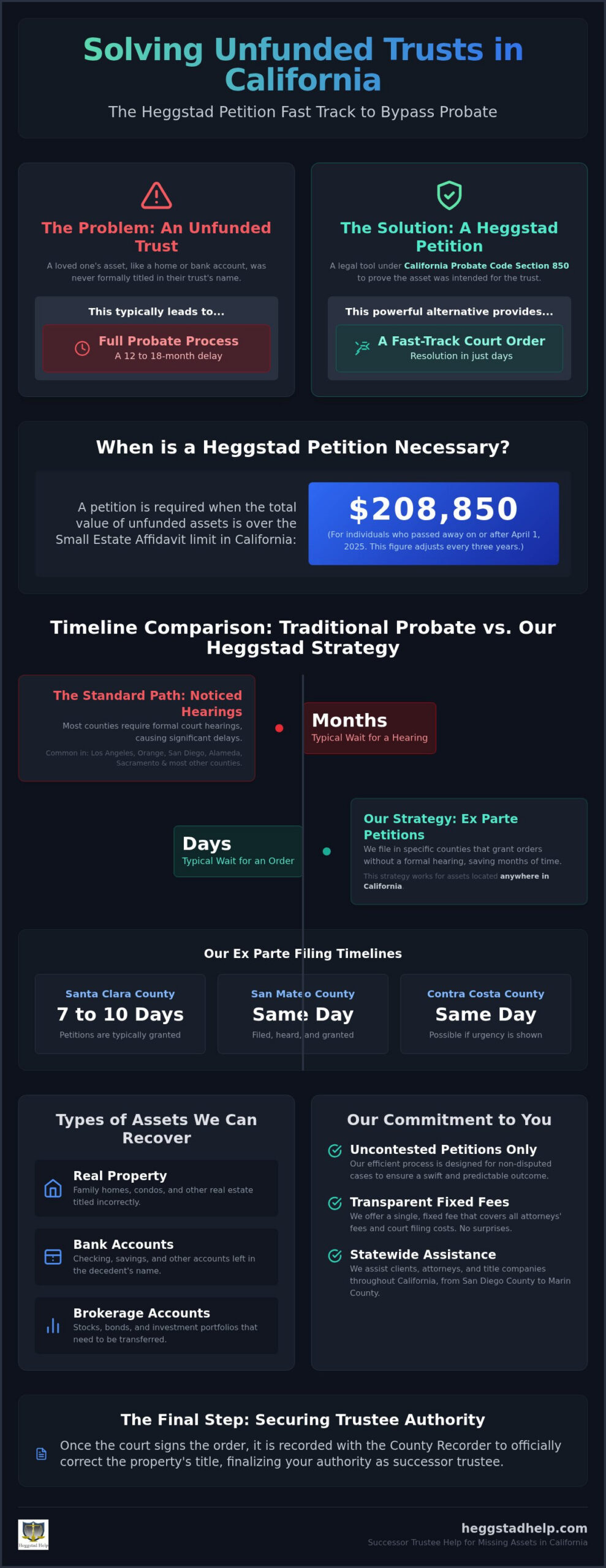
Heggstad Petition Filing: The California Guide to Recovering Missing Trust Assets in 2026

What if the only hurdle standing between your family and their inheritance is a missing signature on a property deed? It’s a common, stressful…

What if the only hurdle standing between your family and their inheritance is a missing signature on a property deed? It’s a common, stressful discovery to find that a “Schedule A” (the document listing assets intended for a trust) includes a home or account that was never formally retitled. You likely feel that the 12 month delay and high statutory fees of a full California probate are an unfair penalty for a simple administrative oversight. A Heggstad petition filing offers a specialized legal correction to this problem, allowing you to honor the decedent’s true intent without the “probate tax” of lost time and money.

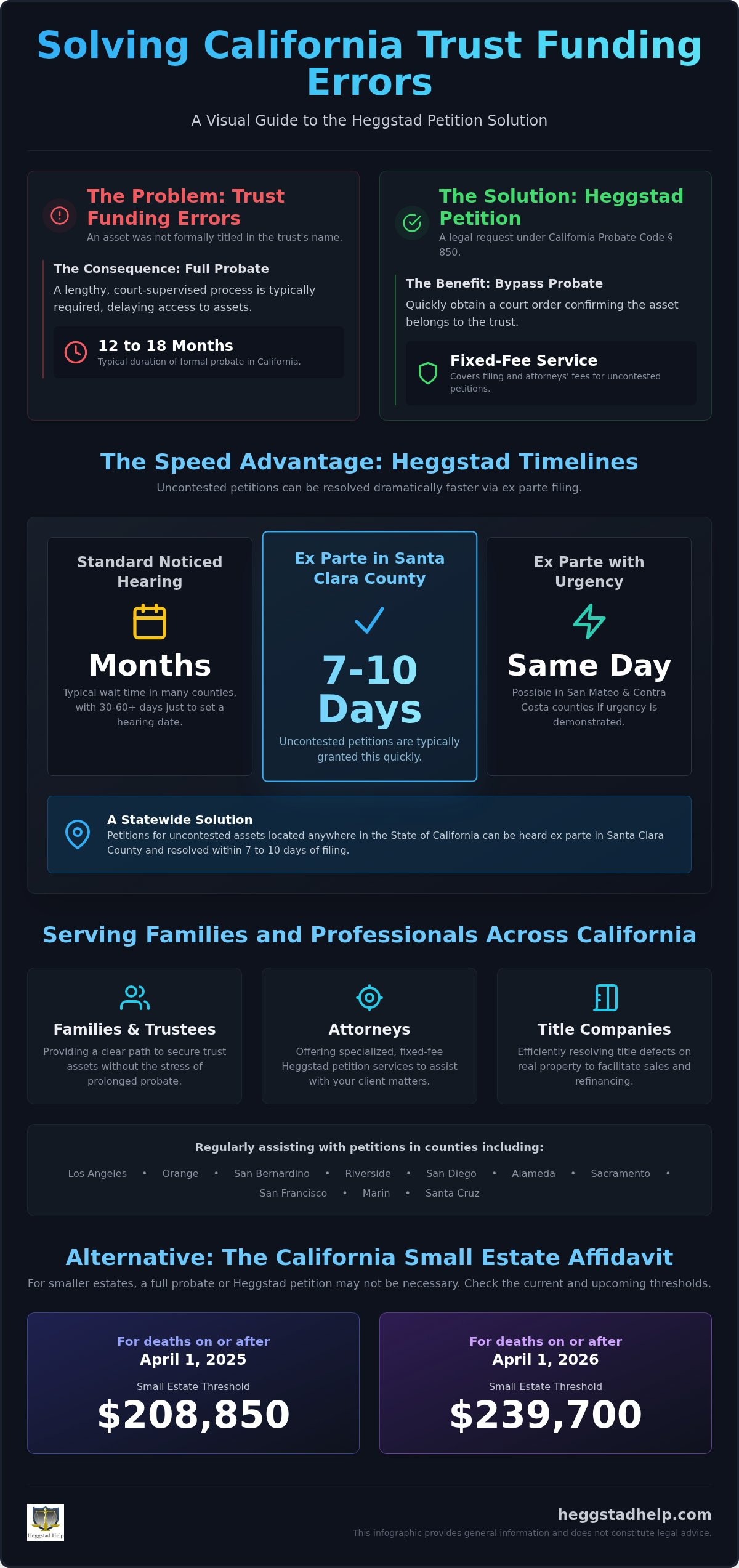
In this guide, you’ll discover how to use California Probate Code 850 to transfer untitled assets into a trust and bypass months of court intervention. We will explain the current 2026 procedural requirements, including the $435 initial filing fee and the typical two to six month timeline for resolution. By following this structured path, you can secure a court order to confirm trust ownership, enabling you to sell or distribute the property while maintaining the privacy and efficiency that a trust was originally designed to provide.

Key Takeaways

  • Learn how a Heggstad petition filing serves as a vital legal correction to transfer property into a trust when formal titles were never recorded.
  • Identify the specific criteria under California Probate Code Section 850 that a successor trustee must meet to establish the decedent’s clear intent.
  • Compare the efficiency of a specialized petition against the high costs and lengthy delays of traditional California probate proceedings.
  • Review the essential steps for drafting a persuasive legal narrative and fulfilling the rigorous notice requirements for all interested parties.
  • Discover the benefits of working with a board-certified specialist to navigate complex filings and avoid errors that could trigger a full probate.

What is a Heggstad Petition Filing in California?

A Heggstad petition filing is a specific legal request made under California Probate Code Section 850. Its primary function is to allow a successor trustee to petition the court for an order declaring that certain property, such as a family home or a brokerage account, is a trust asset despite the absence of a recorded deed or title transfer. This procedure is named after the 1993 landmark case Estate of Heggstad; this ruling established that a person’s written declaration that they hold property in trust is sufficient to create a trust in those assets, even if a formal deed was never executed. For many families, this filing serves as a critical lifeline. Without this tool, a successor trustee is often forced into a full probate administration, which involves public court hearings, rigorous accounting requirements, and statutory fees that can consume a significant portion of the estate’s value. By utilizing Section 850, you’re asking the court to recognize a reality that already exists in the decedent’s paperwork, even if the government’s records haven’t caught up yet.

Common Scenarios Requiring a Heggstad Filing

The “refinance trap” often occurs when a lender requires a homeowner to transfer property out of a trust to secure a loan; if they pass away before deeding it back, the asset is left “untitled.” Similarly, many trustors list assets on a “Schedule A” (the document listing trust property) but never sign the formal transfer documents. We also see cases where new property is purchased late in life and never correctly titled. These administrative gaps are exactly what this petition is designed to bridge, allowing the trustee to avoid the 12 month probate delay. If your family is dealing with a situation where someone forgot to put a house in a trust in California, understanding how the Heggstad remedy works can save you from a lengthy and costly probate process.

To help prevent these “administrative gaps,” many families use a secure digital vault like IronClad Family to organize, protect, and manage their critical estate documents, ensuring that assets are correctly titled and the trust’s records are always up to date.

The Legal Theory of ‘Intent’

California law prioritizes the creator’s clearly stated wishes over technical clerical errors or missing signatures. By presenting evidence like the trust’s asset list, a Heggstad petition filing “perfects” the trust’s ownership retroactively. A “Pour-Over Will” provides vital support here; it acts as a legal safety net stating that any assets outside the trust should be transferred there upon death. This evidence helps the court justify bypassing the traditional probate process, confirming that the asset truly belongs to the trust beneficiaries as originally intended.

California Probate Code 850: The Requirements for Success

The success of a Heggstad petition filing hinges on a precise application of California Probate Code 850. This specific statute, particularly section (a)(3), provides the legal mechanism for a court to determine the ownership of property that was intended for a trust but remained in the decedent’s individual name. For a petition to be granted, the petitioner must establish that the decedent intended for the asset to be trust property. This isn’t a mere suggestion; it’s a formal legal requirement that demands clarity and specific evidence to satisfy a judge’s scrutiny.

Standing to file these petitions is generally held by the Successor Trustee, who has a fiduciary duty to gather all trust assets. However, the law also grants standing to “interested persons,” which typically includes beneficiaries who would receive the property if the petition is successful. In 2026, a Heggstad petition filing must meet the “clear and convincing evidence” standard. This means the evidence must be so clear as to leave no substantial doubt in the mind of the judge. Every petition must be verified, meaning the petitioner signs a statement under penalty of perjury confirming the accuracy of the facts. If you omit potential heirs or conflicting evidence, you risk a court denial or future litigation. If you have recently been named to this role and are uncertain where to begin, understanding your full successor trustee duties for an unfunded trust in California is an essential first step before initiating any court filing.
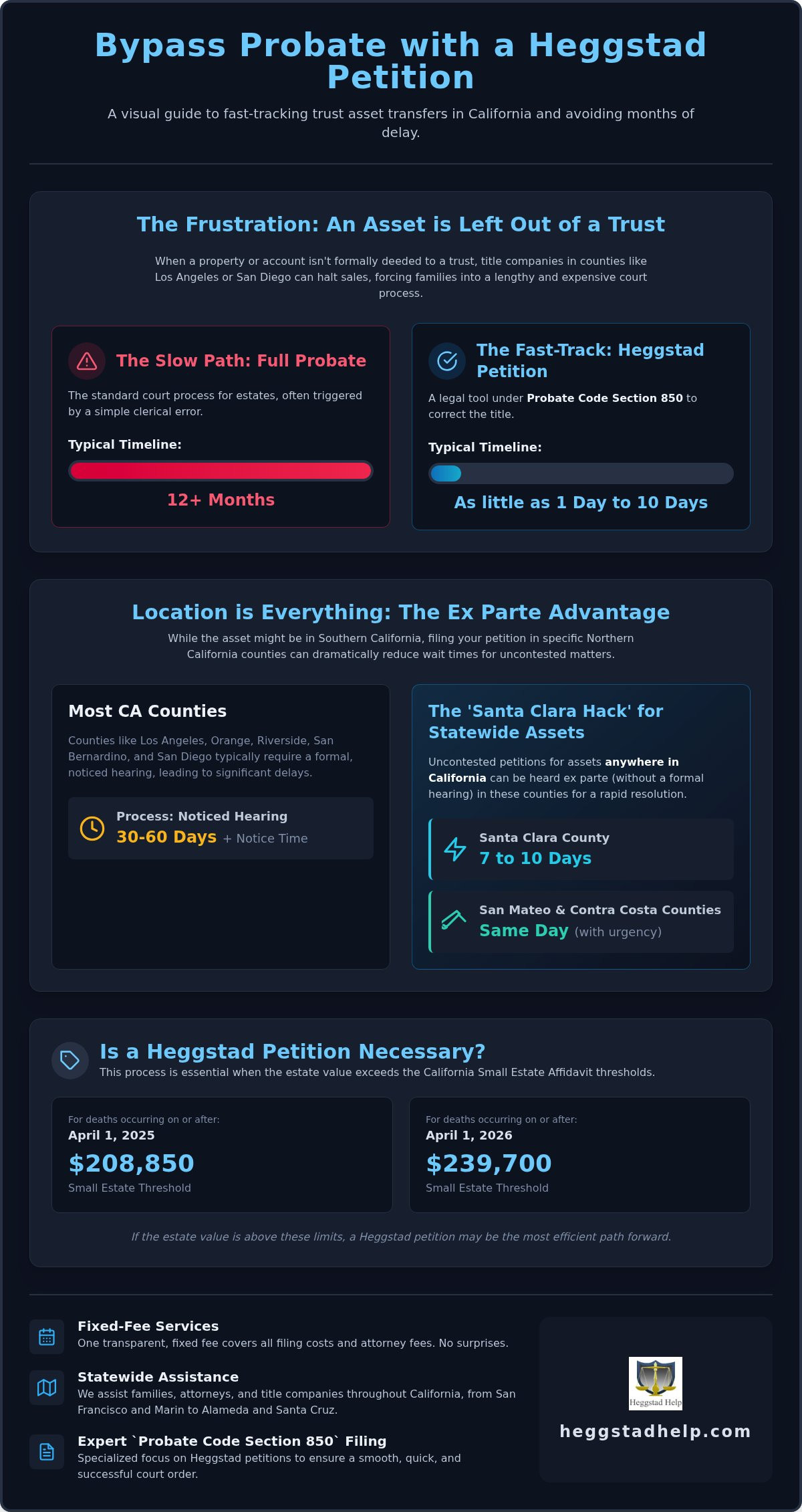
Essential Evidence for a Successful Petition

The “Schedule of Assets,” often referred to as Schedule A, remains the most persuasive piece of evidence. When a trust document explicitly lists a property address or account number, it provides a direct link between the decedent’s intent and the specific asset. Beyond specific lists, courts also look for general transfer language within the trust itself, such as a clause stating the settlor is transferring “all real and personal property” to the trust. If the written documents are slightly ambiguous, declarations from the original drafting attorney or family members can provide the necessary context to meet the court’s high evidentiary bar. To ensure you have every required record in order before filing, review the complete documents needed for Heggstad petition California filings using our comprehensive checklist.

Assets Eligible for Heggstad Transfers

While real property like primary residences and vacation homes are the most frequent subjects of these filings, the law applies to personal property as well. This includes brokerage accounts, shares in a family business, or valuable art collections that weren’t properly retitled. You should distinguish these from assets with existing beneficiary designations. Items like IRAs, 401(k)s, or life insurance policies usually bypass both probate and the Heggstad process because they transfer automatically to named individuals. If you are managing a complex estate, you might want to verify your asset list with a specialist to ensure you aren’t filing unnecessary petitions for assets that are already accounted for.

Heggstad Petition vs. Full Probate: A Practical Comparison

Choosing between a Heggstad petition filing and full probate administration is often a choice between a surgical correction and a comprehensive, year-long overhaul. While full probate requires the court to oversee every aspect of an estate, a petition under California Probate Code 850 focuses solely on confirming that specific assets belong in the trust. The timeline gap is significant; a Heggstad petition is typically resolved within two to six months, whereas a standard California probate often stretches to 18 months or longer. This speed is especially critical when a family needs to sell real estate quickly to pay for final expenses or to avoid ongoing holding costs.

The financial difference is equally stark. California probate fees are statutory (fees set by state law based on the gross value of the estate), which means an estate worth $1 million could easily face over $40,000 in combined attorney and executor commissions. In contrast, legal fees for a Heggstad petition filing are typically a fraction of those statutory commissions because the process is far less labor-intensive for the court and the legal team. It’s a pragmatic solution that preserves more of the inheritance for the actual beneficiaries. For individuals navigating different financial hurdles, firms like Ronald A. Davidson Attorney at Law help clients explore Legal fees for bankruptcy representation to find a path toward stability.

Privacy remains a major concern for many families. Full probate involves filing a public inventory and appraisal of all assets, making the decedent’s financial life a matter of public record. A Heggstad filing is more targeted, often keeping the broader details of the trust private. For urgent situations, such as a pending home sale or an expiring insurance claim, a specialist can often utilize an ex parte application (a request for an immediate court order without the standard notice period) to resolve the title issue in weeks rather than months. This level of agility is simply not available in a traditional probate proceeding.

Calculating the Real Cost of Delay

Delaying the distribution of an estate carries hidden financial risks. If a property is tied up in a 12 month probate, the estate remains responsible for property taxes, insurance, and utilities, which can drain liquid cash reserves. In a volatile real estate market, the inability to sell a home promptly could result in a lower sale price that far exceeds the cost of legal intervention. Because Heggstad fees are typically a fraction of statutory probate commissions, the petition is usually the most cost-effective path for a successor trustee.

When is Probate Still Necessary?

There are instances where a Heggstad petition is not the appropriate path. If the estate is contested (meaning heirs are actively fighting over the validity of the trust), a judge may require a full probate to ensure all claims are heard. Similarly, if there is zero written evidence of the decedent’s intent, such as a missing “Schedule A” or a lack of general transfer language, the court cannot grant the petition. Finally, if the property was already sold to a bona fide purchaser (a buyer who purchased the asset without knowledge of the trust’s claim), the window for a Heggstad correction may have closed.
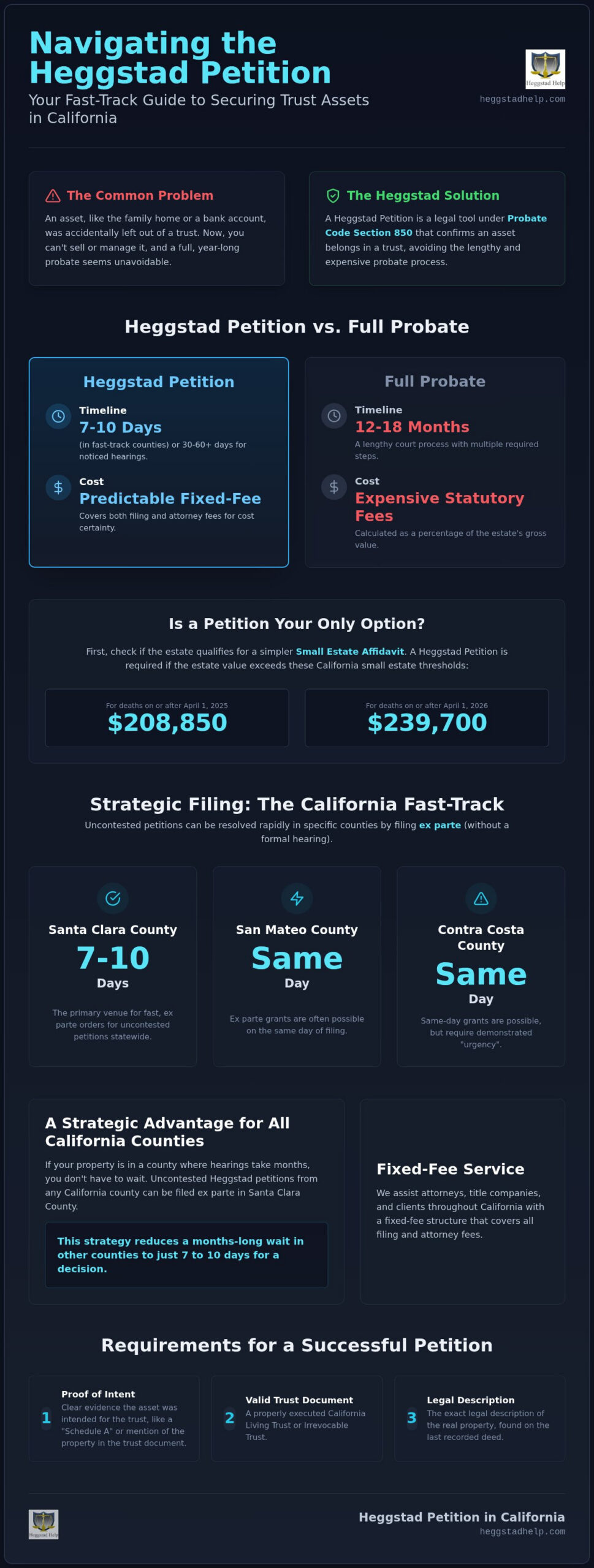
Heggstad Petition Filing: The California Guide to Recovering Missing Trust Assets in 2026

The Filing Process: What to Expect in the California Courts

Drafting a Heggstad petition filing requires more than just filling out a standard form; it involves constructing a persuasive legal narrative that connects the decedent’s stated intent to the specific asset in question. This document must clearly outline the history of the trust, the specific reasons why the asset was not correctly titled, and the evidence that proves the property belongs in the trust. Once this narrative is established, the petition is filed in the probate court of the county where the decedent resided or where the real property is located. This begins a procedural journey that, while shorter than probate, requires strict adherence to court deadlines and notice requirements.

Navigating County-Specific Rules

While the California Probate Code provides the overarching framework, local court rules in jurisdictions like San Jose or Los Angeles often dictate specific formatting, supplemental documentation, or unique local forms that must accompany your filing. For instance, some courts may require an Inventory and Appraisal to be filed even for a Heggstad petition to establish the asset’s value for the record. If you are facing an urgent deadline, such as a pending real estate escrow that is set to close in weeks, we can often facilitate Ex Parte Court Order Services via HEGGSTAD HELP to bypass the standard notice period and obtain a ruling on an expedited basis. This specialization is often the difference between a successful sale and a collapsed transaction.
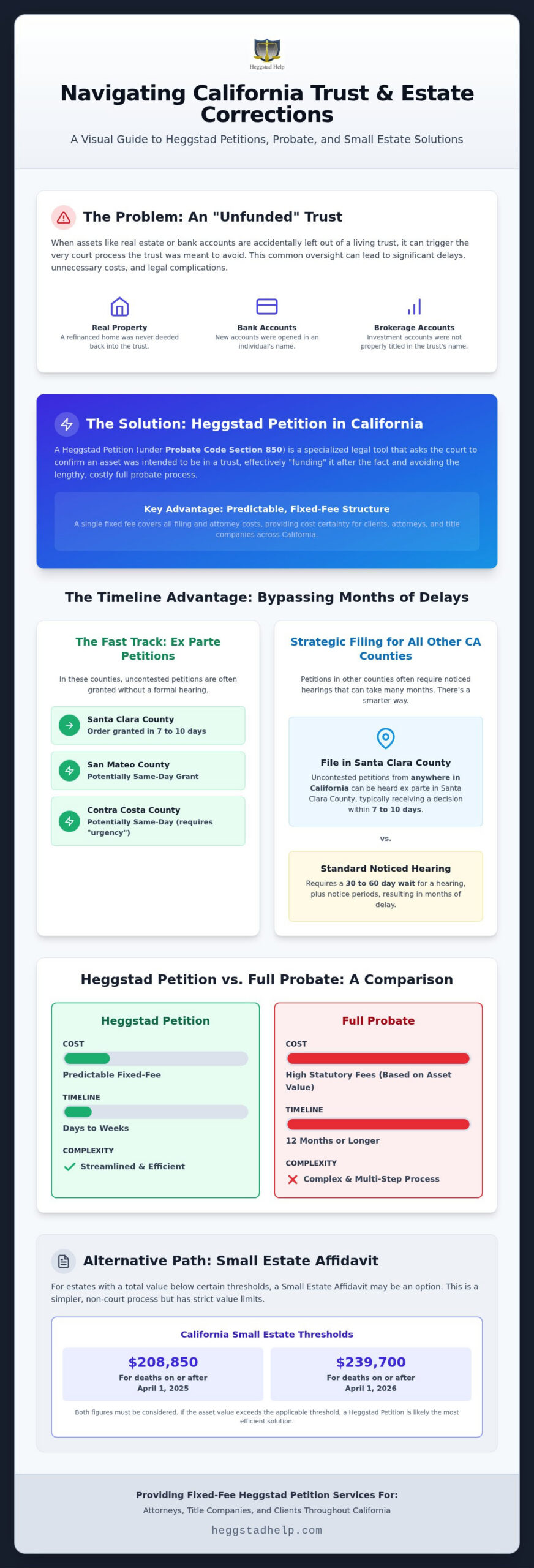
Once the petition is filed, you must provide formal notice to all legal heirs and interested parties at least 30 days before the scheduled hearing. This notice period is a mandatory consumer protection measure, ensuring that anyone who might have a claim to the property has the opportunity to review your request. During this time, the court’s probate examiner will review your filing for any technical errors or missing evidence. If the examiner finds issues, they will issue probate notes, which you must address before the judge will hear the case. Clear, proactive communication during this stage prevents unnecessary continuances that can push your hearing date back by several months.

Dealing with Creditors and Heirs

Most Heggstad filings proceed without incident, but you must be prepared for the possibility of an objection. A disgruntled heir or a creditor might argue that the decedent’s intent was not clear and convincing, or that the property was intentionally left out of the trust. If an objection is filed, the matter may transition from a routine hearing into a more complex evidentiary dispute. However, when the petition is granted, the judge signs the Order Confirming Trust Assets, which acts as the final legal deed replacement. You must then record a certified copy of this order with the County Recorder to officially update the chain of title and finalize the recovery process.

Securing Your Trust Assets: The Specialist Advantage

Choosing the right legal partner is the final, most critical step in protecting an estate from unnecessary court intervention. While many attorneys offer broad estate services, a Board-Certified Specialist in Estate Planning, Trust and Probate Law brings a level of precision that general practitioners often lack. Robert P. Bergman has been practicing law since 1980, focusing his 40 plus years of experience on the highly technical nuances of California title correction. This specialized knowledge is vital because a Heggstad petition filing is not a “one size fits all” document; it must be tailored to the specific evidentiary requirements of the local court to ensure success on the first attempt.

Attempting a “do it yourself” approach or hiring a generalist carries significant risks. A single procedural error, such as failing to provide the mandatory 30 day notice to a specific heir or omitting a necessary declaration of intent, can lead to a court denial. If your petition is rejected, the property remains outside the trust, often triggering the very 12 to 18 month probate process you were trying to avoid. By securing expert guidance, you ensure that the legal narrative is robust enough to meet the “clear and convincing” standard required by California judges in 2026. A successor trustee managing unfunded trust assets in California can also benefit from reviewing the complete guide to successor trustee duties for an unfunded trust to fully understand their fiduciary obligations before proceeding.

The HEGGSTAD HELP Approach

Our firm maintains an exclusive focus on Heggstad petitions and trust asset recovery. We don’t handle general civil litigation or contested trust battles; instead, we dedicate our resources to the streamlined correction of titled assets. This narrow focus allows us to handle the “heavy lifting” of court filings and county recordings with calm competence. We manage every detail, from drafting the initial petition to facilitating Ex Parte Court Order Services when a family faces an urgent deadline. Our goal is to reduce the successor trustee’s stress by providing a clear, logical path toward a court order.

Getting Started with Your Consultation

To begin the process of recovering missing trust assets, you should gather three primary documents: the full Trust Agreement (including all amendments), the decedent’s Will (specifically the “Pour-Over Will”), and the most recent Deed for any real property in question. During an initial assessment, we review these documents to determine if your case meets the Heggstad criteria. We look for the “gold standard” of evidence, such as a Schedule of Assets or general transfer language, to build a winning case. Before your consultation, you may also want to review the full list of documents needed for a Heggstad petition in California to ensure you arrive prepared with everything required for a successful filing. If you’re ready to resolve these title issues and protect the estate’s value, you can Contact HEGGSTAD HELP for a specialized review of your California trust assets today.

Finalizing Your Trust Asset Recovery and Protecting the Estate

Finding that a major asset was left out of a trust shouldn’t mean your family is stuck in a year-long probate battle. By initiating a Heggstad petition filing, you can correct these administrative errors and honor the true intent of the trust’s creator. This process not only saves significant time and statutory fees but also maintains the privacy and efficiency that estate planning was intended to provide. Whether you are dealing with a property pulled out during a refinance or an account that was never retitled, a structured legal path exists to bring those assets home. Families who discover that someone forgot to put their house in a trust in California will find that this targeted remedy can resolve the title issue without the burden of a full probate proceeding.

Navigating the specific evidentiary requirements of the California courts requires a steady, experienced hand. Robert P. Bergman is a Board-Certified Specialist in Estate Planning, Trust and Probate Law with over 40 years of experience focusing exclusively on title corrections and ex parte orders. If you’re ready to move forward and secure the assets your family depends on, Schedule a Consultation with Board-Certified Specialist Robert P. Bergman today. You don’t have to face these procedural hurdles alone; expert guidance can transform a complex legal obstacle into a manageable resolution.

Frequently Asked Questions

How long does a Heggstad petition filing take in California?

A Heggstad petition filing typically takes between two and six months to resolve. This timeframe depends heavily on the court’s current backlog and the specific county where the petition is filed. If you face an urgent situation, such as a pending real estate sale, we can often utilize ex parte court order services to expedite the ruling and avoid a collapsed escrow.

Can I file a Heggstad petition if there is no ‘Schedule A’ in the trust?

Yes, you can still file a petition even without a formal “Schedule A” (the document listing trust assets) if the trust contains general transfer language. If the document states the creator intended to hold “all my real and personal property” in the trust, the court may accept this as sufficient evidence of intent. Supporting declarations from the drafting attorney or family members can also strengthen your case when a specific list is missing.

What is the average cost of a Heggstad petition compared to probate?

The legal fees for a Heggstad petition are generally a fraction of the statutory commissions required for a full probate. In a standard California probate, fees are set by law as a percentage of the gross estate value (the total value before debts), which can be quite high. A Heggstad filing avoids these mandatory percentages, making it a much more cost-effective way to correct title issues and preserve the inheritance.

Does a Heggstad petition work for out-of-state property?

No, a California court does not have the jurisdiction to transfer title for real property located in another state. If the decedent owned a home in Nevada or Florida that wasn’t in the trust, you would likely need to file an ancillary probate (a secondary probate process) in that specific state. However, a California Heggstad petition can often be used for personal property, such as brokerage accounts or business interests, regardless of where the institution is headquartered.

What happens if the Heggstad petition is denied by the court?

If the court denies the petition, the asset must typically go through the full probate process to be distributed to heirs or beneficiaries. This often happens if the judge finds the evidence of the decedent’s intent to be insufficient or ambiguous. Because a denial triggers the very delays and costs you’re trying to avoid, it’s vital to ensure the initial petition is comprehensive and meets the “clear and convincing” evidentiary standard.

Do I need to go to court personally for a Heggstad hearing?

In most cases, the successor trustee doesn’t need to appear in court personally for the hearing. Your attorney will represent the trust and present the evidence to the judge on your behalf. If the petition is “verified” (signed under penalty of perjury) and the probate examiner has no outstanding questions, the judge may even grant the order without requiring a formal oral argument.

Can a Heggstad petition be filed before someone dies?

No, a Heggstad petition cannot be filed while the trust creator is still alive. This is a remedial procedure designed to fix title errors after a death has occurred and the trust has become irrevocable. If the creator is still living and has the mental capacity to sign documents, they should simply execute a new deed or transfer document to move the asset into the trust properly.

Is a Heggstad petition the same as a Small Estate Affidavit?

No, these are two distinct legal procedures with different requirements. A Small Estate Affidavit is used for estates with personal property valued under the 2026 threshold of $208,850 and doesn’t involve a court hearing or a judge’s order. A Heggstad petition is a formal court filing used specifically to transfer assets (often high-value real estate) into a trust by proving the decedent’s original intent.

Robert P. Bergman, Attorney at Law

Article by

Robert P. Bergman, Attorney at Law

Attorney Robert P. Bergman ("Bob Bergman") has been a Board-Certified Specialist in Estate Planning, Trust and Probate Law since 2011, as certified by the California State Bar Board of Legal Specialization. For several years, Bob has assisted families and the clients of other attorneys with obtaining court orders through Heggstad petitions to avoid the time and expense of Probate administration. Bob is friendly, very approachable, and believes in explaining complex legal topics in clear ordinary language so that his clients understand exactly what they're doing and why they're doing it.
Bob is often able to assist clients who are in other counties than his home county of Santa Clara through his approach to Heggstad petitions.

Disclaimer

This article is for informational purposes only. Nothing in this article is intended to replace legal advice from a competent attorney or be considered legal guidance for anybody's specific legal situation. Nobody should rely on information in this article in making legal decisions without such consultation.