Posted Articles

Trust Title Defects in California

Trust title defects can block sales, delay administration, and trigger probate. Learn when a Heggstad petition may fix California trust ownership.

A house is listed for sale, escrow opens, and then the title report shows the property is still in an individual name instead of the trust. That is how many California families first discover trust title defects – not during estate planning, but when a trustee is trying to act and cannot. The issue is common, stressful, and often time-sensitive, especially after a death or in the middle of a pending transaction.

In plain terms, a trust title defect means the trust was supposed to own an asset, but the legal record does not clearly show that ownership. Sometimes a deed was never signed. Sometimes it was signed but never recorded. Sometimes property was transferred into the trust, then pulled out during a refinance and never put back. Bank and brokerage accounts can have similar problems when beneficiary paperwork was started but ownership was never formally changed.

For successor trustees and family members, this creates an immediate practical problem. The trust says one thing, but title says another. Until that conflict is resolved, selling, refinancing, distributing, or even confidently administering the asset can become difficult.

Why trust title defects happen

Most trust title defects are not the result of fraud or a contested estate. They are usually paperwork failures. A settlor signs a trust and believes the job is finished, but trust funding never actually occurs. Or the person does transfer one property into the trust, but overlooks another parcel, an old brokerage account, or a vacant lot purchased years earlier.

Real estate defects often arise during refinancing. Lenders sometimes require title to be placed back into an individual’s name for the loan process. The expectation is that the property will later be re-transferred to the trust, but that final step gets missed. Years pass, the settlor dies, and the successor trustee learns the trust does not hold record title after all.

There are also gray-area cases. The trust document is valid, the schedule of assets identifies the property, and the settlor clearly intended the trust to own it, but the deed was never completed. In those situations, the problem is not whether the trust existed. The problem is whether there is enough evidence to have the court confirm the asset as a trust asset.

Why these defects matter so much

A title defect is not just a technical issue. It can determine whether an estate can be administered efficiently or whether a family is pushed into a more expensive and time-consuming probate process.

If the asset is real estate, a title company may refuse to insure a sale without a clear chain of title. If a financial institution sees a mismatch between trust documents and account ownership, it may freeze access or require further legal authority. If beneficiaries disagree, even a small recordkeeping mistake can become a larger dispute about intent, authority, or distribution.

The cost of delay is real. Mortgage payments continue. Property taxes remain due. A vacant property may need insurance, maintenance, and security. Families trying to settle an estate can lose weeks or months while they figure out whether the defect can be corrected without full probate.

When a Heggstad petition may help with trust title defects

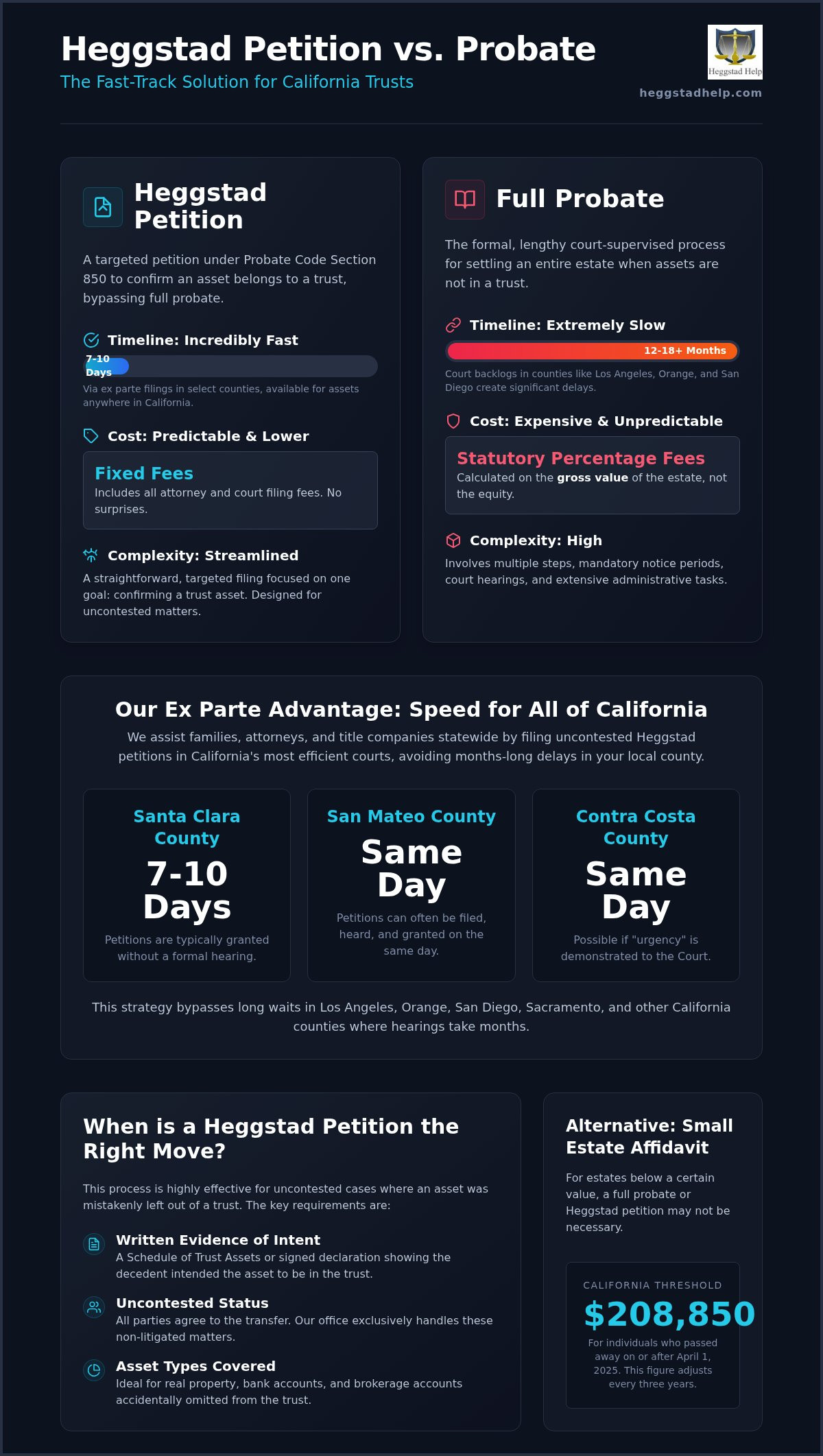
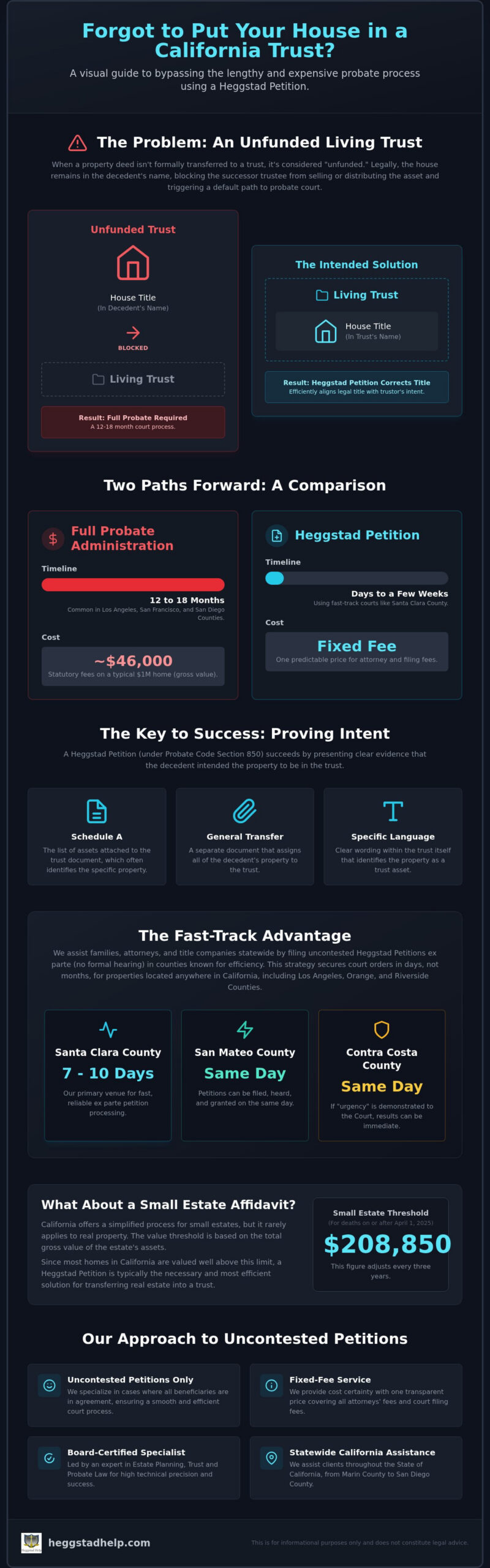
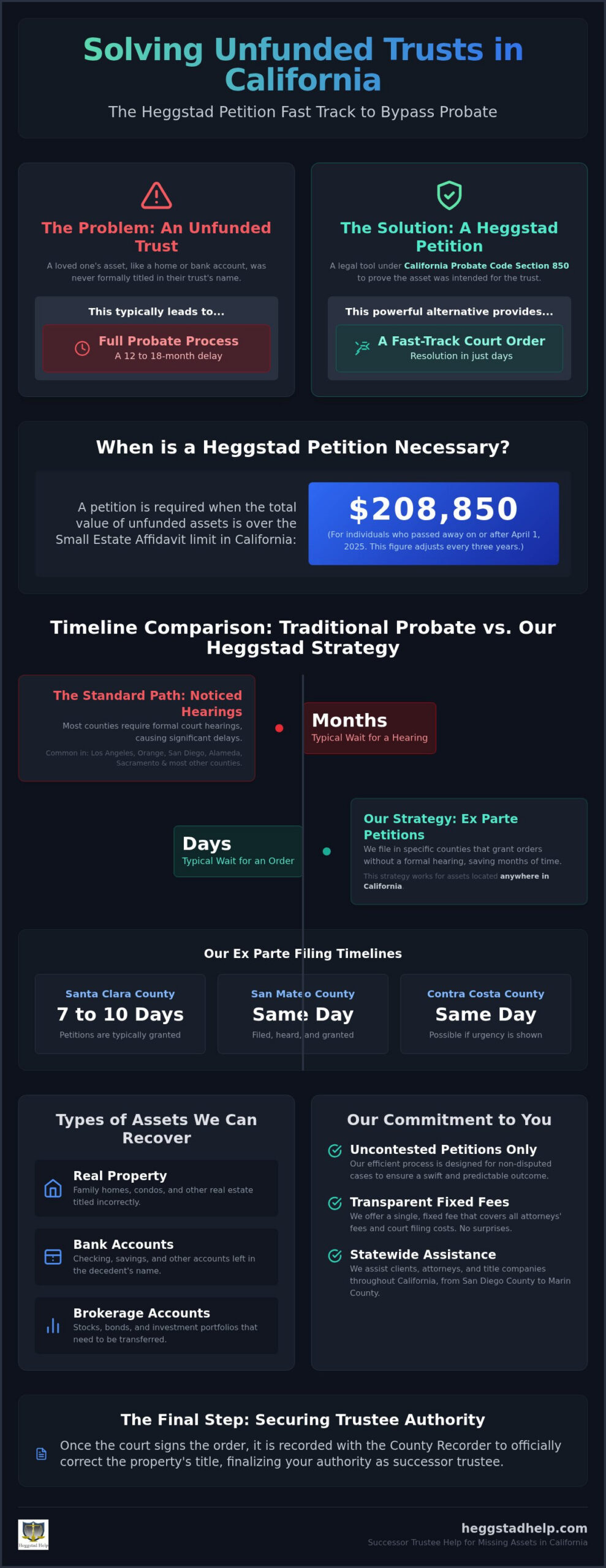
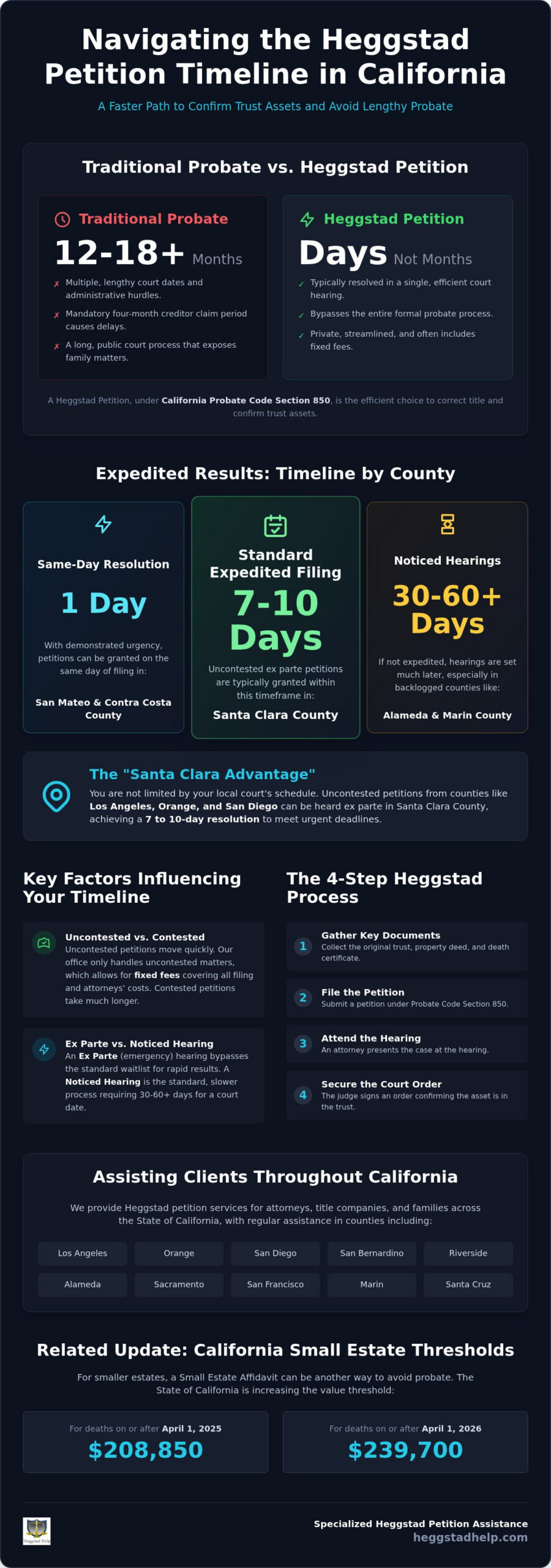
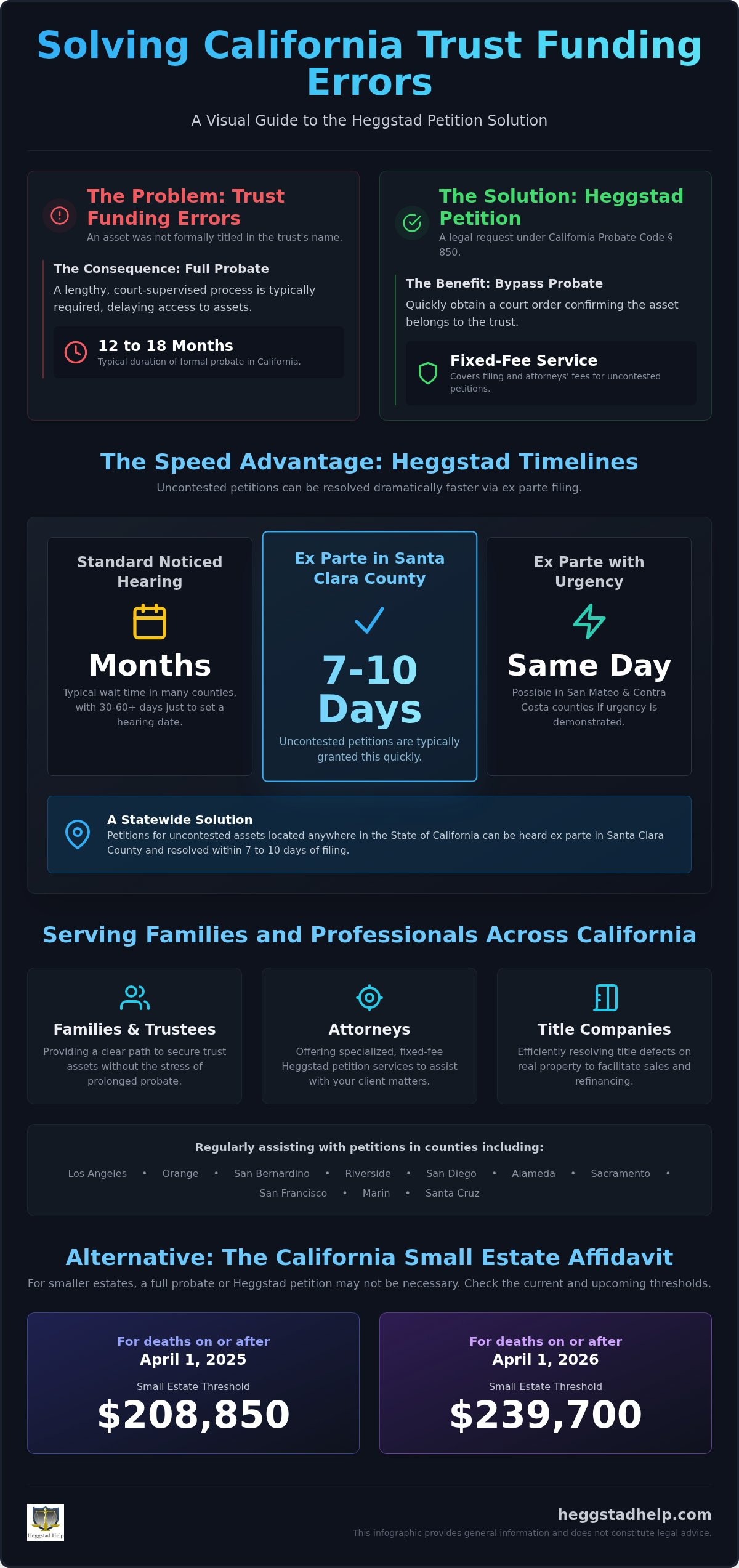
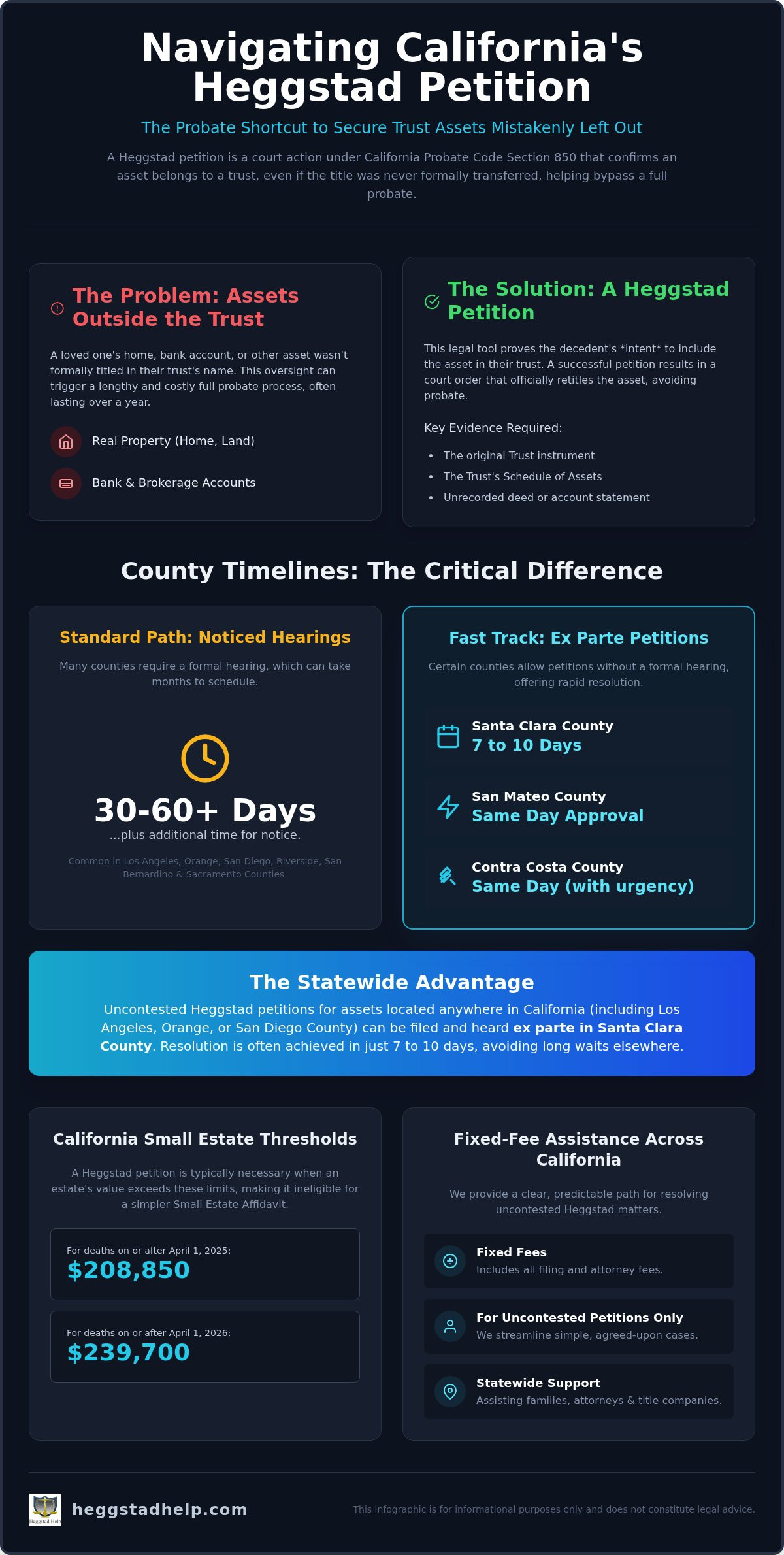
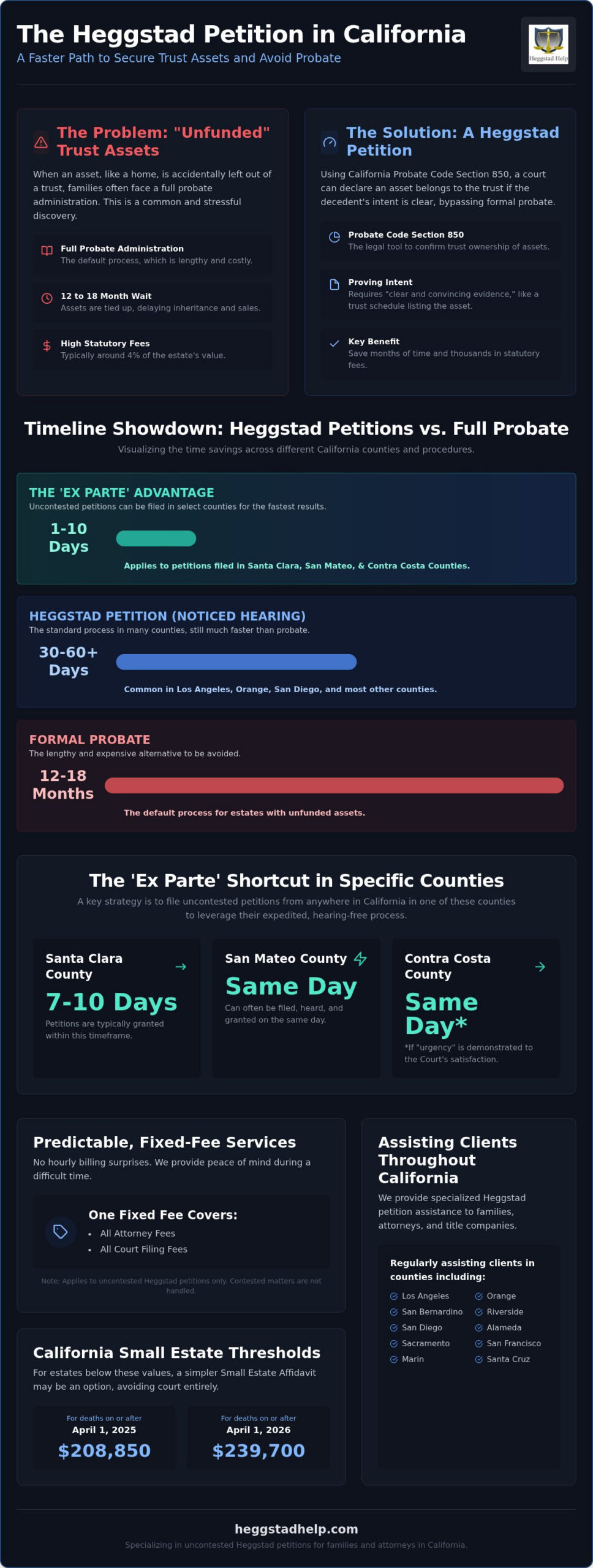
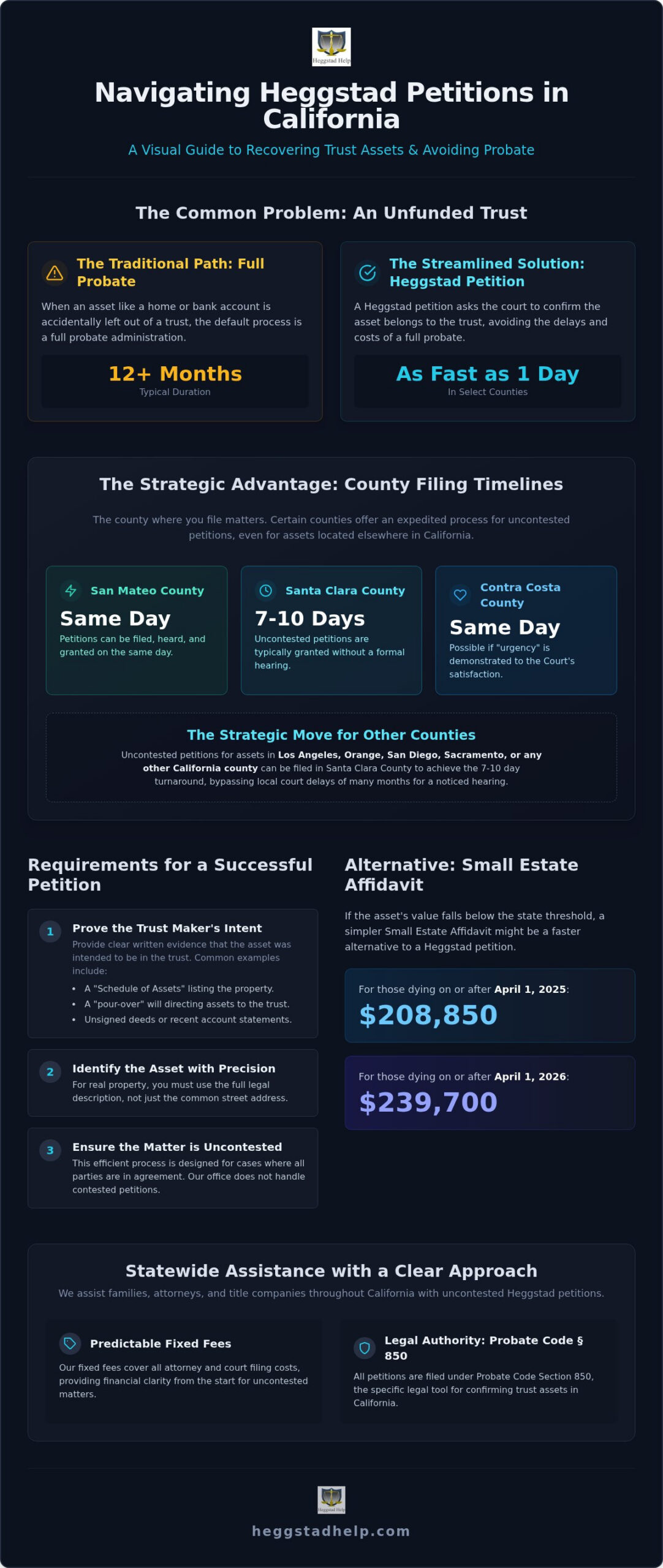
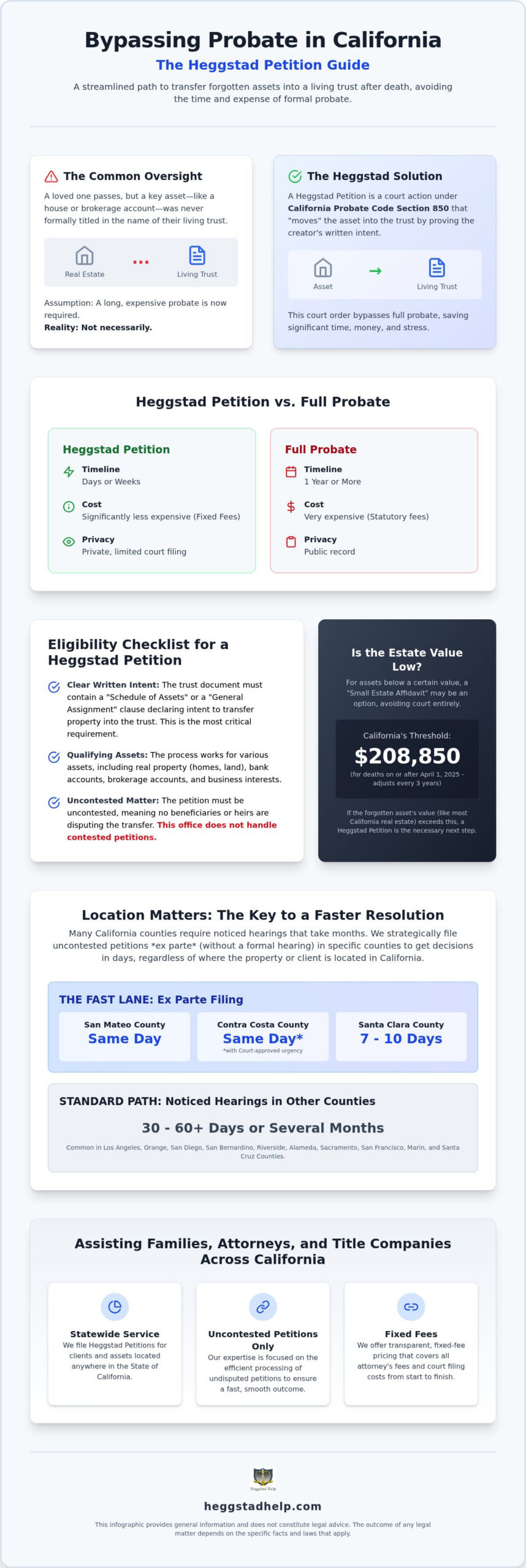
California law provides a potential remedy in the right case. Under Probate Code Section 850, a petition commonly called a Heggstad petition may allow the court to confirm that an asset belongs to the trust, even if formal title was never transferred correctly during the settlor’s lifetime.

This is often the most important question at the outset: was the asset intended to be in the trust, and is there sufficient evidence of that intent? If the answer is yes, a Heggstad petition may provide a path to cure the ownership problem without opening a full probate estate.

That does not mean every trust title defect qualifies. The facts matter. Courts look at the trust instrument, schedules attached to the trust, deeds, account statements, assignment documents, and the overall evidence showing the settlor’s intent. Some cases are strong and straightforward. Others are weaker, especially when the documents are inconsistent or the asset is not identified with enough specificity.

For example, a residence listed by address or legal description on a trust schedule may present a stronger case than a vague reference to “all my assets.” A deed prepared but not recorded may support the petition differently than a case where no transfer document exists at all. The answer is often not yes or no at first glance. It depends on the paper trail.

Trust title defects involving real estate

Real estate is where these issues usually become urgent. A successor trustee may need to sell a home, transfer rental property, or clear title before distribution to beneficiaries. If record title remains in the decedent’s individual name, that can stop the process cold.

In California, real property title problems require careful attention to county practice, recorder records, and the exact wording of the trust documents. Even where the legal theory is sound, procedural details matter. Petition format, supporting declarations, notice requirements, and whether ex parte treatment is available can affect timing.

That is one reason general estate administration experience is not always enough. Trust title defects are a narrow procedural problem with high consequences. The legal issue is simple to describe but technical to fix.

What to gather before seeking help

The first step is not guessing. It is collecting documents. In most cases, the key records include the trust agreement and any amendments, schedules of trust assets, deeds, title reports, refinance documents, account statements, and the death certificate if the settlor has died.

Those records help answer three core questions. What asset is affected? How is title currently held? What evidence shows it was meant to be held in the trust? Without those answers, it is hard to evaluate whether a Heggstad petition is viable or whether another probate procedure may be required.

Families are sometimes discouraged when they cannot find a recorded deed. That alone does not end the analysis. In some cases, the trust documents themselves provide enough evidence of intent. In other cases, the missing deed is a serious problem. This is exactly where a focused legal review matters.

What professionals should watch for

Title companies, real estate brokers, and estate planning attorneys often encounter trust title defects before the family understands what has happened. A listing file, escrow demand, or title review may reveal the defect for the first time.

For professionals, speed matters, but so does precision. The wrong assumption can send a matter down the wrong path. Not every defect requires probate. Not every trust document cures the problem. And not every county handles these petitions in exactly the same way in practice, even when the governing statute is statewide.

When a sale is pending, timing can become the central issue. A specialist who regularly handles these matters can often assess quickly whether the documents support a petition and what kind of court timeline is realistic. That clarity helps everyone involved – trustee, escrow, agents, and beneficiaries – make informed decisions.

The practical path forward

If you are facing trust title defects, the goal is to move from uncertainty to evidence. Start with the documents. Confirm exactly how title is held today. Then compare that record to the trust and any asset schedules or transfer documents.

From there, the legal analysis becomes much clearer. If the evidence strongly supports trust ownership, a Heggstad petition may be the most efficient way to obtain a court order confirming that the asset belongs to the trust. If the documentation is weak or conflicting, you may need to consider other options, including probate. Neither result should be assumed without review.

This is one of those areas where focused experience saves time. Heggstad Help concentrates specifically on these trust funding and title correction matters in California, which is often what families and professionals need when a title defect appears late in the process and deadlines are already running.

Trust title problems feel bigger than they are when no one can tell you the next step. Once the records are reviewed and the right procedure is identified, the issue usually becomes much more manageable. The most useful thing you can do is act early, before a paperwork defect turns into a longer administration problem.

Omitted Trust Assets in California

Omitted trust assets can trigger title problems and delays. Learn when California trustees may need a Heggstad petition to fix trust funding defects.

A trustee often finds out about omitted trust assets at the worst possible moment – when a home is about to be sold, a bank asks for proof of ownership, or a family is trying to avoid probate after a death. The trust says one thing, but the title record or account registration says another. That gap creates real risk, especially in California, where whether an asset is actually part of a trust can determine if court action is needed.

In plain terms, omitted trust assets are assets that were intended to be held in a trust but were never properly transferred into the trust’s name. Sometimes the omission happened during the original estate plan signing. In other cases, an asset was transferred out during a refinance, account change, or retitling event and never put back. The trust may refer to the asset generally, or the surrounding documents may show a clear intent to place it in the trust, but the legal title does not match that intent.

That distinction matters because a trust controls only the property it actually owns, unless a court determines otherwise. For trustees and families, this is not just a paperwork problem. It can delay administration, block a sale, create disputes among beneficiaries, and push an estate toward probate when everyone believed the trust would avoid it.

Why omitted trust assets create immediate problems

The most common issue is real estate. A parent signs a living trust, believes the house is in the trust, and years later dies with the property still titled individually. Title companies notice it quickly. If the trustee cannot show that the trust owns the property, the trustee may not have authority to sign sale documents on behalf of the trust.

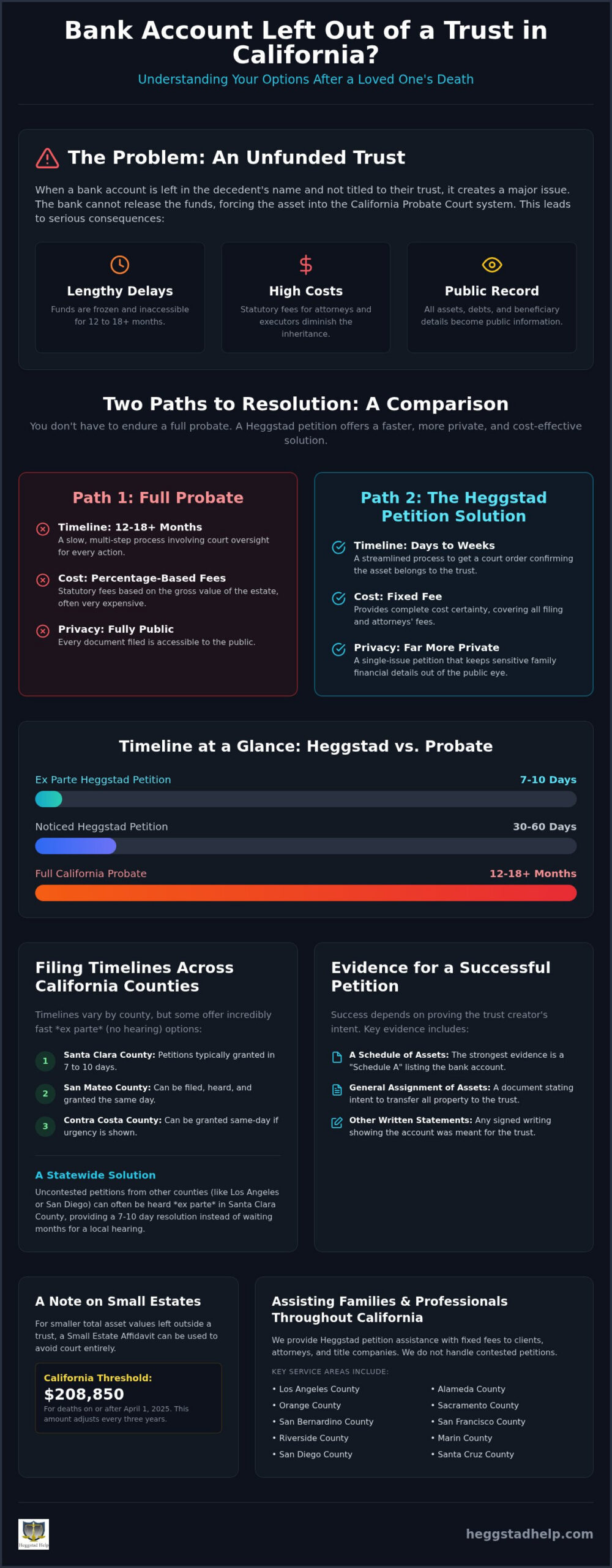
Financial accounts can create similar problems, although the evidence is often different. A brokerage account may have trust-related statements or internal paperwork, but the formal registration may still be in an individual’s name. A bank may freeze access until ownership is clarified. If there are multiple beneficiaries, uncertainty over ownership can turn into conflict very fast.

There is also a practical timing issue. Many families discover omitted trust assets only after death, when deadlines suddenly matter. Mortgage payments continue. Insurance must stay in place. Property taxes are due. If a sale is pending, each missing document becomes more than an inconvenience.

When a Heggstad petition may help with omitted trust assets

California law can provide a path to confirm that certain omitted trust assets belong to the trust, even if formal transfer steps were incomplete. This is where a Heggstad petition often becomes relevant. The core issue is whether there is sufficient evidence that the settlor intended the asset to be trust property.

A classic example is a schedule of trust assets attached to the trust instrument that specifically identifies the property. In the right circumstances, that documentation may support a court order confirming the asset as part of the trust under Probate Code Section 850. This can allow the matter to be resolved without a full probate administration.

But this is not automatic, and it is not available in every case. The quality of the documents matters. The wording of the trust matters. The nature of the asset matters. County-level court practice also matters because filing procedures, supporting papers, and scheduling can vary in ways that affect timing and outcome.

For that reason, families should be careful about assuming that any asset omitted from title can simply be pulled into the trust after the fact. Some cases fit well for a Heggstad petition. Others do not. If the evidence of intent is weak, contradictory, or missing, a different legal path may be required.

What courts usually look at

The legal analysis is narrower than many people expect. The court is not deciding whether the decedent probably wanted the asset in the trust in some broad emotional sense. The court is looking for evidence that the settlor created a present trust interest in that asset.

With real estate, judges often focus on whether the trust document or attached schedule identifies the property with enough specificity. A vague statement that all assets are intended to be in the trust may not carry the same weight as a clear property description or street address. If there was a deed prepared but never recorded, that fact may help, but the effect depends on the full record.

With accounts and other personal property, the evidence may include account statements, assignment documents, trust schedules, or institution records. Again, the details matter. A trustee should not rely on assumptions about what the court will infer.

This is one reason specialist review is so valuable. Cases involving omitted trust assets often look simple from the family’s perspective but turn on technical questions of trust funding and proof.

Common situations that lead to omitted trust assets

Most omissions are not the result of anyone trying to defeat the trust. They usually come from ordinary life events and incomplete follow-through.

Refinancing is a frequent culprit. A property may be taken out of the trust for loan purposes and never transferred back in. New accounts are opened after the trust is signed and are left in an individual’s name. A trust package is signed, but the deed was never recorded. Sometimes one parcel of real estate was transferred correctly while another parcel was missed.

There are also mixed situations where some evidence points toward trust ownership and some does not. For example, property insurance may name the trust, tax bills may go to the trust address, and the settlor may have treated the property as trust-owned for years, yet the recorded title remains unchanged. Those facts may be useful, but they do not replace a careful legal analysis of whether a petition is likely to succeed.

What a trustee should do first

If you suspect omitted trust assets, the first step is not to guess. It is to gather the core documents and review the ownership trail carefully.

For real estate, that usually means the trust agreement and all amendments, the schedule of assets, every recorded deed affecting title, refinance documents if applicable, and any preliminary title materials. For accounts, it means statements, signature cards, beneficiary designations, and any trust certification or transfer forms.

Just as important, do not assume the problem is limited to one asset. When one funding defect appears, others sometimes surface as well. A full document review can save time by identifying whether there is a broader trust administration issue rather than a single isolated omission.

Trustees should also be careful about signing sale documents, making distributions, or representing that the trust owns an asset before ownership is legally clear. Acting too quickly can complicate the correction process.

Why speed matters, but shortcuts can backfire

Families often come to this issue under pressure. A property sale may be pending. A lender or escrow officer may want immediate answers. Beneficiaries may be asking why administration is stalled. Those pressures are real, and delay has costs.

At the same time, rushing into the wrong procedure can create more delay, not less. If a petition is filed without the right evidentiary support, the court may require additional filings, continue the hearing, or deny relief. If probate is actually required, losing time on an unsupported shortcut only extends the timeline.

That is why these cases benefit from focused, county-aware handling. In California practice, the difference between a smooth ex parte or petition process and a drawn-out court problem often comes down to preparation, document quality, and familiarity with local expectations.

When professional guidance is especially useful

Some omitted trust assets cases are straightforward. Others involve title breaks, multiple parcels, blended families, prior deaths, or incomplete records from decades earlier. If there is active disagreement among heirs, a pending sale, or uncertainty about whether the trust documents are strong enough, legal review should happen early.

This is particularly true for successor trustees who are trying to do the right thing but are not sure whether they have authority. A trustee has duties to beneficiaries and should not rely on informal advice from escrow, a bank employee, or family members when ownership is disputed or unclear.

A specialized Heggstad review can often clarify the path quickly: whether the matter appears suitable for a petition, what additional records are needed, and whether another probate procedure is more appropriate. For California families and professionals dealing with trust funding defects, that kind of clarity is often the difference between moving forward and staying stuck.

If you are facing omitted trust assets, the best next step is usually simple: pause, collect the documents, and get a precise legal assessment before the title problem grows into a larger estate problem.

Trust Funding Correction Guide for California

A trust funding correction guide for California trustees dealing with title defects, Heggstad petitions, probate risks, and urgent next steps.

When a home, account, or other asset was supposed to be in a trust but still shows in the decedent’s individual name, the problem usually appears at the worst possible moment – during administration, during a pending sale, or after a bank or title company refuses to proceed. This trust funding correction guide explains what that mistake means under California law, when it may be fixable through a Heggstad petition, and when a different path may be required.

For many families, the surprise is not that a trust exists. The surprise is that the trust was never fully funded. A parent signed a living trust years ago, but the deed was never transferred. A refinance pulled property out of the trust and nobody moved it back. A brokerage account was meant to be trust-owned, but the title paperwork was never completed. Those facts matter because a trust only controls assets that are actually held by the trust or can be proven to have been intended for the trust in a way California courts will recognize.

What a trust funding problem really is

A trust funding defect is not just a paperwork annoyance. It is an ownership problem. If legal title to real estate, a financial account, or another asset was not properly transferred into the trust, the successor trustee may not have clear authority to manage, sell, or distribute that asset under the trust terms alone.

That does not always mean full probate is unavoidable. In California, Probate Code Section 850 may allow a court to confirm that an asset belongs to the trust if the evidence shows the settlor intended that result. This is commonly called a Heggstad petition, based on the case that recognized this approach. It can be a powerful correction tool, but it is not automatic, and the facts have to support it.

Trust funding correction guide: the first question to ask

The first question is simple: what evidence exists that the asset was intended to be part of the trust?

With real estate, the answer may be a signed schedule of trust assets, a transfer document that was prepared but not recorded, prior estate planning files, refinance records, or trust language specifically identifying the property. With financial accounts, the evidence may include account statements, trust certification documents given to the institution, or account opening records showing the trust was supposed to be the owner.

The strength of that evidence often determines whether a court petition is realistic. A trust document by itself may help, but it is not always enough. County practice, the wording of the trust, the type of asset, and the history of title all matter. This is where many trustees lose time by assuming every missing transfer can be fixed the same way. It depends on the paper trail.

When a Heggstad petition may solve the issue

A Heggstad petition is often used when the settlor created a trust, intended to place a specific asset into it, but failed to complete title transfer correctly. If granted, the court issues an order confirming that the asset is a trust asset. That can allow administration or sale to move forward without a full probate proceeding.

This approach is especially relevant when there is a clear trust instrument and supporting evidence of intent. It can be valuable for successor trustees dealing with a house still held in a deceased parent’s individual name, or professionals facing a title defect that blocks closing. In the right case, it is a practical and efficient remedy.

Still, not every title problem is a Heggstad case. If there is serious ambiguity, competing ownership claims, signs of creditor issues, problematic amendments, or facts suggesting the asset was intentionally kept outside the trust, the court may require a more involved process. Some assets also present institution-specific obstacles even after a favorable order. The legal theory may be sound, but implementation can still take work.

When the problem is caused by refinancing or later title changes

One of the most common trust funding failures involves real estate that was once intended for the trust but was removed during refinancing. A lender may have required temporary transfer to the borrower individually. Sometimes the deed back into the trust was never recorded. Years later, the settlor dies, and the title report exposes the defect.

This scenario is often fixable, but the details matter. The timing of the refinance, the exact deed chain, and the surrounding estate planning documents can all affect the analysis. If the title history shows a clean transfer out of trust ownership with no later correction, the court will want a solid basis to conclude the property should still be treated as a trust asset.

That is also why trustees should not rely on assumptions such as, “everyone knew it was in the trust.” Courts and title companies work from records and admissible evidence, not family understanding alone.

A practical trust funding correction guide for trustees

If you are the successor trustee, the most useful first step is not filing something immediately. It is gathering the right documents before anyone takes a position that may be hard to unwind.

Start with the complete trust and all amendments, not just the signature page. Pull every recorded deed affecting the property. If the issue involves an account, gather the most recent statements and any account-opening or beneficiary paperwork you can obtain. If the settlor worked with an estate planning attorney, ask for the file or at least the funding instructions and asset schedules. If there was a refinance, obtain the closing package if available.

Then look at the immediate business need. Is there a pending sale? Is a financial institution freezing an account? Is property tax, insurance, or maintenance becoming urgent? The right legal procedure may be the same either way, but the timeline changes how aggressively the matter should be prepared and presented.

Trustees should also be careful about acting beyond their current authority. Signing listing documents, escrow instructions, or transfer paperwork before title is properly corrected can create avoidable complications. In some cases, limited steps are appropriate to preserve the asset, but dispositive action should be reviewed carefully.

What professionals should watch for

Estate planning attorneys, probate lawyers, title officers, and real estate professionals usually see these cases at a transactional pressure point. A listing is ready. Escrow is open. An underwriter raises an exception. The family insists the property belongs to the trust. The file suddenly becomes both legal and urgent.

The main risk is treating the defect as a routine clerical issue. Some are. Many are not. A missing deed may reflect a straightforward funding failure, or it may point to a deeper ownership problem involving marital rights, multiple trusts, old vesting, or contradictory documents. Quick answers are attractive, but bad assumptions can produce delay rather than speed.

That is why specialized review matters. A narrowly focused trust ownership correction practice can usually identify faster whether the file supports a Section 850 petition, whether ex parte relief may be available in the relevant county, or whether the facts call for a different strategy.

Why county-level experience matters

California trust law is statewide, but procedure is not identical in every courthouse. Filing expectations, evidentiary preferences, scheduling realities, and local handling of ex parte or shortened-time requests can differ materially from one county to another.

For a trustee or referring professional, that difference is not academic. It affects timing, filing format, and the likelihood of getting a practical result without unnecessary motion practice. A petition that looks sufficient in theory can stall if it is not prepared with the local court’s expectations in mind.

This is one reason specialized California counsel is often more useful than general advice. Heggstad Help focuses on these trust funding and title correction matters, including cases where speed matters because administration or sale cannot wait.

What to expect from the correction process

Most people want a simple answer to one question: how long will this take? The honest answer is that timing depends on the evidence, the county, the asset type, and whether anyone is likely to object.

A well-documented case can move much more efficiently than a disputed one. Real estate often requires careful title review before filing. Financial accounts may require separate follow-up even after an order is entered. If documents are missing, the time spent reconstructing intent can be as important as the court process itself.

The better question is whether the matter is being framed correctly from the start. A focused review early in the process often saves weeks or months later.

If you are facing a trust asset that should have been in the trust but is not clearly titled there now, do not assume the problem is fatal, and do not assume it is simple. Get the documents together, identify the real ownership gap, and move quickly enough to preserve options. Many trust funding defects can be corrected – but they are corrected best when handled with precision before delay turns a fixable problem into a larger one.

How to Avoid Probate With Trust Assets

Learn how to avoid probate with trust assets in California, what proper trust funding requires, and what to do when title was never transferred.

A family often learns there is a trust only after a parent dies – and then discovers the house, a bank account, or an investment account was never actually transferred into it. That is usually the moment people start searching for how to avoid probate trust assets in California. The hard truth is that having a trust document alone does not avoid probate. The asset must be owned by the trust, or there must be a clear legal basis for asking the court to confirm that it should be treated as trust property.

This issue comes up constantly with homes, rental property, and financial accounts. A trust may have been carefully drafted years earlier, but refinancing, lender requirements, incomplete paperwork, or simple oversight can leave title in the individual name of the settlor instead of the trustee of the trust. When that happens, the question is no longer just whether probate can be avoided. The real question is whether the problem can be fixed efficiently under California law.

How to avoid probate with trust assets in California

In California, the most reliable way to avoid probate with trust assets is to make sure the trust is properly funded during the settlor’s lifetime. For real estate, that usually means signing and recording a deed transferring title from the individual owner to the trustee of the trust. For bank and brokerage accounts, it usually means changing ownership on the institution’s records so the account is held in the name of the trust or the trustee of the trust.

If that step is completed correctly, administration after death is generally far simpler. The successor trustee can act under the trust terms without opening a probate estate for those assets. That is the practical benefit people expect when they create a revocable living trust.

But there is an important distinction here. A trust avoids probate only for assets that are actually in the trust, payable to the trust, or otherwise legally connected to the trust in a way the court will recognize. Assets left outside the trust may still require probate unless another procedure applies.

Why trust documents alone do not avoid probate

Many families assume the signed trust agreement is enough. It is not. The trust is the legal framework, but title determines how a particular asset passes.

For example, a parent may sign a trust stating that the family home is part of the trust estate, yet the recorded deed still shows title in that parent’s individual name. Or the trust’s schedule of assets may list a brokerage account, but the brokerage firm never changed the account registration. In those situations, the trust shows intent, but the public record or account record may not match that intent.

That mismatch is where administration problems begin. Title companies, financial institutions, and courts look closely at ownership records. If the records do not show trust ownership, a successor trustee may not be able to sell, transfer, or administer the asset without additional legal action.

The most common trust funding mistakes

The same issues appear again and again in California trust administration. Real estate is often the biggest problem. A deed may never have been recorded, or property may have been taken out of trust during a refinance and never transferred back. Sometimes a newly purchased property was intended for the trust, but escrow closed in the settlor’s individual name.

Financial accounts present similar problems. An account may be mentioned in the trust file, but the bank’s records still show the settlor individually. In other cases, the owner completed some paperwork, but the institution never finalized the transfer.

These are not minor technicalities. They can determine whether the family faces a probate proceeding or can pursue a more targeted court remedy.

When a Heggstad petition may help avoid probate

If the settlor intended an asset to be part of the trust but title was never properly transferred, California Probate Code Section 850 may provide a solution. This is commonly called a Heggstad petition. It asks the probate court to confirm that the asset belongs to the trust, even though formal title transfer was incomplete.

A Heggstad petition is not automatic, and it is not available in every case. The strength of the petition depends on the evidence of intent. Courts typically look for a signed trust, schedules of trust assets, assignment language, deeds, account records, or other documentation showing that the settlor intended the asset to be held in the trust.

When the facts and documents support that intent, this procedure can be far more efficient than a full probate. That is why it matters so much in cases involving homes, investment property, and other assets that should have been trust-owned but were left outside the trust on paper.

For families and successor trustees, the practical value is straightforward. A successful petition may allow the asset to be administered under the trust rather than through a full probate estate, saving time, expense, and delay.

How to evaluate whether trust assets can bypass probate

The first step is document review. Before assuming probate is required, the successor trustee or family should gather the trust agreement and all amendments, schedules of assets, recorded deeds, title reports if available, account statements, and any correspondence showing efforts to transfer the asset into the trust.

Then the legal question becomes more specific: was the asset actually transferred to the trust, or is there enough evidence to ask the court to confirm trust ownership? Those are different issues, and the answer depends on the asset type and the paper trail.

With real estate, recorded title is usually central. With financial accounts, the institution’s records matter, but trust schedules and assignments may also become important. There is no one-size-fits-all answer. A house with a strong trust schedule and consistent estate planning file may be a good Heggstad candidate. An account with no transfer documents and no clear trust designation may be more difficult.

That is why these matters should be evaluated early, especially if a sale, refinance, or distribution is pending.

Practical steps if title was never transferred

If you are dealing with a possible trust funding defect, speed matters, but so does precision. Start by confirming exactly how title is held today. For real property, that means reviewing the current vesting deed. For accounts, it means obtaining current and historical ownership records if possible.

Next, compare those records to the trust documents. Look for any schedule listing the asset, any assignment to the trust, and any evidence that the settlor treated the asset as trust property. Tax bills, insurance records, and prior transaction documents can sometimes help complete the picture, although they are not a substitute for proper title.

After that, the issue should be assessed by counsel familiar with California trust funding defects and Section 850 procedure. This is not a routine probate filing question. The analysis often turns on county practice, the exact language of the trust documents, and whether the available evidence is strong enough for the relief requested.

In a focused practice such as Heggstad Help, that means reviewing whether the asset can be confirmed into the trust through petition rather than forcing the family into a broader and slower probate process.

What trustees and professionals should not do

One common mistake is assuming a trust exists, so the asset must already avoid probate. Another is recording corrective documents after death without understanding whether the signer had authority or whether the record will create more problems.

Professionals should also be careful about oversimplifying title defects. A missing deed is not always fatal, but it is not something to gloss over either. The same is true for bank and brokerage accounts. Institutions may refuse to honor trust claims unless ownership was properly updated or the court has issued an order.

The safer approach is to identify the defect clearly, preserve the documents, and determine the correct procedural path before taking action.

The real answer to how to avoid probate trust assets

If you want to know how to avoid probate trust assets, the most accurate answer is this: fund the trust correctly while the settlor is alive, and if that did not happen, investigate quickly whether California law allows the asset to be confirmed into the trust through a Heggstad petition. Probate is sometimes unavoidable, but not every title defect leads there.

That distinction matters because many families are told too quickly that probate is the only option. In reality, some cases involve correctable trust funding failures, not failed estate plans. The difference can affect timing, cost, and whether a successor trustee can move forward with administration or sale.

If you are facing a house, account, or other asset that should have been in the trust but was not properly titled, do not assume the paperwork mistake is the final word. The right documents, reviewed early and handled correctly, can make all the difference.

Section 850 Versus Full Probate

Compare section 850 versus full probate in California. Learn when a Heggstad petition can confirm trust ownership and avoid probate delays.

When a family learns that a house, account, or other asset was supposed to be in the trust but was never formally transferred, the question becomes urgent fast: section 850 versus full probate. That choice can affect how long administration takes, how much it costs, and whether a sale, distribution, or refinance can move forward without months of delay.

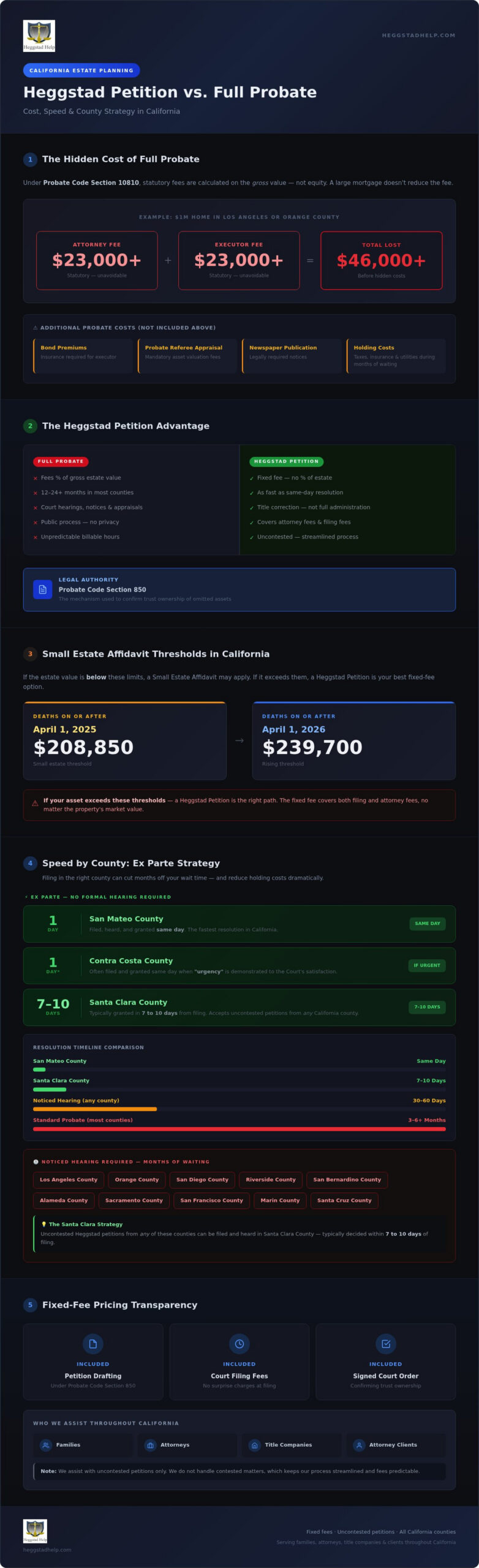
In California, these two paths are not interchangeable. A Probate Code Section 850 petition, often called a Heggstad petition, is a targeted court procedure used to confirm that an asset belongs to a trust when the trust creator clearly intended that result but title was never completed correctly. Full probate is the broader court-supervised administration of a decedent’s estate when assets are still owned in the decedent’s individual name and no simpler path applies.

For successor trustees and families, the difference matters because the wrong assumption can waste time. Some assets can be brought into the trust through a Section 850 petition and administered under the trust. Others truly require probate. The key issue is not what everyone hoped would happen. It is whether the documents and surrounding facts support trust ownership strongly enough for the court to confirm it.

How section 850 versus full probate differs

A Section 850 petition is usually narrower, faster, and less expensive than full probate because it asks the court to decide a specific ownership issue. The petition typically argues that the asset should be treated as trust property based on the trust instrument, schedules of assets, assignment language, prior deeds, or other evidence showing intent to hold the asset in the trust.

Full probate is different in both scope and procedure. It opens a formal estate administration, often requiring appointment of a personal representative, notice to heirs and creditors, inventory and appraisal, possible bond issues, and court oversight before assets can be distributed. That process may be necessary, but it is a much larger proceeding than asking the court to confirm trust ownership of a particular asset.

This is why Section 850 matters so much in trust administration. If a trust creator signed a trust and identified the property as a trust asset, but a deed was never recorded or an account stayed titled individually, a focused petition may solve the problem. If the evidence of intent is thin, contradictory, or missing, probate may still be the required path.

When a Section 850 petition may work

The classic Heggstad scenario involves a revocable living trust that specifically lists an asset on a schedule attached to the trust, or otherwise clearly identifies it as trust property, but title was never updated. California courts have long recognized that in the right case, that can be enough to confirm trust ownership.

Real estate is where this issue often becomes urgent. A family may be preparing to sell a home and discover title is still in the deceased settlor’s individual name. A refinance years earlier may have removed the property from the trust, and no one put it back. In other cases, a trust schedule names the property, but no deed was ever signed or recorded. If the trust documents and facts are favorable, Section 850 may allow the successor trustee to obtain a court order confirming that the property belongs to the trust.

The same issue can arise with brokerage accounts, bank accounts, business interests, or other assets. But the analysis is always asset-specific. The stronger the paper trail showing intent to place the asset in the trust, the stronger the Section 850 case tends to be.

That does not mean every mistake can be fixed this way. If the trust never mentions the asset, if ownership changed in a way that conflicts with trust treatment, or if there is a beneficiary dispute about the decedent’s intent, the court may not view Section 850 as the right solution.

Evidence matters more than labels

Families sometimes say, “It was always meant to be in the trust,” and that may be true as a matter of personal understanding. But courts look for objective evidence. The trust document, asset schedules, assignments, deeds, account statements, and estate planning file can all matter. So can the history of how the asset was handled during the settlor’s lifetime.

This is where a careful review is critical. Calling an asset a trust asset does not make it one. On the other hand, a title defect does not automatically force probate if the written record supports trust ownership.

When full probate is still necessary

Full probate is often required when assets remain in the decedent’s sole name and there is no sufficient basis to treat them as trust property. That may be because no trust exists, the trust is silent about the asset, the paperwork is inconsistent, or the value and ownership structure place the asset outside any simpler procedure.

Probate also becomes more likely when there are disputes. If heirs, beneficiaries, or other interested parties disagree about ownership, the matter may not be suitable for the streamlined approach often used in cleaner Section 850 cases. A contested case can quickly become more complicated, and the procedural advantages of a narrow petition may disappear.

Some estates involve a mix of both paths. One parcel of real property may be a strong candidate for a Section 850 petition, while other individually owned assets still require probate or some other transfer procedure. That is why broad assumptions are risky. California estate administration often turns on the details of each asset, not just the existence of a trust.

Section 850 versus full probate for timing and cost

For most families, the practical question is simple: which route gets this resolved with the least delay and expense? In many suitable cases, Section 850 is attractive because it can avoid the lengthy administration associated with full probate. If the asset can be confirmed as trust property, the successor trustee may be able to move ahead under the trust rather than opening an entire estate.

That said, faster does not mean automatic. The petition still must be prepared correctly, supported by the right evidence, and filed in a county where local practice can matter. Courts differ in how they handle these matters, and procedural experience is important. Ex parte handling may be available in some situations, but only when the facts, papers, and local court practices support that approach.

Cost follows the same pattern. A well-founded Section 850 matter is often more efficient than probate, but not every case qualifies. If the petition is weak or the documents are incomplete, the family may spend time pursuing a shortcut that is not actually available. A realistic legal analysis at the outset usually saves money compared with guessing.

How to evaluate the right path

The first step is to gather the trust, all amendments, schedules of assets, deeds, account statements, and any estate planning documents that show how the asset was supposed to be held. If the issue involves real estate, current title records and any refinance history are often essential.

The next step is to ask a very focused question: what written evidence shows that this specific asset was intended to be trust-owned? That question is more useful than asking whether the decedent generally wanted to avoid probate. General intent helps explain the story, but courts decide ownership based on documents and legally significant facts.

From there, the analysis becomes practical. Is the asset clearly identified in the trust? Was there an assignment? Was title removed from the trust at some point? Are there conflicting beneficiaries or family members? Is there a pending sale that creates timing pressure? These issues shape whether Section 850 is a strong fit or whether full probate is the safer answer.

For California trustees, families, and professionals facing a title defect, specialized review can make a real difference. A narrow problem often needs a narrow solution, and a Heggstad-focused practice such as Heggstad Help is built around exactly that type of analysis.

The real decision is not speed versus formality

The phrase section 850 versus full probate can sound like a simple comparison between a quicker option and a slower one. In practice, the real issue is whether the law supports trust administration at all for the asset in question. If it does, Section 850 can be a powerful tool. If it does not, probate is not a failure. It is simply the correct procedure.

For families already dealing with a death, trust administration, or a delayed property sale, that distinction matters. The goal is not to force every case into a Heggstad petition. The goal is to identify the cleanest legally supportable route, fix the title problem, and move administration forward with as little friction as the facts allow.

If you are staring at a deed, trust schedule, or account statement that does not match what the trust was supposed to own, the best next step is usually not to wait and hope the problem solves itself. A prompt document review can tell you whether the asset belongs in a Section 850 petition, a probate case, or a different transfer process entirely – and that clarity is often what gets everything else moving again.

California Trust Funding Checklist Guide

A California trust funding checklist guide for trustees and families fixing title errors, missing transfers, and assets left outside a trust.

A successor trustee often learns there is a problem at the worst possible moment – when a house is about to be sold, a bank asks for proof of ownership, or a title company finds that an asset was never transferred into the trust. This California trust funding checklist guide is designed for that moment. It will help you identify what to review, what documents matter, and when a simple correction may be enough versus when court involvement may be necessary.

Trust funding sounds administrative, but in California it can determine whether an asset passes under the trust or gets pulled into probate. Many families have a signed trust and assume the work is finished. Then they discover that the deed was never recorded, a brokerage account stayed in the decedent’s individual name, or real property was taken out of the trust during a refinance and never transferred back. The trust may be valid, but the title may still be wrong.

What trust funding means in California

A revocable living trust controls only the assets actually transferred to it, or assets that otherwise become payable to it by beneficiary designation or similar mechanism. In plain terms, the trust document by itself is not enough. Ownership has to line up with intent.

For real estate, that usually means a properly prepared and recorded deed transferring the property into the trust. For bank and brokerage accounts, it usually means account registration in the name of the trustee of the trust, or a payable-on-death or beneficiary setup if that fits the plan. Business interests, promissory notes, and other personal property each have their own transfer method. The details vary, and that is where mistakes happen.

California trust funding checklist guide for trustees

Start with the trust document and every amendment or restatement. Confirm the exact name of the trust, the date of the trust, and the currently acting trustee. Small inconsistencies in naming can create confusion later, especially if financial institutions or title companies are comparing paperwork.

Next, build a complete asset inventory. Do not rely on memory or a partial schedule attached to the trust. Review tax returns, bank statements, brokerage statements, real property tax bills, insurance policies, business records, and mail. A trust schedule can show intent, but it is not always enough by itself to prove legal transfer of every type of asset.

Then separate assets into categories. Real property should be reviewed differently from accounts, and accounts differently from business interests or tangible personal property. That helps you spot the missing step for each asset rather than assuming one fix applies to everything.

Review real estate title first

Real estate usually creates the most urgency because title defects can block a sale, refinance, or distribution. Pull the current vesting deed for each California property. Look at how title is held now, not how everyone assumed it was held.

If title shows the trust creator as an individual, that is a warning sign. If title shows the trust, confirm the vesting language is accurate and matches the trust. Also check whether a later refinance deed, transfer, or correction instrument changed vesting without anyone noticing. This is common. Property may have been placed into the trust correctly years ago, then removed for loan purposes and never transferred back.

Do not stop with the most recent deed. Review the chain of title around major events such as refinancing, marriage, divorce, death of a spouse, or property tax planning. In many cases, the answer is in the recording history.

Check financial accounts and non-real-estate assets

For bank and brokerage accounts, verify the current registration directly from recent statements or institution records. If the account is titled in the name of the individual and there is no beneficiary designation or transfer-on-death arrangement consistent with the estate plan, the asset may be outside the trust.

For stocks, bonds, LLC interests, partnership interests, and closely held business ownership, review the governing records. That might include membership certificates, operating agreements, assignments, or partnership amendments. A trust schedule listing an asset helps show intent, but ownership records still matter.

For personal property, look for a general assignment to the trust. That document can help with household contents and other non-titled property, though it may not solve every issue for assets requiring a separate transfer procedure.

What documents you should gather

A practical California trust funding checklist guide is only useful if it tells you what to put on the table before you ask for help. Start with the trust, amendments, certifications of trust, and any schedules of assets. Add all deeds, escrow papers, preliminary title reports, refinance documents, and property tax records for each parcel of real estate.

For accounts, gather the most recent statements, signature cards if available, beneficiary designation forms, and any correspondence showing attempted trust registration. For business assets, collect entity formation documents, ownership ledgers, assignments, and buy-sell agreements. If the trust creator has died, include the death certificate and any documents showing who is now acting as trustee.

If there was an effort to transfer an asset into the trust but the paperwork was never completed, that evidence can be very important. Draft deeds, emails to the estate planning attorney, escrow instructions, trust schedules, and account applications may all help establish intent. In this area, incomplete paperwork is not worthless paperwork.

When a missing transfer can be fixed without court

Some problems are straightforward. If the trust creator is alive and has capacity, an omitted transfer can often be completed now with the correct deed, assignment, or account registration paperwork. The key is making sure the correction is done properly and documented clearly.

After death, options become narrower. Some institutions may accept strong documentary proof and update records voluntarily for certain assets. Real estate is less flexible because title insurers and recorders typically need formal, legally sufficient evidence. It depends on the asset, the county, the institution involved, and the quality of the existing paper trail.

That is why families should avoid assuming that every defect requires full probate – or that every defect can be solved with a phone call. The right path depends on what the documents actually show.

When a Heggstad petition may be the right solution

If the trust creator intended an asset to belong to the trust but legal title was never completed, a petition under California Probate Code Section 850 may be available to ask the court to confirm the asset as trust property. This is commonly called a Heggstad petition.

The strongest cases usually include credible evidence of intent, such as a trust schedule identifying the property, transfer documents that were prepared but not finished, or other records showing the settlor treated the asset as part of the trust plan. Real estate is a frequent subject of these petitions, but other assets can also qualify depending on the facts.

A Heggstad petition is highly useful when the goal is to avoid a full probate solely because of a trust funding defect. That said, not every case fits. Weak documentation, competing claims, and unusual asset histories can complicate the process. County practice also matters. Procedure and timing are not handled identically everywhere.

This is where specialized review becomes valuable. Heggstad Help focuses specifically on these title and funding problems, including situations where families, attorneys, and title professionals need a clear court path rather than general estate planning advice.

Common mistakes that delay trust administration

The most common mistake is assuming the existence of a trust proves ownership by the trust. It does not. Another is relying only on a trust schedule without checking title records, account registration, or entity documents.

Families also lose time by distributing personal property before identifying all titled assets, or by listing real estate for sale before confirming vesting. Professionals sometimes encounter the opposite problem – everyone sees the title defect, but no one gathers the trust amendments, old deeds, or evidence of intent early enough to evaluate whether a court order can be obtained efficiently.

Speed matters, but sequence matters too. The fastest route is usually a careful document review at the front end.

What to do next if you find a funding defect

First, stop guessing and confirm current title or registration in writing. Second, gather the trust documents and the asset-specific records that show ownership history and intent. Third, determine whether the trust creator is alive and able to complete a transfer now, or whether a post-death solution is needed.

If the issue involves California real estate, a pending sale, or a deceased settlor whose trust was never fully funded, treat it as a legal title problem rather than a clerical inconvenience. The difference matters. A trust administration problem can sometimes be managed with forms. A title defect often requires a precise legal remedy.

The good news is that many of these cases are fixable. Even when the paperwork was never completed correctly, the facts may still support bringing the asset into the trust through the proper procedure. A calm review of the documents usually tells you much more than assumptions ever will.

If you are a trustee, family member, attorney, or real estate professional facing one of these issues, the best next step is to get the paper trail organized and evaluate the exact ownership problem before deadlines make the situation harder. Clear title starts with clear evidence.

Heggstad Petition Real Estate Example

See a heggstad petition real estate example, when it works in California, what facts matter, and where title defects can complicate trust transfer.

A common call starts the same way: a successor trustee is ready to sell or refinance a California home, and title comes back in an individual name instead of the trust. The trust exists. The settlor signed it. Everyone believed the property was part of the plan. But the deed was never transferred, or it was transferred out during a refinance and never put back. That is where a heggstad petition real estate example becomes useful, because the real question is not academic. It is whether the court can confirm the property belongs to the trust without opening a full probate.

A heggstad petition real estate example in plain English

Take a typical scenario. A parent creates a revocable living trust and signs a schedule of assets listing the family residence. The trust says the settlor intends to hold identified assets in the trust. Years later, the parent dies. During administration, the successor trustee learns the recorded deed still shows the parent as an individual.

That gap creates a title problem. The trust says one thing, the public record says another. If the available documents show the settlor intended the real estate to be trust property, a petition under California Probate Code Section 850 may allow the court to confirm that the property is a trust asset. This is often called a Heggstad petition, based on the case Estate of Heggstad.

In practical terms, the petition asks the court to recognize that the trust owned the beneficial interest in the property even though formal transfer steps were incomplete. If granted, the court order can often be used to clear title and move administration forward.

What facts usually make the example stronger

Not every trust funding mistake is a good Heggstad case. The strength of the petition depends on the documents and the surrounding facts.

The classic real estate example usually includes a signed trust agreement, language showing the settlor intended to transfer identified property to the trust, and a trust schedule or attachment specifically listing the real property. The legal description helps. The property address helps too, but the legal description is usually more precise and more persuasive.

Timing matters as well. If the trust and asset schedule were signed before death and clearly identify the property, the argument is generally stronger. If the property appears nowhere in the trust papers, the petition becomes harder. If the trust references only a vague category like “all my assets,” that may not be enough by itself for real estate. Courts want evidence of intent, and the more specific the evidence, the better.

There are also title-history issues that can affect the analysis. If the property was once deeded into the trust and later removed during refinancing, that may support a different but still strong evidentiary path. If there are multiple trusts, amendments, restatements, transfers between spouses, or changes after the original trust signing, the paperwork needs closer review.

The simplest sample fact pattern

A straightforward example looks like this: John Smith creates the John Smith Revocable Trust in 2018. He signs the trust before a notary. Attached to the trust is Schedule A, which lists “123 Main Street, San Jose, California” and includes the legal description from a prior deed. John dies in 2024. No deed transferring the house to the trust was ever recorded. The title company flags the issue during a pending sale.

In that fact pattern, the petition would typically present the trust, the schedule, the death certificate, the current vesting deed, and a declaration explaining that John intended the property to be held in trust but failed to complete the deed transfer. If the evidence is clean and there is no dispute, the court may issue an order confirming the property is a trust asset.

Where a real estate example gets more complicated

The phrase “real estate example” can sound simpler than the real file usually is. Properties often carry facts that make the case less mechanical.

One common complication is community property. If a married couple owned the property, the chain of title and the trust documents have to line up. Was the home held by one spouse, both spouses, or by one spouse as separate property? Did both spouses sign the trust or only one? Did the trust schedule identify the whole property or only a partial interest? Those details matter because a court order should match the ownership interest actually intended for the trust.

Another complication is lender activity. Refinances often create title defects. A property may have been deeded out of trust to complete a loan transaction, with the expectation that it would be transferred back afterward. That final step sometimes never happened. When that is the history, the title record may show a pattern that supports the petition, but it still needs to be documented carefully.

There can also be county-level procedural differences. Some courts are more accustomed to these petitions than others. Some are more willing to entertain streamlined procedures in the right case. That is one reason specialized handling matters. The law is statewide, but procedure on the ground can vary.

When a Heggstad petition may not be enough

A strong example should also include the limits. A Heggstad petition is not a cure-all for every title problem.

If there is an actual ownership dispute, expected objection, or competing claim from heirs or beneficiaries, the matter may become more involved. If the trust documents are inconsistent, unsigned, incomplete, or missing the property reference, the court may not have enough to confirm trust ownership. If the property was acquired after the trust was signed and never added to a schedule or assignment, that can create a different level of difficulty.

There are also situations where probate may still be required. For example, if the evidence of trust ownership intent is too thin, or if the property was plainly held outside the trust with no reliable documentation showing otherwise, the faster petition route may not be available. That does not mean the problem is unsolvable. It means the procedural path may be different.

What the court usually needs to see

For families and trustees, the immediate question is usually, “What documents should I gather?” In a real estate matter, the answer often starts with the trust agreement and all amendments or restatements, any schedule of trust assets, every recorded deed affecting the property, and the death certificate if the settlor has passed away.

Beyond that, declarations matter. The petition should tell a coherent story supported by exhibits. The court needs to understand what the settlor intended, how title ended up defective, and why the property should be treated as a trust asset. Clarity helps. Specificity helps more.

This is also where title companies, real estate agents, and estate-planning attorneys often become part of the process. A pending sale can add urgency. A title officer may identify exactly what vesting defect must be cured. A listing agent may need a realistic timeline. A prior estate plan may reveal whether the omission was an oversight or part of a larger pattern of incomplete trust funding.

Why examples matter, but file review matters more

A heggstad petition real estate example is helpful because it shows the basic legal theory. It reassures trustees that a missing deed does not always force a probate. But examples can also mislead if they make every case sound identical.

Two files may look the same at first glance and lead to different outcomes. In one, the trust schedule clearly lists the property by legal description and the petition is relatively clean. In another, the address is wrong, the trust was amended twice, and the property was refinanced through multiple vesting changes. Both involve a house not titled in trust. Only one may be suitable for an efficient petition without significant extra work.

That is why experienced review at the outset saves time. A focused lawyer will not just ask whether the property was supposed to be in the trust. The better questions are how the trust identifies it, what the record title shows, whether there was a refinance or transfer event, whether any beneficiaries may object, and which county will hear the matter.

For people facing this problem now, the most practical next step is simple: gather the trust, every amendment, the latest deed, any old deeds you can find, and any title report or escrow request already in hand. In a niche practice like Heggstad Help, that early document review often reveals whether the property fits the stronger end of the Heggstad spectrum or whether a different court path is safer.

A missing deed can feel like the moment the entire estate plan failed. Often, it is not that dramatic. Sometimes the right petition, built on the right documents, is enough to put the real estate back where the settlor intended it to be.

When a Section 850 Petition Makes Sense

Learn when a section 850 petition can confirm trust ownership, avoid probate, and fix title problems for California real estate and assets.

A house is in the decedent’s name. The trust exists. The trust says the property should be part of the trust. But the deed was never signed, never recorded, or got undone during a refinance. That is the moment many families first hear the term section 850 petition.

In California, a section 850 petition is often the procedural tool used to ask the probate court to confirm that an asset belongs to a trust even though legal title was never transferred correctly. For successor trustees, surviving spouses, and families trying to administer a trust without falling into a full probate, this issue is not academic. It affects whether real estate can be sold, whether accounts can be accessed, and whether the estate plan will actually work the way it was intended.

What a section 850 petition is really for

California Probate Code Section 850 allows certain parties, including a trustee or personal representative, to bring a court petition over property ownership issues. In the trust funding context, the petition is commonly used to establish that property should be treated as a trust asset because the decedent intended to transfer it to the trust.

Most people encounter this after a death, but the problem usually started years earlier. A trust was signed, schedules were attached, and the estate plan looked complete. Then one asset was left out, or title stayed in an individual name, or a lender required a temporary transfer out of trust and nobody put it back. On paper, that can create a mismatch between the trust documents and the public record.

A section 850 petition asks the court to resolve that mismatch. If granted, the order can confirm trust ownership and allow administration to proceed under the trust rather than through a separate probate proceeding. That can save substantial time and expense, but only when the facts support it.

When a section 850 petition may be appropriate

The most common example is real estate. A settlor signs a revocable trust and intends the house to be held in trust, but no deed is ever recorded. In some cases, the trust schedule lists the property specifically. In others, there may be supporting estate planning documents showing the transfer was intended even though the deed was missing.

Financial accounts can raise similar issues, although the analysis is often more fact-specific. A brokerage account, bank account, or other asset may have been identified as trust property in the estate plan but never retitled. Whether a petition is likely to succeed depends on the documents, the wording, the ownership history, and the court’s view of the evidence.

This is also common when title was disturbed after the trust was created. A property may have been transferred into trust properly, then later removed for refinancing or other transactional reasons, and never transferred back. Families are often surprised to learn that a carefully drafted trust does not, by itself, fix a title record problem. The court may still be needed.

What the court usually looks at

A successful petition generally turns on evidence of intent. The court is not simply filling in a missing formality because it seems fair. It is being asked to determine that the asset belongs to the trust based on legally sufficient proof.

That proof may include the trust instrument itself, schedules of assets attached to the trust, assignment documents, prior deeds, refinance records, escrow papers, correspondence from the drafting attorney, and other evidence showing the settlor intended the property to be held in trust. The exact mix matters. Some cases are straightforward on the face of the documents. Others are weaker and require a more careful evaluation before filing.

Real estate cases often present the cleanest path when the property is specifically identified in writing. Even then, county practice, local filing requirements, and the judge’s expectations can affect timing and presentation. A technically valid case can still be slowed down by procedural missteps.

Intent matters, but so do details

A broad statement that someone wanted “everything in the trust” is usually not enough by itself. Courts tend to respond better to concrete evidence tied to the specific asset. If the trust schedule lists the property address, that is different from a vague expression of general intent.

There are also situations where a section 850 petition may not be the right fix. If the ownership facts are disputed, if third parties have competing claims, or if the available evidence is thin, the matter may become more complex than families expect. Sometimes a probate proceeding or another form of litigation may still be necessary.

Why this matters before a sale or refinance

Title problems rarely stay hidden once a transaction starts. A successor trustee may think a home can be listed immediately, only to have title review show that the property is still vested in the decedent individually. At that point, buyers, escrow officers, title companies, and agents want a clear legal path, not assumptions.

A section 850 petition can provide that path when the underlying facts support trust ownership. The court order helps establish who has authority to act and whether the property can be administered and conveyed through the trust. Without that order, a sale may stall, or the parties may be pushed toward probate when they were hoping to avoid it.

Timing matters here. The earlier the issue is identified, the more options there usually are. Waiting until a listing is active or closing is approaching creates pressure that can often be avoided with prompt review of the trust and title documents.

How the process usually works

The first step is document review. That means the trust, amendments, schedules, any certificates of trust, recorded deeds, title records, death certificate if applicable, and any related estate planning or transaction documents. The question is not simply whether something went wrong. It is whether there is a legally supportable basis to ask the court to confirm trust ownership.

If the facts are favorable, the petition is prepared and filed in the appropriate California superior court. In many cases, notice requirements and local procedures must be handled carefully. Some counties are more familiar than others with ex parte or streamlined handling in the right circumstances, while others may require a more conventional hearing track. That is one reason county-level experience matters.

After the court reviews the matter and any hearing requirements are satisfied, the goal is an order confirming that the asset belongs to the trust. For real property, that order can then be used to address title so administration or sale can proceed.

Not every county handles these matters the same way

The statute is statewide, but practice is not identical from county to county. Filing mechanics, calendaring, judicial preferences, and how readily a petition moves can vary. For families and professionals working under a deadline, those differences are not minor. They can affect strategy, expected timing, and how the petition should be presented.

This is where a specialized practice has real value. A general understanding of trust law is helpful, but these cases are often won or lost on the quality of the evidence and the handling of the procedure.

Common misunderstandings about section 850 petitions

One common misunderstanding is that a trust automatically controls every asset once it is signed. It does not. Trust administration depends heavily on funding, which means assets must actually be transferred to the trust or otherwise tied to it in a legally effective way.

Another misunderstanding is that a missing deed always means probate is unavoidable. Sometimes that is true. Sometimes it is not. A section 850 petition exists because California law recognizes that title defects and incomplete transfers happen, and that some of those problems can be corrected through the court without opening a full probate.

Families also assume these petitions are routine. Some are. Some are not. The difference usually comes down to the paper trail. If the documentation is strong, the path may be efficient. If the evidence is mixed, the analysis becomes much more careful.

When to get the issue reviewed

If you are a successor trustee, surviving family member, attorney, real estate professional, or title officer dealing with a trust ownership defect, the right time to review it is as soon as the mismatch appears. That could be after death, during trust administration, before listing a property, or when title review raises a red flag.

At Heggstad Help, these matters are handled as a narrow specialty, with close attention to both the legal standard and the practical pressure families face when property cannot be transferred or sold on schedule. A section 850 petition is not a cure-all, but in the right case it can be the difference between carrying out the trust and getting stuck in avoidable delay.

If the trust says one thing and title says another, do not assume the plan has failed. It may simply mean the next step is a careful review of whether the court can be asked to put the asset where it was meant to be.

When to Call a Trust Deed Correction Attorney

Need a trust deed correction attorney in California? Learn when title defects can be fixed through a Heggstad petition instead of probate.

A refinance closed years ago. A parent dies. The family reviews the trust and assumes the house is covered, only to learn the recorded deed still shows individual ownership. That is the moment many people start looking for a trust deed correction attorney.

In California, this problem is common, and it does not always mean a full probate is unavoidable. Sometimes the issue is a simple clerical defect. Sometimes the deeper problem is that property was intended to be held in trust, but the transfer was never completed or was later disrupted by a refinance, sale transaction, or title mistake. The right legal response depends on what the trust documents say, how title is currently held, and whether the court can confirm trust ownership through a Heggstad petition under Probate Code section 850.

What a trust deed correction attorney actually does

A trust deed correction attorney focuses on fixing ownership problems involving real estate that was supposed to be in a trust. That work can involve reviewing trust schedules, prior deeds, escrow records, loan documents, and county recording history to determine whether the defect is minor or whether a court order is needed.

Not every deed problem is the same. A misspelled name, incorrect vesting language, or recording error may call for one kind of correction. A complete failure to transfer the property to the trust is different. So is a situation where title was once in the trust, then taken out during refinancing and never transferred back. These are not paperwork details in the abstract. They directly affect whether a successor trustee can administer or sell the property without opening probate.

The value of specialized counsel is not just legal knowledge in the broad sense. It is knowing which facts matter, which documents persuade the court, and which counties have procedural expectations that can affect timing.

Why these title problems happen so often

Most trust deed defects are not caused by fraud or bad intent. They happen because estate planning and title work often occur at different times, with different professionals, and sometimes with no final check to confirm that trust funding actually happened.

A trust may be signed, but no deed is recorded. A deed may be prepared, but never returned from escrow for recording. A lender may require temporary individual vesting during a refinance, and no one handles the transfer back into the trust afterward. In other cases, the settlor believed a property schedule attached to the trust was enough by itself, when the title company later takes the position that recorded title still controls.

For families, the result is frustratingly simple: the trust says one thing, the land records say another, and no one can move forward until the conflict is resolved.

When a Heggstad petition may help

A trust deed correction attorney in California will often evaluate whether the ownership issue can be addressed through a Heggstad petition. This procedure is based on Probate Code section 850 and is commonly used when there is evidence that the decedent intended the asset to belong to the trust, even though formal title transfer was incomplete.

This is often relevant when the property is identified in the trust instrument or in an attached schedule of assets, and the surrounding documents show a clear intent to hold the asset in trust. If the court is satisfied that the property should be treated as a trust asset, it can issue an order confirming that result. In the right case, that may avoid probate and allow the trustee to administer or transfer the property under the trust.

It depends, however, on the facts. A Heggstad petition is not a cure-all. If the trust documents are vague, if the property is not identified with enough clarity, if ownership changed in a way that breaks the chain of evidence, or if there are competing claims, the matter may require a different approach. Timing also matters. A case involving an active sale, title insurer concerns, or an urgent administration deadline benefits from an attorney who understands both the statute and the practical court path.

When a simple deed correction is not enough

Families are often told to “just correct the deed.” Sometimes that advice is incomplete.

If the person who should sign the corrective deed has died, lacks capacity, or no longer holds legal authority over the property, a new deed may not solve the problem. If title is still in an individual name and that person is deceased, the issue is not merely correcting wording on a recorded document. The central question becomes whether the property legally belongs to the trust despite the defective title history.

The same is true when a title company will not insure a sale based on informal explanations or unrecorded intent. At that point, a recorded corrective instrument may not carry enough legal weight by itself. A court order may be the cleaner and more reliable solution.

That is where specialist analysis matters. The problem may look like a deed defect on the surface, but the actual issue is often one of trust ownership and probate procedure.

What documents matter most

The first step is usually document review. The trust agreement itself is critical, especially the provisions describing the trust property and the trustee’s authority. Any schedule of assets attached to the trust can be important, particularly if it specifically identifies the real property by address or legal description.

Recorded deeds are equally important. The attorney will want to see how title was held before the trust was signed, whether a deed into trust was ever recorded, and whether any later refinance or transfer changed vesting. Preliminary title reports, escrow instructions, loan documents, and correspondence can also help establish what happened.

In some cases, the strongest evidence is not a single document but the way the documents fit together. A trust naming the property, combined with records showing the settlor treated it as trust property, can create a persuasive factual record. In weaker cases, the paperwork may show intent in general but not as to that specific asset. That difference can determine whether a petition is practical.

Why specialization matters in California

California trust and probate practice is procedural. Small differences in facts and filing strategy can change the result. A general practitioner may recognize that title is defective, but that does not necessarily mean they regularly handle section 850 petitions, ex parte requests where available, or county-specific filing expectations.

A trust deed correction attorney with focused California experience can usually assess the issue faster and with more precision. That includes spotting whether the problem is really a Heggstad matter, whether probate is likely, whether additional declarations will be needed, and how title concerns may affect a pending transaction.

This is especially important when real estate is involved. Delays can interfere with listings, closings, loan payoff deadlines, and trustee administration. An overly broad or uncertain approach can cost time that a family or professional team does not have.

What to expect when you reach out

Most people contacting counsel are not looking for a legal lecture. They want to know three things: what is wrong, can it be fixed, and how quickly can the process start.

A productive consultation usually begins with a review of the trust, the deed history, and the current objective. If the goal is to sell the property, timing and title company requirements may shape the legal strategy. If the issue arises during post-death administration, the attorney will also evaluate whether the available documents support a petition strong enough to avoid probate.

From there, the path should be direct. Either the matter appears suitable for deed correction, a Heggstad petition, or some other probate-related process. Clear advice matters here because uncertainty is expensive. Families often lose weeks chasing informal fixes that do not satisfy the recorder, the court, or the title insurer.

For California trustees, family members, and professionals facing this kind of defect, focused help is usually the difference between circling around the problem and resolving it. Heggstad Help concentrates on these trust funding and title correction matters, particularly where a court order may be the most efficient path forward.

If you are staring at a deed that does not match the trust, do not assume the mistake is either trivial or fatal. The better question is whether the available documents can support the right procedural fix before delay turns a correctable problem into a much more expensive one.

7 Top Mistakes Successor Trustees Make

Learn the top mistakes successor trustees make in California trust administration, especially when assets were never properly titled in trust.

A successor trustee often discovers the real problem only when trying to act. The house is still in the decedent’s individual name. A bank account was never retitled. A refinance may have taken property out of the trust years ago and no one caught it. These are the top mistakes successor trustees make – not because they are careless, but because trust administration in California turns on details that are easy to miss and costly to ignore.

Why these mistakes happen so often

Most successor trustees are stepping into the role during a stressful time. They are dealing with family expectations, funeral arrangements, deadlines, and sometimes a property that needs to be insured, maintained, or sold quickly. At the same time, they may assume that having a signed trust means every asset automatically belongs to the trust. That assumption causes trouble.

A trust only controls assets that are actually owned by the trust, payable to the trust, or otherwise directed into it. If title was never changed, or was changed and later reversed, the successor trustee may not have authority to handle the asset without additional legal steps. This is where administration often goes off course.

Top mistakes successor trustees make with trust assets

Assuming the trust owns everything

This is the most common problem. Families find a trust document and believe probate has been avoided across the board. Then title records, account statements, or beneficiary designations tell a different story.

In California, the trust document matters, but ownership records matter too. If real property is still held in an individual’s name at death, or an account was never transferred to the trust, the successor trustee may face a title defect. Sometimes the solution is straightforward. Sometimes it requires a petition under Probate Code Section 850, commonly called a Heggstad petition, to have the court confirm that the asset belongs to the trust.

The practical lesson is simple: verify ownership before making promises to beneficiaries or signing transaction documents.

Acting before confirming legal authority

Successor trustees sometimes start collecting rent, listing real estate, talking with financial institutions, or distributing personal property before they have fully established their authority. In some cases, institutions will accept a certification of trust and death certificate. In others, they will not, especially if the asset is not clearly titled in the trust.

This is not just a paperwork issue. If a trustee tries to sell or transfer an asset without clear authority, the transaction can stall or collapse. Title companies are particularly sensitive to breaks in title, and for good reason.

A careful trustee confirms three things first: the trust terms, the current title or registration of each asset, and whether a court order is needed. That early review often saves months of delay.

Waiting too long to investigate title problems

Another of the top mistakes successor trustees make is delay. A trustee may suspect something is wrong but put it off because the issue seems technical or because everyone wants to avoid court. Then a sale is scheduled, a lender requests documents, or a beneficiary starts asking for distributions. At that point, the timing gets harder.

Title defects rarely improve with time. If a deed was never recorded into the trust, if a refinance moved property back into an individual’s name, or if account ownership is inconsistent, the trustee should get answers early. In many California cases, especially where there is clear evidence of intent to hold the asset in trust, prompt action can prevent the matter from turning into a full probate problem.

It depends, of course, on the facts. Not every title issue can be solved the same way, and not every case qualifies for the fastest procedural path. But delay usually narrows options rather than expanding them.

Administrative mistakes that create personal risk

Mixing trustee duties with family assumptions

A successor trustee may also be a child, sibling, or surviving spouse. That family role can make it tempting to handle matters informally. Verbal understandings replace written notices. One beneficiary gets more information than another. Property is distributed based on what “everyone knows” the settlor wanted, rather than what the trust says.

That approach can create conflict even in close families. Trustees owe duties to all beneficiaries, not just the most vocal or the most cooperative. The trustee must follow the trust instrument and California law, keep appropriate records, and act with neutrality where required.

This does not mean every administration needs to feel adversarial. It means the trustee should document decisions and avoid shortcuts that look harmless at first but later appear biased.

Distributing assets too early

Beneficiaries often want quick action, especially when they know a trust exists. But early distributions can backfire if debts, taxes, expenses, or title issues have not been resolved.

For example, a trustee may distribute cash from one account only to discover later that legal work is needed to bring real property into the trust. Now the trust has obligations but fewer liquid funds to handle them. The trustee may have to ask beneficiaries to return money, which rarely goes smoothly.

A measured pace is usually better. Identify the assets, confirm ownership, evaluate liabilities, and understand whether any court procedure is necessary before making significant distributions.

Poor recordkeeping

Trust administration does not require perfection, but it does require a paper trail. Trustees should retain deeds, account statements, correspondence, valuations, expense receipts, and notes showing why decisions were made.

This matters for two reasons. First, beneficiaries are entitled to information. Second, when title is unclear, historical documents may become critical evidence of the settlor’s intent. A schedule of trust assets, old escrow records, refinance documents, prior deeds, and trust certifications can make the difference between a clean court presentation and a much more complicated dispute.
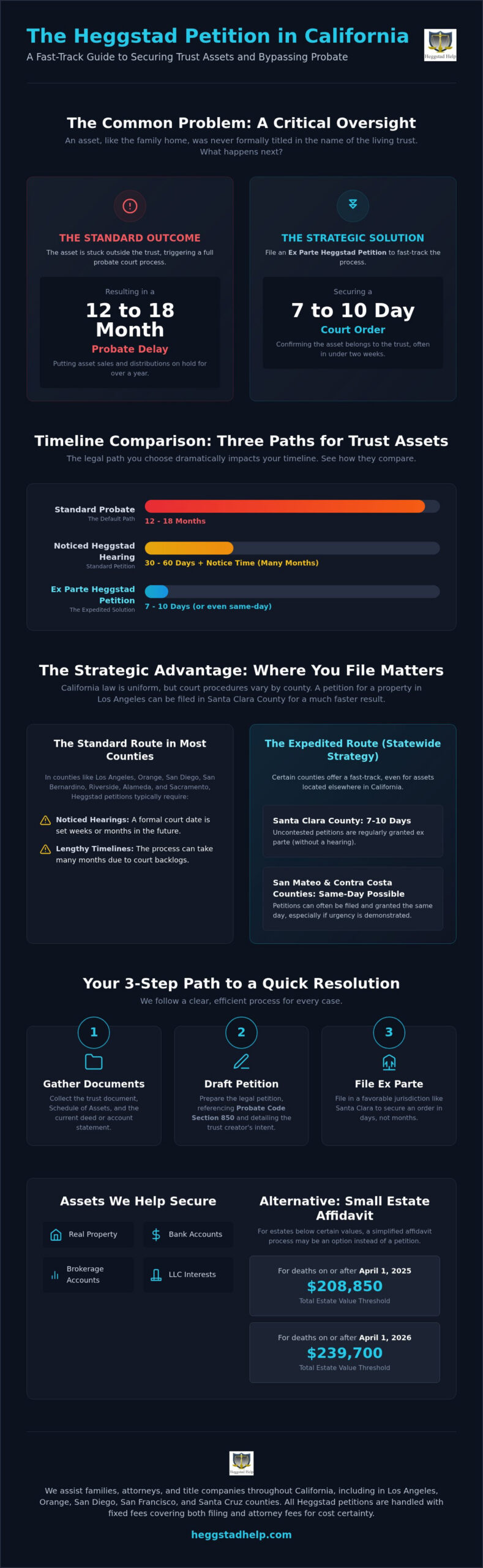
When documents are scattered across filing cabinets, email inboxes, and real estate folders, the trustee loses time and leverage. Organized records are not a formality. They are part of the job.

Mistakes involving California real estate and Heggstad issues

Treating an unfunded trust like a minor technicality

With California real estate, title is everything. If the settlor signed a trust but never recorded the deed transferring the property into the trust, that is not a small clerical issue when death occurs. It may determine whether the trustee can sell, refinance, or distribute the property without probate.

The same is true when a property was once in the trust but later came out during refinancing or other transactions. This fact pattern appears more often than families expect. Years pass, everyone assumes the trust still owns the home, and the error surfaces only when the trustee tries to act.

In the right case, a Heggstad petition may allow the court to confirm trust ownership based on the decedent’s intent and supporting documentation. But that analysis is fact-specific. The trustee should not assume the court result, and should not wait until closing is a week away.

Using generic advice instead of county-specific, issue-specific guidance

Many trustees start with broad internet research or general estate administration advice. That can be useful up to a point, but trust funding defects are specialized. Procedure, local court practice, and the available evidence all matter.

A trustee in California may hear that “you just need an affidavit” or “the trust controls everything anyway.” Those statements are often incomplete or wrong. Real estate title problems, account ownership disputes, and post-death trust confirmation issues need analysis grounded in actual California probate procedure.

This is one reason specialized review matters. A narrow problem can look simple until a title company, escrow officer, or financial institution refuses to proceed.

What a careful successor trustee should do first

The best response is not panic. It is methodical verification. Start by collecting the trust, amendments, death certificate if applicable, deeds, recent account statements, beneficiary designations, and any schedules of assets attached to the trust. Then compare what the trust was supposed to own with what public records and institutions say it actually owns.

If there is a mismatch, treat it as a legal issue, not a clerical annoyance. Real property that was intended to be in trust but is not properly titled may require court action. Accounts and brokerage assets may require a separate analysis depending on registration, pay-on-death designations, and the available documentation.


For trustees facing a California trust funding defect, specialized help early in the process is usually more efficient than trying to force a transaction through and fixing title at the last minute. Heggstad Help focuses on exactly this kind of problem, where the trust exists but ownership records do not line up the way they should.

Being a successor trustee is not about knowing every probate rule from the start. It is about recognizing when title, authority, or procedure needs to be confirmed before the mistake becomes expensive.

California Heggstad Petition Guide

A California Heggstad petition guide for trustees and families dealing with trust funding errors, title defects, and probate avoidance options.

A house is ready to be sold, the trust says it should own the property, and then title review shows the deed was never transferred. That is the moment most people start looking for a California Heggstad petition guide. The problem feels technical, but the stakes are practical: delay, added cost, and the risk of a probate proceeding that may have been avoidable.

A Heggstad petition is often used when a person intended to place an asset into a trust, but the title or account registration was never completed properly. In California, that usually means asking the probate court to confirm that the asset belongs to the trust under Probate Code Section 850. When the facts and documents line up, this procedure can correct ownership without opening a full probate estate.

What a California Heggstad petition actually does

The basic legal issue is not whether the trust exists. It is whether the specific asset can be treated as trust property even though title was left in the settlor’s individual name or was transferred incorrectly. A Heggstad petition asks the court to recognize the settlor’s intent and confirm that the asset is held by, or should be treated as held by, the trust.

This matters most with real estate, but it also comes up with brokerage accounts, bank accounts, partnership interests, and other property that should have been titled in the trust. The petition is not a shortcut for every title problem. It works best where there is strong written evidence that the asset was meant to be part of the trust.

The key point is that this is a trust ownership confirmation procedure, not a substitute for careful legal analysis. Some cases are straightforward. Others turn on county practice, document wording, competing heirs, lender issues, or gaps in the estate plan.

When the Heggstad procedure may be available

The most common fact pattern is simple. A settlor signs a revocable living trust and also signs a schedule of assets listing the property, but never signs or records a deed transferring the real estate into the trust. After death, the successor trustee discovers that record title is still in the settlor’s name.

Another common situation arises after refinancing. Property may have been transferred into the trust years earlier, then taken out during a refinance, and never transferred back. Families often assume the property is still in the trust because that was the original estate plan. Title records sometimes tell a different story.

A California Heggstad petition guide also needs to mention limits. If the evidence of trust ownership is weak, if the asset is not described clearly, or if there is a serious dispute over intent, the court may not grant the petition. If there are creditor issues, tax concerns, or title complications involving third parties, the analysis becomes more fact-specific.

The documents that usually matter most

Courts generally want to see clear evidence that the settlor intended the asset to be part of the trust. The trust instrument itself is the starting point. If the trust includes language assigning all present and future property to the trust, that can help. A schedule of assets attached to the trust is often important, especially if it specifically identifies the real property or account.

For real estate, the legal description and street address need to be reviewed carefully. A vague reference can create problems. For financial accounts, exact account identification can make the difference between a smooth petition and a contested one.

Other supporting records may also matter, including old deeds, refinance documents, account statements, written instructions to planners or lenders, and correspondence showing the settlor’s intent. The court is not just looking for a general wish to avoid probate. It is looking for evidence tied to the specific asset.

California Heggstad petition guide to the court process

The process begins with document review. Before anything is filed, counsel should confirm whether the trust language, asset schedule, and ownership records support a Section 850 petition. This early review often reveals whether the matter is likely to proceed efficiently or whether a different strategy is needed.

If the case is appropriate, a petition is prepared and filed in the proper California superior court probate division. The petition typically explains the trust, identifies the asset, sets out the facts showing intent, and asks the court to confirm the property as a trust asset. Proposed orders and supporting declarations are usually part of the package.

Notice requirements depend on the facts and county procedure. Some courts allow an ex parte path in suitable cases, which can be much faster than a regularly noticed hearing. That is one reason county-level experience matters. The same legal theory may be handled differently in Santa Clara, San Mateo, Contra Costa, or other counties.

If the court grants the petition, the signed order becomes the critical document. For real estate, that order may then be recorded to clear title and allow sale, refinance, or administration through the trust. For accounts and other property, the order can be used to work with the institution holding the asset.

Why these cases are often urgent

Many trustees do not discover the problem until there is a deadline. A sale is pending. Escrow is open. A title company has raised an objection. Or beneficiaries are waiting for distribution and cannot understand why the trust administration has stalled.

That urgency is real, but rushing without proper review can make things worse. If a petition is filed with weak documentation, incorrect property description, or avoidable notice problems, the delay can become longer and more expensive. Efficient handling depends on accuracy at the front end.

This is also why specialized practice matters. A general probate filing is not the same as a focused trust ownership petition. The legal issue may be narrow, but the procedural details are not always forgiving.

Situations where a Heggstad petition may not be enough

Not every unfunded trust asset can be pulled into the trust through this procedure. If the trust never identified the asset in any meaningful way, the court may not find sufficient evidence of intent. If title was changed for reasons that suggest the settlor did not want trust ownership, that can also defeat the petition.

There are also cases where probate is still required. That may happen if the asset falls outside the available evidence, if there are competing ownership claims, or if the petition only solves part of the estate. The practical answer is sometimes mixed: one asset may be handled through a Heggstad petition while another requires a different process.

For professionals, this distinction matters during transactions. Real estate brokers and title officers often need to know whether the defect is curable by court order within the transaction timeline or whether the matter is likely to outlast the deal. Early evaluation can prevent avoidable surprises.

What trustees and families should do first

Start by gathering the trust, all amendments, any schedules of trust assets, the current vesting deed, prior deeds, and any recent title report. For financial assets, collect statements, beneficiary paperwork, and any correspondence that shows how the account was meant to be held.

Do not assume the name on tax bills, insurance, or informal family records proves legal ownership. Title and registration control far more often than people expect. At the same time, do not assume that a missing deed automatically means probate is unavoidable. The whole file needs to be read together.

Once the documents are assembled, the next step is legal review by someone who handles these petitions regularly. At Heggstad Help, that review is centered on one question: is there a reliable court path to confirm trust ownership, and if so, what is the fastest sound procedure available in the relevant county?

Choosing the right kind of legal help

These matters look simple from a distance because the issue can be stated in one sentence: the asset should have been in the trust. But the court does not decide cases based on what should have happened. It decides based on evidence, statutory procedure, and the exact relief requested.

That is why specialization is not a luxury here. It affects document selection, petition framing, notice strategy, county filing approach, and the ability to spot facts that may block relief. Trustees and families are usually trying to solve a narrow but urgent problem. They benefit from counsel who already knows the terrain.

If you are facing a missing trust transfer, a title defect, or a sale that cannot move forward until ownership is cleared, the most useful next step is not guessing. It is getting the documents reviewed quickly, so you can move from uncertainty to a concrete plan.

When You Need a Section 850 Lawyer

Need a section 850 lawyer in California? Learn when a Heggstad petition can fix trust title problems and when probate may still be required.

A house is in the decedent’s name. The trust names that same house. Everyone assumed it had been transferred years ago, but the recorded deed was never signed, never recorded, or was later taken out of the trust during a refinance and not put back. That is the moment people start looking for a section 850 lawyer.

In California, these cases are rarely about family conflict at the outset. More often, they begin with a practical problem – title will not clear, a sale cannot move forward, or a bank account that was supposed to be in the trust is still titled in an individual name. The question is not simply whether there is a trust. The question is whether there is enough evidence to ask the probate court to confirm that the asset belongs to the trust despite the title defect.

What a section 850 lawyer actually does

A section 850 lawyer handles petitions under California Probate Code Section 850, which is often the procedural vehicle used in a Heggstad petition. In plain terms, the lawyer asks the court to determine that property should be treated as trust property even though legal title was never properly transferred.

That sounds straightforward, but the outcome depends on details. The court is not fixing paperwork as a courtesy. It is deciding whether the available documents and surrounding facts show a clear intent to place the asset into the trust. If that showing can be made, the court may issue an order confirming trust ownership. If it cannot, a full probate may still be required.

This is why specialization matters. A general estate lawyer may understand probate broadly, but Section 850 cases turn on a narrower mix of trust drafting, title history, probate procedure, and county-level court practice. Timing, supporting exhibits, and the quality of the evidentiary record can make a real difference.

When a Section 850 lawyer may be the right choice

The most common situation involves real estate. A settlor signs a trust and a schedule of assets listing the residence, rental property, or other parcel, but no deed was ever recorded into the trust. In many California courts, that may support a Heggstad-style petition if the documents and facts line up.

Another common problem arises after refinancing. Property may have been transferred out of the trust to complete a loan transaction and never transferred back. Families are often surprised to learn that the trust still refers to the property, yet the vesting on title does not.

Financial accounts can create similar issues. A trust may identify brokerage or bank accounts as trust assets, but institution records may still show individual ownership. Some of these matters are better candidates for court relief than others. Much depends on how the account was described in the trust documents, whether account numbers match, and whether there is other written evidence of intent.

A section 850 lawyer is also often brought in by successor trustees, title companies, real estate agents, or other attorneys when an administration or sale is already underway and the title issue is blocking the next step. In that setting, speed matters, but speed without accuracy can make things worse.

The key issue is evidence, not just the existence of a trust

Families often assume that if the trust exists, the asset automatically belongs to it. California law is more precise than that. The court usually needs to see evidence that the settlor intended the specific asset to be held in the trust.

That evidence often includes the trust agreement itself, schedules attached to the trust, later amendments or restatements, deeds, refinance documents, account statements, and any related estate planning paperwork. The exact wording matters. A vague reference to “all my assets” may not carry the same weight as a schedule that specifically identifies a property by address or a financial account by institution and account details.

There are also cases where the paperwork cuts the other way. If title history suggests the asset was intentionally kept outside the trust, or if the trust documents are inconsistent, the petition may face resistance from the court or interested parties. A careful lawyer should say so early. Not every title problem is a clean Heggstad case.

Why these cases are often urgent

Section 850 issues tend to surface at inconvenient moments. A trustee is trying to administer the estate. A buyer is waiting to close. An heir needs clarity about whether probate will be required. A title officer has raised an exception. Nobody wants to pause for months while ownership questions remain unresolved.

In the right case, a focused petition can be far more efficient than opening a full probate just to deal with one asset that was plainly meant to be in the trust. That is the practical value of hiring a lawyer who handles these matters regularly. The goal is not to create more process. It is to use the right process.

Still, urgency does not erase procedural requirements. Notice may be required. Supporting declarations must be prepared carefully. County practices vary. Some courts are more accustomed to ex parte handling in appropriate trust-confirmation matters, while others may have different expectations based on the facts presented. That is one reason local experience matters so much in California probate work.

What to expect from a section 850 lawyer

A good Section 850 evaluation usually starts with document review, not promises. The lawyer should want to see the trust, all amendments or restatements, any schedules of assets, current vesting documents, prior deeds, refinance paperwork if relevant, and whatever records identify the asset at issue.

From there, the real work is analytical. Is this a true trust funding defect, or is there a separate ownership dispute? Is the evidence strong enough for a petition? Is there a risk that a probate referee valuation, creditor issue, tax issue, or competing beneficiary claim could complicate what first appears to be a narrow title correction matter?

The best advice is often candid and a little narrower than clients expect. Sometimes the answer is yes, a Section 850 petition is the right tool. Sometimes the answer is not yet, because more records are needed. And sometimes the answer is no, because the facts point toward probate or another procedure.

That kind of screening is valuable. It protects families and trustees from spending time and money on the wrong legal path.

Why county experience matters in California

California probate practice is statewide, but probate courts are not identical in how matters are processed day to day. Filing procedures, calendaring realities, preferred formats, and judicial expectations can vary by county. What works smoothly in one court may need adjustment in another.

For successor trustees and professionals facing a title defect, that is not a minor detail. It affects timing, preparation, and how quickly a matter can move from problem identification to court order. A specialist who regularly handles these petitions in counties such as Santa Clara, San Mateo, and Contra Costa is usually better positioned to anticipate procedural issues before they slow the case down.

That is also why niche practices like Heggstad Help exist. This is not broad probate marketing. It is a narrow legal service built around a recurring California problem that demands both technical knowledge and procedural efficiency.

Choosing the right lawyer for a Heggstad petition

If you are comparing counsel, ask a simple question: how often does this lawyer actually handle Section 850 and Heggstad matters involving trust funding defects? That is more useful than asking whether they do estate planning generally.

You want a lawyer who can quickly distinguish between a fixable title problem and a case that needs a different strategy. You also want someone who can explain the trade-offs clearly. A petition may save substantial time and expense when the facts are favorable, but no responsible lawyer should present it as automatic. The strength of the documentary record still controls the analysis.

It also helps to work with counsel who understand the pressure points around real estate transactions, title review, and trustee administration. In many cases, the legal issue is only part of the stress. The larger concern is getting the administration back on track.

If you are dealing with property or accounts that were supposed to be in a California trust but were never properly transferred, the right next step is usually not guessing. It is getting the documents in front of a section 850 lawyer who can tell you, with specificity, whether the court is likely to treat the asset as trust property and what it will take to move forward.

How to Fix Trust Title Defects in California

Learn how to fix trust title defects in California, when a Heggstad petition may help, what documents matter, and when probate may still apply.

A trust looks complete on paper until someone tries to sell a house, transfer an account, or administer an estate and finds the asset was never actually titled into the trust. That is usually the moment people start asking how to fix trust title defects, and in California, the answer often depends on whether the decedent clearly intended the asset to be trust property.

This is not a minor paperwork problem. A title defect can delay a sale, block access to an account, create conflict among beneficiaries, and in some cases force a probate that the family thought had been avoided years earlier. The good news is that some defects can be corrected through a court procedure under California Probate Code Section 850, commonly called a Heggstad petition. The harder truth is that not every defect qualifies, and timing and documentation matter.

What a trust title defect actually means

A trust title defect exists when an asset was supposed to be held in a trust, but the legal title does not match that intent. The most common example is real estate. A person signs a trust, but the deed transferring the home into the trust is never recorded. Sometimes a deed was prepared but never signed. Sometimes property was once in the trust, then taken out during a refinance and never transferred back.

The same issue can arise with bank accounts, brokerage accounts, business interests, and other assets. The trust may refer broadly to all property, or the schedule of assets may specifically list the item, but the institution or public record still shows ownership in the individual name.

That difference between intent and title is where the legal problem begins. A trust controls only the assets that are actually owned by the trust, unless a court determines the asset should be confirmed as trust property.

How to fix trust title defects depends on the asset and the evidence

There is no single cure for every title problem. In California, the right path usually turns on three questions. Was there a clear intent to place the asset into the trust? Is there enough documentation to prove that intent? And is the asset the kind of property the court can reasonably confirm as trust-owned without requiring a full probate administration?

If the trust creator is still alive and has capacity, the solution may be straightforward. A new deed, assignment, or account retitling may fix the problem without court involvement. But when the trust creator has died or no longer has capacity, the options narrow quickly. At that stage, the family often needs a court order.

For many California trust funding failures, the key remedy is a Heggstad petition. This asks the probate court to confirm that a specific asset belongs to the trust even though formal title was never properly transferred. The petition is based on evidence showing the settlor intended the asset to be in the trust.

When a Heggstad petition may work

A Heggstad petition is often the best fit when the trust document and related records show a clear, specific intent to transfer an asset into the trust. For example, a trust schedule may list the property address, or the trust may assign all real and personal property to the trustee of the trust. Supporting evidence can include the signed trust, schedules, prior deeds, escrow records, refinance documents, account statements, and other paperwork that helps show what the settlor meant to do.

Real estate is a common setting for these petitions because title companies, buyers, and escrow officers need certainty. If a house was intended to be trust-owned but the deed was never recorded, a court order may allow the successor trustee to proceed with administration or sale without opening a full probate.

That said, success is not automatic. Courts and counties vary in how closely they examine the evidence. Some judges want the trust schedule to identify the asset with real precision. Others may accept broader language if the surrounding facts are strong. Procedure also matters. In some counties, ex parte handling may be available, which can significantly reduce delay when the facts are clean and the paperwork is well prepared.

Situations where the answer may not be a Heggstad petition

Not every trust title defect can be fixed this way. If the evidence of intent is weak, contradictory, or missing, the court may not be willing to confirm trust ownership. If there is a dispute among heirs or beneficiaries about whether the asset was meant to be in the trust, the matter can become contested. Once that happens, speed and simplicity usually disappear.

There are also cases where probate is still necessary. If the asset was never clearly assigned to the trust and there is no reliable paper trail, the court may require a probate estate to transfer title. That can be frustrating for families who thought the trust would avoid probate, but it is better to know that early than to lose time pursuing the wrong remedy.

Another complication involves jointly owned property, beneficiary designations, and community property issues. A home held with another person, an account with a pay-on-death beneficiary, or an asset affected by marital property rules may require a more careful analysis than a simple title correction.

The documents that usually matter most

The strongest cases are built on paper, not assumptions. If you are trying to determine how to fix trust title defects, start by gathering the trust and every document connected to the asset.

For real estate, that usually means the trust agreement and all amendments, the schedule of trust assets, every recorded deed, preliminary title reports, escrow instructions, refinance paperwork, and property tax records. For financial accounts, collect signature cards, account statements, beneficiary forms, transfer-on-death designations, and any correspondence with the institution.

Details matter. A trust schedule that says 123 Main Street is in the trust is usually more helpful than a vague reference to real property. A signed assignment can help. So can evidence showing the settlor acted as though the trust owned the asset, such as insurance, tax treatment, or transaction documents prepared in the trust name.

Why timing matters more than people expect

Many families wait until a transaction is already in motion. A listing goes live, escrow opens, or a bank refuses to release funds, and only then does someone discover the trust title problem. That delay can limit options.

Court calendars, title review, and document collection all take time. Even when a petition can be handled efficiently, it is easier to solve a trust funding issue before a closing date is at risk. The same is true when multiple beneficiaries are involved. Early action reduces the chance that a correctable defect turns into a dispute.

This is one reason specialists focus so much on document review at the outset. The faster you can identify whether the facts support a Section 850 petition, the faster you can decide whether to pursue court confirmation or prepare for probate instead.

Practical next steps if you found a title defect

Start with the trust document and the current title record. Do not assume the trust owns the asset just because the trust exists. Confirm exactly how the asset is titled now, then compare that with the trust language and schedules.

Next, gather the supporting records and look for evidence of intent. If the trust creator is living and competent, ask whether a direct transfer can still be completed. If not, the issue should be evaluated promptly under California probate procedure.

This is usually the point where specialized counsel matters. Trust funding defects sit at the intersection of estate planning, probate procedure, and title practice. A general answer is rarely enough when a sale, administration deadline, or family distribution depends on getting title right. Heggstad Help focuses specifically on these California trust ownership problems, including cases where a court order may avoid the time and expense of full probate.

A careful fix is better than a fast guess

Trust title defects are stressful because they surface at the worst time, when a family is already dealing with a death, administration duties, or a pending transaction. But they are also highly fact-specific. The right solution comes from matching the asset, the documents, and the county procedure to the legal remedy that actually fits.

If the records show clear intent, a Heggstad petition may provide an efficient path to confirm trust ownership. If the evidence is thin, a more formal probate route may be the safer answer. Either way, the most helpful first move is not to improvise a transfer, but to evaluate the title problem carefully and act before delay creates a larger one.

When a Trust Petition for Omitted Assets Fits

A trust petition for omitted assets can confirm trust ownership in California when property was meant for a trust but never titled correctly.

A successor trustee is often sure about the decedent’s intent long before the paperwork agrees. The house was always discussed as a trust asset. The trust schedule lists the brokerage account. Everyone assumed the refinance deed would be corrected later. Then a sale, distribution, or title review exposes the problem: the asset was never properly transferred.

In California, a trust petition for omitted assets may be the right court procedure when property was intended to be held in a trust but title does not match that intent. In many cases, the issue is not a dispute over who should inherit the asset. The issue is proving, in a way the court and third parties will accept, that the asset belonged in the trust and should be treated as trust property.

What a trust petition for omitted assets is really trying to fix

This kind of petition addresses a common gap between estate planning documents and actual title. A settlor signs a revocable living trust, but one or more assets remain outside the trust because the deed was never recorded, a bank account was never retitled, or an asset was removed during refinancing and not transferred back.

That gap matters because a trust controls only the assets it owns. If real estate, accounts, or other property stay in the settlor’s individual name, the successor trustee may be blocked from administering them under the trust terms. Title companies may refuse to insure a sale. Financial institutions may refuse to release funds. In some cases, the asset may appear headed for probate even though the trust was clearly intended to control it.

A petition under California Probate Code section 850, often referred to in practice as a Heggstad petition, can allow the court to confirm that the omitted asset should be treated as trust property. The strength of that petition depends on the evidence. Intent alone is not enough unless it is documented in a way the court finds persuasive.

When a trust petition for omitted assets may work

Not every title problem qualifies, and not every omitted asset can be brought into a trust through the same procedure. The key question is whether there is credible evidence that the settlor intended the specific asset to be held by the trust.

That evidence often includes the trust agreement itself, especially if it contains a schedule of assets or language assigning certain property to the trust. Real estate cases may involve an unrecorded deed, prior trust transfer documents, loan papers showing a temporary transfer out of trust, or correspondence reflecting the settlor’s instructions. Financial account matters may turn on account statements, trust certifications, transfer forms, or account opening documents.

Some cases are straightforward. A trust schedule specifically lists the property address, and every surrounding document supports trust ownership. Others are less clean. The trust references broad categories of property but not the exact asset. The settlor’s intent may still be provable, but the analysis becomes more fact-specific and more dependent on county practice and the assigned judge.

That is why these petitions are specialized. The law matters, but so does presentation. A petition that simply says the asset was “supposed to be in the trust” is not the same as one built around admissible documents, a clear chronology, and a focused request for relief.

Common situations that lead to omitted trust assets

The most frequent problem is real estate. A home, rental property, or vacant parcel was meant to be transferred into the trust, but no deed was ever signed or recorded. Another common scenario arises after refinancing. Lenders often require property to be moved out of trust temporarily, and the transfer back never happens.

Bank and brokerage accounts also create trouble. The settlor may have intended to retitle an account but never completed the institution’s process. Sometimes the trust is named in personal notes or estate planning instructions, but the account remains in an individual name at death.

There are also hybrid situations where the trust document is solid, but third-party records are incomplete or inconsistent. That tends to surface when a trustee tries to sell property, open escrow, distribute funds, or respond to a title company’s requirements.

Why this matters before assuming probate is necessary

Families often hear the same initial reaction: if the asset is not in the trust, probate is required. Sometimes that is true. Sometimes it is not.

A properly supported section 850 petition may avoid a full probate proceeding for an omitted asset that was intended to be trust-owned. That can save substantial time, cost, and administrative burden. It may also preserve the trust’s distribution plan rather than forcing the asset through a separate probate track.

Still, this is not automatic. If the evidence of trust ownership is weak, contradictory, or incomplete, probate may remain the safer or only option. There can also be procedural differences depending on the county, the type of asset, and whether anyone is likely to object. A good analysis starts with the documents, not with assumptions.

What the court usually needs to see

The court generally wants a coherent paper trail tying the omitted asset to the trust. For real property, that often means the trust instrument, trust schedule, vesting history, any deeds, and a declaration explaining the circumstances. For accounts and securities, the evidence may include trust provisions, account records, transfer requests, and communications showing the settlor’s intent.

Precision matters. The legal description of real property must match. Account information should identify the exact institution and account. Dates should make sense. If there was a refinance, sale attempt, or prior administration event, the petition should explain how that fits the title history rather than ignoring it.

This is one reason general estate planning knowledge is not always enough. A practitioner handling these matters regularly will usually spot evidentiary gaps early, before they become reasons for delay or denial.

The practical path for trustees and families

If you believe an asset was omitted from a trust, the first step is to gather the core documents. That usually includes the trust agreement and amendments, any schedules of assets, deeds, account statements, prior estate planning files, and correspondence related to transfers or refinancing. If real estate is involved, title records are often essential.

The next step is to evaluate whether the documents show actual trust intent for the specific asset. This is where many people lose time. They know the family story, but they have not yet matched that story to the level of proof a court will require.

Once the evidence is reviewed, the strategy becomes clearer. In some cases, an ex parte or streamlined approach may be available depending on the county and the facts. In others, formal notice and a more traditional petition process will be appropriate. The right procedure is not identical in every courthouse, which is why county-level experience can affect both timing and outcome.

For professionals such as title officers, real estate agents, and estate planning attorneys, speed matters too. A pending sale or administration deadline can turn a title defect into an urgent legal issue. The value of a focused petition is not just legal correctness. It is moving the matter from uncertainty to a court order that others can rely on.

When the case is not as simple as it looks

Some omitted asset matters involve family conflict, unclear amendments, multiple trusts, or competing beneficiary expectations. Others involve property acquired after the trust was signed, which raises a different set of questions about whether the trust language reaches later-acquired assets. There are also situations where the trust schedule mentions an asset, but title history suggests the settlor deliberately kept it outside the trust.

These are the cases where trade-offs become real. Pushing a weak Heggstad-style petition can waste time if probate is ultimately unavoidable. On the other hand, assuming probate too quickly can impose unnecessary delay when the documentation is actually strong enough to support trust confirmation.

The best approach is usually a disciplined one: identify the asset, reconstruct the title or ownership history, compare that record to the trust documents, and choose the procedure that matches the facts. That is the type of narrow, technical work this area requires. For California trustees and families facing that problem, specialized help from a practice such as Heggstad Help can make the difference between a vague theory and a workable court solution.

If an asset was meant to be in the trust, do not wait for the title problem to fix itself. The sooner the documents are reviewed, the sooner you can find out whether the court can confirm what the settlor intended.

Successor Trustee Asset Transfer Guide

A successor trustee asset transfer guide for California families handling real estate, accounts, and title defects after death or incapacity.

The problem usually shows up at the worst possible moment. A parent has died, the trust names you as successor trustee, and everyone assumes the house or account is already in the trust – until title, a bank, or a brokerage statement shows otherwise. This successor trustee asset transfer guide explains what California trustees should do next, when transfer is straightforward, and when a court order may be needed.

Start with authority, not assumptions

Before any asset transfer begins, confirm that you are actually acting with legal authority. In most cases, that means reviewing the trust instrument, any amendments, and the section naming the successor trustee after death or incapacity. If incapacity is involved rather than death, the trust may require written medical determinations before your authority begins.

This step sounds basic, but it matters. Families often focus on what the decedent intended while institutions focus on what the documents currently show. If your authority is not clearly established, even a simple transfer can stall.

You should also gather the supporting documents institutions commonly request, including a certification of trust, death certificate if applicable, and government identification. Some asset holders will accept a concise trust certification. Others ask for selected trust pages or their own internal forms. That variation is normal.

Identify what the trust owns and what it was supposed to own

A practical successor trustee asset transfer guide has to start with inventory. Create a written list of all major assets and divide them into two groups: assets already titled in the trust, and assets that appear to be outside the trust.

For real estate, review the recorded deed, not just the trust schedule. For bank and brokerage accounts, check the exact account registration. For business interests, look at operating agreements, stock certificates, and assignment documents. For personal property, review any general assignment and the trust schedule, but understand that some assets require more than a schedule entry to establish ownership.

This is where many trustees discover a title defect. A house may be listed on the trust schedule, but the deed was never recorded into the trust. A property may have been transferred into the trust years ago, then taken out during a refinance and never returned. An account may have been opened in the settlor’s individual name even though the trust was meant to hold it. Those facts can change the procedure dramatically.

When transfer is simple and when it is not

Some assets can be transferred with standard administration documents. Others cannot.

If an asset is already titled in the name of the trust, the successor trustee often only needs to prove authority to manage, sell, or distribute it under the trust terms. For example, a bank account properly registered to the trust may simply require the bank’s trustee certification process.

If an asset is not titled in the trust but has a valid beneficiary designation, it may pass outside the trust altogether. That does not make it a trust asset. It means the trustee may not control it unless the trust or estate later receives it from the beneficiary.

The harder category is the asset that was intended to be in the trust but was never properly transferred. In California, that issue often arises with homes, rental properties, brokerage accounts, and other valuable property. The settlor’s intent may be clear from the trust and related documents, but intent alone does not always satisfy title companies, financial institutions, or county records. That is where trustees need to evaluate whether a Heggstad petition under Probate Code section 850 may be available.

Real estate needs special attention

Real estate is usually where mistakes become urgent. A trustee may need to sell a house, refinance, insure property, collect rent, or distribute a residence to a beneficiary. If title is still in the decedent’s individual name, the trust may not be enough by itself to close the transaction.

Start by pulling the last recorded deed and checking vesting carefully. Do not rely on memory or old estate planning binders alone. If the deed shows the settlor as an individual, the next question is whether there is strong evidence the property was intended as a trust asset. That evidence may include the trust schedule, a general assignment, prior transfer documents, escrow instructions, or other estate planning records.

Sometimes the answer is straightforward. Sometimes it is not. If the trust never referenced the property and no transfer steps were taken, probate may be required instead of a trust-confirmation procedure. If the property was clearly treated as trust property but title was left defective, a court petition may provide a faster and more targeted solution.

Financial accounts can be easier, but not always

Banks and brokerages each have their own internal rules, and those rules do not always track how families think trust administration should work. A bank may freeze an account until it receives a death certificate, tax identification information for the trust, and updated trustee paperwork. A brokerage may require medallion guarantees, transfer forms, or branch-level review.

If the account is already in the trust, the process is usually administrative rather than judicial. If the account stayed in the decedent’s name and lacks pay-on-death directions, the trustee cannot simply claim it because the trust exists. The institution will look at the registration first.

That said, some unfunded accounts may still qualify for court relief if the documents support trust ownership. The analysis depends on the paper trail. The stronger the evidence of intent and trust assignment, the stronger the position.

How a Heggstad petition fits into this guide

For California trustees, a Heggstad petition can be one of the most important tools when an asset was intended to be in the trust but title was never completed properly. The petition asks the probate court to confirm that the asset belongs to the trust, avoiding full probate when the legal and factual basis is there.

This is not a do-it-yourself filing for most people. The success of the petition often turns on the exact language of the trust, the schedules, the chain of title, county-specific court practices, and how the evidence is presented. A weak or incomplete record can delay administration and create avoidable objections.

There is also a timing issue. Trustees often learn about the title problem while trying to list property for sale or respond to a title company’s exception. Waiting too long can disrupt a transaction. Early review by a lawyer who regularly handles these petitions can clarify whether the matter is suitable for an ex parte approach or another procedure in the relevant county.

Common mistakes successor trustees make

The most common mistake is distributing or promising assets before confirming ownership. Beneficiaries may assume the trust controls everything the decedent owned. That is often wrong, and premature promises can create conflict.

Another mistake is relying only on the trust schedule. A schedule is important evidence, but it is not a substitute for proper title in every case. Trustees also run into problems when they sign transfer documents before their authority is fully documented, or when they assume a title defect can be fixed later without affecting a pending sale.

A more subtle mistake is waiting until an institution rejects the transfer. By that point, deadlines may be tighter and family pressure higher. Early document review usually saves time.

What to gather before you ask for legal help

If you are facing an asset transfer problem, organize the core documents first. That usually includes the trust and all amendments, the death certificate if there has been a death, the recorded deed for any real property, account statements, beneficiary designation forms if available, and any old estate planning documents showing intent to fund the trust.

If there was a refinance, sale attempt, or title review that exposed the problem, keep those papers too. They often reveal exactly where the chain broke. In practice, a focused document set is more useful than a large stack of unrelated records.

For trustees in California dealing with a likely trust funding defect, specialized review matters. A general description of what the decedent wanted is rarely enough. The question is whether the documents support a legal path to confirm trust ownership efficiently.

A practical path forward for California trustees

The right next step depends on the asset, the documents, and the urgency. Some transfers can be completed directly with institutions once trustee authority is documented. Others require deeper title analysis. And when an asset was meant to be in the trust but was left outside, court confirmation may be the cleanest route.

That is why this process works best when treated as both an administrative task and a legal title review. If you are a successor trustee, your job is not to guess. It is to establish authority, verify ownership, and choose the correct procedure before delay turns into a larger estate problem.

If the paperwork suggests a missing trust transfer, a targeted legal review can often tell you quickly whether the issue is fixable through a Heggstad petition or whether a different path is required. For families already under pressure, that clarity is often the first real relief.

How to Transfer Omitted Property to a Trust

Learn how to transfer omitted property trust issues in California, when a Heggstad petition may apply, and what trustees should do next.

You usually find an omitted asset at the worst possible moment – when a house is about to be sold, a bank asks for proof of trust ownership, or a family realizes a deceased parent’s trust does not actually hold the property everyone assumed it did. If you are searching for how to transfer omitted property trust assets in California, the answer depends on one key question: was the asset meant to be in the trust, but never properly transferred?

That distinction matters. Sometimes the fix is simple retitling while the trust creator is still alive and competent. Sometimes it requires a court order after death under California Probate Code Section 850, often referred to as a Heggstad petition. And sometimes the asset cannot be moved into the trust at all without a full probate or a different legal process. The right path depends on the documents, the title history, and the timing.

What omitted property means in a trust case

In practical terms, omitted property is property that was supposed to be part of a trust but was left outside of it. That might include real estate never deeded to the trust, a bank or brokerage account opened in an individual name, or property that was once in the trust but later came out during refinancing and was never transferred back.

For successor trustees, this often comes as a surprise. The trust document may clearly describe how assets should be managed and distributed, but the trust only controls assets actually owned by the trust, or assets that can be confirmed as trust property through a recognized legal procedure. Good estate planning intent helps, but intent alone is not always enough.

How to transfer omitted property trust assets while the settlor is alive

If the trust creator, also called the settlor or trustor, is still living and has capacity, the cleanest solution is usually to transfer title properly now. For real estate, that often means preparing and recording a new deed into the name of the trustee of the trust. For financial accounts, it may mean working directly with the bank or brokerage firm to change ownership or registration.

This sounds straightforward, but details matter. The legal name of the trust, the identity of the acting trustee, vesting language, and any lender or institution requirements all need to line up. A deed with the wrong trustee name or incomplete trust reference can create a new title problem instead of solving the old one.

If the omitted asset is significant, it is also wise to review the full funding picture at the same time. Many families discover one missing asset only to learn that several others were never transferred either.

How to transfer omitted property to a trust after death

Once the settlor has died, you cannot simply sign a new deed on their behalf or retitle an account as if the omission never happened. At that point, the question becomes whether California law allows the court to confirm that the property belongs to the trust based on the decedent’s intent and the available evidence.

This is where a Heggstad petition may be the right tool. In California, Probate Code Section 850 can sometimes be used to ask the court to order that an omitted asset is a trust asset, even though legal title was never formally transferred before death. This can be especially valuable when the alternative is a probate proceeding that is slower, more expensive, and less consistent with the trust creator’s estate plan.

Not every case qualifies. The petition is strongest when the trust documents and related evidence show a clear present intent to hold the asset in the trust. Real estate schedules, assignment language, trust transfer documents, and other supporting records can make a major difference.

When a Heggstad petition works – and when it may not

A common misunderstanding is that any asset a person wanted to place in a trust can be pulled in later. California law is more nuanced than that.

A Heggstad-style petition is often most effective where the trust instrument itself identifies the asset, includes a schedule of property, or otherwise shows that the settlor intended the property to be part of the trust. This issue comes up frequently with real property, but it can also arise with financial accounts and other assets.

The weaker cases are those with little or no documentary support. If the only evidence is that family members believe the decedent wanted everything in the trust, the court may not view that as enough. Likewise, some assets have their own transfer rules, beneficiary designations, or third-party contractual restrictions that complicate the analysis.

There are also title situations where another problem is layered on top of the trust issue. For example, if ownership changed after trust creation, if a refinance removed trust vesting, or if there are competing claims from heirs or beneficiaries, the matter may require a more involved strategy.

Documents that usually matter most

Before anyone decides how to proceed, the first step is document review. In many omitted property cases, the answer is already hidden in the paperwork.

The trust agreement is central, especially the signature pages, schedules of assets, and any language assigning property to the trustee. For real estate, the recorded deed history matters just as much. For accounts, statements, account applications, beneficiary forms, and correspondence with the financial institution can all be relevant.

It also helps to locate any estate planning file materials, including old funding instructions, transfer deeds that were prepared but never recorded, and refinance documents. A property that appears omitted today may have been transferred before and later removed from the trust without anyone realizing it.

Why title problems often show up during a sale or administration

Many families do not discover a trust funding defect until they try to act. A successor trustee signs listing documents, a title company pulls the vesting, and suddenly the property is still in the decedent’s individual name. Or a bank asks for certification of trust and then notes the account was never registered to the trustee.

That timing creates pressure. There may be beneficiaries waiting for distribution, a pending escrow, or property expenses that continue to mount. In those situations, the legal question is not academic. The trustee needs a practical path that fits the county’s procedures and the urgency of the transaction.

This is one reason specialized experience matters. The issue is not just whether a petition can be filed, but how to present it efficiently, with the right evidence, in the right court, and on a timeline that reflects the real-world stakes.

What a California trustee should do next

If you are dealing with omitted trust property, avoid making assumptions based on the trust document alone. Start by confirming how title is actually held today. Then compare that with the trust language and any schedules or assignments that may show intent to transfer the asset.

If the settlor is alive and competent, the solution may be direct transfer work. If the settlor has died, the next step is usually to evaluate whether a Heggstad petition is available, or whether another probate or title correction procedure is required. Waiting too long can delay administration and complicate sales, refinancing, and distributions.

For California trustees and families, this is one of those problems that looks simple until the paperwork is examined closely. A narrow, document-driven review usually saves time and prevents costly missteps. Heggstad Help focuses on exactly this kind of omitted property and trust funding problem, particularly where a court order may be needed to confirm trust ownership.

The best next move is not to guess whether the asset is in or out of the trust. It is to get the documents in order, identify the strongest legal path, and fix the title issue before it grows into a larger administration problem.

How to File Heggstad Petition in California

Learn how to file Heggstad petition in California, what documents you need, when it works, and how to correct trust title problems efficiently.

A trust administration can stall fast when you find the asset was never actually transferred into the trust. The house is still in the settlor’s individual name. A bank or brokerage account has no trust registration. Title says one thing, but the estate plan clearly says another. If you are trying to figure out how to file Heggstad petition in California, the key is understanding that this is not a generic probate filing. It is a focused court procedure used to confirm that an asset belongs to the trust when the evidence shows the trustor intended that result.

For many successor trustees and families, this issue appears at the worst time. You may be preparing to sell a home, distribute trust assets, refinance, or satisfy a title company’s requirements. A Heggstad petition can often solve the problem without opening a full probate, but only when the facts and documents support it.

What a Heggstad petition is really asking the court to do

A Heggstad petition is commonly filed under California Probate Code Section 850. In practical terms, the petition asks the probate court to make an order confirming that a specific asset is a trust asset even though formal title was never completed, or was later disturbed. The classic example is real property listed on a trust schedule, often called Schedule A, but never recorded into the trust by deed.

The court is not rewriting the estate plan. It is deciding whether the available evidence shows that the trustor intended the property to be held in the trust. That distinction matters. If the documents are strong, the procedure can be efficient. If the paperwork is thin, inconsistent, or points the other way, the petition may be denied or require a more contested process.

When filing a Heggstad petition makes sense

This procedure is most often used when there is a valid written trust and a clear paper trail showing the asset was meant to be part of that trust. Real estate is a common example, especially where a home was identified in the trust schedule but no deed was ever signed or recorded. It can also arise with financial accounts, business interests, or other property, although those cases can be more fact-specific.

Sometimes the problem is not that the asset was never transferred. It may have been transferred into the trust and later taken out during refinancing, loan modification, or title correction, with no deed transferring it back. In that situation, the trust plan may still show that the property was intended to remain trust-owned, but the public record does not match. A Heggstad petition may still be appropriate, though the history has to be documented carefully.

This is also where judgment matters. Not every unfunded asset belongs in a Section 850 petition. If the trust says nothing specific about the asset, if ownership changed for reasons unrelated to the trust plan, or if there are competing heirs and factual disputes, the path may be more complicated.

How to file Heggstad petition: start with the documents

Before anyone drafts a pleading, the first job is evidence review. The trust instrument is central, including all amendments and restatements. If there is a schedule of assets attached to the trust, that schedule must be reviewed closely. The exact description matters. A street address, legal description, account identification, or other specific reference can make a significant difference.

You also need the title and ownership documents. For real estate, that usually means the current deed, prior deeds, assessor information, and sometimes refinance documents. For accounts, it may include statements, account agreements, beneficiary paperwork, or correspondence showing how the asset was treated. If the trustor is deceased, the death certificate and any certification of trust are usually part of the file as well.

At this stage, the main question is simple: what documents show trust intent, and what documents undercut it? A good petition faces that issue directly instead of assuming the court will fill in missing facts.

Preparing the petition and supporting declaration

The petition itself must identify the asset, the trust, the trustee, and the court order being requested. In most cases, the petition asks the court to confirm that the property is an asset of the trust under Probate Code Section 850. If real property is involved, the legal description must be accurate. A sloppy property description can create new title problems even if the petition is otherwise sound.

The supporting declaration often carries much of the practical weight. This is where the trustee or other declarant explains the history of the trust, how the omission or title defect was discovered, and why the records show the asset was intended to be held in trust. The declaration should be factual and documented. Courts respond better to a clean chronology tied to exhibits than to broad statements about what the decedent probably wanted.

Exhibits commonly include the trust, relevant schedules, deeds, account records, and any other writings that connect the asset to the trust. If there was a refinance or transfer event that interrupted title, that should be explained clearly.

Filing in the right county and using the right procedure

A Heggstad petition is filed in the probate division of the California superior court, usually in the county with proper venue under the facts of the case. Venue can depend on where the decedent lived, where the trustee is acting, or where the real property is located. County-specific practice matters more than many people expect. Filing requirements, local forms, reservation systems, and hearing procedures can vary.

In some counties, an ex parte route may be available in the right case. That can significantly reduce delay when the matter is straightforward and uncontested. In other cases, a regularly noticed hearing is required. The right approach depends on the county and the facts. This is one reason specialized probate and trust experience matters. A petition that is legally sound can still lose time if it is filed without attention to local procedure.

Notice, objections, and what can slow things down

Even where the petition seems obvious, notice requirements still matter. Interested parties may need to receive notice depending on the type of asset, the trust terms, and the court’s requirements. If beneficiaries or heirs object, the matter can shift from an administrative correction into a litigated trust dispute.

The most common reasons for delay are predictable. The trust schedule is vague. The property description is wrong. The asset is not clearly identified. The declaration is conclusory. Or the title history shows facts that were not addressed in the petition. A title company may have already flagged these issues, but sometimes they only become clear when the court reviews the papers.

That is why these cases benefit from careful front-end analysis. Filing quickly is not the same as filing well.

What happens after the court grants the petition

If the court signs the order, the next step is making sure the order is used correctly. For real property, the certified order may need to be recorded in the county land records so title reflects the court’s determination. For financial institutions, the order may need to be delivered with trust documents and administrative forms so the account can be retitled or distributed through the trustee.

The court order is not the end of the file if practical transfer work remains. A good result means the asset is not only confirmed as trust property on paper, but also positioned so administration, sale, or distribution can move forward without another title defect appearing later.

When not to rely on a do-it-yourself approach

People often search how to file Heggstad petition because they want to avoid probate quickly and keep costs under control. That goal makes sense. But this is one of those procedures where a narrow legal issue can have outsized consequences. If the petition is denied, the family may lose time, incur extra expense, and face pressure from property taxes, insurance, lender deadlines, or a pending sale.

The risk is highest when real estate is involved, when trust documents are incomplete, or when there is any chance of disagreement among heirs or beneficiaries. In those situations, the legal theory may still be strong, but the presentation has to be precise.

Because this is a niche area of California probate practice, families and professionals often turn to a specialist rather than a general practitioner. Heggstad Help focuses specifically on these trust funding and title correction matters, which is often the difference between a petition that merely gets filed and one that is positioned to get signed.

The practical next step

If you think an asset was supposed to be in the trust, gather the trust, all amendments, any schedules, current title documents, and whatever records show the asset’s ownership history. Do that before making assumptions about probate, distribution, or sale timing. The answer usually turns on the documents.

A Heggstad petition can be an efficient remedy, but only when the facts support it and the filing is handled with care. When the paperwork is analyzed early and the petition is matched to the right county procedure, the path forward is often clearer than it first appears.

Selling Inherited House With Trust Title Issue

Selling inherited house with trust title issue in California often requires court action. Learn when a Heggstad petition may clear title.

A sale can come to a halt the moment title review shows the house was never properly transferred into the trust. That is the core problem in selling inherited house with trust title issue cases in California: everyone may believe the property belongs to the trust, but the public record does not clearly say so.

This usually surfaces at the worst possible time. The successor trustee is preparing to list the property, a buyer is ready to move forward, or escrow is already asking for documents. Then the preliminary title report shows the home is still in the decedent’s individual name, held in an outdated vesting, or tied to a deed that was never recorded. At that point, the issue is no longer just administrative. It becomes a legal title problem that can delay or derail the sale unless it is handled correctly.

Why this title issue blocks a sale

In California, title companies and buyers need a clear chain of ownership before they will insure or complete a transfer. If the trust says the property should have been in the trust, but the deed was never signed, never recorded, or was removed during refinancing and not transferred back, the trustee may not have clear authority to sell.

That does not always mean full probate is required. But it does mean you cannot assume the trust alone fixes the problem. A trust document can show intent, and intent matters, but title companies usually want more than a statement that the settlor meant to place the house in the trust. They want a legally sufficient basis to insure the sale.

This is where many families lose time. They are told the home is “in the trust” because the estate plan says so, yet escrow or title says the record title does not match. Both can be true. The estate plan may show intent, while the land records still show a defect that must be corrected.

Selling inherited house with trust title issue in California

The first question is not whether the property was inherited. The first question is how title was held when the owner died and what documents show the owner’s intent. If the decedent created a revocable living trust and signed a trust schedule listing the property, or signed transfer documents that were never properly recorded, a court petition may be available to confirm the asset belongs to the trust.

In California, that often means a Heggstad petition under Probate Code Section 850. This procedure can allow the court to confirm that an asset belongs to the trust where there is sufficient evidence the settlor intended to hold it in the trust, even though legal title was not properly completed during life.

For families trying to sell an inherited house, that can be the difference between moving forward and being pushed into a more expensive and time-consuming probate process. It is not automatic, and it is not available in every case. The facts matter. The county matters. The documents matter. But when the evidence is strong, it can be an efficient way to cure a trust funding defect affecting real property.

What usually causes the problem

The most common scenario is simple: the trust was signed, but the deed into the trust was never completed or recorded. Another common problem appears after a refinance. The property may have been transferred out of the trust to satisfy lender requirements, then never transferred back. In other cases, the owner signed a general assignment to the trust, listed the property on a trust schedule, or clearly referred to the house as a trust asset, but the chain of title still remained incomplete.

Sometimes the issue is older and messier. The deed may have a legal description error. The trust name may not match across documents. One spouse may have signed documents while the other did not. The home may also have passed through multiple estate planning updates, making it unclear which trust controls. These are not minor technicalities if you are trying to close a sale. They affect whether a title insurer will accept the trustee’s authority.

When a Heggstad petition may help

A Heggstad petition is often considered when there is credible evidence that the decedent intended the real property to be a trust asset, but the title transfer was incomplete. Courts look at the available evidence, which may include the trust agreement, schedules of assets, deeds, amendments, assignments, and related estate planning records.

If the court grants the petition, the resulting order can confirm the property is held in the trust. That court order can then be used to address title concerns and support the trustee’s sale authority. For a successor trustee facing a pending listing or escrow deadline, this can be a practical solution.

Still, there are trade-offs. A Heggstad petition is not a shortcut that works on weak facts. If there is little or no evidence that the property was intended to be in the trust, probate may still be necessary. If ownership is disputed among beneficiaries or family members, the matter may become more contested. And even where the law is favorable, local court practice affects timing and procedure.

Selling inherited house with a trust title issue – what to review first

Before anyone lists the property or promises a closing date, the documents should be reviewed in a disciplined way. Start with the current deed, any prior deeds, the full trust agreement and amendments, all trust schedules, and any refinance paperwork that may have changed title.

Next, compare the legal owner shown in the public record to the person or entity described in the trust documents. If the trust names the property but record title stayed in the settlor’s individual name, that gap needs legal analysis. If the property was community property, or if there are co-owners, additional issues may affect whether one petition is enough.

It also helps to know where the property is located and where the trust administration is centered. California procedure is statewide, but practical handling often varies by county. That matters if the goal is to resolve the title issue efficiently rather than allowing the file to sit while a sale opportunity disappears.

What trustees, agents, and title companies should avoid

The biggest mistake is assuming the title defect can be explained away informally. A buyer’s agent, escrow officer, or family member may say the trust clearly intended to hold the property, but verbal explanations do not cure record title problems.

Another mistake is waiting too long. If the issue is discovered only after a buyer is in contract, the pressure increases and options can narrow. Some transactions can be paused while a petition is filed and heard, but many would have gone more smoothly if the title problem had been identified before listing.

A third mistake is using a general approach to a specialized issue. Trust funding defects tied to real estate sales are not just estate planning problems and not just title problems. They sit at the intersection of trust law, probate procedure, and real property practice. That is why focused analysis matters.

The practical path forward

If you are dealing with selling inherited house with trust title issue, the right next step is usually document review before marketing the property aggressively. The key question is whether the evidence supports a court order confirming trust ownership, or whether a different procedure is required.

That review should focus on the trust’s terms, the chain of title, and the county-specific path to obtaining relief. In many California cases, a properly prepared Heggstad petition can resolve the issue without full probate and put the trustee in a better position to sell. Heggstad Help focuses specifically on these trust funding and title correction matters, which is often what makes the difference between a workable fix and unnecessary delay.

For families, the real value is not just legal theory. It is getting a clear answer about whether the property can be sold, what court action is needed, and how quickly the title problem can realistically be addressed. For attorneys, title professionals, and real estate agents, it is having a clean procedural route instead of repeated uncertainty.

A trust title issue does not always mean the sale is lost. But it does mean the sale should pause long enough for a careful legal assessment. When the facts support trust ownership, the law may provide a direct way to confirm it and get the transaction back on track.

Attorney for Heggstad Petition California

Need an attorney for Heggstad petition California? Learn when a Section 850 petition can fix trust title problems and avoid probate delays.

A title report arrives, and suddenly the problem is clear: the house was supposed to be in the trust, but the deed was never recorded. Or a bank account was listed on the trust schedule, yet the institution still shows ownership in the settlor’s individual name. When that happens, people often start looking for an attorney for Heggstad petition California because the issue is no longer theoretical – it affects administration, sale timelines, and whether probate can be avoided.

This is a narrow area of California trust and probate law. It is also one where the right procedural move can save substantial time and expense. A Heggstad petition is often used to ask the probate court to confirm that an asset belongs to a trust even though legal title was not properly transferred. In the right case, that court order can correct a trust funding defect without forcing the family through a full probate proceeding.

When a Heggstad petition makes sense

The classic fact pattern is simple. A person created a revocable living trust, signed estate planning documents, and intended to place certain assets into the trust. But one or more assets stayed outside the trust on paper. That can happen because a deed was never signed, a signed deed was never recorded, a refinance pulled property out of trust ownership, or a financial account was never retitled.

California Probate Code Section 850 may provide a path to bring that asset into the trust if the evidence shows intent to transfer it. The leading case people refer to as Heggstad involved a written schedule attached to the trust that identified property as trust property even though no separate deed had been recorded. Since then, courts have recognized that under the right facts, a petition can be used to confirm trust ownership.

That does not mean every unfunded asset qualifies. The details matter. Courts look at the trust instrument, any assignment schedules, deeds, account statements, refinance documents, and the overall record of intent. A petition is strongest when the documentation clearly shows the settlor treated the asset as trust property and meant for it to pass under the trust.

Why an attorney for Heggstad petition California matters

A Heggstad matter can look easy from the outside. Someone finds a trust, sees an omitted asset, and assumes filing paperwork should be enough. In practice, success often depends on how the petition is framed, what evidence is attached, and whether the county court will consider an ex parte procedure or require a more formal hearing track.

An attorney for Heggstad petition California should understand more than the statute. The work requires familiarity with county-level probate practice, judicial expectations, title issues, and the difference between a fixable trust funding defect and a situation that really belongs in probate. Those distinctions affect cost, timing, and the likelihood of getting an order that title companies and financial institutions will accept.

This is especially true with real estate. If a home was refinanced out of trust and never transferred back, there may be a chain-of-title issue layered on top of the trust problem. If a sale is pending, delay becomes expensive. A lawyer who regularly handles these petitions will know what supporting documents matter most and what kind of order is likely to resolve the issue in the real world, not just on paper.

The key question: was there provable intent?

Most Heggstad cases turn on evidence of intent. The court is not rewriting an estate plan after the fact. It is deciding whether the asset should be treated as trust property because the settlor already intended and documented that result.

For real property, evidence may include the trust itself, a schedule of assets, an assignment to the trust, prior deeds, escrow records, and statements from the circumstances surrounding trust creation. For bank and brokerage accounts, the evidence may include trust schedules, account documents, correspondence, and consistent treatment of the account as part of the trust estate.

There are limits. If the trust documents are vague, the asset is not identified, or the evidence points both ways, the petition may be contested or denied. There are also assets where beneficiary designations or contractual transfer rules complicate the analysis. In those situations, a careful lawyer should say so early rather than oversell the likelihood of a quick fix.

What the process usually looks like

The process starts with document review. Before any petition is drafted, counsel should analyze the trust agreement, amendments, certifications of trust, schedules, deeds, title reports, account records, death certificate if applicable, and any probate filings already opened or considered.

From there, the legal question becomes whether the facts support a Section 850 petition and, if so, how to present it. Some counties may allow an efficient ex parte path under the right circumstances. Others may require more formal notice and scheduling depending on the facts, the asset type, or the court’s local practice. This is where specialization matters. The law may be statewide, but procedure often has a local character.

If the petition is granted, the resulting court order can be used to establish trust ownership. For real estate, that often means recording a certified copy of the order so title reflects the trust’s interest. For financial institutions, the order can support transfer or administration consistent with the trust terms.

Common situations that call for a Heggstad petition

The most frequent scenario is a residence or rental property that the settlor meant to place into a living trust but never formally transferred. Another common problem appears after a refinance, when the lender required title in the borrower’s individual name and no deed was later recorded back into the trust.

It also arises with accounts. A trust schedule may list a checking account, CD, or brokerage account, but the institution records still show individual ownership. In administration, that can stop distributions and create confusion about whether probate is required.

Professionals encounter these issues too. Title companies may see a trust referenced in estate documents but not in the vesting record. Real estate agents may be ready to list a property and discover a trust ownership defect that must be fixed before closing. Estate planning attorneys may inherit a matter where the original planning was done years earlier and funding was never completed.

Choosing the right lawyer for the petition

Not every probate attorney regularly handles Heggstad matters, and not every estate planner is comfortable with probate court procedure. For this issue, broad experience is less important than relevant experience.

Ask whether the attorney regularly files Section 850 petitions involving omitted trust assets. Ask whether they handle real estate title defects tied to trusts, whether they know the local probate court’s filing and hearing practices, and whether they can assess at the outset whether ex parte relief may be available. You also want candid advice about risk. A good lawyer will explain when the facts support the petition and when the case may require a different path.

For families under time pressure, responsiveness matters too. If a property sale is pending or a trustee cannot complete administration, delay has real consequences. A specialized practice such as Heggstad Help often brings efficiency because the document review, petition drafting, and court handling are built around this exact problem.

What to gather before you call

The fastest consultations usually happen when the basic documents are available. That includes the trust and any amendments, all schedules or assignment pages, recorded deeds, preliminary title reports if real estate is involved, account statements for financial assets, and any correspondence showing how the asset was intended to be held.

If the settlor has died, include the death certificate and any existing probate or trust administration paperwork. If the issue arose during a refinance or sale, gather escrow documents and lender paperwork. These records often answer the most important question before the petition is even drafted: is there enough evidence to show the asset belongs in the trust?

A missing transfer into a trust is stressful, but it is not always a probate dead end. The right case, supported by the right documents and presented through the right procedure, can often be corrected. If you are facing an ownership problem that threatens administration, title, or a pending transaction, the most useful next step is to have the documents reviewed by someone who handles this narrow issue regularly and can tell you, with precision, whether a Heggstad petition is the right solution.

How to Fix an Unfunded Trust in California

Learn how to fix an unfunded trust in California, when a Heggstad petition may work, what documents matter, and when probate may still be required.

A trust can look perfectly complete on paper and still fail where it matters most – ownership. That problem usually surfaces at the worst time: after death, during a home sale, or when a bank or title company asks for proof that an asset is actually in the trust. If you are trying to figure out how to fix an unfunded trust, the first step is understanding that the issue is often not the trust document itself. It is title.

In California, an unfunded trust means assets were intended to be held by the trust but were never properly transferred into the name of the trustee. Sometimes the trust creator signed a solid revocable trust but never recorded the deed for the house. Sometimes a refinance moved property out of the trust and no one transferred it back. Sometimes accounts were opened individually even though the estate plan assumed trust ownership.

This is a technical problem, but it is often fixable. The right solution depends on the asset, the documents, and the county procedure.

What an unfunded trust actually means

A trust controls only the assets it owns. If real estate, bank accounts, brokerage accounts, or other property were never transferred to the trustee of the trust, those assets may not pass under the trust terms automatically. That is why successor trustees are often surprised to learn that having a signed trust does not, by itself, prove trust ownership.

For real estate, title usually tells the story. If county records show the decedent owned the property individually, title companies will usually treat it as an individually owned asset until a legal correction is made. For financial accounts, the institution’s records matter. If the account remained in an individual name with no trust registration or beneficiary structure that fits the plan, there may be a gap between the estate plan and the asset record.

That gap is what creates delay, risk, and uncertainty.

How to fix an unfunded trust depends on the asset

There is no single repair method for every unfunded trust. The proper path depends on what was left out, whether the trust creator is living or deceased, and what evidence exists showing intent to transfer the asset to the trust.

If the trust creator is still alive and competent, the fix may be straightforward. A new deed can be prepared and recorded for real property, or account ownership can be updated directly with the financial institution. In that situation, the goal is simply to complete the funding that should have happened earlier.

If the trust creator has died, the analysis changes. You can no longer sign a new transfer on that person’s behalf. At that point, the question becomes whether California law allows the court to confirm that the asset belonged to the trust despite the missing transfer document.

That is where a Heggstad petition may come into play.

When a Heggstad petition can solve the problem

In California, Probate Code Section 850 can sometimes be used to confirm that an asset belongs to a trust even though legal title was never formally transferred. This is commonly referred to as a Heggstad petition.

The basic theory is simple. If the trust creator clearly identified the asset as trust property in the trust paperwork or related estate planning documents, the court may be willing to recognize the trust’s ownership. When successful, that court order can allow administration or sale of the asset through the trust without opening a full probate.

This can be especially important for real estate. A home may have been listed on a schedule of trust assets, described in a trust transfer document, or referenced in a way that shows clear intent. In the right case, a petition can bridge the gap between intent and title.

But not every case qualifies. Courts look closely at the documents, and county practice matters. A vague reference to “all my assets” may not be enough by itself in every situation. If the evidence of intent is weak, inconsistent, or missing, probate may still be required.

The documents that matter most

When evaluating how to fix an unfunded trust, paperwork usually decides the outcome. The strongest cases are built on contemporaneous documents that show the trust creator intended the specific asset to be held in the trust.

For real property, that often includes the trust agreement, schedules of assets attached to the trust, any unrecorded deed, refinance papers, prior title records, and the decedent’s broader estate planning file. For accounts, relevant material may include account statements, trust certification records, transfer forms, correspondence with the institution, and schedules listing the account.

Timing matters too. A schedule created at the time the trust was signed often carries more weight than a later informal note. Specificity matters as well. A street address, legal description, or clearly identified account is stronger than a general statement of intention.

This is why these cases should be reviewed carefully before anyone assumes the trust has failed. Families often believe probate is unavoidable when the file actually contains enough evidence for a targeted court petition.

Real estate problems are especially common

Most urgent unfunded trust issues involve California real estate. The common pattern is familiar: a revocable trust was created years ago, but the deed into the trust was never recorded, was recorded incorrectly, or was later undone by a refinance. The problem may remain hidden until the successor trustee tries to sell or distribute the property.

At that point, title companies typically want a clean legal basis for trust ownership. They are not being difficult. They are doing what title companies are supposed to do – match the proposed transaction to the record chain of title.

If title remains in the decedent’s individual name, the successor trustee usually needs more than the trust document alone. Depending on the file, that may mean a Heggstad petition, a probate proceeding, or another corrective step. The right answer depends on what the documents show and how the county court handles these petitions.

When probate may still be necessary

A Heggstad petition is a valuable tool, but it is not a shortcut for every funding defect. Sometimes there is no schedule of assets, no deed, no clear transfer language, and no reliable evidence that the trust creator meant to place the asset in the trust. In that situation, asking the court to confirm trust ownership may be difficult or unrealistic.

Probate may also be necessary when ownership is disputed, when the asset description is too vague, or when the facts suggest the trust creator intentionally kept the property outside the trust. The legal standard is not simply whether putting the asset into the trust would be convenient now. The issue is whether the evidence supports trust ownership under California law.

That distinction matters because filing the wrong proceeding can waste time when the family is already under pressure.

Practical steps to take right away

If you have discovered an unfunded trust, gather documents before making assumptions. Start with the full trust, all amendments, schedules of assets, deeds, account statements, and any correspondence related to estate planning or refinancing. If there is real property, obtain the current vesting deed and review how title is actually held.

Next, separate assets into categories. Some may already be in the trust. Some may pass by beneficiary designation. Others may have a funding defect that needs legal correction. This prevents overreacting to one title problem and missing the bigger administration picture.

Then get a focused legal review from someone who handles California trust funding defects and Section 850 petitions regularly. These matters are specialized. A general overview of trust law is not enough when the issue is whether a county court will accept a petition, what evidence is needed, and whether an ex parte process may be available.

For successor trustees facing a pending sale or distribution, speed matters. Delays often come from uncertainty, not from the court process itself. Once the right path is identified, the case can move more efficiently.

Why specialization matters in unfunded trust cases

Unfunded trust cases are narrow, document-heavy, and procedural. They sit at the intersection of estate planning, probate, title, and local court practice. That is why the same fact pattern may be obvious to a specialist and confusing to everyone else involved.

A title officer may flag the problem correctly but cannot solve it. A family may have the right documents but not know their significance. A general practitioner may recognize the issue yet still be unfamiliar with the most efficient county-specific approach.

That is the practical value of a focused review. It helps answer the real questions quickly: Is there enough evidence for a Heggstad petition? Does this asset require probate instead? What should be filed first? What documents will the court and title company want to see?

Heggstad Help works in this exact niche, which is often what families and professionals need when a trust ownership problem appears late in the process.

An unfunded trust is serious, but it is not automatically a dead end. In many California cases, the missing step is not rebuilding the estate plan. It is proving, with the right documents and procedure, what the trust creator intended all along.